Monday, 2 January 2012

Not of This Earth (1957)

Roger Corman really hit his stride as a film-maker with the first of his Edgar Allan Poe adaptations, The Fall of the House of Usher, in 1960. His movies prior to that are a mixed bag. His early science fiction efforts were notable for the ingenious ways in which he contrived to make science fiction movies with virtually no money, but some of them do suffer from being just a little bit too low-budget. Not of This Earth being a good example.

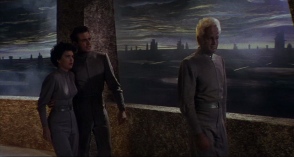
Paul Johnson (played by Paul Birch) is a rather odd fellow who turns up at a clinic asking for a a blood transfusion, but refusing to take the obligatory blood test first. Luckily he has mond-control powers so he’s able to persuade the doctor to do the blood test but not to reveal the results to anyone. In fact Paul Johnson has a refrigerator full of blood. He’s an alien and he’s studying the inhabitants of Earth, starting with their blood.

Johnson’s blood is like nothing the doctor’s ever seen before. He can’t figure out how this guy is still alive. Johnson’s strange blood disease explains his mission to Earth. All his people are afflicted and they’re looking for a cure. But they’re looking for more than that, as will later become apparent.

Johnson is assigned a full-time nurse, Nadine Storey (played by Beverly Garland). He has another employee, a rather disreputable character, a petty criminal. As it happens Nadine is dating a policeman, a circumstance which will cause Johnson some inconvenience. Both he and Nadine suspect that strange things are going on at the Johnson house. Johnson invites three bums to dinner, but the bums are never seen again. Johnson is collecting more than blood samples.

Not of This Earth follows a rather typical pattern for 1950s alien invasion movies - the aliens are as much victim as villains. Their planet, Davana, has been devastated by nuclear war (another all too familiar trope in 50s sci-fi). Johnson’s mission is their last chance for survival, but will the survival of the people of Davana come at the expense of the people of Earth?

Making a science fiction movie when you don’t have the budget to cover such desirable things as special effects, spaceships and fancy alien makeup is quite a challenge, and Corman does a pretty fair job of it. How do you make aliens seem alien without expensive makeup effects? You give them strange eyes, mind-control powers and telepathy, all of which have the advantage of costing nothing.

You also give the aliens a teleportation device, much cheaper than having to provide spaceship models!

None of that would suffice without the right acting performances, and that’s where Paul Birch comes in. He’s disconnected enough to seem truly alien and he’s sinister whilst also being rather tragic. Anna Lee Carroll is equally effective as a Davana woman trying to flee her doomed home planet.

Beverly Garland gives a solid performance as well although the human characters are oddly enough on the whole much less interesting and less sympathetic than the aliens.

The rash of sympathetic alien movies is one of the mysteries of the 1950s, presumably a reaction to the nuclear war hysteria of the time. Not of This Earth is a reasonably good example of the breed, and a good example of Corman’s ability to make surprisingly intelligent movies for a drive-in audience. It looks very cheap, which it was, but it’s worth a look.

The Region 2 DVD from In2Film is at best a barely acceptable transfer. At least it’s incredibly cheap!

Sunday, 1 January 2012

From Beyond the Grave (1974)

I’ve never been a huge fan of Amicus’s horror anthology films but either From Beyond the Grave is a particularly good one or I’m mellowing a bit because I thoroughly enjoyed it.

As usual there’s a framing story connecting the various segments and in this case that framing story works rather nicely and actually does tie the stories together to a certain extent. All four episodes are based on tales by R. Chetwynd-Hayes.

It benefits from a extremely strong cast.

Peter Cushing plays the owner of an antiques shop called Temptations, and it’s well named. The temptation is provided by the items in the shop and there is a further temptation at work - the temptation to try to cheat the owner. Buying anything from this store is dangerous enough but if you’re dishonest it’s even more perilous.

The first segment stars David Warner. He sees an antique mirror in the shop and convinces the proprietor that it’s not as old as it’s claimed to be, thereby getting the mirror for a fraction of what it’s really worth. It proves to be a poor bargain. This is a vampire mirror, or at least it’s a mirror that contains a kind of vampire. The figure in the mirror craves blood and poor David Warner is forced to commit a series of murders to feed this bloodlust. It’s a very gory segment but it’s genuinely horrific even if the idea is a bit thin.

The second segment is much stronger. It’s an object lesson in telling a quite complex tale very succintly. Ian Bannen plays a middle-aged ex-army paymaster married unhappily to Diana Dors. She dominates him and constantly mocks him for being weak and ineffectual, which he is. He encounters an old soldier, played by Donald Pleasence, and he succumbs to the temptation to present himself as a real war hero. To do this he steals a medal from Peter Cushing’s shop, a medal he is not entitled to wear. He faces other temptations as well when he meets the old soldier’s daughter (played by Donald Pleasence’s real-life daughter Angela), the temptations of lust and of revenge.

It’s easy to see why his wife despises him but at the same time we can’t help but feel rather sorry for a man who is lonely and all too well ware of his on inadequacies. And while it’s easy to see why he hates his wife we feel some sympathy for her as well, married to a man who is in many ways a bit of a loser, and a pompous loser as well.

He will soon find that he’s been well and truly ensnared and that getting what you want is not always a good thing. This is by far the most interesting and most impressive of the four segments.

The third segment introduces some comic relief, with Ian Carmichael as a well-to-do businessman who cheats the proprietor into selling him a snuff box worth £40 for just £5 and then compounds his sin by beating the poor man down to just £4. He thinks he’s made a rather good deal until a rather eccentric woman on a train points out that he has a very nasty elemental perched in his shoulder. Luckily she’s a psychic and she gives him her card and tells him to call her if he needs help dealing with the homicidal elemental. He thinks it’s all a great joke, until the elemental tries to kill his wife. It’s silly light-hearted fun but it comes off fairly well.

The final segment sees Ian Ogilvy buying a very gothic-looking door. He gives Peter Cushing the £40 agreed to but when Cushing leaves the till unattended he has the opportunity to steal back part of the purchase price. By this time we know that cheating this shop owner is a very unwise thing to do. He discovers that the door leads to a ghost room, a room that exists in another realm, a room that was created by an evil occultist centuries earlier. And the room needs to be fed, with souls. It’s the most visually spectacular of the four segments and provides a fitting finale.

The acting throughout is uniformly excellent. It’s almost unfair to single out any individual performance but if I had to do so I’d pick Angela Pleasence’s unbelievably creepy turn in the second segment.

Director Kevin Connor did some good work for Amicus in the early 70s and this is no exception.

The pacing is excellent, there’s real creepiness and real horror, and while some of the component stories are stronger than others they’re all entertaining. This is classic 70s British horror and is highly recommended.

Wednesday, 28 December 2011

The First Men in the Moon (1964)

The 1950s saw a rash of big-budget Victorian science fiction films, based on the works of Jules Verne and H. G. Wells (presumably the only early science fiction writers most movie producers had heard of), a genre kicked off by Disney’s 20,000 Leagues Under the Sea. Most of these movies are excellent; all are at least watchable. The First Men in the Moon appeared in 1964 making it one of the last such movies. It’s one of the weakest as well, but it’s still well worth catching.

A framing story has been added, not that it’s really needed. In the 1960s when the first manned mission lands on the surface of the Moon they make an extraordinary discovery - a Union Jack. Even stranger, they find a proclamation, claiming the Moon in the name of Queen Victoria, and dated 1899! An investigation is launched and it is established that one of the people who reached the Moon in 1899 is still alive. He tells his amazing story.

Joseph Cavour (Lionel Jeffries) is an eccentric scientist who has made a potentially earth-shattering discovery. He has discovered a substance that has the same effect on gravity that lead sheeting has on x-rays - it blocks the force of gravity. He has named the substance cavourite, after himself.

Th only thing is, the production of cavourite is slightly hazardous (it tends to involve fairly regular explosions), and Cavour is concerned about his neighbours, the inhabitants of Cherry Cottage. So he makes an offer to buy the cottage. Thats’ how he makes the acquaintance of Arnold Bedford (Edward Judd) and Kate Callender (Martha Hyer). Arnold doesn’t actually own the cottage but he doesn’t allow a small detail like that to prevent him from selling it. But rather than keep the money he decides to invest it in Cavour’s experiments.

Arnold has various ideas as to what cavorite could be used for but Cavor knows what he wants to use it for - a trip to the Moon! Arnold is persuaded to join this expedition. The untimely arrival of the bailiffs means that a third passenger will be making the trip - Arnold can’t leave Kate behind to sort out his financial mess so she must accompany them.

The journey to the Moon is uneventful but some surprises await our adventurers upon arrival. They discover an underground world that has breathable air, and they also discover the insectoid inhabitants of the Moon, the Selenites.

As you’d expect in a movie with special effects by Ray Harryhausen, there are monsters. Well, only one real monster, which is perhaps a little disappointing.

The major problem with this movie is that it’s played just a little too much for laughs, especially in the first half. A little bit of Lionel Jeffries goes a long way. The other cast members are adequate enough.

Nathan Juran directed many science fiction movies in the 50s, most of which are great fun.

The sets have the steampunk feel that makes these Victorian science fiction films so appealing.

The Region 2 DVD includes a couple of featurettes although they’re the same ones included in the other movies released as part of the Ray Harryhausen Signature Collection. The widescreen presentation is impressive though.

All in all The First Men in the Moon offers plenty of entertainment value, even if Lionel Jeffries’ performance is a bit excessive.

Monday, 26 December 2011

The Black Torment (1964)

The Black Torment is an almost forgotten 1964 British gothic horror flick, which is a great pity because it’s a good deal of fun.

It was produced by Tony Tenser who later went on to found Tigon British Film Productions, a company responsible for some of the most interesting British horror movies of the 60s and early 70s.

The film is set in 18th century England. Sir Richard Fordyke (John Turner) returns to his ancestral home with his new bride, the Lady Elizabeth (Heather Sears). Strange rumours have been circulating that he has been seen in the local area even though he has been away in London for some months. Strange and rather sinister rumours involving assaults on young women. And there are reports that he has been been seen being pursued on horseback by his deceased first wife, the Lady Anne.

The atmosphere at his home is somewhat strained. His father has had a stroke and cannot speak. He communicates in sign language, but the only person who can understand him is the sister of Sir Richard’s first wife. Anne Fordyke committed suicide by throwing herself out of a window and there are those who blame Sir Richard for her death. Sir Richard has the reputation of possessing a passionate and rather volatile temperament, something that is not improved by the rumours surrounding him.

The strange sightings of Sir Richard continue after his return, leading to much confusion and suspicion. Can the fiery nobleman be in two places at the same time? Is the Fordyke manor haunted, and if so, who or what is doing the haunting?

The movie has an appealingly manic quality to it, a quality that is increased by the tendency of virtually all the actors to overact outrageously. There’s an atmosphere of suppressed hysteria. Compared to other British gothic horror movies of its era, especially Hammer’s, it has a much more overheated feel.

The acting is terrific, as long as you like completely over-the-top performances (which I have no problem with). John Turner is the worst offender, or the most enjoyably excessive, depending on your point of view.

Director Robert Hartford-Davis had a fairly brief and uneven career which included Incense for the Damned (AKA Bloodsuckers), a movie that has few defenders but which I thought was quite interesting even if not totally successful.

Production values are quite high showing that Hammer weren’t the only ones able to make handsome period pictures on very low budgets. There’s also a fairly impressive sword fight. And there are some genuine chills.

On the whole it’s entertaining hokum and I thoroughly enjoyed it.

Odeon have released this one as an all-regions PAL DVD in their Best of British series. It’s unfortunately fullframe and without extras but the picture quality is fine and it’s inexpensive.

Saturday, 24 December 2011

Diamonds Are Forever (1971)

Diamonds Are Forever was the seventh Bond film, and the last official Bond film to star Sean Connery. It marked a definite move towards the camp sensibility that would come to dominate the series in the Roger Moore era.

Connery had very little interest in doing Bond movies by this time, but with George Lazenby unwilling to go on with the series after On Her Majesty’s Secret Service the producers offered Connery a great deal of money and he reluctantly agreed to return to the role. They had apparently been considering John Gavin, which would have been a spectacularly bad casting decision.

Diamonds Are Forever is based very very loosely on the fourth of Ian Fleming’s Bond novels. The movie opens with Bond killing Blofeld, but of course nobody is going to believe that such a splendid villain is really going to be killed off. With the threat from SPECTRE apparently neutralised Bond finds himself assigned to what seems to be a fairly routine case, involving diamond smuggling on a large scale.

Bond assumes he’s going to be sent to South Africa but in fact he ends up in Las Vegas where he has to make contact with the appropriately named Tiffany Case (Jill St John). He uncovers a mystery involving the disappearance of billionaire casino owner Willard Whyte and it soon becomes obvious that more than diamond smuggling is at stake.

Charles Gray makes an adequate Blofeld but he lacks the genuine menace that Telly Savalas brought to the role in On Her Majesty’s Secret Service. Jill St John and Lana Wood (as the wonderfully named Plenty O’Toole) provide the requisite glamour. Putter Smith and Bruce Glover are fun as the sinister gay assassins Mr Kidd and Mr Wint.

Connery may not have been enthusiastic about taking the role but there are no problems with his performance.

The action sequences are an odd mix of engaging silliness (the moon buggy chase) and high-powered excitement (with Bond and Tiffany being chased through the streets of Las Vegas in a bright-red Ford Mustang). The special effects in the climactic scenes have been much criticised but the main problem is that an oil rig is not really an exciting enough locale for the climax to a Bond movie.

The movie’s strengths generally outweigh its weaknesses, with production designer Ken Adam providing some memorable sets (especially the fish tank bed), and director Guy Hamilton and cinematographer Ted Moore both know exactly what they’re doing when making a Bond film.

The real star of the film is Las Vegas which provides a perfect setting with its mix of glamour, sleaze, excess and surreal extravagance. The circus in a casino is a definite highlight. The desperate fight in a tiny elevator cage is equally memorable, one of two very impressive fight scenes (the other being Bond’s fight with the two female gymnasts)

I have a soft spot for Diamonds Are Forever since it was the first Bond movie I ever saw. It still holds up rather well. Highly entertaining if occasionally silly fun.

Thursday, 22 December 2011

Batman and Robin (1949)

Batman and Robin, made by Columbia in 1949, was the second movie serial to feature the caped crime-fighter. Lewis Wilson had played Batman in the original 1943 serial but for the 1949 version he was replaced by Robert Lowery.

This time the arch-villain is The Wizard, and he’s managed to get hold of a remote control device. This is not just any remote control device, this is the ultimate remote control device. It can take control of absolutely any piece of machinery. The Wizard is aiming eventually at power but he starts out using the device to blackmail the railroads into giving him vast sums of money.

Tracking down The Wizard is going to be a challenge since he can take control of any motor vehicle anywhere and bring it to a standstill. Commissioner Gordon is definitely going to need Batman’s help.

The remote control machine is powered by diamonds and it uses a lot of them, which is the reason that Gotham City has experienced so many diamond robberies recently.

The situation becomes even more serious when The Wizard steals the neutraliser from the man who invented the remote control machine, Professor Hamill. This gadget can do ore than just neutralise the effects of the remote control device. Combining the two devices has the effect of making things, or people, invisible!

This is a fairly typical movie serial of its era, very low-budget but hugely enjoyable. It looks very very cheap but that just adds to the fun. The plot has plenty of twists and turns. And there are silly gadgets (The Wizard has a submarine which really serves no purpose at all but submarines are cool so they threw one in).

Robert Lowery as Batman and Johnny Duncan as Robin take things very seriously and Lyle Talbot is a wonderful Commissioner Gordon. Lyle Talbot was one of the great B-movie actors. Jane Adams adds a touch of glamour as feisty newspaper photographer Vicki Vale. There are lots of B-movie heavies and plenty of hardboiled dialogue.

While the emphasis in serials was always on thrills and fun it doesn’t have the camp sensibility of the 1960s TV series. It has its own flavour and its own charm.

Columbia’s DVD release is superb. Picture and sound quality are terrific.

Monday, 19 December 2011

This Island Earth (1955)

Universal’s This Island Earth was one of the more ambitious science fiction movies of the 50s. It’s been overshadowed by films such as Invasion of the Body Snatchers, The Day the Earth Stood Still and Forbidden Planet but in its own way it’s just as interesting.

It’s also typical of American science fiction movies of that era in its ambiguous treatment of the theme of alien invasion. It’s one of several such movies that suggested that taken invaders might not necessarily be completely hostile, or at the very least that they might have some justification for their actions.

The first half of the movie is especially clever. An electronics engineer, Dr Cal Meacham, at a major laboratory orders a part. The part that arrives is far more advanced than anything he’s ever seen, and the company from which he ordered it denies any knowledge of it. He orders more parts and receives a catalogue ad instructions for constructing an apparatus. He has no idea what this apparatus will do but being an inquisitive kind of chappie he builds it anyway.

It turns out to be a communications device (which he is told is called an interociter) and a guy with a curiously pronounced forehead contacts him and tells him to be at a remote airstrip at a particular time where a plane will take him somewhere where he’ll discover all sorts of interesting things. Now the average person would be pretty suspicious of all this but like he said he’s an inquisitive fellow and so he goes. He’s taken to a laboratory where a group of mysterious people have assembled a team of top-flight atomic scientists.

One of the scientists is, naturally, a beautiful woman. Dr Ruth Adams (Faith Domergue) in fact is an old fame of Cal Meacham’s but strangely she claims never to have set eyes on him before. These scientists do seem to be behaving a bit oddly and several of them have started to suspect that something very strange is behind all this. And they’re right about that. The guys with the big foreheads are of course aliens, from the planet Metaluna.

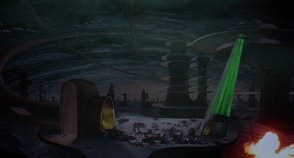
At the halfway point the movie not only switches settings but also switches tone as the aliens are recalled to their own planet. Cal and Ruth are trying to make their escape in a light plane but it’s snared by a tractor beam from the aliens’ flying saucer and they find themselves on the way to Metaluna. And they discover that the aliens aren’t evil, they’re merely desperate. They are engaged in a war with the planet Zagon and they’re losing. The laboratory on earth was part of a last-ditch attempt to find a way to save their civilisation.

This Island Earth was filmed in Technicolor and Universal did their best to give it an epic feel. Mostly they succeeded although the special effects occasionally let them down. The alien planet is rendered mostly with matte paintings and although they look obviously artificial the imaginative nature of the paintings does give an eerie other-worldly feel. Personally I like the use of matte paintings even when they’re obvious. And there are some pretty impressive sets.

There are also some very cool concepts, such as the use of comets and meteors as weapon of mass destruction. That’s the great strength of this movie - the aliens use technologies that seem genuinely alien, rather than death rays and similar gadgets.

The acting is quite passable with most of the players appearing to do their best to take proceedings as seriously as possible.

With an intelligent thoughtful script and plenty of visual imagination this movie represents 1950s Hollywood sci-fi at its best.

Universal’s UK DVD release is coded for Regions 2, 4 and 5 and although there’s a lack of extras it’s a very impressive widescreen transfer and I recommend it unhesitatingly.