Tokugawa Sex Ban AKA The Erotomaniac Daimyo (The Lustful Lord) is a 1972 Japanese exploitation movie from Toei Studios. Although it was written and directed by one of the masters of the pinky violence genre, Norifumi Suzuki, it’s not actually a pinky violence movie. It’s a combination of costume drama and sex comedy. And since it is a Norifumi Suzuki movie it does include a great deal of inspired craziness. A very great deal.
The setting is Japan in 1825, during the Tokugawa Shogunate. The current shogun has 54 children so as you’d expect finding suitable wives and husbands for all of them is quite a challenge. The immediate problem is the Princess Kyohime (Miki Sugimoto). Finally it is decided that Lord Tadateru Ogura (Hiroshi Nawa) would be a suitable match.
This lord is not pleased at the prospect. He is a middle-aged virgin with zero desire to marry. The princess for her part is unhappy about having to live in Kyushu which she considers to be a kind of barbaric hicksville.
She’s been doing some research on a wife’s marital duties, perusing instructional manuals on the subject. She is concerned that some of the positions look rather uncomfortable but overall she’s looking forward to losing her virginity.
Sadly her wedding night is a major disappointment. The bliss she anticipated does not eventuate.
This is a problem for Lord Ogura. If the shogun finds out that his daughter is disappointed in her husband he is likely to be very annoyed.
Lord Ogura’s chief advisor decided that his lord needs to undergo some intensive training. His lack of sexual prowess is due largely to inexperience. The advisor has three young lady assistants who undertake his training, He also has a secret weapon. It has just arrived in a crate from Paris. It is a French Doll. The doll is in fact a gorgeous French babe, Sandra (Sandra Julien). Soon Lord Ogura is obsessed with her.
This does not solve the princess’s problem.
Lord Ogura comes up with a fiendish plan. If he cannot enjoy connubial bliss then no-one will. He bans sex throughout his domain.
After this the movie gets more and more bizarre. It’s pointless to try to describe what happens. You have to see it to believe it and when you’ve seen it you still won’t believe it.
Fans of Norifumi Suzuki’s movies will know that he had a bit of an obsession with Catholicism. That obsession figures in this movie, in ways that make very little sense.
As a sex comedy it is very very funny although in a totally deranged way. It should be mentioned as an aside that sex comedies are something the Japanese do extremely well.
Perhaps the most interesting thing is the feel of the movie. Many of the sets have a kind of fairy tale feel and there are scenes that look like they’re shot through the proscenium arch of a theatre. There is a play within a play. With the voiceover narration as well it appears that Suzuki was aiming for a fairy tale or folk tale or storybook feel.
The subject matter certainly suggests that Suzuki intended the movie to be a satirical comment on censorship. There’s also a bizarre seppuku scene, this coming just a couple of years after celebrated Japanese writer Yukio Mishima’s pubic act of seppuku.
Tokugawa Sex Ban is wild and crazy but it’s pleasingly oddball and it’s sexy and it’s funny and it’s highly recommended.
The movie looks lovely on Mondo Macabro’s Blu-Ray release. There’s an excellent exhaustively detailed audio commentary by Jasper Sharp.
Norifumi Suzuki made some extraordinary movies including several featuring Miki Sugimoto, most notably Sex and Fury, Girl Boss Revenge (Sukeban, 1973) and Terrifying Girls' High School: Lynch Law Classroom.
Sandra Julien was clearly cast in this movie after the successful Japanese release of I Am a Nymphomaniac (1971).
Horror, sci-fi, exploitation, erotica, B-movies, art-house films. Vampires, sex, monsters, all the fun stuff.
Showing posts with label japanese exploitation movies. Show all posts
Tuesday, 20 January 2026
Thursday, 1 January 2026
Black Tight Killers (1966)
Yasuharu Hasebe’s Black Tight Killers was released in 1966 and it’s one of those movies that is perfectly in tune with the zeitgeist. The Swinging 60s were underway. London wasn’t the only place that was swinging. Tokyo was definitely swinging as well. Black Tight Killers is a wild crazy Pop Art-infused thriller that includes everything you could possibly desire in a 60s movie.
Daisuke Hondo (Akira Kobayashi) is a globe-trotting photojournalist who always manages to be in the thick of the action and the danger. On his return flight to Tokyo he meets a very pretty stewardess, Yoriko Sawanouchi (Chieko Matsubara). They’re hitting it off really well until Yoriko is kidnapped. There’s a gang led by a hoodlum named Lopez after her but the beautiful girl ninjas are after her as well. Of course you can never be sure if girl ninjas will turn out to be evil girl ninjas or good girl ninjas.
It all seems to have something to do with Yoriko’s father and the disappearance of a huge stash of gold during the war.
From this point on there’s non-stop mayhem. Fortunately Hondo can handle himself pretty well and he’s spent time at the Momoko Ninja Research Station so he knows a few ninja tricks himself. Although the ninja chewing gum bullet trick does come as a surprise to him.
Yoriko keeps falling into the hands of assorted bad guys. Hondo is still trying to figure out which side the girl ninjas are on. They do seem inclined to offer him at least a temporary alliance.
Yasuharu Hasebe has been an assistant to Seijun Suzuki and that’s significant. This was the very year in which Suzuki made his crazed masterpiece Tokyo Drifter. It’s clear that Suzuki and Hasebe were working along very similar lines, with plot coherence taking a back seat to energy, very cool visuals, Pop Art style, wild use of colour and major flirtations with surrealism. Black Tight Killers, like Tokyo Drifter, takes place in its own universe. Realism pretty much goes out the window. And both films display an obsessive interest in the use of colour to undermine realism. There’s an obvious comic-book influence. And there are hints of the psychedelic freak-out elements which were becoming increasing a feature of late 60s movie.
There’s also go-go dancing.
I love the fact that some of the supposedly exterior shots were deliberately done in the studio and that in the frequent driving scenes the rear projection is obviously intended to look as artificial as possible.
The sets are cool but they’re made to look a lot cooler with very nifty lighting effects.
There are some odd tonal shifts. Mostly the emphasis is on super-charged hyper-kinetic action fun but then there are periodic dark tragic gut-punch moments.
There are also some cynical moments.
Akira Kobayashi is a serviceable action hero. Chieko Matsubara is cute and likeable.
The action scenes have plenty of energy.
The movie is as sexy as you could get away with in 1966, with some very brief glimpses of nudity.
Black Tight Killers was clearly much in tune with international trends in pop cinema. The Bond movies obviously, but it’s closer in feel to eurospy movies like the wonderful French Fantomas (1964) and the amazing Italian heist movie Seven Golden Men (1965), the thoroughly enjoyable Lightning Bolt (1966) and one of the best of all the eurospy films, Special Mission Lady Chaplin (1966). And the German Kommissar X series kicked off in 1966 as well, with Kiss Kiss, Kill Kill.
And let’s face it - you can’t make a bad movie with beautiful girl ninjas.
Black Tight Killers has so much energy, so much fun and so much style. This is pure pop cinema. Highly recommended.
The Radiance Blu-Ray looks lovely. There are some decent extras.
Yasuharu Hasebe went on to direct several of the wonderful Stray Cat Rock movies - Stray Cat Rock: Delinquent Girl Boss (1970), Stray Cat Rock: Sex Hunter (1970) and Stray Cat Rock: Machine Animal (1970). These three movies are all quite different in tone but they’re all very enjoyable.
Daisuke Hondo (Akira Kobayashi) is a globe-trotting photojournalist who always manages to be in the thick of the action and the danger. On his return flight to Tokyo he meets a very pretty stewardess, Yoriko Sawanouchi (Chieko Matsubara). They’re hitting it off really well until Yoriko is kidnapped. There’s a gang led by a hoodlum named Lopez after her but the beautiful girl ninjas are after her as well. Of course you can never be sure if girl ninjas will turn out to be evil girl ninjas or good girl ninjas.
It all seems to have something to do with Yoriko’s father and the disappearance of a huge stash of gold during the war.
From this point on there’s non-stop mayhem. Fortunately Hondo can handle himself pretty well and he’s spent time at the Momoko Ninja Research Station so he knows a few ninja tricks himself. Although the ninja chewing gum bullet trick does come as a surprise to him.
Yoriko keeps falling into the hands of assorted bad guys. Hondo is still trying to figure out which side the girl ninjas are on. They do seem inclined to offer him at least a temporary alliance.
Yasuharu Hasebe has been an assistant to Seijun Suzuki and that’s significant. This was the very year in which Suzuki made his crazed masterpiece Tokyo Drifter. It’s clear that Suzuki and Hasebe were working along very similar lines, with plot coherence taking a back seat to energy, very cool visuals, Pop Art style, wild use of colour and major flirtations with surrealism. Black Tight Killers, like Tokyo Drifter, takes place in its own universe. Realism pretty much goes out the window. And both films display an obsessive interest in the use of colour to undermine realism. There’s an obvious comic-book influence. And there are hints of the psychedelic freak-out elements which were becoming increasing a feature of late 60s movie.
There’s also go-go dancing.
I love the fact that some of the supposedly exterior shots were deliberately done in the studio and that in the frequent driving scenes the rear projection is obviously intended to look as artificial as possible.
The sets are cool but they’re made to look a lot cooler with very nifty lighting effects.
There are some odd tonal shifts. Mostly the emphasis is on super-charged hyper-kinetic action fun but then there are periodic dark tragic gut-punch moments.
There are also some cynical moments.
Akira Kobayashi is a serviceable action hero. Chieko Matsubara is cute and likeable.
The action scenes have plenty of energy.
The movie is as sexy as you could get away with in 1966, with some very brief glimpses of nudity.
Black Tight Killers was clearly much in tune with international trends in pop cinema. The Bond movies obviously, but it’s closer in feel to eurospy movies like the wonderful French Fantomas (1964) and the amazing Italian heist movie Seven Golden Men (1965), the thoroughly enjoyable Lightning Bolt (1966) and one of the best of all the eurospy films, Special Mission Lady Chaplin (1966). And the German Kommissar X series kicked off in 1966 as well, with Kiss Kiss, Kill Kill.
And let’s face it - you can’t make a bad movie with beautiful girl ninjas.
Black Tight Killers has so much energy, so much fun and so much style. This is pure pop cinema. Highly recommended.
The Radiance Blu-Ray looks lovely. There are some decent extras.
Yasuharu Hasebe went on to direct several of the wonderful Stray Cat Rock movies - Stray Cat Rock: Delinquent Girl Boss (1970), Stray Cat Rock: Sex Hunter (1970) and Stray Cat Rock: Machine Animal (1970). These three movies are all quite different in tone but they’re all very enjoyable.
Saturday, 14 June 2025
Saturday, 17 May 2025
Belladonna of Sadness (1973)
If you go into Belladonna of Sadness expecting the kind of anime movie you’re accustomed to you’ll be confused and disappointed. This is not even remotely similar to what we now think of as anime. In fact it’s not even a true animated movie. It’s partly animated but relies to a huge extent on still images.
Belladonna of Sadness was released in 1973. It was made by Mushi Production, an important company in the early history of anime. They made many of the best-known 1960s anime TV series, such as Astro Boy. Belladonna of Sadness was the third in Mushi’s Animerama series of adult-oriented anime feature films. All three films were commercial flops and the box-office failure of Belladonna of Sadness pushed the studio into bankruptcy.
It has something of a fairy tale feel, at least superficially. It’s based on Jules Michelet’s 1862 history of witchcraft, La Sorcière.
The setting of the movie is France in the Middle Ages and it reflects Michelet’s virulent anti-Catholic anti-monarchy views. Jean, a simple farmer, and Jeanne are about to be married. The wicked lord deflowers Jeanne (reflecting the popular but entirely false myth that feudal lords had this right). Jeanne responds by calling on Satan, although when he appears Satan tells her that he’s already inside her. Satan is like a cute little floating penis.
With Satan’s help Jeanne prospers but her wealth makes her unpopular with the people and attracts the jealousy of the lord’s wife. Jean becomes a wealthy tax collector and an alcoholic. Jean and Jeanne experience lots of ups and down until finally the movie just devolves into bad acid trip territory.
Finally we get a kind of bizarre nightmare orgy scene which is rather hair-raising.
To me Belladonna of Sadness doesn’t feel the slightest bit Japanese (which might explain why Japanese audiences didn’t bother seeing it). It’s clearly heavily influenced by European art cinema and by all kinds of counter-culture elements such as American underground comics.
This is a psychedelic freak-out movie. It’s not a movie, it’s a happening. Can you dig it?
There is a plot. The plot is not terrible. It’s your basic selling your soul to the Devil and getting mixed up in witchcraft kind of plot.
You can tell that the visual artists involved were real artists because so much of the artwork is incredibly crude and ugly and looks like it was done by a deranged five-year-old. Overall this is a movie that looks hideous. A large part of the problem is that that late 60s arty aesthetic has not worn well. The 60s aesthetic is terrific when it’s done with wit and style in a very “pop” way but when it’s done with serious arty pretensions it can be cringe-inducing.
The frustrating thing is that there are some very good visual moments. It does have to be said however that those moments are very hippie-dippie.
This movie uses a variety of animation techniques and only uses traditional cel-and-ink animation sparingly. It’s all very experimental and avant-garde.
It’s a movie that is quite divisive. Some people think it’s a masterpiece. Some people think it’s an embarrassing train-wreck. I lean more towards the embarrassing train-wreck theory. It is at times an interesting train-wreck. I tend to like movies that are interesting failures but this one really didn’t grab me. Maybe I just wasn’t in the right head space man.
This is a movie that was for many years little seen although despite legends to the contrary it was never a lost movie.
If you want to see this movie through to the end I’d advise getting in a large supply of mind-altering substances. Then you’re really be able to groove to it. Maybe. I can’t really recommend seeing this movie but I’d be reluctant to advise people not to see it. All I can say is that if it sounds like the sort of thing you enjoy then see it but if it sounds like the sort of thing you won’t enjoy then don’t see it. Belladonna of Sadness is just not my cup of tea.
The Discotek Blu-Ray offers a nice transfer with a number of extras. The audio commentary includes a lot of fascinating information about the tumultuous history of Mushi Production and the movie’s troubled production history.
Belladonna of Sadness was released in 1973. It was made by Mushi Production, an important company in the early history of anime. They made many of the best-known 1960s anime TV series, such as Astro Boy. Belladonna of Sadness was the third in Mushi’s Animerama series of adult-oriented anime feature films. All three films were commercial flops and the box-office failure of Belladonna of Sadness pushed the studio into bankruptcy.
It has something of a fairy tale feel, at least superficially. It’s based on Jules Michelet’s 1862 history of witchcraft, La Sorcière.
The setting of the movie is France in the Middle Ages and it reflects Michelet’s virulent anti-Catholic anti-monarchy views. Jean, a simple farmer, and Jeanne are about to be married. The wicked lord deflowers Jeanne (reflecting the popular but entirely false myth that feudal lords had this right). Jeanne responds by calling on Satan, although when he appears Satan tells her that he’s already inside her. Satan is like a cute little floating penis.
With Satan’s help Jeanne prospers but her wealth makes her unpopular with the people and attracts the jealousy of the lord’s wife. Jean becomes a wealthy tax collector and an alcoholic. Jean and Jeanne experience lots of ups and down until finally the movie just devolves into bad acid trip territory.
Finally we get a kind of bizarre nightmare orgy scene which is rather hair-raising.
To me Belladonna of Sadness doesn’t feel the slightest bit Japanese (which might explain why Japanese audiences didn’t bother seeing it). It’s clearly heavily influenced by European art cinema and by all kinds of counter-culture elements such as American underground comics.
This is a psychedelic freak-out movie. It’s not a movie, it’s a happening. Can you dig it?
There is a plot. The plot is not terrible. It’s your basic selling your soul to the Devil and getting mixed up in witchcraft kind of plot.
You can tell that the visual artists involved were real artists because so much of the artwork is incredibly crude and ugly and looks like it was done by a deranged five-year-old. Overall this is a movie that looks hideous. A large part of the problem is that that late 60s arty aesthetic has not worn well. The 60s aesthetic is terrific when it’s done with wit and style in a very “pop” way but when it’s done with serious arty pretensions it can be cringe-inducing.
The frustrating thing is that there are some very good visual moments. It does have to be said however that those moments are very hippie-dippie.
This movie uses a variety of animation techniques and only uses traditional cel-and-ink animation sparingly. It’s all very experimental and avant-garde.
It’s a movie that is quite divisive. Some people think it’s a masterpiece. Some people think it’s an embarrassing train-wreck. I lean more towards the embarrassing train-wreck theory. It is at times an interesting train-wreck. I tend to like movies that are interesting failures but this one really didn’t grab me. Maybe I just wasn’t in the right head space man.
This is a movie that was for many years little seen although despite legends to the contrary it was never a lost movie.
If you want to see this movie through to the end I’d advise getting in a large supply of mind-altering substances. Then you’re really be able to groove to it. Maybe. I can’t really recommend seeing this movie but I’d be reluctant to advise people not to see it. All I can say is that if it sounds like the sort of thing you enjoy then see it but if it sounds like the sort of thing you won’t enjoy then don’t see it. Belladonna of Sadness is just not my cup of tea.
The Discotek Blu-Ray offers a nice transfer with a number of extras. The audio commentary includes a lot of fascinating information about the tumultuous history of Mushi Production and the movie’s troubled production history.
Wednesday, 6 November 2024
Stray Cat Rock: Machine Animal (1970)
Stray Cat Rock: Machine Animal, directed by Yasuharu Hasebe and released in 1970, was the fourth of the five very successful Stray Cat Rock pinky violence movies made by Japan’s Nikkatsu studio at the beginning of the 1970s. The legendary Meiko Kaji features in all five movies.
The first thing that needs to be pointed out is that the Stray Cat Rock movies were not what today would be thought of as a franchise. There are no direct links between the five films. Each film features entirely different characters. Meiko Kaji plays different women in each film. Each film has a slightly different feel. What they all have in common is that they all involve the adventures of girl juvenile delinquent gangs.
The second thing to be pointed out is that while Machine Animal feels like a pinky violence movie it features no nudity and no sex and the violence is very restrained. This is a rather good-natured movie.
Maya (Meiko Kaji) is the leader of a Yokohama girl gang. They have a friendly relationship with a male juvenile delinquent gang, the Dragons (led by a guy named Sakura), but Maya’s gang is fiercely independent. They sort out their own problems.
Both gangs, Maya’s gang and the Dragons, encounter three young guys whose car has broken down. Two of the guys are Japanese while the third is an American, Charlie. It seems like these three guys are going to get beaten up, but that doesn’t happen. These juvenile delinquents are not mere thugs. They’re not out for aimless violence. If you don’t bother them they won’t bother you.
The girls later discover that these three guys have a huge stash of LSD tablets that they’re trying to sell. The girls steal the drugs.
Maya then finds out that Charlie is a U.S. Army deserter tired of the carnage of the Vietnam War. He’s trying to escape to Sweden. The drugs are to be sold to finance his escape on a cargo ship. Now the girls feel really bad. They don’t want Charlie to have to go back to the war.
The girls decide to return the drugs but then things get really complicated, with everybody trying to steal the acid tabs from everybody else. The Dragons get involved. Various pushers get involved. Sakura’s somewhat sinister sister Yuri (Bunjaku Han), the major local dealer, gets mixed up in it as well. Nobody is sure any longer where the LSD stash is.
There is major trouble between Maya’s gang and the Dragons, with both gangs resorting to kidnappings in order to force their rivals to negotiate a deal. Inevitably things get dangerously heated.
It’s fun in these Stray Cat Rock movies seeing Meiko Kaji playing characters far removed from the ice-cold killer psycho bitch roles with which she later became associated. She was perfectly capable of playing very sympathetic nice girls and she could be funny and even adorable. In this movie she’s very likeable. Maya is a nice girl. She does not rule her gang by fear. The other girls accept her leadership because they know they can trust her and they know she’s smart and resourceful. She’s the queen but she’s a benevolent queen.
The way girl gangs are treated in this series (and other pinky violence series) is extremely interesting. These are young women trying to cope with a world that they find confusing and alienating. They deal with this by forming girl gangs which function as tight-knit emotionally supportive female groups. Girls who have fun together, but who will unhesitatingly back each other up.
It’s not done in a heavy-handed feminist way. It’s just the natural inclination of women to want to bond with female friends. They like men but they need the mutual trust and respect of female friends.
Meiko Kaji was a successful pop singer as well as an actress and she gets to sing in this movie. There are in fact a number of pop songs featured in the movie which makes it a nice time capsule of 1970 Japanese pop culture. Even better, this film features go-go dancing!
I loved the fact that at one point the girls need motorcycles so they steal them from a showroom but after they’ve finished with them they return the motorcycles to the showroom. They may be juvenile delinquents but they’re not common thieves! And when they ride the bikes through a restaurant they apologise to the customers for the inconvenience. Being a juvenile delinquent doesn’t mean you have to forget to be polite.
The acting is fine with all the girls being likeable and cute.
Stray Cat Rock: Machine Animal’s greatest strengths are Meiko Kaji’s star power and its sense of female camaraderie. It’s also fast-moving. Don’t expect lashings of sex and violence. This is more like a good-natured caper movie. But it’s entertaining, it’s a great chance to appreciate Meiko Kaji’s versatility as an actress and it’s recommended.
All five Stray Cat Rock movies are included in Arrow’s Blu-Ray boxed set and all five movies look terrific. There are a few extras as well.
Yasuharu Hasebe also directed the first and third movies in the series, Stray Cat Rock: Delinquent Girl Boss (1970) and Stray Cat Rock: Sex Hunter (1970). I’ve also reviewed the second movie in the series, Stray Cat Rock: Wild Jumbo (1970), which was directed by Toshiya Fujita.
The first thing that needs to be pointed out is that the Stray Cat Rock movies were not what today would be thought of as a franchise. There are no direct links between the five films. Each film features entirely different characters. Meiko Kaji plays different women in each film. Each film has a slightly different feel. What they all have in common is that they all involve the adventures of girl juvenile delinquent gangs.
The second thing to be pointed out is that while Machine Animal feels like a pinky violence movie it features no nudity and no sex and the violence is very restrained. This is a rather good-natured movie.
Maya (Meiko Kaji) is the leader of a Yokohama girl gang. They have a friendly relationship with a male juvenile delinquent gang, the Dragons (led by a guy named Sakura), but Maya’s gang is fiercely independent. They sort out their own problems.
Both gangs, Maya’s gang and the Dragons, encounter three young guys whose car has broken down. Two of the guys are Japanese while the third is an American, Charlie. It seems like these three guys are going to get beaten up, but that doesn’t happen. These juvenile delinquents are not mere thugs. They’re not out for aimless violence. If you don’t bother them they won’t bother you.
The girls later discover that these three guys have a huge stash of LSD tablets that they’re trying to sell. The girls steal the drugs.
Maya then finds out that Charlie is a U.S. Army deserter tired of the carnage of the Vietnam War. He’s trying to escape to Sweden. The drugs are to be sold to finance his escape on a cargo ship. Now the girls feel really bad. They don’t want Charlie to have to go back to the war.
The girls decide to return the drugs but then things get really complicated, with everybody trying to steal the acid tabs from everybody else. The Dragons get involved. Various pushers get involved. Sakura’s somewhat sinister sister Yuri (Bunjaku Han), the major local dealer, gets mixed up in it as well. Nobody is sure any longer where the LSD stash is.
There is major trouble between Maya’s gang and the Dragons, with both gangs resorting to kidnappings in order to force their rivals to negotiate a deal. Inevitably things get dangerously heated.
It’s fun in these Stray Cat Rock movies seeing Meiko Kaji playing characters far removed from the ice-cold killer psycho bitch roles with which she later became associated. She was perfectly capable of playing very sympathetic nice girls and she could be funny and even adorable. In this movie she’s very likeable. Maya is a nice girl. She does not rule her gang by fear. The other girls accept her leadership because they know they can trust her and they know she’s smart and resourceful. She’s the queen but she’s a benevolent queen.
The way girl gangs are treated in this series (and other pinky violence series) is extremely interesting. These are young women trying to cope with a world that they find confusing and alienating. They deal with this by forming girl gangs which function as tight-knit emotionally supportive female groups. Girls who have fun together, but who will unhesitatingly back each other up.
It’s not done in a heavy-handed feminist way. It’s just the natural inclination of women to want to bond with female friends. They like men but they need the mutual trust and respect of female friends.
Meiko Kaji was a successful pop singer as well as an actress and she gets to sing in this movie. There are in fact a number of pop songs featured in the movie which makes it a nice time capsule of 1970 Japanese pop culture. Even better, this film features go-go dancing!
I loved the fact that at one point the girls need motorcycles so they steal them from a showroom but after they’ve finished with them they return the motorcycles to the showroom. They may be juvenile delinquents but they’re not common thieves! And when they ride the bikes through a restaurant they apologise to the customers for the inconvenience. Being a juvenile delinquent doesn’t mean you have to forget to be polite.
The acting is fine with all the girls being likeable and cute.
Stray Cat Rock: Machine Animal’s greatest strengths are Meiko Kaji’s star power and its sense of female camaraderie. It’s also fast-moving. Don’t expect lashings of sex and violence. This is more like a good-natured caper movie. But it’s entertaining, it’s a great chance to appreciate Meiko Kaji’s versatility as an actress and it’s recommended.
All five Stray Cat Rock movies are included in Arrow’s Blu-Ray boxed set and all five movies look terrific. There are a few extras as well.
Yasuharu Hasebe also directed the first and third movies in the series, Stray Cat Rock: Delinquent Girl Boss (1970) and Stray Cat Rock: Sex Hunter (1970). I’ve also reviewed the second movie in the series, Stray Cat Rock: Wild Jumbo (1970), which was directed by Toshiya Fujita.
Saturday, 26 October 2024
Genocide (1968)
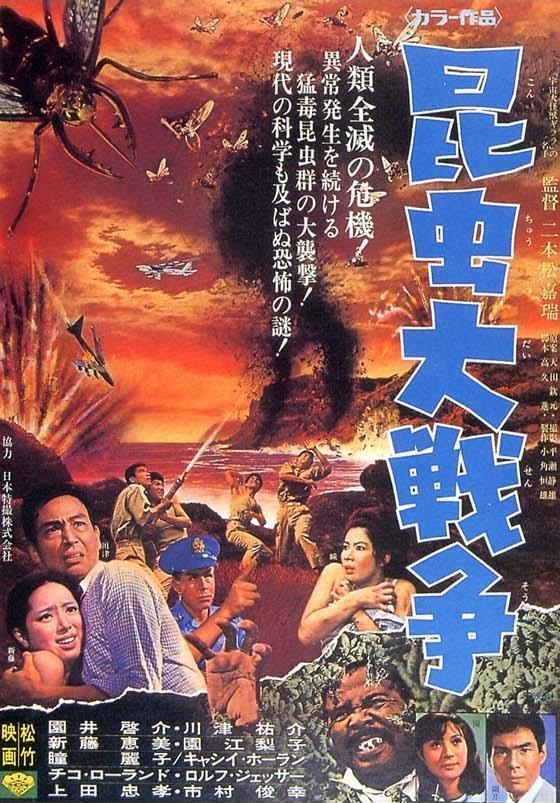
In the late 1960s Japan’s Shochiku studio made a short-lived and rather tentative attempt to break into the booming market for science fiction, horror and monster movies. Four of these movies are included in Criterion’s Eclipse Series 37 DVD boxed set When Horror Came to Shochiku. While it’s a cool name for a boxed set it’s a tad misleading since these movies are certainly not typical late 60s horror films. They all combine horror and science fiction in weird and wonderful ways.
Genocide begins with a swarm of insects causing an American B-52 bomber to crash into the sea near Kojima Island, just off the coast of Japan. The three crew members survive and reach the island. The B-52 was carrying a H-bomb.
The crash was witnessed by Joji (Yûsuke Kawazu), a young Japanese guy who collects insects for a scientist. At least his gorgeous young wife Yukari (Emi Shindô) thinks he’s collecting insects. Actually he’s canoodling with a blonde named Annabelle (Kathy Horan).
The Americans really want to find their H-bomb. They do find the three crew members but two are dead and the third, Charly, has lost his memory (we later find out he’s lost his mind as well).
Joji is now under suspicion of murder. Yukari knows about the blonde and she’s not happy about it but she still loves Joji. She appeals to Dr Nagumo (Keisuke Sonoi) for help. Nagumo is the scientist for whom Joji collects bugs. Nagumo is keen to help.
Genocide begins with a swarm of insects causing an American B-52 bomber to crash into the sea near Kojima Island, just off the coast of Japan. The three crew members survive and reach the island. The B-52 was carrying a H-bomb.
The crash was witnessed by Joji (Yûsuke Kawazu), a young Japanese guy who collects insects for a scientist. At least his gorgeous young wife Yukari (Emi Shindô) thinks he’s collecting insects. Actually he’s canoodling with a blonde named Annabelle (Kathy Horan).
The Americans really want to find their H-bomb. They do find the three crew members but two are dead and the third, Charly, has lost his memory (we later find out he’s lost his mind as well).
Joji is now under suspicion of murder. Yukari knows about the blonde and she’s not happy about it but she still loves Joji. She appeals to Dr Nagumo (Keisuke Sonoi) for help. Nagumo is the scientist for whom Joji collects bugs. Nagumo is keen to help.
So far it all makes sense, doesn’t it? Well it won’t make sense for long. Dr Nagumo is already disturbed by reports from around the globe of strange insect behaviour.
Dr Nagumo is more worried after he’s visited the cave in which the American airmen took shelter. He’s also worried about Charly’s condition. Charly has been seriously spooked by something. He is now terrified of bugs.
The bugs are definitely behaving oddly but there are humans on the island who are up to mysterious and possibly wicked things as well. At this stage we have no idea what they might be up to or which of the people on the island might be involved.
There are quite a few people acting strangely. There’s the creepy guy at the hotel. Maybe he just wants to get into Yukari’s pants but maybe he has another agenda as well. We know that Joji has been covering up his torrid love affair with Annabelle. He could be covering up other things. Dr Nagumo seems like a nice guy but we can’t discount the possibility he might turn out to be a mad scientist. We’re a bit suspicious of Annabelle. And the Americans get rather evasive when they’re asked about that H-bomb.
Up to this point the movie’s craziness level is in low gear but it will soon be kicked into overdrive. The motivations of the various characters are totally nuts. The nature of the mysterious happenings on the island turns out to be bizarre.
And then we get a full-blown psychedelic freak-out sequence.
The acting isn’t very good but it’s appropriate to the demented subject matter and I rather enjoyed Kathy Horan doing the dangerous blonde thing as Annabelle.
The special effects (and especially the miniatures work) are definitely iffy. That doesn’t matter in such an insane movie. It just adds to the fun. And some of the effects with the insects do work.
The plot is gloriously silly but you have to admire its boldness. Who says movies have to make sense?
Genocide is a wild crazy ride. The pacing is excellent. The craziness doesn’t let up. Thankfully there’s no comic relief. There’s an anti-war message but it doesn’t become tedious. There’s delightfully off-the-wall pseudo-science. It combines horror, science fiction and spy film elements. Genocide is just pure enjoyment. Highly recommended if you love insane psychotronic movies.
The DVD transfer is very good. So far I’ve watched three of the movies in the boxed set. The X from Outer Space (1967) and The Living Skeleton (1968) are both goofy fun while Goke, Body Snatcher from Hell (1968) is delightfully deranged.
Dr Nagumo is more worried after he’s visited the cave in which the American airmen took shelter. He’s also worried about Charly’s condition. Charly has been seriously spooked by something. He is now terrified of bugs.
The bugs are definitely behaving oddly but there are humans on the island who are up to mysterious and possibly wicked things as well. At this stage we have no idea what they might be up to or which of the people on the island might be involved.
There are quite a few people acting strangely. There’s the creepy guy at the hotel. Maybe he just wants to get into Yukari’s pants but maybe he has another agenda as well. We know that Joji has been covering up his torrid love affair with Annabelle. He could be covering up other things. Dr Nagumo seems like a nice guy but we can’t discount the possibility he might turn out to be a mad scientist. We’re a bit suspicious of Annabelle. And the Americans get rather evasive when they’re asked about that H-bomb.
Up to this point the movie’s craziness level is in low gear but it will soon be kicked into overdrive. The motivations of the various characters are totally nuts. The nature of the mysterious happenings on the island turns out to be bizarre.
And then we get a full-blown psychedelic freak-out sequence.
The acting isn’t very good but it’s appropriate to the demented subject matter and I rather enjoyed Kathy Horan doing the dangerous blonde thing as Annabelle.
The special effects (and especially the miniatures work) are definitely iffy. That doesn’t matter in such an insane movie. It just adds to the fun. And some of the effects with the insects do work.
The plot is gloriously silly but you have to admire its boldness. Who says movies have to make sense?
Genocide is a wild crazy ride. The pacing is excellent. The craziness doesn’t let up. Thankfully there’s no comic relief. There’s an anti-war message but it doesn’t become tedious. There’s delightfully off-the-wall pseudo-science. It combines horror, science fiction and spy film elements. Genocide is just pure enjoyment. Highly recommended if you love insane psychotronic movies.
The DVD transfer is very good. So far I’ve watched three of the movies in the boxed set. The X from Outer Space (1967) and The Living Skeleton (1968) are both goofy fun while Goke, Body Snatcher from Hell (1968) is delightfully deranged.
Friday, 18 October 2024
Female Prisoner Scorpion: Beast Stable (1973)
Female Prisoner Scorpion: Beast Stable, released in 1973, was the third of the Female Prisoner Scorpion movies. Once again Meiko Kaji is the star and Shunya Itō is the director.
One of the cool things about the Japanese pinky violence movies is that there are often considerable differences between the various entries in a series.
If you haven’t seen the first two Female Prisoner Scorpion movies you won’t have the remotest idea what’s going on in this movie. You’ll be wondering why this girl is such a psycho bitch. If you have seen the first two movies you’ll understand. We do get snippets of her backstory in the course of the movie but nowhere near enough to make her personality comprehensible.
Matsu (Meiko Kaji), who gained the nickname Scorpion in prison, is on the run. The cops, led by Detective Kondo (Mikio Narita), almost catch her on the train. Poor Kondo has no idea what he is dealing with. There are two cops and one lone girl but if the girl is the Scorpion the odds are all on her side. The way she escapes is a fine illustration of the breathtaking excesses that make pinky violence movies so addictive. When you think you have Matsu cornered and helpless that’s when you should be really scared.
Matsu makes a friend. Yuki (Yayoi Watanabe) is a prostitute. She lives with her brain-damaged brother. She has sex with him regularly because it makes him happy.
Yuki has gangster problems. Those problems become Matsu’s problems. The first problem is Tanida (Takashi Fujiki). He knows Matsu is an escaped convict. He is going to force Matsu to provide him with regular sexual services. If she doesn’t play along he’ll turn her in. That annoys Matsu. Annoying Matsu is a seriously bad idea. The method Matsu adopts to deal with this problem is delightfully fiendish. It’s a woman’s revenge.
The other problem is sinister crazy sadistic procuress Katsu. Katsu had been in prison with Matsu. Katsu is a very tough very mean lady but she’s terrified of Matsu. She decides that Matsu will have to be dealt with.
Meanwhile Matsu still has the cops to deal with.
It all leads up to an extended pursuit through the city’s sewers, or at least we think that’s the finale but then we get a whole new subplot. And an amazing ending.
Stylistically this movie switches between gritty realism and outrageous theatricality.
One thing I like about the Female Prisoner Scorpion movies is that Matsu is not a typical kickass action heroine. She doesn’t have superpowers. She’s no stronger than any normal woman. She has no advanced unarmed combat skills. There are several factors that make her a formidable opponent. Firstly there’s her patience. She has the ability to withdraw into her shell and wait. She doesn’t care how long she has to wait. Eventually her chance will come. Then she strikes like a scorpion. And there’s her will to survive and her crazed savagery. When cornered she fights like a wounded panther at bay. She will do whatever it takes to survive. If she has to kill she will do so without hesitation. She will strike the death-blow without flinching. And she goes into a killing frenzy.
There’s a lot of emphasis in this film on Matsu’s utter aloneness. She cannot form emotional relationships with men. She cannot form friendships with other women. She trusts no-one. Yuki has some of the same problems. Both Matsu and Yuki need the friendship of another woman but can they learn to trust each other?
There’s a temptation to see Matsu as a feminist icon but in fact she’s a tragic figure. She has lost her humanity. She has been pursued and mistreated (often by other women) for so long that she has developed the personality of a hunted animal. We admire her extraordinary determination to survive but we feel desperately sorry for her. She was once a perfectly ordinary young woman. Now only a shell remains. She has survived in one sense, but perhaps not in other senses.
Female Prisoner Scorpion: Beast Stable is a weird disturbing movie but that description applies to all the movies of this series (and it applies to pinky violence movies in general). Highly recommended, but see the first two movies first.
All four movies in this cycle are included in Arrow’s Female Prisoner Scorpion Blu-Ray boxed set. The transfers are excellent. There are some extras, for those who bother with such things.
I’ve reviewed the first two movies in this series, Female Prisoner #701: Scorpion (1972) and Female Prisoner Scorpion: Jailhouse 41 (1972). These movies absolutely have to be seen in production order.
One of the cool things about the Japanese pinky violence movies is that there are often considerable differences between the various entries in a series.
If you haven’t seen the first two Female Prisoner Scorpion movies you won’t have the remotest idea what’s going on in this movie. You’ll be wondering why this girl is such a psycho bitch. If you have seen the first two movies you’ll understand. We do get snippets of her backstory in the course of the movie but nowhere near enough to make her personality comprehensible.
Matsu (Meiko Kaji), who gained the nickname Scorpion in prison, is on the run. The cops, led by Detective Kondo (Mikio Narita), almost catch her on the train. Poor Kondo has no idea what he is dealing with. There are two cops and one lone girl but if the girl is the Scorpion the odds are all on her side. The way she escapes is a fine illustration of the breathtaking excesses that make pinky violence movies so addictive. When you think you have Matsu cornered and helpless that’s when you should be really scared.
Matsu makes a friend. Yuki (Yayoi Watanabe) is a prostitute. She lives with her brain-damaged brother. She has sex with him regularly because it makes him happy.
Yuki has gangster problems. Those problems become Matsu’s problems. The first problem is Tanida (Takashi Fujiki). He knows Matsu is an escaped convict. He is going to force Matsu to provide him with regular sexual services. If she doesn’t play along he’ll turn her in. That annoys Matsu. Annoying Matsu is a seriously bad idea. The method Matsu adopts to deal with this problem is delightfully fiendish. It’s a woman’s revenge.
The other problem is sinister crazy sadistic procuress Katsu. Katsu had been in prison with Matsu. Katsu is a very tough very mean lady but she’s terrified of Matsu. She decides that Matsu will have to be dealt with.
Meanwhile Matsu still has the cops to deal with.
It all leads up to an extended pursuit through the city’s sewers, or at least we think that’s the finale but then we get a whole new subplot. And an amazing ending.
Stylistically this movie switches between gritty realism and outrageous theatricality.
One thing I like about the Female Prisoner Scorpion movies is that Matsu is not a typical kickass action heroine. She doesn’t have superpowers. She’s no stronger than any normal woman. She has no advanced unarmed combat skills. There are several factors that make her a formidable opponent. Firstly there’s her patience. She has the ability to withdraw into her shell and wait. She doesn’t care how long she has to wait. Eventually her chance will come. Then she strikes like a scorpion. And there’s her will to survive and her crazed savagery. When cornered she fights like a wounded panther at bay. She will do whatever it takes to survive. If she has to kill she will do so without hesitation. She will strike the death-blow without flinching. And she goes into a killing frenzy.
There’s a lot of emphasis in this film on Matsu’s utter aloneness. She cannot form emotional relationships with men. She cannot form friendships with other women. She trusts no-one. Yuki has some of the same problems. Both Matsu and Yuki need the friendship of another woman but can they learn to trust each other?
There’s a temptation to see Matsu as a feminist icon but in fact she’s a tragic figure. She has lost her humanity. She has been pursued and mistreated (often by other women) for so long that she has developed the personality of a hunted animal. We admire her extraordinary determination to survive but we feel desperately sorry for her. She was once a perfectly ordinary young woman. Now only a shell remains. She has survived in one sense, but perhaps not in other senses.
Female Prisoner Scorpion: Beast Stable is a weird disturbing movie but that description applies to all the movies of this series (and it applies to pinky violence movies in general). Highly recommended, but see the first two movies first.
All four movies in this cycle are included in Arrow’s Female Prisoner Scorpion Blu-Ray boxed set. The transfers are excellent. There are some extras, for those who bother with such things.
I’ve reviewed the first two movies in this series, Female Prisoner #701: Scorpion (1972) and Female Prisoner Scorpion: Jailhouse 41 (1972). These movies absolutely have to be seen in production order.
Friday, 11 October 2024
The Living Skeleton (1968)
In the late 60s Japan’s Shochiku studio made a short-lived and tentative attempt to break into the booming market for science fiction, horror and monster movies. Criterion’s Eclipse Series 37 DVD boxed set When Horror Came to Shochiku includes four of the movies made at Shochiku at that time. When Horror Came to Shochiku is a cool name for a boxed set but a bit misleading since these movies are not quite what one would think as typical late 60s horror films.
The Living Skeleton (Kyûketsu dokuro-sen), made in 1968, is one of these four movies.
You have to bear in mind that this is not a low-budget independent film. It was made by a major studio, with the resources of a major studio. It was made by people who had learnt their craft in a studio system. They were professionals. They knew how to make movies. It has a certain amount of major studio polish.
The Living Skeleton opens in fairly spectacular style. A freighter, the Dragon King, has been captured by pirates. The setting is contemporary - it’s worth remembering that piracy still goes on today. These pirates are particularly ruthless and the crew and the handful of passengers are massacred.
Three years later we meet a young woman named Saeko (Kikko Matsuoka). She lives in a small Japanese costal town. She is an orphan and along with her identical twin sister Yoriko was more or less raised by the village priest. He’s a Catholic priest - Japan has a large Catholic community.
Saeko is a nice girl but she has been troubled since her twin sister disappeared. The sister is assumed to have been drowned when the freighter on which she was travelling went down in a typhoon. Of course the audience knows that the twin sister was killed by those pirates.
Saeko has a boyfriend, Mochizuki (Yasunori Irikawa). He’s a decent guy and they plan to get married.
They go scuba diving and see something unexpected - skeletons.
Later they see a ship. Not on the bottom of the sea, but afloat. Maybe it’s the ship on which Yoriko met her fate. Saeko wants to reach the ship, she does so, and she is disturbed by what she finds.
Then things get spooky for a bunch of people all of whom have something to hide. What they have to hide is connected with the events on board the Dragon King.
Viewers will have their suspicions about what is going on but it may not be so simple.
This is one of those movies that plays around with genre. You think you know what kind of movie it is and then you start to think it’s not that sort of movie at all. And then you find yourself thinking it could belong to any one of several genres. Is anything supernatural going on? Certainly strange creepy things happen. We’re kept guessing. Maybe we’ll get a definite answer at the end. You’ll have to watch the movie yourself to find out.
There are some nicely crazy plot twists.
There’s a touch of ambiguity to at least one major character. We might understand a character’s motivations without entirely approving of the actions to which those motivations lead.
We have to talk about the special effects. There are some very obvious miniatures shots. I don’t mind that. In fact in a movie such as this where you’re not always entirely certainly that everything you see is real or truthful obvious special effects can be an asset. There are some really ambitious effects shots and they’re often quite effective and disturbing.
This film was shot in the ’scope aspect ratio in black-and-white, a combination I always find rather appealing. The cinematography is suitably moody.
This movie has a lot of the qualities you expect in a horror exploitation movie combined with some genuinely unsettling atmosphere. It has some outlandish moments and a few crazy moments.
Overall The Living Skeleton is entertaining with enough weird touches to make it a cut above average. Highly recommended.
The DVD transfer is very good. So far I’ve watched three of the movies in the boxed set. The X from Outer Space (1967) is goofy fun while Goke, Body Snatcher from Hell (1968) is delightfully demented.
The Living Skeleton (Kyûketsu dokuro-sen), made in 1968, is one of these four movies.
You have to bear in mind that this is not a low-budget independent film. It was made by a major studio, with the resources of a major studio. It was made by people who had learnt their craft in a studio system. They were professionals. They knew how to make movies. It has a certain amount of major studio polish.
The Living Skeleton opens in fairly spectacular style. A freighter, the Dragon King, has been captured by pirates. The setting is contemporary - it’s worth remembering that piracy still goes on today. These pirates are particularly ruthless and the crew and the handful of passengers are massacred.
Three years later we meet a young woman named Saeko (Kikko Matsuoka). She lives in a small Japanese costal town. She is an orphan and along with her identical twin sister Yoriko was more or less raised by the village priest. He’s a Catholic priest - Japan has a large Catholic community.
Saeko is a nice girl but she has been troubled since her twin sister disappeared. The sister is assumed to have been drowned when the freighter on which she was travelling went down in a typhoon. Of course the audience knows that the twin sister was killed by those pirates.
Saeko has a boyfriend, Mochizuki (Yasunori Irikawa). He’s a decent guy and they plan to get married.
They go scuba diving and see something unexpected - skeletons.
Later they see a ship. Not on the bottom of the sea, but afloat. Maybe it’s the ship on which Yoriko met her fate. Saeko wants to reach the ship, she does so, and she is disturbed by what she finds.
Then things get spooky for a bunch of people all of whom have something to hide. What they have to hide is connected with the events on board the Dragon King.
Viewers will have their suspicions about what is going on but it may not be so simple.
This is one of those movies that plays around with genre. You think you know what kind of movie it is and then you start to think it’s not that sort of movie at all. And then you find yourself thinking it could belong to any one of several genres. Is anything supernatural going on? Certainly strange creepy things happen. We’re kept guessing. Maybe we’ll get a definite answer at the end. You’ll have to watch the movie yourself to find out.
There are some nicely crazy plot twists.
There’s a touch of ambiguity to at least one major character. We might understand a character’s motivations without entirely approving of the actions to which those motivations lead.
We have to talk about the special effects. There are some very obvious miniatures shots. I don’t mind that. In fact in a movie such as this where you’re not always entirely certainly that everything you see is real or truthful obvious special effects can be an asset. There are some really ambitious effects shots and they’re often quite effective and disturbing.
This film was shot in the ’scope aspect ratio in black-and-white, a combination I always find rather appealing. The cinematography is suitably moody.
This movie has a lot of the qualities you expect in a horror exploitation movie combined with some genuinely unsettling atmosphere. It has some outlandish moments and a few crazy moments.
Overall The Living Skeleton is entertaining with enough weird touches to make it a cut above average. Highly recommended.
The DVD transfer is very good. So far I’ve watched three of the movies in the boxed set. The X from Outer Space (1967) is goofy fun while Goke, Body Snatcher from Hell (1968) is delightfully demented.
Tuesday, 27 August 2024
Blood Shadow (2001-02)
Blood Shadow is an anime OVA from AT-2 Project comprising three episodes released in 2001 and 2002, directed by Nao Okezawa. I believe it has also been released as Crimson Lotus and Red Lotus. It was based on the PC game Guren.
The setting is Japan during the Tokugawa shogunate (1603-1868). A brigade of elite warriors has been established to fight demons. They are the Crimson Lotus and they are answerable only to the shogun. They have been trained since childhood. They have all kinds of ninja skills as well as demon-hunting skills. Since this is anime you won’t be surprised to learn that most of the members of the Crimson Lotus are very cute young women. Their leaders are a young man named Rekka and a slightly older woman, Tsukikage. Tsukikage was Rekka’s mentor and he sees her as a kind of big sister.
The other members of the Crimson Lotus are girls, Misako, Akane and Ayano.
I’ve been able to find out very little about the production history of this anime. It seems to be regarded as rather disreputable and is often dismissed as mere hentai. Technically this is hentai. It includes hardcore sex scenes. I think it’s a little unfair to dismiss Blood Shadow as nothing more than hentai. There’s plenty of action and plenty of horror content. I’d call it erotic horror with both the erotic and horror elements being reasonably extreme.
Episode 1, The Demons, introduces us to the hero Rekka and Tsukikage as they are battling a particularly troublesome demon. Tsukikage sacrifices herself to save Rekka.
During another fight with demons Rekka encounters Haruka. She’s a sweet girl but she’s not entirely human. She has some demon blood, and she hates herself for this. She is shocked when Rekka wants to have sex with her - how could a man want to make love with a girl tainted by demon blood? She expects him to be repulsed by her but it turns out that they both enjoy themselves a great deal. Haruko is recruited into the Crimson Lotus.
They also hear a rumour of a mysterious group known as the Black Steel.
In Episode 2, Darkness, their mission is to persuade the legendary demon huntress Kureha to join the Crimson Lotus. At first she’s not interested but eventually she relents. There’s another mission as well - to destroy a powerful demon named Burai who preys on women.
They discover that the Black Steel (or Kagemai) is another demon-hunting group, but they seem more ruthless and perhaps more morally ambiguous than the Crimson Lotus. Rekka has by now made a discovery - not every demon is evil. That’s not just because of Haruko.
Rekka and Kureha also make a discovery - a hard day’s demon-hunting puts them both in the mood for a bit of bedroom fun.
Things get much more crazy in Episode 3, Laughter, as Rekka starts to figure out what is really going on. There’s evil afoot but the evil is much more complicated and twisted than he’d thought. Key characters will find out things about themselves. There have been betrayals by powerful people. Certain forces have been unleashed.
Blood Shadow is a pretty decent horror tale with lots of demonic mayhem and rivers of blood.
The idea of sex-obsessed demons isn’t really all that outlandish. Sex demons (such as succubi and incubi) are an important feature of many folklores and let’s face it every vampire story is to some extent about sex.
Whether you enjoy Blood Shadow or not depends entirely on how you feel about depictions of graphic sex and how you feel about hentai. If you can handle some of Jess Franco’s more extreme blendings of sex and horror (such as Female Vampire and Doriana Gray) you should be able to handle this. While it’s certainly scuzzy I think hardcore scenes are easier to take in anime form than in live-action form. The erotic content is part and parcel of the story here. But if you really don’t care for hardcore scenes you might not enjoy this anime.
I thought Blood Shadow was not outstanding but still pretty good. I recommend it, with the caveats alluded to above.
Blood Shadow has been released on Blu-Ray by Critical Mass. It offers the Japanese language version with English subtitles, and for those masochistic enough to want to watch anime in an English dubbed version that option is offered as well. The transfer is excellent.
The setting is Japan during the Tokugawa shogunate (1603-1868). A brigade of elite warriors has been established to fight demons. They are the Crimson Lotus and they are answerable only to the shogun. They have been trained since childhood. They have all kinds of ninja skills as well as demon-hunting skills. Since this is anime you won’t be surprised to learn that most of the members of the Crimson Lotus are very cute young women. Their leaders are a young man named Rekka and a slightly older woman, Tsukikage. Tsukikage was Rekka’s mentor and he sees her as a kind of big sister.
The other members of the Crimson Lotus are girls, Misako, Akane and Ayano.
I’ve been able to find out very little about the production history of this anime. It seems to be regarded as rather disreputable and is often dismissed as mere hentai. Technically this is hentai. It includes hardcore sex scenes. I think it’s a little unfair to dismiss Blood Shadow as nothing more than hentai. There’s plenty of action and plenty of horror content. I’d call it erotic horror with both the erotic and horror elements being reasonably extreme.
Episode 1, The Demons, introduces us to the hero Rekka and Tsukikage as they are battling a particularly troublesome demon. Tsukikage sacrifices herself to save Rekka.
During another fight with demons Rekka encounters Haruka. She’s a sweet girl but she’s not entirely human. She has some demon blood, and she hates herself for this. She is shocked when Rekka wants to have sex with her - how could a man want to make love with a girl tainted by demon blood? She expects him to be repulsed by her but it turns out that they both enjoy themselves a great deal. Haruko is recruited into the Crimson Lotus.
They also hear a rumour of a mysterious group known as the Black Steel.
In Episode 2, Darkness, their mission is to persuade the legendary demon huntress Kureha to join the Crimson Lotus. At first she’s not interested but eventually she relents. There’s another mission as well - to destroy a powerful demon named Burai who preys on women.
They discover that the Black Steel (or Kagemai) is another demon-hunting group, but they seem more ruthless and perhaps more morally ambiguous than the Crimson Lotus. Rekka has by now made a discovery - not every demon is evil. That’s not just because of Haruko.
Rekka and Kureha also make a discovery - a hard day’s demon-hunting puts them both in the mood for a bit of bedroom fun.
Things get much more crazy in Episode 3, Laughter, as Rekka starts to figure out what is really going on. There’s evil afoot but the evil is much more complicated and twisted than he’d thought. Key characters will find out things about themselves. There have been betrayals by powerful people. Certain forces have been unleashed.
Blood Shadow is a pretty decent horror tale with lots of demonic mayhem and rivers of blood.
The idea of sex-obsessed demons isn’t really all that outlandish. Sex demons (such as succubi and incubi) are an important feature of many folklores and let’s face it every vampire story is to some extent about sex.
Whether you enjoy Blood Shadow or not depends entirely on how you feel about depictions of graphic sex and how you feel about hentai. If you can handle some of Jess Franco’s more extreme blendings of sex and horror (such as Female Vampire and Doriana Gray) you should be able to handle this. While it’s certainly scuzzy I think hardcore scenes are easier to take in anime form than in live-action form. The erotic content is part and parcel of the story here. But if you really don’t care for hardcore scenes you might not enjoy this anime.
I thought Blood Shadow was not outstanding but still pretty good. I recommend it, with the caveats alluded to above.
Blood Shadow has been released on Blu-Ray by Critical Mass. It offers the Japanese language version with English subtitles, and for those masochistic enough to want to watch anime in an English dubbed version that option is offered as well. The transfer is excellent.
Thursday, 1 August 2024
Angel Cop (1989-94)
Angel Cop is a 1989-94 Japanese anime OVA. It comprises six 30-minute segments.
There is some slight cyberpunk flavouring but this does not have the feel of fully-fledged cyberpunk.
It has a near-future setting. Terrorists are trying to destroy the Japanese economy. An elite anti-terrorist unit, the Special Security Force (SSF), has been set up. They have a licence to kill. In fact they have a licence to do anything at all they consider to be necessary. They’re a law unto themselves.
Their latest recruit is a sexy girl cop known as Angel. Even by SSF standards she’s ruthless. When asked if she would shoot a terrorist who was using a hostage as a human shield, even if it meant killing the hostage, she replies that she wouldn’t like doing it but she’d do it anyway. We’ve already seen her in action. We know she isn’t kidding.
The SSF has captured a terrorist leader and they need to keep him alive. There are lots of people from various groups who want him dead.
The SSF’s approach to anti-terrorist operations is ruthless to say the least. It soon becomes apparent there are other groups out to kill terrorists. There are the Hunters, and both their nature and motivations are obscure.
As the six linked episodes progress more and more conspiracies come to light, and each revelation has the effect of making the entire situation even murkier.
The Hunters are simply trying to exterminate all terrorists. There seems to be another group hunting the Hunters. There is infighting among the terrorists. There is infighting on the government side. The SSF is a government agency but there are other government agencies trying to destroy the SSF. And when I say destroy I mean they intend to kill every single member of the SSF. There’s also a possibly unstable scientist with access to very high technology who seems to have his own agenda.
These factions are all extremely well-funded with access to advanced weaponry. They have powerful shadowy backers. Some of these backers may be domestic, some may originate outside Japan. Some of these backers may be pro-Japanese while others are anti-Japanese. There are factions within the Japanese government. The motivations of all of these factions and groups might be ideological, they might simply be motivated by greed or they might be out for power for its own sake. There’s no way of knowing just how many conspiracies there are.
The paranoia levels are off the scale.
While this OVA can be considered as a kind of political thriller don’t let that put you off. It’s not obsessed with ideological preaching. Angel Cop is more focused on the nature of political power games considered purely as power games. The truth is that none of the players are actually motivated by ideals.
There’s also a considerable interest in the corrupting effects of power. The SSF routinely employs hideous methods of torture. There’s one chilling scene in which a suspect is being horrifically tortured while in the office next door the female SSF operatives calmly catch up on their paperwork, oblivious to the screaming.
Another theme of Angel Cop is loyalty. Angel is a loyal Japanese. She has always assumed that loyalty to the Japanese government and loyalty to Japan are perfectly compatible and indeed almost synonymous. Unfortunately that assumption might prove to be incorrect.
There are lots of other things going on in Angel Cop. The nature of the Hunters is mysterious. They have just be the products of ultra high technology. They might be supernatural entities. They might have psychic or paranormal powers and if so those powers might be enhanced by technology. Their powers look like magic but it would be a mistake to jump to conclusions.
Angel is an interesting heroine. She’s tough, brave and very competent but she’s no super-woman. She also has some serious character flaws. As far as she is concerned she’s a cop. A cop does her duty. Angel has never thought beyond this. She lacks empathy. She has repressed her emotions entirely. She is breathtakingly ruthless and callous. She will have to learn to be a human being as well as a cop. The question is whether she will be capable of doing this.
She has been partnered with Raiden. It’s an uneasy partnership. Raiden doesn’t trust her. You can’t blame him. Their relationship will evolve but not in the way you would expect in a non-Japanese story.
There’s an immense amount of carnage and it’s extremely graphic. There are epic battles involving both conventional and psychic weapons.
The tone is generally dark and often very dark. It gets steadily darker and more paranoid.
The ending has lost none of its power to shock. It is deeply Japanese, reflecting distinctly Japanese cultural attitudes such as bushido, the code of the samurai. To understand the ending I think you have to assume that Angel does indeed see herself as a samurai, and not in a superficial way. And that Raiden comes to see himself as a samurai as well. They have chosen the way of the samurai and they are prepared to accept everything that that entails. I don’t see any other way of making sense of the ending.
The Discotek Blu-Ray looks terrific. It includes the Japanese language version with uncensored English subtitles. For hyper-sensitive souls there’s also the option for censored subtitles or there’s the censored English dub. The censorship has nothing to do with bad language or sexual references. The original version would have been considered antisemitic and would have been totally unacceptable to American distributors. It’s unfortunate that many people have been so distracted by this element that they have overlooked two other far more interesting elements that reflect an uncompromisingly Japanese point of view that would have been deeply disorienting to American audiences.
Angel Cop is fast-moving and action-packed with an enormous amount of very graphic violence. It’s a bleak paranoid vision of the future. It’s not for the faint-hearted but I highly recommend it.
There is some slight cyberpunk flavouring but this does not have the feel of fully-fledged cyberpunk.
It has a near-future setting. Terrorists are trying to destroy the Japanese economy. An elite anti-terrorist unit, the Special Security Force (SSF), has been set up. They have a licence to kill. In fact they have a licence to do anything at all they consider to be necessary. They’re a law unto themselves.
Their latest recruit is a sexy girl cop known as Angel. Even by SSF standards she’s ruthless. When asked if she would shoot a terrorist who was using a hostage as a human shield, even if it meant killing the hostage, she replies that she wouldn’t like doing it but she’d do it anyway. We’ve already seen her in action. We know she isn’t kidding.
The SSF has captured a terrorist leader and they need to keep him alive. There are lots of people from various groups who want him dead.
The SSF’s approach to anti-terrorist operations is ruthless to say the least. It soon becomes apparent there are other groups out to kill terrorists. There are the Hunters, and both their nature and motivations are obscure.
As the six linked episodes progress more and more conspiracies come to light, and each revelation has the effect of making the entire situation even murkier.
The Hunters are simply trying to exterminate all terrorists. There seems to be another group hunting the Hunters. There is infighting among the terrorists. There is infighting on the government side. The SSF is a government agency but there are other government agencies trying to destroy the SSF. And when I say destroy I mean they intend to kill every single member of the SSF. There’s also a possibly unstable scientist with access to very high technology who seems to have his own agenda.
These factions are all extremely well-funded with access to advanced weaponry. They have powerful shadowy backers. Some of these backers may be domestic, some may originate outside Japan. Some of these backers may be pro-Japanese while others are anti-Japanese. There are factions within the Japanese government. The motivations of all of these factions and groups might be ideological, they might simply be motivated by greed or they might be out for power for its own sake. There’s no way of knowing just how many conspiracies there are.
The paranoia levels are off the scale.
While this OVA can be considered as a kind of political thriller don’t let that put you off. It’s not obsessed with ideological preaching. Angel Cop is more focused on the nature of political power games considered purely as power games. The truth is that none of the players are actually motivated by ideals.
There’s also a considerable interest in the corrupting effects of power. The SSF routinely employs hideous methods of torture. There’s one chilling scene in which a suspect is being horrifically tortured while in the office next door the female SSF operatives calmly catch up on their paperwork, oblivious to the screaming.
Another theme of Angel Cop is loyalty. Angel is a loyal Japanese. She has always assumed that loyalty to the Japanese government and loyalty to Japan are perfectly compatible and indeed almost synonymous. Unfortunately that assumption might prove to be incorrect.
There are lots of other things going on in Angel Cop. The nature of the Hunters is mysterious. They have just be the products of ultra high technology. They might be supernatural entities. They might have psychic or paranormal powers and if so those powers might be enhanced by technology. Their powers look like magic but it would be a mistake to jump to conclusions.
Angel is an interesting heroine. She’s tough, brave and very competent but she’s no super-woman. She also has some serious character flaws. As far as she is concerned she’s a cop. A cop does her duty. Angel has never thought beyond this. She lacks empathy. She has repressed her emotions entirely. She is breathtakingly ruthless and callous. She will have to learn to be a human being as well as a cop. The question is whether she will be capable of doing this.
She has been partnered with Raiden. It’s an uneasy partnership. Raiden doesn’t trust her. You can’t blame him. Their relationship will evolve but not in the way you would expect in a non-Japanese story.
There’s an immense amount of carnage and it’s extremely graphic. There are epic battles involving both conventional and psychic weapons.
The tone is generally dark and often very dark. It gets steadily darker and more paranoid.
The ending has lost none of its power to shock. It is deeply Japanese, reflecting distinctly Japanese cultural attitudes such as bushido, the code of the samurai. To understand the ending I think you have to assume that Angel does indeed see herself as a samurai, and not in a superficial way. And that Raiden comes to see himself as a samurai as well. They have chosen the way of the samurai and they are prepared to accept everything that that entails. I don’t see any other way of making sense of the ending.
The Discotek Blu-Ray looks terrific. It includes the Japanese language version with uncensored English subtitles. For hyper-sensitive souls there’s also the option for censored subtitles or there’s the censored English dub. The censorship has nothing to do with bad language or sexual references. The original version would have been considered antisemitic and would have been totally unacceptable to American distributors. It’s unfortunate that many people have been so distracted by this element that they have overlooked two other far more interesting elements that reflect an uncompromisingly Japanese point of view that would have been deeply disorienting to American audiences.
Angel Cop is fast-moving and action-packed with an enormous amount of very graphic violence. It’s a bleak paranoid vision of the future. It’s not for the faint-hearted but I highly recommend it.
Subscribe to:
Posts (Atom)