Showing posts with label tv movies. Show all posts

Wednesday, 31 August 2022

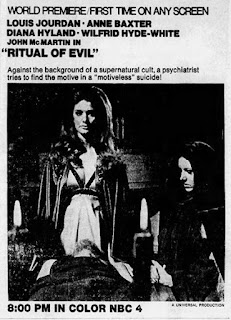
Ritual of Evil (1970)

Ritual of Evil, screened on NBC in 1970, was the second TV movie featuring Louis Jourdan as psychiatrist/occult investigator Dr David Sorell. The original intention had been to make an ongoing series under the title Bedevilled. Unfortunately that series never eventuated. The producer of Fear No Evil was apparently so disappointed that he quit Universal and when the decision to make a second Dr Sorell TV movie David Levinson took over as producer. Ritual of Evil would also have a different writer, Robert Presnell Jr, and a different director, Robert Day.

Ritual of Evil does resemble its predecessor in a number of crucial ways. In both cases there’s an avoidance of horror movie clichés such as monsters, werewolves, vampires, etc. The evil comes from people rashly dabbling in forbidden areas of knowledge. There’s an attempt to make the supernatural elements vaguely plausible and to deal with supernatural subjects in a very contemporary setting.

On a wild night Dr Sorell visits the house of one of his patients. Aline Wylie is twenty-four and she’s a bit of a wild child, and she’s also the heiress to an enormous fortune. Aline doesn’t seem to be home but David sees her aunt Jolene (Anne Baxter). Jolene lives with Aline, and also in the household is Aline’s kid sister Loey. Jolene is drunk as usual, and is muttering something about Walpergis Night.

If we’ve seen the first David Sorell TV movie, the excellent Fear No Evil, then we’re going to find the mention of Walpergis Night rather significant. David Sorell is a psychiatrist but he has an interest in the occult and he takes the occult rather seriously.

The next morning Aline Wylie is dead, an apparent suicide. Loey tells Dr Sorell that it’s all her fault, that she used black magic to kill her sister. Of course teenage girls get crazy ideas like that and nobody takes too much notice, but David Sorell has had personal experience of the results when people try summoning demons so he doesn’t dismiss such ideas lightly.


Loey is now the heiress but until she’s twenty-one Jolene will be her guardian. Loey doesn’t mind that but is she worried about what will happen if Jolene marries the creepy avaricious sleazy no-good Edward (John McMartin).

Everybody connected with this household seems to have disturbing dreams. David Sorell is not convinced that they’re just dreams. He tends to worry when people have dreams about human sacrifices. He’s more worried than ever when someone else connected to the Wylie household, folk singer Larry Richmond, turns up dead.

And then there’s the missing hippie. At least there might be a missing hippie. The sheriff doesn’t think so, but David Sorell not only thinks there is a missing hippie, he thinks there may be a dead missing hippie.


David discusses the matter with Harry Snowden (Wilfred Hyde-White). Harry is David’s mentor when it comes to the occult. It seems likely that there is some kind of demonology at work. There was a wild party at the Wylie house the night before Aline committed suicide but it may have been something more sinister than just a party. It may have been a Black Mass.

Photographer Leila Barton (Diana Hyland) seems to have a growing influence over Loey. Loey had been in the shadow of her more vivacious older sister Aline. Loey is at an awkward stage, starting to become aware of herself as a woman and starting to become aware of men. She’s pretty vulnerable to anyone with a strong enough personality.

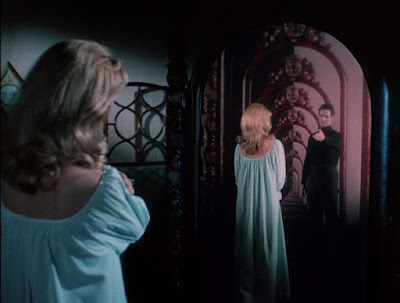
Fear of Evil dealt with a mirror that possessed supernatural powers. Ritual of Evil plays a variation on this theme, with photographs being used to exercise demonic powers. It’s a good idea and it’s utilised skilfully and it gives the movie a contemporary feel - this is evil making use of modern technology.


Louis Jourdan is once again relaxed and likeable and charming as Dr Sorell. Belinda Montgomery does well as Loey, a tricky rôle because of the danger that the character woulds come cross as irritatingly precocious or bratty. Anne Baxter is extremely good as the rather sad Jolene, a woman who can’t quite figure out how her life became so messed up.

Like Fear No Evil this second movie is quite impressive visually for a TV movie, although Robert Day doesn’t quite have Paul Wendkos’s flair. Technically it’s still more ambitious and more polished than most TV movies.

There was a definite erotic subtext to Fear No Evil. In fact it wasn’t even subtext, it was right out there in plain view. There’s an erotic undercurrent in Ritual of Evil as well. Leila appears to have several sexual obsessions going and there’s just the faintest hint that she may have sapphic tendencies. Loey’s disturbing dreams, which are obviously the result of some kind of occult influence, definitely contain major sexual fantasy elements.


I don’t think Ritual of Evil is quite as good as Fear No Evil but it’s still definitely a well above average TV movie with a subtly creepy atmosphere and some decent chills.

Both David Sorell movies come on a single DVD or Blu-Ray disc with both movies getting a very informative Gary Gerani audio commentary. The transfers are excellent. This Kino Lorber double-header can be very highly recommended to fans of subtle atmospheric horror. These two movies are not just good movies by TV movie standards, they’re fine horror films by any standards.

I reviewed Fear No Evil here recently.

Monday, 15 August 2022

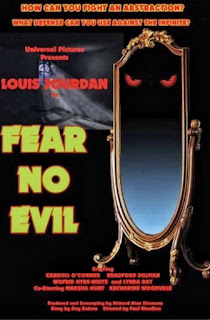
Fear No Evil (1969)

Fear No Evil belongs to the much-despised category of TV movies. So why would a company like Kino Lorber decide that an obscure long-forgotten 1969 TV movie is worth a Blu-Ray release, with an accompanying audio commentary? Have the folks at Kino Lorber taken leave of their senses or is Fear No Evil actually worthy of such treatment? We shall see.

It certainly starts promisingly, with a man fleeing in terror in a darkened building, with some Dutch angles to make it that little bit more disorienting. This opening scene is definitely more striking and more atmospheric in a subtly weird way than we would normally expect in a TV movie.

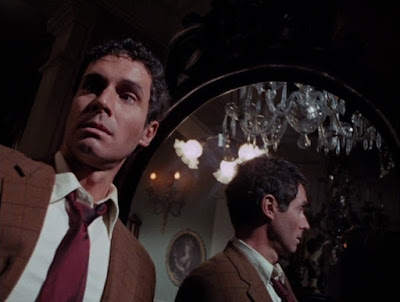
Then we see a man, obviously confused and afraid (and we assume it’s the same man), hammering on the door of an antiques store in the middle of the night. When the proprietor reluctantly lets him in the man buys an ornate full-length mirror. He can see something in that mirror that no-one else can see. Instead of his reflection he can see a man, a rather suave dark-haired man. He sees himself, and yet it’s not himself.

The frightened man is physicist Paul Varney (Bradford Dillman). It’s possible of course that Varney is seeing things because he’s drunk, or because he’s been doing drugs, or because he’s crazy. But he has to buy that mirror.

When the mirror is delivered the next day his girlfriend Barbara (Lynda Day) is not overly impressed.

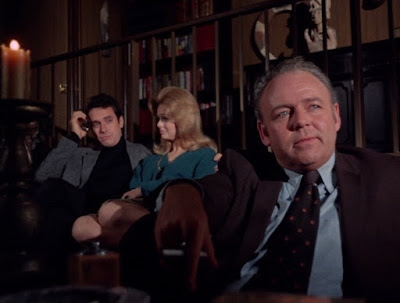
Paul works with Myles Donovan (Carroll O’Connor) and Myles is taking Paul and Barbara to what he hopes will be an amusing party.

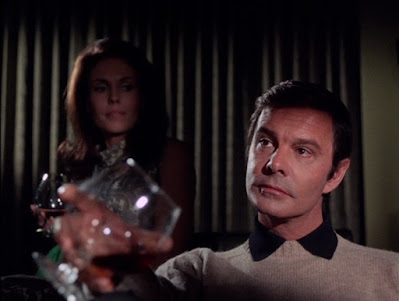
The host is Dr David Sorell (Louis Jourdan), a psychiatrist with an interest in the occult. He developed his interest in the occult as a result of a case a few years earlier, a case he refuses to talk about.


Dr Sorell has fun playing games with his party guests, demonstrating just how superstitious people really are, even people who consider themselves to be totally rational.

Then Paul is killed in an automobile accident. Barbara is devastated. She goes to live with Paul’s mother. Neither woman wants to be alone. Paul’s belongings have been sent to his mother’s house. Including that mirror.

Barbara starts to have some rather disturbing experiences. She sees Paul in the mirror. More than that, she can enter the mirror and touch him.

She decides it might be wise to consult Dr Sorell. She fears she is going mad.

As Dr Sorell soon realises, the problem is that she enjoys these experiences. Whether they are hallucinations, or ghostly manifestations, or paranormal phenomena, or vivid wish-fulfilment fantasies Barbara does not want them to stop. The truth is that experiences are not just emotionally comforting but also erotically gratifying.


Barbara is aware that she may be in some danger, at least as far as her sanity is concerned. But she cannot give up her times with Paul in the mirror.

You expect vampire stories to have an erotic undercurrent but you don’t necessarily expect that in a ghost story. And you don’t expect a 1969 American TV movie to be diving into the world of erotic horror. But this is indeed an erotic horror movie. It’s subtle and low-key, there’s no actual sex and no nudity, but the erotic undercurrent is very obvious and very overt. Dr Sorell even suggests to Barbara that she is merely having very vivid (and somewhat perverse) sexual fantasies.

Of course you could ask if this is actually a ghost story. At first it seems like it might be a ghost story but it soon becomes apparent that it’s not exactly ghosts we’re dealing with. It’s something terrifying and inexplicable.

Of course what we have is a woman who is having strange experiences, and a psychiatrist who believes that the woman is being as honest as she can be about what she experiences but he also feels that it’s possible that she may not have any understanding of what is happening to her. Dr Sorell has no evidence whatsoever that he is dealing with anything other than a delusional woman. So this is one of those horror movies that for most of its running time leaves us uncertain whether we are dealing with the supernatural, or the world of dreams and delusion, or possibly even a sinister plot to send a woman mad.


Eventually the movie will have to commit itself one way or the other but I’m not going to tell you whether the events really are supernatural or not.

We certainly are dealing with people who believe in the occult. At least some of the characters are definite believers. Others are on the fence. Dr David Sorell comes across as a guy who would probably prefer not to believe, but he’s neither a dogmatic believer not a dogmatic non-believer.

Louis Jourdan surprisingly enough did quite a bit of horror work on TV, most notably in the 1977 BBC-TV Count Dracula (in which he was absolutely superb). He’s very good in Fear No Evil, playing a sympathetic character. Carroll O’Connor is solid as Paul’s friend Myles. Lynda Day is extremely good as Barbara - she’s so sweet and innocent and yet at the same time she convinces us that Barbara is a woman of very strong passions, both emotional and sexual. Her passionate nature makes her reluctant to give up her love for Paul, even if he is dead. Wilfred Hyde-White is fun as David's friend and occult expert Harry Snowden.

The special effects are simple but effective and the mirror scenes are particularly well done and spooky.


Director Paul Wendkos worked mostly in television and made countless TV movies. He was clearly more than a hack. In this movie he shows plenty of flair and style. A rather flat lighting style was characteristic of TV (and TV movies) in this period but Wendkos manages some very effective atmosphere. He’s always trying to keep things interesting, and he’s always trying to keep things moving along.

Richard Alan Simmons wrote the screenplay from a story by Guy Endore and it’s a story that has just enough ambiguity to keep us interested without leaving us feeling that we’ve been cheated.

There were plans to produce a series of TV movies, with the working title of Bedevilled, with Dr David Sorell dealing with psychiatric cases involving hints of the occult, the supernatural or the paranormal. In fact a second movie, Ritual of Evil, was made and the Kino Lorber release includes both Fear No Evil and Ritual of Evil. Bedevilled could have been extremely interesting since Fear No Evil makes it clear that the intention was to avoid monsters and concentrate on psychological and existential horror.

The audio commentary is by Gary Gerani (who always does lively commentaries).

So I can now answer the question I posed at the beginning. No, the folks at Kino Lorber haven’t gone nuts. Fear No Evil really is good enough to justify a fancy Blu-Ray release. It’s a very cool low-key horror gem and it’s highly recommended.

Thursday, 4 October 2018

Knight Rider 2000 TV-movie (1991)

The 1991 TV-movie Knight Rider 2000 was shot as the pilot for what was hoped would be a new series based (albeit a little loosely) on the 1980s hit series Knight Rider. Knight Rider 2000 failed to capture anyone’s imagination, it was not picked up as a series and it seems to be generally disliked by fans of the original Knight Rider series.

Despite this it does have some limited interest for cult movie fans and it is a bit more overtly science fictional than the original television series, with a futuristic rather than a contemporary setting.

For what it's worth here’s the link to my review of Knight Rider 2000 at Cult TV Lounge.

Thursday, 9 August 2018

Time Travelers (TV-movie, 1976)

Time Travelers is pretty unusual - you don't get many collaborations between Irwin Allen and Rod Serling. It’s a TV-movie that was actually made in 1976 as a pilot for a projected Irwin Allen television series that never eventuated.

What's most surprising about this production is that it's actually quite a decent (and even moderately intelligent) science fiction movie.

Here's the link to my review on Cult TV Lounge.

Sunday, 19 January 2014

Schalcken the Painter (1979)

The paintings of real-life Dutch artist Godfried Schalcken (1643-1706) inspired Joseph Sheridan le Fanu (possibly the greatest of all 19th century writers of gothic fiction) to write his 1839 gothic tale A Strange Event in the Life of Schalken the Painter. This tale was adapted by Leslie Megahey in a TV movie, with the title Schalcken the Painter, which was screened in the BBC’s arts program Omnibus in 1979.

As the movie opens Schalcken (Jeremy Clyde) is a pupil of the Dutch master Gerrit Dou (Maurice Denham). He is rather promising and seems destined for a successful career but at the moment he is still a poor pupil, certainly in no financial position to ask for the hand of  Dou’s niece Rose (Cheryl Kennedy) with whom he is in love. Rose reciprocates his love but a sudden visit to Dou’s home by a mysterious stranger seals the fate of their hopeless love. This stranger claims to a certain Vanderhausen from Rotterdam and he brings with him a casket laden with a fortune in gold. He asks, or rather demands, Rose’s hand in marriage. Vanderhausen isn’t merely old and ugly - he looks almost like a walking corpse. But his riches are enough to induce Dou to accede to his demand. Rose is to be married to Vanderhausen.

Rose begs Schalcken to save her from the terrifying prospect of this marriage but while Schalcken certainly loves her he is too ambitious to renounce any prospect of a successful career as a painter by alienating Dou. The unfortunate Rose is married to Vanderhausen who takes her off to Rotterdam.

After her marriage nothing further is heard of her. At one time Dou, worried by the lack of letters or any other contact from his niece, had sent Schalcken to Rotterdam to find her. But nobody in that city has heard of her, or of Vanderhausen for that matter. It is as if she has vanished into the air.


The years pass. Schalcken devotes himself to his career and has soon established himself as a highly sought-after painter whose fame eclipses that of his old teacher Dou. Schalcken marries. It is in practical terms a good match but there is clearly no great passion or even affection involved. Schalcken had already made his choice between love and fame and his single-minded pursuit of success has left him without the time, the energy or the inclination for the kind of love he might have had with Rose.

Schalcken will eventually encounter Rose again, in very peculiar and disturbing circumstances. And Schalcken will have a very disturbing experience of his own in the crypt of a church. This experience may perhaps be a vision, a waking nightmare, or an encounter with the supernatural. The film makes no attempt to clarify the nature of the event, a decision that makes the event all the more unsettling.


Even with its modest 68-minute running time Schalcken the Painter is somewhat slow and while there are hints of what is to come the actual horror does not kick in until the very end, and when it does kick in it’s horror of a very subtle kind. The leisurely pacing works in its favour, largely because this is a TV movie that is very atmospheric indeed.

This is a good story, but more interesting than the story itself is the way it is told. It is a movie about a 17th century Dutch painter and the movie looks like a 17th century Dutch painting. Writer-director Leslie Megahey, cinematographer John Hooper and production designer Anna Ridley immersed themselves thoroughly in 17th century Dutch art with the aim of reproducing this look in the entire production. They clearly took particular note of Vermeer’s work - so many scenes in this movie look astonishingly like Vermeer paintings. And they have captured the essential stillness of Dutch art of this period. They have also reproduced the sense of composition in depth of such paintings, with figures in the background framed by doorways. They have avoided the most glaring faults of most television costume dramas - too much lighting and too vivid colours. This is a visually beautiful film but it is beautiful in a restrained manner.


A sense of eroticism runs throughout the movie, but it is always a suppressed eroticism. The conflict between the indiscipline of romantic love and the rigid discipline required for artistic achievement, the conflict between the selflessness of love and the necessary selfishness of artistic obsession, the conflict between art and commerce, all these elements are clearly present but this film does not try to bludgeon the viewer with these themes. It makes those points but it does so with restraint. Restraint is the keynote, just as restraint was the keynote of 17th century Dutch art.

Schalcken was famous for his ability to reproduce the effects of candle light, and the movie  endeavours, very successfully, to reproduce these effects. Most scenes really do look like they were filmed by candle light. They probably were not, but they succeed in looking that way. Schalcken the Painter may have been a TV movie but it looks more like a feature film although at the same time it takes advantage of the greater intimacy of television. It was an ambitious project and it looks a good deal more expensive that it was.

The acting is also restrained, but is at the same time deliberately somewhat artificial. Paintings are scenes that have been staged and it is appropriate that the film has a slightly staged feel to it. Jeremy Clyde is particularly impressive, giving a performance that hints at inner anguish rigidly suppressed.


Schalcken the Painter has been released as a Blu-Ray/DVD combo by the BFI in its Flipside series and it has to be said that it’s far more interesting than most of their releases. The picture is quite grainy but it seems quite likely that this was a deliberate artistic choice rather than a fault in either the source material or the transfer. Aside from this picture quality is extremely good with excellent contrast (a very important factor given the style of the photography). Sound quality is fine.

Schalcken the Painter is a bold attempt to make a TV movie that works as both a horror movie and an art movie, and for the most part it succeeds admirably. It provides intelligent entertainment and a viewer can hardly ask for more than that. This is one of the forgotten treasures of the golden age of British television. Highly recommended.

Friday, 12 July 2013

Sweeney Todd (1970, TV)

Sweeney Todd was screened on British television in 1970 as part of the final season of the Mystery and Imagination series.

This feature-length production starts out as a rather promising version of the classic tale (which had been published in 1850 as a  “penny dreadful”). Like most British of this period it’s very studio-bound but that’s more of an asset than a liability - creating a gothic kind of atmosphere tends to be easier in a studio. And given that the budget was obviously much smaller than would be usual for a feature film it’s a reasonably handsome production.

The tale of course involves a barber who murders his customers whose bodies then end up being served to the patrons of Mrs Lovett’s pie shop. The barber, Sweeney Todd, steals an extremely valuable string of pearls from one of his unfortunate customers. This will eventually be his undoing.

Sweeney Todd has a young apprentice named Tobias. Sweeney’s apprentices also tend to meet with unfortunate fates, ending up in a lunatic asylum which is in reality a death factory. Tobias will not last long. He will be succeeded by another apprentice named Charlie, who will play a key role in the plot.

Freddie Jones makes a suitably sinister Sweeney Tood. Russell Hunter (best known to fans of British television of this era as Lonely in the excellent Callan series) steals the picture, playing several very creepy doctors including the villainous director of the previously mentioned asylum. Sweeney Todd is classic melodrama and melodrama requires a larger-than-life villain. Russell Hunter is so good that he actually outshines the star.

The rest of the supporting cast do reasonably well, although Mel Martin isn’t going to fool anybody into thinking she’s a boy, which rather weakens the plot.

Compared to other screen versions of the story this one adds some very blatant sexual perversity. I’m not really sure this element is entirely appropriate to this type of melodrama.

Things go reasonably well until the ending, which I found to be very unsatisfactory indeed. I won’t give any hints as to what happens but it is the kind of ending that I always find to be irritating to an extreme.

On the plus side this production does deliver some real chills, although these are mostly provided by Dr Fogg’s lunatic asylum rather than Sweeney Todd himself.

Sweeney Todd is worth seeing for the performances of Freddie Jones and Russell Hunter, but apart from that it’s difficult to recommend this one.

The definitive screen version of the story of Sweeney Todd the Demon Barber remains the 1936 British movie with Tod Slaughter in the title role.


Monday, 8 July 2013

Mystery and Imagination (1966 TV series)

I’ve now watched the two surviving episodes of the original run of the Mystery and Imagination series made by ABC Television in Britain between 1966 and 1968.

The six episodes made by Thames TV from late 1968 to 1970 all survive but sadly most of the ABC episodes perished in the great British videotape holocaust of the early 70s when just about everything that had been made in black-and-white was destroyed.

The two surviving ABC episodes both date from 1966 - The Open Door (based on a story by Mrs Oliphant) and The Fall of the House of Usher (based rather loosely on the Edgar Allan Poe story).

For some unknown reason the producers at ABC decided to have a continuing character in the first three seasons, a young man by the name of Richard Beckett (played by David Buck). He seems to me to serve little purpose but he also seems to do little harm. It appears that in some episodes he became directly involved in the story (as he does in The Fall of the House of Usher) while in others he acted as little more than an introducer (as he does in The Open Door).

The Open Door is a classic ghost story with a Scottish setting. A young boy is disturbed at night by the sound of a child wailing and screaming to be let in. But of course no such child can be found. The father of the boy who hears the screaming ventures into the old ruined house nearby and hears the voice as well. Even the sceptical local doctor hears the voice.

Jack Hawkins plays the father. By this time he could no longer speak and all his dialogue had to be dubbed. The wonderful Scottish character actor John Laurie is delightful as the local minister who is called upon to exorcise the presumed ghost.

The Fall of the House of Usher takes some liberties with Poe’s story although it’s reasonably faithful to the spirit of his writing. Richard Beckett, who is about to be married, meets a young woman, the sister of an old college chum. Madeleine Usher is beautiful, a fact he notices at once. She is also clearly quite quite mad, a fact he singularly fails to notice.

Richard persuades his wife-to-be, Lucy, to befriend Madeleine. This proves to be a slightly unfortunate decision. Richard arrives at Roderick Usher’s house to find that his old friend is scarcely recognisable, his hair turned completely white. The atmosphere of the house is ominous indeed, the house itself making ghastly creaking noises as the unstable foundation settles. The behaviour of Madeleine and Roderick is not reassuring. Roderick tells Richard that neither he nor his sister may ever marry, madness being the sure inheritance of the Usher family. We are inclined to believe Roderick on this point. Roderick is worrying enough but Madeleine seems like she might be the more dangerous of the two.

Susannah York, one of my favourite actresses, plays Madeleine Usher. Roderick Usher is played by Denholm Elliott. With these two fine performers cheerfully and enthusiastically chewing the scenery poor David Buck is rather overwhelmed. He’s distinctly out of their league.

Despite the studio-bound feel that is common to most classic 1960s British television these two episodes manage to conjure up a fairly impressive gothic atmosphere. In fact, as was often the case with the best British television of that era, the studio-bound feel becomes more of an asset than a liability. It presented a challenge to everyone involved, from the set designers to the directors, and it was a challenge that often brought out the best in people. The gothic is particularly suited to black-and-white productions shot entirely in the studio, lending such productions a decidedly other-worldly feel.

With great stories to work with and some truly superb actors the results are impressive, making the loss of the other sixteen episodes even more of a tragedy.

Monday, 10 June 2013

Mystery and Imagination - The Suicide Club

The Suicide Club was one of the late episodes of the British gothic horror anthology television series Mystery and Imagination. This episode was broadcast in 1970. It is a feature-length adaptation of three connected short stories by Robert Louis Stevenson.

Stevenson’s original idea was delightfully twisted and this adaptation captures that perverse quality extremely well. A bored Bohemian prince, Prince Florizel (Alan Dobie) wanders London at night in disguise, looking for the sorts of adventures that will appeal to his jaded tastes. Accompanied by his faithful Master of the Horse (Colonel Geraldyne, played by Eric Woofe) he finds an adventure that is too rich even for his blood.

The Suicide Club is a club for those who have grown weary of life and who lack even the energy to end their lives themselves. Each Friday night the cards are dealt at the club. Whoever draws the ace of spades is destined to be that week’s victim while the man who draws the ace of clubs will be his executioner. It’s the sort of Russian roulette that appeals to those who wish to end their existences in the most dissipated and decadent manner possible.

Prince Florizel has his suspicions that the Suicide Club may be even more sinister that it appears to be. The President of the club (Bernard Archard) and his beautiful, mysterious and creepily cold assistant (played by Hildegard Neil) may be playing a game of their own, a very profitable if very cold-blooded game.

In order to gain admittance to the club Prince Florizel had to sign the articles of membership. As a man of honour he will have to settle matters on his own account without any assistance from the police. The prince is a man of courage and of intelligence and he will be a formidable adversary, but the President of the club is also a very dangerous man.

The period detail is done well, as you expect from British television of this era. The club rooms of the Suicide Club are the right mixture of decadence and gothic excess.

Alan Dobie makes a fine hero and the role gives him the opportunity to indulge himself in some rather theatrical but very effective acting. Bernard Archard and Hildegard Neil play their roles to the hilt.

A fine adaptation of one of the perverse classics of gothic literature.

Saturday, 8 June 2013

Mystery and Imagination - Frankenstein

Mystery and Imagination was a gothic horror anthology series broadcast on British television from 1966 to 1970. Each episode was based on a classic work of gothic fiction. Sadly only eight of the original twenty-four episodes survive and these have now been released on DVD by Network DVD. One of the more interesting of the surviving episodes is the feature-length adaptation of Frankenstein.

The early episodes were made by ABC. After their forced merger with Rediffusion the later seasons, with some major format changes, came out under the Thames TV banner. Frankenstein, first broadcast in 1968,  belongs to this later period.

The intention was clearly to produce an adaptation of the novel that was closer to both the letter and the spirit of Mary Shelley’s novel. In this it succeeds reasonably well. This version makes use of one clever trick that had surprisingly not been tried in previous screen versions. I won’t reveal the trick as it does constitute a minor spoiler.

Ian Holm was always a fairly reliable actor and he does well in the title role. The supporting cast is solid with Richard Vernon being memorable as a crusty old professor of anatomy.

Obviously the producers didn’t have the kind of budget to play with that most film versions of the story have had but they still do a fine job of evoking the gothic atmosphere and the crucial bringing-the-monster-to-life scene works well. Frankenstein’s laboratory is less spectacular than in most Frankenstein movies but still looks reasonably impressive.

This TV version puts more emphasis on Dr Frankenstein’s conscious efforts to emulate a God he professes not to believe in, and in this respect is probably closer to Mary Shelley’s intentions than most movie versions. Mary Shelley’s father was a socialist agitator, her mother was an nearly feminist and her husband a strident and aggressive atheist. In spite of all this, or more probably because of these things, Mary Shelley was rather sceptical of our ability to dispense with God.

This Frankenstein focuses to a large extent on Dr Frankenstein’s responsibility towards his creature, and the psychological horror of his guilt over his creation. This is in general a much more psychological approach than has been taken in any film version.

Although Ian Holm was nearly forty when the program was made his Dr Frankenstein seems in many ways to be a very young man. His arrogance comes across as being partly at least the arrogance of youth, which makes his actions perhaps slightly more forgivable.

On the downside this TV version is rather talky, which is perhaps inevitable in a TV production that can’t rely as heavily on visual images as a movie would. Ian Holm at times gives the impression that he’s giving a stage performance.

An interesting Frankenstein adaptation and worth a look.