Showing posts with label lesbian vampires. Show all posts

Sunday, 5 April 2026

Female Vampire (1973)

Jess Franco’s Female Vampire, released in 1973, presents a few problems for a reviewer. It’s one of his most famous films, it’s enthusiastically admired by most (although not all) of his fans and it’s one of my favourites among his films. It is also very extreme in a number of ways. If you’re new to the world of Jess Franco this is most definitely not the movie with which you should start. This one is for advanced students only.

This was a Franco-Belgian co-production and it not only exists in several radically different cuts, it was intended right from the start to be released in several very different versions. It’s not just a matter of different titles. These versions are so different as to almost constitute separate films. The version that matters is the French cut with the title La comtesse noire and in English-speaking markets entitled Female Vampire.

Franco had already eliminated most of the established vampire lore in Vampyros Lesbos, stripping the vampire myth down to its essential. It features a vampire who is an immortal creature who feeds on human blood and uses hypnotic powers to ensnare her victims. With Female Vampire Franco goes further. This vampire kills by draining the victim’s life force during sex. This is a reasonable idea given that vampirism has always been about sex. Franco just makes this explicit.


There is a plot but it’s minimalist to say the least. The Countess Irina Karlstein (Lina Romay) is a vampire, the last of her family line of vampires.

She does not want to kill but she must. She must kill to survive, and to satisfy her erotic cravings. She cannot stop herself. She is trapped. Having disposed of several recent victims she falls in love with a poet, Baron Von Rathony (Jack Taylor). She has no desire to kill him but she cannot see a way of avoiding doing so. That’s it for the plot.

But this is not a plot-driven movie - it’s all about mood and about the forces driving Irina.

This is not one of those Franco movies in which dreams and reality intersect, but Irina goes through her life in a kind of trance state. The forces that drive her allow her to have little awareness of anything else. She is entirely disconnected from human society (her muteness emphasises this).


Irina’s only connection with people is through her seduction and then destruction of them. Part of her tragedy is that she craves real emotional connections. There is still enough human-ness in her, enough of the woman, that she craves love but when she finds love with a man can she love him without destroying him?

Now for the extreme elements I mentioned earlier. These have nothing to do with violence. There is no gore. We not see a drop of blood. There is however a lot of quite explicit sex and an immense amount of very explicit nudity. These do serve a purpose. Irina is overwhelmed by her desires. There is the need to hunt. She hates doing so but it’s a matter of survival. And there are her uncontrollable erotic desires. The hunger for the life forces that she must devour and the hunger for sex occupy her every waking moment.

She seduces her victims by means of hypnotic powers so that they are similarly consumed by desire for her. The nudity emphasises that Irina is unaware of anything other than her physical cravings. The nudity does get the point across.


There is also the stylistic excess. The emphasis is all on mood. It does not in any way look or feel like a movie that is interested in reflecting straightforward reality.

While there is no sense that we are simply watching a dream Irina is so cut off from human society that her existence has a slightly dream-like quality. She is aware of her alienation from human society and from everyday reality. And the movie does have a misty dream-like non-real ambience. We’re seeing things from Irina’s point of view. Which means we’re not seeing things from a human point of view. Franco obviously wants us to feel that this is not quite reality in a straightforward way.

If we saw the world from the point of view of a leopard it would not look like our concept of reality and I don’t think any movie has more effectively conveyed the idea of the vampire as a predator driven entirely by instinct. But with the complication that she has a kind of dual nature, a vampire nature and a woman’s nature.


While La comtesse noire is a more interesting title perhaps Female Vampire is not such a bad title - she is a very female vampire.

There’s plenty of symbolism - the kite, lots of birds, the flapping bird hood ornament on Irina’s car, mist, etc. It’s not complex symbolism but it works.

La comtesse noire is even further removed from our conventional expectations of the vampire movie than Vampyros Lesbos. It’s closer in feel than any of Franco’s other movies to Jean Rollin’s vampire fever dreams. I love this movie but it is an uncompromisingly unconventional vampire movie. If you can accept that and if you’re not put off by a blending of extreme eroticism and artiness then it’s highly recommended.

Monday, 23 March 2026

Vampyros Lesbos (1970)

If you’re a eurocult fan you’ve seen Jess Franco’s Vampyros Lesbos. And given that it was one of the first Jess Franco movies to be available on DVD way back early in the DVD era, and one of the first European erotic horror movies available on DVD at that time. There’s a good chance that this movie was your first exposure to Franco’s cinematic world. It was my first Franco movie and my first European erotic horror movie.

So it’s easy to take it for granted. But watching it now for the first time in many years I’m struck by just how startling it must have been at the time. That opening sequence! This is not how you begin a vampire movie. First off we know that we are not in central Europe or England in the 19th century. We are in Turkey. And the setting is contemporary.

The avant-garde music is most emphatically not what you expect in a vampire movie.

The erotic elements are also there front and centre right from the start. We get frontal nudity 60 seconds into the movie.

And then we find we are watching a night-club act. Of course there’s an erotic night-club act in most of Franco’s movies but in 1970 it wasn’t standard practice in horror movies.


And we are in seriously arty territory. This was the most arty period in Franco’s career. Necronomicon - Geträumte Sünden (AKA Succubus, 1968) is full-blown surrealism with wild narrative experiments. This was a movie that numbered Fritz Lang among its admirers. Paroxismus (AKA Venus in Furs, 1969) is equally avant-garde. At this time Franco had reasonably serious art-house credentials.

It’s so long since I last saw this movie that I had forgotten that unlike most lesbian vampire movies this is not an adaptation of Sheridan le Fanu’s Carmilla. It’s an adaptation of Bram Stoker’s Dracula. And while there are some changes it is very recognisably and very consciously an adaptation of Dracula, at least to begin with.

Linda Westinghouse (Ewa Strömberg) works in a lawyer’s office. She is sent on a journey to the remote home of a Hungarian countess, Countess Nadine Carody (Soledad Miranda), who needs some legal document attended to. The Countess is a vampire. In fact the legal documents relate to an estate left to her by Count Dracula. So Linda at this stage is clearly a stand-in for Jonathan Harker. The Countess begins her seduction of Linda, at which point Linda obviously becomes a stand-in for Lucy Westenra (or Mina Harker).


Linda ends up in the care of Dr Seward (Dennis Price) who is clearly a combination of Dr Seward and Van Helsing. Dr Seward his under his care a mad girl named Agra (Heidrun Kussin) who is obsessed with the Countess Carody. Agra is obviously the Renfield character.

At this time period European directors like Harry Kümel (in Daughters of Darkness), José Larraz (in Vampyres) and Jean Rollin (in movies like The Nude Vampire and Shiver of the Vampire) were radically reinventing the vampire movie. Franco appears to be doing that as well but he isn’t really. He is drastically streamlining the vampire myth, jettisoning the non-essential elements of vampire, but he isn’t going to throw the baby out with the bathwater. The Countess Carody does not sleep in a coffin, she lives in a modernist beach house rather than a castle, she has no feelings one way or the other about garlic and she adores sunbathing.


But all the essential elements are there. She is an immortal creature who feeds on human blood. She has hypnotic powers. She is quite unequivocally a vampire.

So we have major elements of Stoker’s novel established and then Franco starts playing around with them. This is a movie of stylistic excess and as with Succubus the more we see the more we feel that maybe we’re moving in a dreamscape. And we get more touches of surrealism. We know we’re dealing with dreams part of the time. That’s made explicit. But where do the dreams end and where does reality start? And Franco included cool cabaret scenes not just because they were cool. They emphasise that we’re watching a performance. We’re watching the Countess playing a vampire on stage.

Soledad Miranda is mesmerising. She dominates the movie from start to finish.


There are no shadows, no night scenes. Everything is bathed in glorious sunshine. That’s ow Nadine likes it. A girl has to work on her tan, even if she is a vampire. Franco is going out of his way to avoid gothic horror clichés. But it doesn’t feel gimmicky. Soledad Miranda actually has the ability to convince us that she really is a sun-worshipping vampire. This movie is also a great example of Franco’s genius for finding strange but perfect locations.

Vampyros Lesbos is one of the most important movies in Franco’s filmography. This is Franco at his best. Very highly recommended.

The Severin Blu-Ray offers the German cut, Franco’s preferred cut. The Spanish cut was apparently quite different. The most important extra is a perceptive video essay by Stephen Thrower.

Monday, 22 December 2025

Shiver of the Vampires (1971)

Shiver of the Vampires (Le frisson des vampires) was Jean Rollin’s third feature film. By this time he had definitely found his voice as a filmmaker.

If you’re unfamiliar with Rollin it’s as well to know that there is nothing conventional about his movies. If you’ve heard that he was a maker of erotic gothic horror movies or erotic vampire movies you will find that this is somewhat true but his movies are not like other people’s erotic vampire movies. Shiver of the Vampires is a very very different beast compared to Hammer’s The Vampire Lovers or Harry Kümel’s Daughters of Darkness or even José Larraz’s Vampyres or Jess Franco’s Vampyros Lesbos and Female Vampire. Those are all excellent movies that in various ways redefined the vampire movie but Shiver of the Vampires is much stranger.

It is an erotic vampire movie and it is an exploitation movie but it’s also an art film and an exercise in cinematic surrealism. The term surrealist is ludicrously overused but Rollin was the real deal. He was a full-blown surrealist, hugely influenced by surrealist painters such as Paul Delvaux and Clovis Trouille.

Shiver of the Vampires is uncompromisingly surrealist and uncompromisingly arty and it’s uncompromisingly a commercially oriented exploitation movie. Rollin wanted his movies to be commercially successful.

Isle (Sandra Julien) and Antoine (Jean-Marie Durand) are a young newly married couple. They’re heading to a semi-ruined chateau to visit Isle’s two male cousins who are her only living relatives. They arrive to discover that the cousins died a couple of days earlier.


The principal location used was the keep of the 14th century Château de Septmonts in Aisne. The keep is all that remains of the chateau. It’s an extraordinary location and Rollin wanted the chateau itself to be a character in the movie. It is in a sense alive. It influences all the characters. Although Isle and Antoine are madly in love and this is their wedding night (she is still wearing her bridal gown) she does not want to make love with her bridegroom. At this early stage of the story the chateau is already exerting its influence on Isle. It is claiming her.

The cousins reappear. They are not dead after all. Isle and Antoine are surprised but of course we, the viewers, are now suspecting that they are vampires. Perhaps they are, although later we discover that they were at one time vampire hunters. And another vampire, Isolde (Dominique) will soon make her appearance in one of the many dazzling minor visual set-pieces of the film. Isolde takes a keen interest in Isle.


Like many of Rollin’s films this is often regarded as a lesbian vampire story but that is slightly misleading. In Rollin’s films there are links and bonds and attractions between female characters but it is an over-simplification to see these in terms of lesbianism. Rollin describes this movie as a magical love story and the eroticism is indeed more magical than physical. There may be a physical side to it but it’s not physical desire that drives the story.

The connections between the characters between Isolde and the two cousins and between Isolde and Isle are inherently mysterious. The family history is complex. And the vampires here have mysterious origins. The cousins talk about ancient religious cults and conflicts between those cults and the Catholic Church.

There is also no clear-cut good vs evil conflict. Rollin’s vampires were rarely evil in any straightforward way.


And of course in a Rollin movie there is always a point at which we become aware that we are no longer in the world of reality in the sense that we usually understand reality. We may be in the world of myth or the world of dream. Perhaps those worlds are just different realities. In his late vampire movies, the superb Two Orphan Vampires (1997) and Dracula's Fiancee (2002), Rollin creates elaborate alternative mythologies. And in Two Orphan Vampires we are in a storybook world the reality of which is incredibly ambiguous.

Rollin had an overwhelming love for the pop culture of the past and his strange cinematic worlds draw heavily on such influences. In this case he is very deliberately homaging the amazing silent serials of Louis Feuillade, in particular Les Vampires (1915). For Rollin fictional worlds had their own reality.

Shiver of the Vampires is unusual among Rollin’s films for its fascination with hippie culture and the counter-culture in general. It was shot in 1970, a year after Woodstock. This was the high tide of hippiedom.


Rollin tells us in his audio commentary that he wanted to have something bizarre in every single shot. Trying to find a straightforward meaning in his films is a fool’s errand. It’s like trying to find a single coherent meaning in dream or a myth.

When Rollin is discussed it’s perhaps surprising that David Lynch doesn’t get mentioned. Very different filmmakers but with a few striking affinities. Those “I don’t think we’re in Kansas anymore” moments in Lynch movies such as Blue Velvet serve the same purpose as similar moments in Rollin’s movies - opening a portal between everyday reality and another world in which reality has been subtly distorted.

Shiver of the Vampires is one of Rollin’s best and most characteristic movies. Very highly recommended.

Monday, 15 December 2025

The Velvet Vampire (1971)

The Velvet Vampire was made for Roger Corman’s New World Pictures in 1971. It was directed by Stephanie Rothman.

This was a time when filmmakers in many different countries were totally redefining the vampire movie. The period between 1969 and 1974 saw the release of Harry Kümel’s Daughters of Darkness, José Larraz’s Vampyres, Jess Franco’s Vampyros Lesbos and Female Vampire, Michio Yamamoto’s The Vampire Doll and Jean Rollin’s The Nude Vampire. Huge chunks of traditional vampire lore were discarded. These were vampire movies in contemporary settings and these were vampires for the 70s.

The Velvet Vampire was very much part of this trend.

Lee Ritter (Michael Blodgett) and his wife Susan Ritter (Sherry Miles) meet the glamorous but strange Diane LeFanu (Celeste Yarnall) at an art gallery. Lee is clearly besotted. Diane invites the couple to her house in the desert.

The Ritters’ car breaks down so they’re stuck at Diane’s house for several days. Diane seduces Lee. Susan has disturbing dreams.


Susan isn’t the sharpest knife in the drawer but she knows when another woman is trying to steal her man.

For more than a century there have been strange unexplained disappearances in the area. Lee and Susan should be more worried by this than they are. There are clues that there is something odd about Diane but they don’t connect the dots.

This is not likely to end well for the young couple.

The acting is generally terrible. Celeste Yarnall can’t act but she does look like a spooky mysterious sexy lady vampire and she gives off the right sinister seductive but creepy vibes.


Anyone seeing The Velvet Vampire at the time (or today) who was unfamiliar with European horror would have seen it as revolutionary and groundbreaking. Anyone actually familiar with European horror would have noticed that every single groundbreaking element in The Velvet Vampire is found in Jess Franco’s Vampyros Lesbos (made a year earlier) apart from from a few ideas that are found in Jean Rollin’s The Nude Vampire (also made a year earlier). And a few ideas that appeared in Harry Kümel’s Daughters of Darkness.

Vampires who love the sun, vampires who enjoy lazing by the swimming pool, a vampire movie that eschews darkness and gothic trappings in favour of bright sunshine, vampirism as a blood disease. Even the symbolism - the scene with the rattlesnake is reminiscent of the scene with the scorpion in Vampyros Lesbos. And Franco and Rollin had already made vampire movies with dream imagery.


The best thing about this movie is that Diane is not an exiled European noblewoman - she’s an all-American girl. In some scenes, with her hat and boots, she looks a bit like a vampire cowgirl.

Finding good locations is crucial in low-budget filmmaking and in this case the locations are good. Not just the mansion in the desert but the abandoned mine and the ghost town. They could however have been used with a bit more flair and imagination.

The dream sequence with the bed and the mirror in the middle of desert achieves a nicely subtle surreal feel. It’s definitely the high point of the movie.


There’s a reason that Stephanie Rothman did not go on to a glittering career as a director. She was a terrible director. She fails to achieve the necessary feeling of menace. Everything about this movie is stilted and stiff, amateurish and rather dull.

This was a rare flop for Roger Corman. It did poorly at the box office and critics were scathing.

The Velvet Vampire seriously fails to live up to its potential. At best it’s an oddity. Maybe worth a look if you’re a vampire movie completist.

The Shout! Factory DVD offers a very good 16:9 enhanced transfer, with a few extras.

Thursday, 31 March 2022

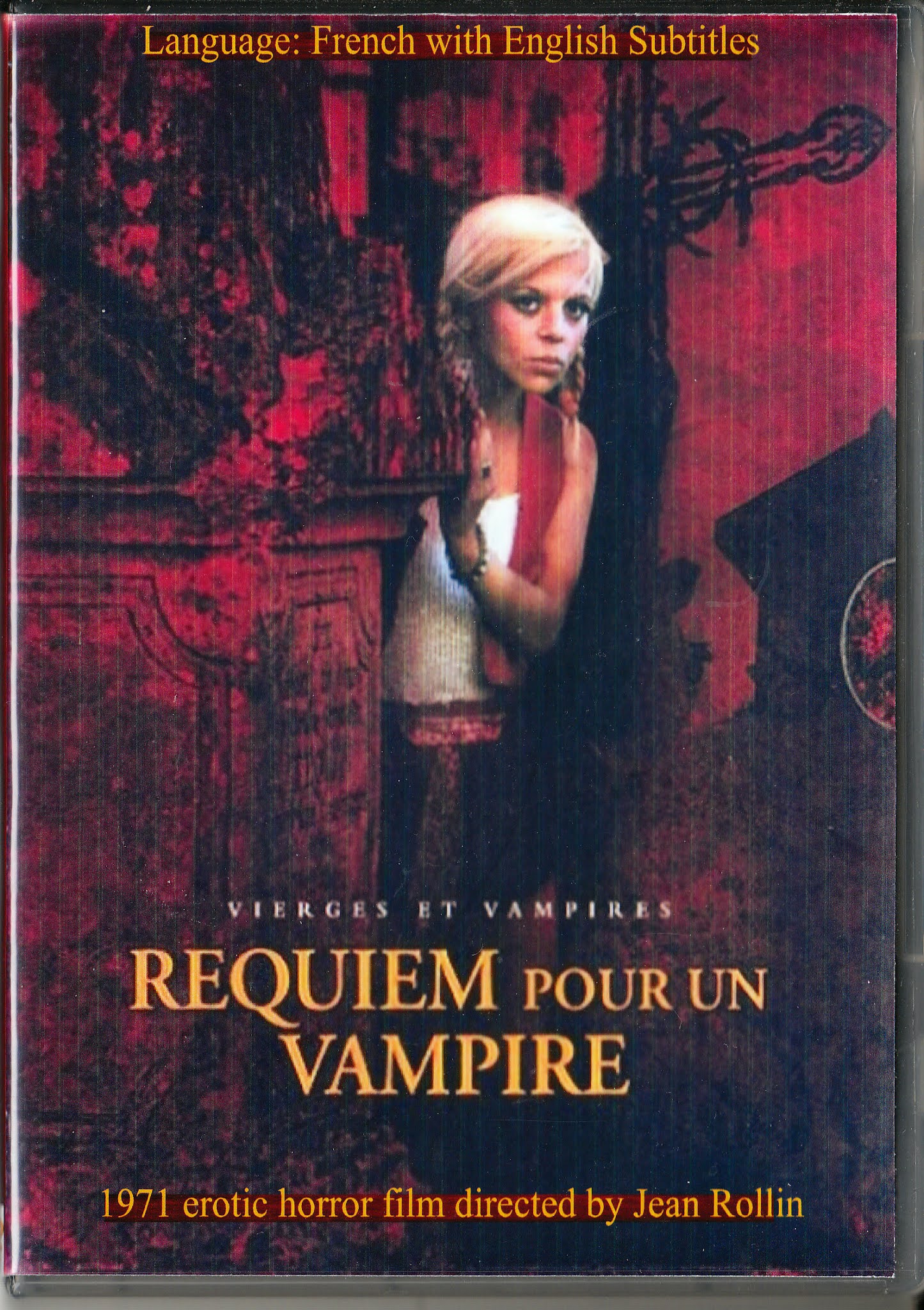
Requiem for a Vampire (1971), Blu-Ray review

Requiem for a Vampire was Jean Rollin’s fourth completed feature film and of all his films this was his personal favourite. It’s been released at various times under ten different titles, including (in the US) Caged Virgins!

This was the first Rollin movie I ever saw, many years ago, and it made me an immediate Rollin fan. I’m now the proud owner of a copy of the Redemption Blu-Ray release so it’s time to take another look at this movie.

It opens with one of the many extraordinary iconic images that Rollin offered us over the years (other that come to mind are Brigitte Lahaie with the scythe in Fascination, the vampires coming out of the clock in Shiver of the Vampires and numerous images in The Iron Rose). Two girls dressed as clowns are making their getaway in a car after an armed robbery. Their driver doesn’t make it and the girls set off on foot.

Why are the girls dressed as clowns? That’s simple. This is a Jean Rollin film and Rollin was first and foremost a surrealist. If you explain a surrealist image it loses its magic.

The girls are Marie (Marie-Pierre Castel) and Michelle (Mireille Dargent). They are lesbians. So far we have clowns, doubles and lesbians, and vampires are about to make their appearance, so you know this is definitely a Jean Rollin film.


The girls steal a motorcycle and end up at the château. The château is inhabited by vampires, or at least by one vampire and his followers. He is the last vampire, but his followers hope to become vampires. Erika (Dominique) has already grown fangs.

The girls are not held prisoner, except that they are in reality prisoners. They can leave the château but no matter which road they take it will always lead them back to the château.

The vampires have a kind of larder in the dungeon - a number of young women chained up who serve as a food supply. They also provide sexual entertainment for the vampires’s male followers. Whether these young women are innocent victims or willing participants in the perversity is left rather ambiguous.


Marie and Michelle are not to serve as vampire food. They are to be initiated which will begin their transformation into vampires. There is one slight problem, the vital question of whether or not the girls are virgins. They are in fact virgins but turning a virgin into a non-virgin is not a difficult task. In fact Marie approaches it with enthusiasm.

Michelle seems to like the idea of becoming a vampire. Marie isn’t so sure. The girls are supposed to lure victims back to the château but Marie decides that the man she’s trying to ensnare is kind of cute and rather nice. This will lead to trouble.

If I’ve given you the impression that this movie has a straightforward linear narrative then I apologise. Early Rollin vampire movies such as this one do not bother overmuch with conventional narrative. Rollin simply serves us up a succession of striking images, and the images are enough to make the film worthwhile. Louise (one of the vampire’s acolytes) playing the piano in the graveyard is one such image (and it was apparently the image that Rollin came up with first and from which he built the entire film).


One thing that is sometimes overlooked is that Rollin had a great fondness for movie serials, both the French serials of the early 20th century and even more especially for American movie serials of the 30s and 40s. These movie serials had a major influence on the way Rollin structured his narratives. Some of the outrageous elements in the plot of Requiem for a Vampire are inspired more by the delirious fun of movie serials than by artiness.

This movie is a good example of Rollin’s attempts at this stage of his career to combine the surrealist artiness which he loved with commercial exploitation elements. And there are enough exploitation elements to keep any exploitation fan happy - there’s copious female frontal nudity, bondage and plenty of sadomasochism. The scene with the presumably vampiric bat apparently feeding between a naked girl’s thighs is one of the more outré images in the film.

Which also explains why Rollin, despite the fact that he was a genuine master of surrealism, had so much trouble getting taken seriously in France.


Rollin tended to cast his actresses as much as anything for their visual suitability. That meant that they had to be pretty but with the kind of prettiness that would fit the visual tone of a particular movie. They needed to be competent but not necessarily especially accomplished actresses. Marie-Pierre Castel and Mireille Dargent are perfect for his purposes, as is Dominique as the sexy but predatory Erika - she really looks like a glamorous lady vampire, seductive and beautiful but in a weird otherworldly way.

Redemption’s Blu-Ray release looks very impressive and includes plenty of extras.

Requiem for a Vampire is certainly a vampire movie and it contains plenty of the elements you’d expect to find in a gothic horror movie, but it’s not really a horror movie. It’s a poetic melancholy movie about love, sex and death, and dreams that pass away, and about loss. It’s a world away from conventional vampire movies, and it has little in common with the lesbian vampire movies of that era such as Hammer’s The Vampire Lovers or Jose Larraz’s Vampyres. It doesn’t even have much in common with Jess Franco’s lesbian vampire movies like Vampyros Lesbos and Female Vampire. Rollin’s vampire movies formed their own unique genre.

Requiem for a Vampire is a strange surreal and entrancing mood piece. Very highly recommended.

Saturday, 5 February 2022

Friday, 21 January 2022

Two Orphan Vampires (1997)

In the latter part of the 80s Jean Rollin’s film-making career started to peter out, due as much as anything to his failing health. He began to devote most of his energies to novel writing, with a certain amount of success. One major writing project he undertook was a series of linked short novels (Rollin loved the old-fashioned serial or feulliton format) about two blind orphan vampire girls.

The first of these novels, Little Orphan Vampires, is alas the only one to have been translated into English. It’s very much worth reading for is own sake and also for the subtle differences between book and film. The two girls are very much younger in the novel and the fact that they’re little more than children whereas in the movie they’re played by much older actresses does change things. Not in a sexual sense since these two vampire girls are more or less asexual, but in the novel their youth makes them seem more convincingly vulnerable.

The movie is based on all six books so if you’ve read the novel you’ll find that there are a lot of additional incidents in the movie that are clearly drawn from the later novels in the series, including flashbacks to the girls’ past lives.

The two girls are Henriette (Isabelle Teboul) and Louise (Alexandra Pic). They are blind and they are orphans. They live in an orphanage run by nuns. The nuns think the girls are angels. Little do they know. The fact is that Henriette and Louise are only blind during daylight hours. When the sun goes down they can see very well indeed and they slip out of the orphanage in search of the blood that they crave.


Dr Dennery, a famous eye specialist. Has been called in. He can finds no reason for their blindness but confirms that they really are blind. It is suggested that if the doctor were to adopt the girls he might be able to find a cure. Dr Dennery, basically a kind-hearted soul, does indeed adopt Henriette and Louise.

He shares the view of the nuns that the two girls are innocent angelic creatures. He takes no precautions such as locking them in at night because that would be unnecessary. The two girls are so obviously helpless and timid that they would never dream of leaving the house after dark. But they do leave the house at night, and they start to leave a trail of corpses behind them.

Henriette and Louise have some strange obsessions. Having read a book on the subject they are convinced that they are, or were, Aztec goddesses. They also reminisce about their past existences including some adventures in New York.


During their nocturnal adventures the girls encounter other creatures of the night, such as the enigmatic bat girl, a strange woman who haunts railway yards and a wandering ghoul (we think of ghouls as hideous creatures but this one is young female and pretty which makes her more creepy). And they encounter a woman of the carnival, played by Rollin favourite Brigitte Lahaie. The girls gradually come to feel trapped in Dr Dennery’s house.

The movie has a slightly episodic feel, which is what Rollin was aiming for.

The true nature of the girls remains enigmatic. They do have retractable fangs and they do drink blood but are they true vampires? Have they really lived previous lives as vampires and been killed and reborn many times? Are they supernatural creatures? Or even actual goddesses? The girls live in a world in which their dreams are more real to them than reality so it’s quite possible that all these things are just dreams or fantasies. But then that raises the question of whether reality actually is more real than dreams. Maybe we all live in a dream.


Rollin had made a series of strange surreal vampires movies in the late 60s and the 70s (ending with the superb Fascination in 1979) and in this movie he picks up where he left off. That does not mean that he is simply retreading his old movies. Rollin returned to certain themes agin and again (two girls who are doubles in some mysterious unexplained way being the most notable) but he always found a totally fresh approach to those themes. He made a lot of vampires movies but he never made the same vampire movie twice.

Rollin is often associated with the lesbian vampire craze of the 70 so it’s worth pointing out that there’s not the slightest suggestion that Henriette and Louise are lesbians. Rollin always made the nature of his doubled girls mysterious but they certainly behave like sisters. There’s no indication that they experience sexual desire of any kind. That’s not say that the movie is lacking in eroticism - the girls’ lust for blood definitely has an erotic tinge. For Rollin eroticism was more than just sex.

Making the girls in Two Orphan Vampires blind during the day but able to see at night is a nice touch. It emphasises that they live in a world totally separate from our world. They live in the world of shadows and dreams. It also makes them extremely vulnerable during the day which certainly adds dramatic tension. It’s also useful because these two girls are killers but we have to empathise with them. Their vulnerability during the day makes us constantly anxious that they are going to get a dangerous situation they can’t get out of.


The girls are both innocent and evil. They have zero understanding of the real world and are not even convinced that it exists. A treasured possession is a book on illusionism but they believe that all the stage illusions depicted in the book are real. They can be merciless killers and then they will spare a victim because the person seems to be just as adrift as they are. One thing they do understand is that people are afraid of them and will try to kill them.

At one point we see that the bat girl has been reading Immoral Tales, the seminal book on eurocult cinema by Pete Tombs and Cathal Tohill who played a major role in establishing Rolion’s cult status in the English-speaking world. And we see the two vampire girls reading one of the Fantomas novels by Marcel Allain and Pierre Souvestre, these early 20th century thrillers being a major influence on Rollin’s work.

The Black House Blu-Ray release doesn’t offer any extras but it’s a pretty good transfer.

Two Orphan Vampires was a very worthy addition to Rollin’s vampire cycle. It has everything that Rollin fans loved about the earlier movies but it takes a slightly different slightly fresh approach, just as each of the earlier movies took a slightly different approach. This is vintage Rollin and it’s highly recommended.

Saturday, 13 November 2021

Jean Rollin's Little Orphan Vampires (novel)

Little Orphan Vampires is a 1993 novel by Jean Rollin (1938-2010). Rollin is better known in the English-speaking world as the director of strange surreal erotic horror movies with the emphasis on the surrealism and with a twisted fairy tale feel to them. In his native France he enjoyed more success as a novelist, working in the fantasy and horror genres. As his health failed he concentrated on the writing of novels.

Rollin was a huge fan of the French movie serials and of the 19th century and early 20th century pulp fiction serial stories known as feullitons.

Little Orphan Vampires was the first of a series of six short novels dealing with two blind orphan girls who are vampires. In 1997 Rollin returned to film-making with his movie version of the tale, under the title Two Orphan Vampires.

Henriette and Louise are blind orphan girls living in an orphanage. No-one knows where they came from or even if they’re sisters or not. The kindly Dr Dennery, an eye specialist, decides to adopt them. He is genuinely moved by compassion but he is also fascinated by the case since there is no apparent physical cause for the girls’ blindness.

On the night before they leave the orphanage we discover several odd things about these young orphans. Firstly, that although they are completely blind during the day they can see very well at night. Secondly, they feed on blood. Thirdly, they are killers.

Leaving Dr Dennery’s house for nocturnal adventures is not difficult. The kindly doctor never imagines for one moment that two blind girls could or would sneak out of the house so it never occurs to him to check that they remain in their bedroom at night. Their favourite huntings grounds are cemeteries. They’re smart enough to pick victims who are vulnerable enough to be overpowered by two young girls. Their biggest advantages as huntresses is that one of them suddenly appears to a prospective victim that victim is unlikely to be on his or her guard against a poor little blind girl.

When they’re not hunting they indulge in bloodthirsty fantasies about being Aztec goddesses. It’s a lifestyle that suits them although eventually they grow bored and start to take greater risks.

The conventional vampire lore was firmly established by the 1930s, by both books and movies. Vampires were immortal creatures, neither dead nor alive, they fed on blood, they feared religious symbols, they abhorred garlic, they slept in coffins, daylight was dangerous or even fatal to them. By the 1970s vampire fiction and vampire movies were starting to play around with these conventions. In 1971 in his film Vampyros Lesbos Jess Franco gave us a lady vampire who loves sunbathing.

Rollin played all sorts of games with the conventions of the vampire genre and in Little Orphan Vampires the exact nature of Henriette and Louise is very ambiguous. Are they vampires or murderesses? They drink blood, but do they need to do so? They can go out in the daylight but they are helpless due to their day time blindness. Is the strange fact that they are blind during the day but have excellent vision at night a sign of their supernatural natures or some rare medical condition? Are they immortal? They seem physically normal in most respects. Are they vampires or is it just a shared delusion?

Rollin’s movies are often regarded as belonging to the lesbian vampire sub-genre but that’s quite misleading. The eroticism in Rollin’s films is too diffuse for such a categorisation. Are Henriette and Louise lesbians? They certainly do not have sex with each other (or with anyone). Their close emotional bond could be explained just as easily by the likelihood that they are sisters (or believe themselves to be sisters in some mystic sense). The book has a sense of strange unhealthy eroticism but it’s a kind of non-sexual eroticism.

They are both evil and innocent. They do not see themselves as having any connection with any human beings other than each other. They cannot comprehend the idea of morality, or of any emotion apart from their fierce devotion to one another. They are complete outsiders. They enjoy killing, with a simple animal pleasure.

Rollin was always fascinated by female doubles. His protagonists are frequently two girls who might be sisters, or they might be lovers, or thy might be something else entirely. They might be two halves of a single personality. Or reflections of each other. Rollin liked to keep the true nature of these female doubles as mysterious as possible.

Rollin was also fascinated by vampires but you should never expect anything resembling a conventional vampire tale from Rollin, in either his fiction or his movies. Some of his vampires are real. Some think they are vampires but they aren’t. Some don’t know they’re vampires. The vampirism may be an illness. Rollin was quite prepared to throw a few science fiction elements into the mix so a Rollin vampire might well be an artificial creation. His vampires can be evil, or simply amoral, or they may inhabit an entirely different moral universe. They can fall in love. And they can have sex. But do not jump to the conclusion that Rollin produced mere vampire porn. The eroticism in his stories and movies is much more subtle and diffuse and strange and mysterious to be dismissed as porn.

Rollin was enormously influenced by the surrealists and his films do have definite art-house credentials. He was just as influenced by trashy pulp fiction serials. He had a sensibility that combined pop, pulp and artiness. You’re not really going to appreciate this novel unless you accept this. Little Orphan Vampires is as literary as it is trashy.

Little Orphan Vampires has been published in an English translation by Redemption. It’s a great pity that the subsequent books in the series have not yet been translated.

If you like your vampire fiction as weird and unconventional as possible but you still demand that it should be fun then Little Orphan Vampires is worth seeking out. Highly recommended.

Monday, 1 February 2021

Vampyres (1974)

Vampyres (also released as Daughters of Darkness) is a 1974 British gothic horror film but it was directed by a Spaniard, José Larraz, so it’s a kind of blending of eurohorror and British gothic horror sensibilities. It has the atmosphere of a Hammer horror movie but with much more gore and a hell of a lot more sex and nudity and generally depraved eroticism.

You might as well make it clear to the audience what kind of movie it is that they’re about to see. Vampyres does this with its opening pre-credits sequences - lots of blood and mayhem plus lesbian sex. If you weren’t aware that you were watching a lesbian vampire erotic horror movie you’re certainly aware of it now. This opening scene is actually very important. It’s a clue. But to what is it a clue?

After the credits we see a young couple, John (Brian Deacon) and Harriet (Sally Faulkner), heading off on a caravanning holiday. They pass a woman by the side of the road, hitch-hiking. The odd thing is that Harriet is sure there was another woman there, hiding behind a tree.

The hitch-hiking woman (we will soon find out that her name is Fran) is picked up by businessman Ted (Murray Brown). She wants a ride to her house. And quite a house it is. It’s your typical horror movie decaying gothic pile. Fran and Ted spend an enjoyable night together although Ted has the uncanny feeling that they’re not alone. He wakes up feeling extraordinarily tired and with a deep gash in his forearm. He also wakes up quite alone.


The camping spot that John and Harriet have chosen just happens to give them a rather nice view of Fran’s house and Harriet is very interested by it. It’s supposedly empty but she sees lights in one of the windows. And then Ted turns up, in need of first aid.

You’d think Ted would be sensible enough not to go back to Fran’s house after this but he is a man and Fran is extremely hot and he can’t help himself.

You’d also think that Harriet might have enough sense not to get too curious about a house that looks exactly like a haunted house, but she can’t help herself either.

Fran turns up just after sundown, and she has two friends with her. There’s Miriam and a male friend, Rupert.


Another night of debauchery follows, with more than just straightforward debauchery. Fran and Miriam are lesbians (or in Fran’s case definitely bisexual) and vampires. Men who get invited back to their house get what they were hoping for (hot sex with gorgeous women) but they get a bit more besides that they weren’t counting on.

The problem for our two lovely lesbian vampires is that Fran is a bit obsessed with Ted. She knows she should just kill him but the sex is so good! Fran likes sex as much as she likes drinking blood. The problem for Harriet is that her curiosity is gnawing away at her.

If you’re expecting a blood-drenched finale you won’t be disappointed.


What’s fascinating about Vampyres is that it’s utterly conventional and formulaic and at the same time it’s quite unconventional and it plays around with the standard formula. You’re never quite sure how to interpret what you’re seeing. Fran and Miriam are your standard vampires. They sleep all day and only come out to play at night. All the mirrors in their house have been taped over. They mesmerise their victims and they drink blood. Miriam has a Count Dracula-style cloak. All stock-standard vampire mythology stuff. But are they actually vampires? If not, what exactly are they? And what did that opening scene actually mean?

Marianne Morris had a fairly brief film career, which is a pity. It’s even more of a pity that Anulka Dziubinska (billed here simply as Anulka) also didn’t have much of a career. I should mention that despite her name the former Playboy Playmate of the Month is in fact English. One can’t help feeling that both ladies would have had much more lucrative careers in Europe. I can certainly see Anulka in a Jean Rollin vampire movie.


The old Magna Pacific Region 4 DVD release is quite OK but there is now a Blu-Ray release and it’s a movie that probably is worth getting in Blu-Ray, if only for the sumptuous English autumn scenes.

José Larraz also directed the bizarre 1974 Spanish erotic horror movie The Coming of Sin (AKA Violation of the Bitch).

https://princeplanetmovies.blogspot.com/2011/05/coming-of-sin-1978.html

Vampyres is an erotic horror lesbian vampire movie with the eroticism, the horror and the lesbianism dialled up to the max. There’s a lot of blood and a lot of naked female flesh. Those who like lesbian vampire movies with those qualities will love it. Those who like vampire movies that attempt something different will enjoy its many subtle ambiguities. Vampyres delivers the goods. Highly recommended.

Wednesday, 16 December 2020

Mary, Mary, Bloody Mary (1975)

Mary, Mary, Bloody Mary follows the adventures in Mexico of an American girl named Mary Gilmore. As this 1975 film opens her van has broken down in a storm, she takes sheltered in a big abandoned house and meets Ben (David Young). We assume they’re both drifters of some kind. Then we get a flashback that tells us a bit more about Mary. She’s a successful painter. And oh yes, she’s just killed a guy and then she drank his blood.

She’s obviously a vampire. Of sorts. She doesn’t have fangs. She drugs her victim, has sex with him and then cuts his throat. So we figure she’s either a vampire or a crazy chick who thinks she’s a vampire.

So what is she going to do with Ben? Is she going to kill him and drain his blood? Fall in love with him? Keep him as her toy boy? Is she going to tell him that usually she kills her boyfriends?

Cristina Ferrare’s slightly detached performance as Mary helps here. It’s hard to get a handle on how she feels about Ben (or how she feels about being a vampire lady for that matter). She seems to like the guy, but then she seemed to like the first guy she killed. She doesn’t go into crazed psycho killer mode when she kills. She just approaches it as something that she has to do.


The movie effectively keeps us uncertain as to exactly what Mary is. She behaves like your regular vampire and she seems to be driven by blood hunger but the fact that she uses a little knife (hidden in her hair comb) might suggest that she’s not a real vampire. The uncertainty is maintained.

She certainly isn’t finished with killing. She seems to kill pretty regularly. But there’s also the person in the mask. It could be a man or a woman and the connection with the murders is unclear.

Lots of murders follow. Lieutenant Pons of the Mexican police and Inspector Cosgrove of the FBI are sure the murders were all committed by the same person. The pattern is always the same.


Or are they? The viewer is not entirely sure.

The police suspect Ben. They don’t have any evidence but he was in the right places at the right time.

Mary’s victims are usually men. But not always. Her lovers are also not always men. There’s also art dealer Greta (Helena Rojo). Mary doesn’t like killing people she knows. Nice girls don’t do that and she’s basically a nice girl, apart from the killing people and drinking their blood thing. She does have some Daddy issues. She doesn’t really remember her father although she has a picture of him that she painted. He thinks that’s what he looked like.

Mexican director Juan López Moctezuma only made a handful of movies. That handful included the wondrously bizarre Alucarda (1977) which I highly recommend.


Mary, Mary, Bloody Mary
is a Mexican movie but was shot in English and obviously aimed at the American market.

I like Cristina Ferrare in this film. She plays Mary as a sweet vulnerable girl, easily frightened, craving love and who just happens to kill lots and lots of people. Somehow Ferrare makes this convincing. We like Mary. We want things to work out for her. We worry about her. We’d just like her to stop killing people. Her performance is odd but kind of chilling. Ferrare’s biggest claim to fame is having been married to John DeLorean.

John Carradine also puts in an appearance. Which is appropriate for a vampire move since he played Dracula in a couple of the 1940s Universal horror flicks. And he always adds a touch of creepiness.


The scenes in which Mary is chased through a graveyard by a figure in a Carnival mask are pretty effective. Compared to Alucarda the weirdness here is much more low-key but the weirdness is still there.

There’s some nudity and some gore but it’s all very tame by 1970s standards. It’s the movie’s subtly offbeat qualities and odd atmosphere that will draw you in.

The German Blu-Ray from CMV includes both German and English soundtracks. The transfer is anamorphic and it’s OK but there is some print damage. To be honest this transfer is only DVD quality. Sound quality is reasonable but not fantastic.

This seems like Moctezuma’s attempt to do a commercial horror film while Alucarda is much more self-consciously arty. Mary, Mary, Bloody Mary actually maintains a good balance - it’s slightly weird and arty but still entertaining in a drive-in movie sort of way. Recommended.

Tuesday, 1 August 2017

Dracula's Daughter (1936)

It took, incredibly, five years for Universal to come up with a sequel to their 1931 mega-hit Dracula. By the time Dracula's Daughter was ready for release in 1936, after seemingly endless script rewrites and production delays, Universal’s financial woes had come to a head and the Laemmles had lost control of the studio. Dracula's Daughter came in well over budget and well behind schedule. It was a very very expensive film (by Universal’s standards) and unfortunately much of the budget was wasted due to production delays and bad decisions. 

Dracula's Daughter was not a particularly lucky movie for Universal but it is an exceptionally intriguing sequel. This is not just a rehash of the original Dracula story. There are some original and provocative ideas. In some ways it can even be regarded as a more interesting film than Dracula.

The movie opens with Dracula having just been staked by Von Helsing (for some unknown reason the Van got changed to Von for the sequel). Von Helsing is still on the scene when the police arrive and he is duly charged with the murder of Count Dracula. 

Sir Basil Humphrey at Scotland Yard would prefer not to proceed with the charges against the mild-mannered professor but he has little choice. Advised to retain a good KC Von Helsing instead asks to be defended by his former student, eminent psychiatrist Jeffrey Garth (Otto Kruger). The case against Von Helsing pretty much collapses when Dracula’s body disappears.

Dracula’s body had been stolen by the Countess Marya Zaleska (Gloria Holden). She is the Dracula's daughter of the film’s title and she is referred to as such but it’s fairly clear that she is not the Count’s biological daughter (and there’s a further clue later in the movie that supports the theory that she’s not literally his daughter). While it’s not quite explicitly stated it’s obvious that she was one of the “brides” of Dracula. We are told that Dracula turned some of his victims into vampires by giving them his own blood to drink and presumably that was the case with Marya Zaleska.


What’s interesting is that the Countess is a very reluctant vampire. She hoped that Dracula’s death would free her from the curse of vampirism. She now hopes that perhaps psychiatry may be able to help her by giving her the strength and willpower to break the hold that Dracula still exerts over her from beyond the grave. This is the first movie to play with the idea that vampirism might perhaps be a form of psychiatric disorder, or possibly even a type of addiction, or that the link between a vampire and his “brides” might be more a matter of will than blood. These are ideas that have been explored countless times since in both literary and cinematic vampire tales but Dracula’s Daughter deserves credit for being the first to do so.

Garth suggests to the Countess that a person can often defeat a psychological craving by deliberately exposing himself to it. An alcoholic can learn to overcome his craving by surrounding himself with liquor. This suggestion by Garth turns out to be disastrously poor advice and has tragic consequences when the Countess tries it for herself.


The Countess is increasingly desperate to escape her vampiric destiny and she grows more and more convinced that only Garth can help her. If he won’t do so willingly then she knows how to force him to do her bidding. She will force him to follow her back to Transylvania. The stage is set for a dramatic climactic confrontation but unfortunately the ending is rather rushed.

Gloria Holden looks strange and exotic and in fact she looks exactly how one might imagine a lady vampire would look. She’s slightly and subtly strange in behaviour as well as appearance. Her performance is crucial and it works.

Irving Pichel is nicely creepy as her faithful manservant Sandor, who seems to understand the Countess’s predicament (and its hopelessness) more fully than she does. Otto Kruger is very professorial. Marguerite Churchill has fun as his spirited aristocratic assistant Janet. Edward Van Sloan is much too bland and much too dull as Von Helsing.


The movie’s visual style is impressive. Director Lambert Hillyer and cinematographer George Robinson don’t go overboard with the gothic trappings. This is a movie that moves back and forth (very effectively) between the gothic world of vampires and the modern world of science and technology.

The idea of vampirism being linked to sexuality, or more specifically to unhealthy or dangerous sexuality, had been around for as long as vampire tales had been around and it had been a central feature of most stories dealing with female vampires. The idea is there in Johann Ludwig Tieck’s 1800 story Wake Not the Dead, it’s there in Samuel Taylor Coleridge’s 1797 poem Christabel and it’s there in a big way in Sheridan le Fanu’s classic 1871 novel Carmilla

Which of course brings us to the most notorious scene in Dracula's Daughter, in which a young woman is lured to the Countess’s studio to pose for a painting and is drained of blood almost to the point of death. The scene certainly does have the feel of a seduction, enhanced by the fact that the girl has partially undressed in order to pose. 


So is Dracula's Daughter the first lesbian vampire movie? Well, there’s there is that one notorious scene (and perhaps one other scene), but those scene certainly can be interpreted in that way without stretching things too far. There is however another possible interpretation. The Countess longs to escape from her unnatural existence and to live as a normal woman. As a result she might well feel considerable jealousy and hatred for other women who can live normal lives, and experience love in a normal non-vampiric way. Her attitude towards Janet tends to support the idea that she might be motivated by hatred of women rather than by lesbian passions.

It’s also obvious that when the Countess attacks a male victim the attack is to some extent a seduction.

My copy of this movie comes from the old Dracula Legacy Collection DVD set. It’s an excellent transfer. 

Dracula's Daughter is an intelligent, ambitious and somewhat complex horror film and is perhaps the most fascinating of Universal’s vampire movies. Highly recommended.