Cult movies means more than just low-budget horror, sci-fi and juvenile delinquent movies. It also means beach party movies, and the daddy of them all is AIP’s 1963 Beach Party. It wasn’t the first beach party movie, but it’s the one that really got the genre rolling. It was also the first teaming of the fabulous Annette Funicello and Frankie Avalon.
To keep an audience interested this type of movie needs more than just surf and bikinis. And Beach Party does have an actual plot. It’s a very silly plot, but this is not Citizen Kane and the plot is more than adequate for the job.
Frankie (Frankie Avalon ) and Dolores (Annette Funicello) are on their summer vacation and they’ve rented a beach house. Frankie says it will be very cozy with just the two of them there. Sort of like being married. Dolores is worried that it may be just a little bit too much like being married. So she takes steps to preserve her virtue - unbeknownst to Frankie she has invited a dozen of their friends to stay. Any girl’s virtue should be safe with that many people around.
Frankie is not too thrilled about this. He thinks that maybe he needs to do something to make Dolores realise what a splendid catch he is. He figures the best way to do this is to make her jealous, and the best way to do this is to start paying attention to another girl. In this case he picks Ava, a voluptuous Hungarian beauty who is a regular at the surfers’ favourite night-time haunt, Big Daddy’s.
What none of the surfers realise yet is that they are being watched. In fact they are being studied. Professor Sutwell (Robert Cummings) is an anthropologist who has studied primitive societies everywhere from the South Seas to the Amazon jungles, with a special emphasis on courtship and mating rites. Now he is turning his attention to the mating habits of an even more exotic and primitive society - teenage American surfers! He has a camera with a telephoto lens and a long-range directional microphone set up and he’s busily making notes.
Of course to really understand a primitive society it is necessary at some point to make contact with some of the natives. His first contact is with Dolores, and it has unexpected consequences. Dolores has decided to pay Frankie back with some of his own medicine and she’s looking for a man to canoodle with to make her surfer boy jealous, and she decides that Professor Sutwell would be just perfect. The professor might be a distinguished anthropologist but he’s a bit of a novice when it comes to actually putting mating rites into practice and he’s soon smitten with young Dolores. This romance between the 53-year-old Cummings and the 20-year-old Funicello would certainly raise eyebrows today but it’s all in good fun and we know right from the start that Frankie and Dolores are destined to be together, and that Professor Sutwell will undoubtedly end up with his glamorous but much more suitable thirty-something assistant Marianne (Dorothy Malone).
The movie also has its villains, in the person of Eric von Zipper (Harvey Lembeck) and his motorcycle gang. They are known as the Ratz, and their girlfriends rather inevitably are known as the Mice. But this is strictly a fun movie and the bumbling von Zipper isn’t much of a real threat to anybody. He’s certainly no match for Professor Sutwell, who has picked up a few tricks on his travels, such as a martial arts technique that allows him to send anybody into suspended animation with the touch of a finger. The climactic fight scene involves nothing more lethal than custard pies.
Now it has to be admitted that Frankie Avalon and Annette Funicello were not the greatest actors who ever graced the silver screen but they’re likeable and they’re ideally cast and their performances work perfectly for the sort of movie this is. Robert Cummings is called on to provide much of the movie’s humour, which he does admirably.
Director William Asher became AIP’s resident beach party movie specialist and handles things with a suitably light touch.
The songs (of which there are quite a few) are of mixed quality but Dick Dale and the Del Tones are on hand to provide a few boppy surf classics.
MGM has released this movie as part of its Midnite Movies range. It’s barebones but it’s presented in an excellent 16x9 enhanced transfer that makes the most of the 2.35:1 aspect ratio. The colours are rich and vibrant which is of course absolutely essential for such a movie to work on DVD.
This is silly goofy fun with a great deal of charm. It’s romantic and it’s genuinely funny and it’s simply impossible to dislike. And Yes, AIP’s biggest star, Vincent Price, does make an appearance!
Horror, sci-fi, exploitation, erotica, B-movies, art-house films. Vampires, sex, monsters, all the fun stuff.
Thursday, 28 March 2013
Sunday, 24 March 2013
A Taste of Blood (1967)
I’m not a great fan of the movies of Herschell Gordon Lewis, and while his 1967 effort A Taste of Blood does have some interesting features they’re not enough to change my mind about Lewis’s movies.
Which is a pity, since this one has a genuinely interesting premise.
Businessman John Stone (Bill Rogers) discovers, to his considerable surprise, that he has the royal blood of Moldavia flowing in his veins. A message to this effect arrives for him, accompanied by two bottles of Moldavian brandy. The brandy packs quite a punch, in more ways than one. His wife Helene (Elizabeth Wilkinson) thinks it smells like blood, and the good lady may be on to something there.
After he’s drunk the brandy Helene notices some disturbing changes in her husband. He sleeps all day and works all night, he seems preoccupied and irritable, and he no longer has any interest in sleeping with her.
It turns out the brandy, a very special preparation, is just the start. He gets another message, asking him to come to England to take possession of the family estate there. While he’s there several rather gruesome murders take place. When he returns to the US he seems even stranger than before.
In fact he is now a vampire, a descendant of Dracula. But this is not merely a 60s version of Dracula - it has some new twists. The new vampire has a mission - to track down and kill six people, all of them descendants of the people responsible for destroying Dracula back in the 1890s. And he is to kill them by driving stakes through their hearts - a rather neat touch.
One of the people on his murder list is psychiatrist Dr Howard Helsing (Otto Schlessinger), and as you might expect with a name like that he proves to be, despite his unpromising appearance (he looks like a down-at-heel middle-aged salesman) a formidable opponent. Helsing knows he is dealing with a vampire, and he knows the drill.
The vampire John Stone has hypnotic powers which he uses on his wife. Helene has been asking advice from John’s best friend Dr Hank Tyson (William Kerwin). Tyson is an old flame of Helene’s and is still in love with her. Stone has always been jealous, but now his jealousy takes on a new zest.
Bill Rogers is effective as the vampire. He’s pretty creepy to begin with and his creepiness naturally increases quite a bit after he’s been initiated into vampirism. He’s perhaps a bit on the weedy side but he has the right mix of weirdness. The other actors range from competent (in the case of William Kerwin) to rather dull (in the cases of Elizabeth Wilkinson and Otto Schlessinger). Look out for a cameo by Lewis himself, as a British sailor. His attempt at an English accent provides some definite comic relief. There’s more comic relief towards the end with some amusing scenes involving a man and his highly trained detective dog.
By the standards of H. G. Lewis films this is a lavish offering, with reasonable production values and a running time of just under two hours. The makeup effects are odd but they work well enough.
The big problem is that very long running time, allied to the movie’s glacial pace. Lewis also has no idea how to stage anything resembling an action scene and his generally pedestrian approach to directing throws away opportunities to build some true gothic atmosphere. Colour is used quite imaginatively though, this being a definite factor in the movie’s favour. There’s considerably less gore than you expect in a H. G. Lewis movie.
Something Weird’s DVD release is satisfactory if not brilliant overall, with some scenes showing quite a lot of print damage.
A potentially interesting vampire movie, but it’s just too slow-moving to sustain interest and it falls disappointingly flat. There are some good ideas here however and it’s not a complete washout. Probably worth a rental.
Which is a pity, since this one has a genuinely interesting premise.
Businessman John Stone (Bill Rogers) discovers, to his considerable surprise, that he has the royal blood of Moldavia flowing in his veins. A message to this effect arrives for him, accompanied by two bottles of Moldavian brandy. The brandy packs quite a punch, in more ways than one. His wife Helene (Elizabeth Wilkinson) thinks it smells like blood, and the good lady may be on to something there.
After he’s drunk the brandy Helene notices some disturbing changes in her husband. He sleeps all day and works all night, he seems preoccupied and irritable, and he no longer has any interest in sleeping with her.
It turns out the brandy, a very special preparation, is just the start. He gets another message, asking him to come to England to take possession of the family estate there. While he’s there several rather gruesome murders take place. When he returns to the US he seems even stranger than before.
In fact he is now a vampire, a descendant of Dracula. But this is not merely a 60s version of Dracula - it has some new twists. The new vampire has a mission - to track down and kill six people, all of them descendants of the people responsible for destroying Dracula back in the 1890s. And he is to kill them by driving stakes through their hearts - a rather neat touch.
One of the people on his murder list is psychiatrist Dr Howard Helsing (Otto Schlessinger), and as you might expect with a name like that he proves to be, despite his unpromising appearance (he looks like a down-at-heel middle-aged salesman) a formidable opponent. Helsing knows he is dealing with a vampire, and he knows the drill.
The vampire John Stone has hypnotic powers which he uses on his wife. Helene has been asking advice from John’s best friend Dr Hank Tyson (William Kerwin). Tyson is an old flame of Helene’s and is still in love with her. Stone has always been jealous, but now his jealousy takes on a new zest.
Bill Rogers is effective as the vampire. He’s pretty creepy to begin with and his creepiness naturally increases quite a bit after he’s been initiated into vampirism. He’s perhaps a bit on the weedy side but he has the right mix of weirdness. The other actors range from competent (in the case of William Kerwin) to rather dull (in the cases of Elizabeth Wilkinson and Otto Schlessinger). Look out for a cameo by Lewis himself, as a British sailor. His attempt at an English accent provides some definite comic relief. There’s more comic relief towards the end with some amusing scenes involving a man and his highly trained detective dog.
By the standards of H. G. Lewis films this is a lavish offering, with reasonable production values and a running time of just under two hours. The makeup effects are odd but they work well enough.
The big problem is that very long running time, allied to the movie’s glacial pace. Lewis also has no idea how to stage anything resembling an action scene and his generally pedestrian approach to directing throws away opportunities to build some true gothic atmosphere. Colour is used quite imaginatively though, this being a definite factor in the movie’s favour. There’s considerably less gore than you expect in a H. G. Lewis movie.
Something Weird’s DVD release is satisfactory if not brilliant overall, with some scenes showing quite a lot of print damage.
A potentially interesting vampire movie, but it’s just too slow-moving to sustain interest and it falls disappointingly flat. There are some good ideas here however and it’s not a complete washout. Probably worth a rental.
Wednesday, 20 March 2013
Asylum of Satan (1972)
Asylum of Satan was William Girdler’s first movie. He directed it and co-wrote the screenplay and it was shot in his hometown of Louisville, Kentucky. It has all the flaws you’d expect in a first feature by a very young film-maker but it does have a certain schlocky low-budget charm to it.
Lucina Martin (Carla Borelli) is a concert pianist who wakes up one morning to find herself in a lunatic asylum. She remembers being taken to the local hospital but has no idea how she came to be transferred to Dr Jason Spector’s asylum. She also has no idea what’s supposed to be wrong with her.
The asylum is a pretty disturbing place, even by the standards of madhouses. There are a whole bunch of patients in wheelchairs wearing hooded robes. The few patients she manages to talk to regard Dr Spector with reverence but they seem to be rather vague about his methods, and rather vague even about their reasons for being there. The head nurse looks suspiciously like a man in drag which adds to the general ambience of weirdness.
She starts to have what seem to be hallucinations or visions of some sort but this asylum is such a strange place that it’s hard to know whether anything she sees is real or not. This is the result not so much of skillful contrivance on the part of Girdler as on the sheer incoherence of the script. Poor Lucina can’t be expected to know what’s going on if the writers don’t know either!
Her boyfriend tries to visit her at Dr Spector’s hospital but is informed that visitors are not permitted. Since he has no idea why she is there he gets pretty annoyed by his, annoyed enough in fact to go to the police. The detective assigned to the case is uninterested and unimpressed by his story, but eventually he does do a little digging around and uncovers some odd things about Dr Spector. For one thing, Dr Spector looks to be in his mid-forties but he was in his early seventies the last time he published anything in a medical journal, and that was ten years earlier. And there have been vague accusations of devil worship!
There’s not much doubt that devil worship is indeed one of the things going on at this hospital. Not to mention that quite a few patients seem to die very unusual and rather grisly deaths.
Asylum of Satan has all the ingredients to make a nifty little satansploitation flick but the screenplay is all over the place and while Girdler, an obsessive Alfred Hitchcock fan, does his best to throw plenty of shocks the audience’s way he lacks the experience to make his visual set-pieces come off. The result is a mess, but an oddly appealing mess. Girdler would go on to make eight more movies, including the wonderfully weird The Manitou (1978) before his tragic death in a helicopter accident at the age of 30.
Carla Borelli as Lucina is reasonably competent and makes a sympathetic heroine. Charles Kissinger is suitably hammy as Dr Spector. The rest of the cast was composed mostly of Girdler’s friends and the general standard of acting is several grades below awful.
The makeup effects are quite good and much of the film was shot in a wonderfully spooky old house in Louisville, a house that sadly no longer exists.
Considering this movie’s extreme obscurity Something Weird have done pretty well to find a print that is at least quite watchable. A commentary track is included which features Patty Breen, a lady whose knowledge of the life and work of William Girdler is awe-inspiringly encyclopedic. The movie is paired on the DVD with another very obscure 70s movie, Satan’s Children (1974).
Asylum of Satan is a long way from being a good movie but if you just let yourself be carried along by the totally incoherent script and don’t try to make sense of anything the experience is weirdly satisfying in a low-budget trashy sort of way. Worth a rental anyway if you’re a 70s satansploitation fan.
Lucina Martin (Carla Borelli) is a concert pianist who wakes up one morning to find herself in a lunatic asylum. She remembers being taken to the local hospital but has no idea how she came to be transferred to Dr Jason Spector’s asylum. She also has no idea what’s supposed to be wrong with her.
The asylum is a pretty disturbing place, even by the standards of madhouses. There are a whole bunch of patients in wheelchairs wearing hooded robes. The few patients she manages to talk to regard Dr Spector with reverence but they seem to be rather vague about his methods, and rather vague even about their reasons for being there. The head nurse looks suspiciously like a man in drag which adds to the general ambience of weirdness.
She starts to have what seem to be hallucinations or visions of some sort but this asylum is such a strange place that it’s hard to know whether anything she sees is real or not. This is the result not so much of skillful contrivance on the part of Girdler as on the sheer incoherence of the script. Poor Lucina can’t be expected to know what’s going on if the writers don’t know either!
Her boyfriend tries to visit her at Dr Spector’s hospital but is informed that visitors are not permitted. Since he has no idea why she is there he gets pretty annoyed by his, annoyed enough in fact to go to the police. The detective assigned to the case is uninterested and unimpressed by his story, but eventually he does do a little digging around and uncovers some odd things about Dr Spector. For one thing, Dr Spector looks to be in his mid-forties but he was in his early seventies the last time he published anything in a medical journal, and that was ten years earlier. And there have been vague accusations of devil worship!
There’s not much doubt that devil worship is indeed one of the things going on at this hospital. Not to mention that quite a few patients seem to die very unusual and rather grisly deaths.
Asylum of Satan has all the ingredients to make a nifty little satansploitation flick but the screenplay is all over the place and while Girdler, an obsessive Alfred Hitchcock fan, does his best to throw plenty of shocks the audience’s way he lacks the experience to make his visual set-pieces come off. The result is a mess, but an oddly appealing mess. Girdler would go on to make eight more movies, including the wonderfully weird The Manitou (1978) before his tragic death in a helicopter accident at the age of 30.
Carla Borelli as Lucina is reasonably competent and makes a sympathetic heroine. Charles Kissinger is suitably hammy as Dr Spector. The rest of the cast was composed mostly of Girdler’s friends and the general standard of acting is several grades below awful.
The makeup effects are quite good and much of the film was shot in a wonderfully spooky old house in Louisville, a house that sadly no longer exists.
Considering this movie’s extreme obscurity Something Weird have done pretty well to find a print that is at least quite watchable. A commentary track is included which features Patty Breen, a lady whose knowledge of the life and work of William Girdler is awe-inspiringly encyclopedic. The movie is paired on the DVD with another very obscure 70s movie, Satan’s Children (1974).
Asylum of Satan is a long way from being a good movie but if you just let yourself be carried along by the totally incoherent script and don’t try to make sense of anything the experience is weirdly satisfying in a low-budget trashy sort of way. Worth a rental anyway if you’re a 70s satansploitation fan.
Saturday, 16 March 2013
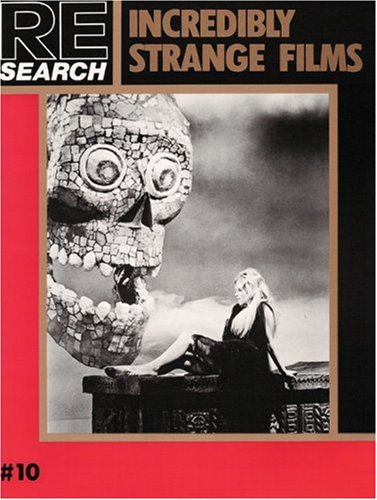
Incredibly Strange Films
Re/Search #10: Incredibly Strange Films was one of the books that launched the cult movie boom (along with Danny Peary’s Cult Movies). Like Peary’s books its great strength is that the authors actually like these movies. They’re not trying to make fun of them.
The book covers just about every cult movie genre you can think of - sexploitation, biker films, juvenile delinquent movies, even beach party movies.
The book was published in 1986, at a time when most of the movies it was dealing with were exceptionally difficult to find. It’s obvious that in many cases the authors have only seen a handful of movies by many of the film-makers they’re writing about. Jean Rollin for example is mentioned in passing as a director who sounds interesting but the authors had been unable to find a single one of his films. Today of course all his movies have been released on DVD and many of them on Blu-Ray as well. It certainly makes you appreciate the DVD age a lot more.
On the other hand the 1986 publication date did have one major advantage - most of the film-makers covered in the book were still alive and were able to be interviewed for the book. It includes interviews with Russ Meyer, Doris Wishman, Joe Sarno, Ted V. Mikels and many others. These interviews are the major reason for buying the book today.
The introduction includes some silly political nonsense but mercifully the rest of the book is free of this bunkum.
There are some interesting movies covered here, movies I hadn’t heard of before. Despite its age this book is still worth getting hold of.
The book covers just about every cult movie genre you can think of - sexploitation, biker films, juvenile delinquent movies, even beach party movies.
The book was published in 1986, at a time when most of the movies it was dealing with were exceptionally difficult to find. It’s obvious that in many cases the authors have only seen a handful of movies by many of the film-makers they’re writing about. Jean Rollin for example is mentioned in passing as a director who sounds interesting but the authors had been unable to find a single one of his films. Today of course all his movies have been released on DVD and many of them on Blu-Ray as well. It certainly makes you appreciate the DVD age a lot more.
On the other hand the 1986 publication date did have one major advantage - most of the film-makers covered in the book were still alive and were able to be interviewed for the book. It includes interviews with Russ Meyer, Doris Wishman, Joe Sarno, Ted V. Mikels and many others. These interviews are the major reason for buying the book today.
The introduction includes some silly political nonsense but mercifully the rest of the book is free of this bunkum.
There are some interesting movies covered here, movies I hadn’t heard of before. Despite its age this book is still worth getting hold of.
The Uninvited (1944)
The Uninvited is an old-fashioned ghost story, and a good one. Made by Paramount in 1944 and helmed by Lewis Allen, it’s a treat for fans of the genre.
Roderick Fitzgerald (Ray Miland) and his sister Pamela (Ruth Hussey) are enjoying a seaside holiday when they discover a charming old house set on a cliff overlooking the ocean. The house is empty so there’s a chance it might be for sale. Pamela has fallen in love with the house and Roderick, although he tries to play it cool, is obviously rather taken by it as well.
As luck would have it the house (which is called Windward) is for sale. Commander Beech (Donald Crisp) is prepared to accept their offer. It’s much less than the house is worth but the commander tells them he needs the money to provide for his grand-daughter.
As Roderick admits in his voiceover at the beginning of the movie they should have taken note of the fairly clear warning signs. Their dog refuses to go into the upstairs part of the house and the room at the top of the staircase that had been locked when they first saw the house is much too cold to be explained merely by draughts. Before very long they start to hear the sounds of a woman sobbing, sounds that always cease with the dawn.
Pamela believes right from the start that the house is haunted but Roderick doesn’t believe in such silliness. He is disturbed however and decides he should find out something about the history of the house.
It transpires that Commander Beech’s wife Mary Meredith died at Windward under mysterious circumstances seventeen years earlier. They get part of the story from Beech’s grand-daughter Stella Meredith (Gail Russell) and other parts from various locals. The commander had been a painter and the mysterious cold room at the top of the stairs was his studio. He had had two models, his wife Mary Meredith and a gypsy girl named Carmel. And thereby hangs a tale. It becomes apparent that Commander Beech had been having an affair with Carmel. He had tried to break it off with her but she had returned to the house. Carmel and Mary Meredith were seen on the edge of the cliff, and then Mary Meredith had fallen to her death.
What were the two women doing on the cliff edge? Was one trying to kill herself while the other tried to save her? Or were they struggling? Could it have been murder? Those who might know aren’t talking.
Roderick is rather taken by Stella Meredith but rather puzzlingly Commander Beech is determined that Stella Meredith should have nothing to do with Roderick and Stella and that she should stay right away from Windward. Pamela and Roderick do find an ally however, in the person of the local doctor, Dr Scott (Alan Napier). Unfortunately he has only been in the village for twelve years but he does the medical records kept by his predecessor in the practice. This provides some valuable clues.
Someone else who certainly knows something of the events of seventeen years ago is the sinister Miss Holloway (Cornelia Otis Skinner). She had been a registered nurse who had attended Mary Meredith. She now runs a sanatorium. Miss Holloway’s position is more than a little ambiguous however. Eventually, in true horror movie fashion, the brother and sister decide to hold a séance.
This is not a particularly terrifying film although it does have its share of eerie moments. The advertising tried its hardest to link this one with Alfred Hitchcock’s 1940 hit Rebecca and it does have some similarities to Hitchcock’s masterpiece. I’d describe the The Uninvited as a gothic thriller/romance with supernatural elements. The romantic angle is as important as the supernatural angle. And like Rebecca it deals with dark secrets, with events in the past that were not what they appeared to be.
The movie benefits greatly from Ray Milland’s easy charm. The entire cast is very strong with Gail Russell in her first major role being quite impressive. Lewis Allen had a long and distinguished career as a director and he handles things with a sure touch, wisely keeping the ghost under wraps for as long as possible. When the ghost finally is revealed it’s reasonably impressive. The old house, the cliff-top setting, the script by Dodie Smith and Frank Partos and the cinematography by Charles Lang all combine to give this movie as much gothic atmosphere as anyone could reasonably want.
Exposure Cinema’s DVD release looks terrific.
The Uninvited is wonderful entertainment done with the sort of light touch that you just don’t see in movies these days. Highly recommended.
Roderick Fitzgerald (Ray Miland) and his sister Pamela (Ruth Hussey) are enjoying a seaside holiday when they discover a charming old house set on a cliff overlooking the ocean. The house is empty so there’s a chance it might be for sale. Pamela has fallen in love with the house and Roderick, although he tries to play it cool, is obviously rather taken by it as well.
As luck would have it the house (which is called Windward) is for sale. Commander Beech (Donald Crisp) is prepared to accept their offer. It’s much less than the house is worth but the commander tells them he needs the money to provide for his grand-daughter.
As Roderick admits in his voiceover at the beginning of the movie they should have taken note of the fairly clear warning signs. Their dog refuses to go into the upstairs part of the house and the room at the top of the staircase that had been locked when they first saw the house is much too cold to be explained merely by draughts. Before very long they start to hear the sounds of a woman sobbing, sounds that always cease with the dawn.
Pamela believes right from the start that the house is haunted but Roderick doesn’t believe in such silliness. He is disturbed however and decides he should find out something about the history of the house.
It transpires that Commander Beech’s wife Mary Meredith died at Windward under mysterious circumstances seventeen years earlier. They get part of the story from Beech’s grand-daughter Stella Meredith (Gail Russell) and other parts from various locals. The commander had been a painter and the mysterious cold room at the top of the stairs was his studio. He had had two models, his wife Mary Meredith and a gypsy girl named Carmel. And thereby hangs a tale. It becomes apparent that Commander Beech had been having an affair with Carmel. He had tried to break it off with her but she had returned to the house. Carmel and Mary Meredith were seen on the edge of the cliff, and then Mary Meredith had fallen to her death.
What were the two women doing on the cliff edge? Was one trying to kill herself while the other tried to save her? Or were they struggling? Could it have been murder? Those who might know aren’t talking.
Roderick is rather taken by Stella Meredith but rather puzzlingly Commander Beech is determined that Stella Meredith should have nothing to do with Roderick and Stella and that she should stay right away from Windward. Pamela and Roderick do find an ally however, in the person of the local doctor, Dr Scott (Alan Napier). Unfortunately he has only been in the village for twelve years but he does the medical records kept by his predecessor in the practice. This provides some valuable clues.
Someone else who certainly knows something of the events of seventeen years ago is the sinister Miss Holloway (Cornelia Otis Skinner). She had been a registered nurse who had attended Mary Meredith. She now runs a sanatorium. Miss Holloway’s position is more than a little ambiguous however. Eventually, in true horror movie fashion, the brother and sister decide to hold a séance.
This is not a particularly terrifying film although it does have its share of eerie moments. The advertising tried its hardest to link this one with Alfred Hitchcock’s 1940 hit Rebecca and it does have some similarities to Hitchcock’s masterpiece. I’d describe the The Uninvited as a gothic thriller/romance with supernatural elements. The romantic angle is as important as the supernatural angle. And like Rebecca it deals with dark secrets, with events in the past that were not what they appeared to be.
The movie benefits greatly from Ray Milland’s easy charm. The entire cast is very strong with Gail Russell in her first major role being quite impressive. Lewis Allen had a long and distinguished career as a director and he handles things with a sure touch, wisely keeping the ghost under wraps for as long as possible. When the ghost finally is revealed it’s reasonably impressive. The old house, the cliff-top setting, the script by Dodie Smith and Frank Partos and the cinematography by Charles Lang all combine to give this movie as much gothic atmosphere as anyone could reasonably want.
Exposure Cinema’s DVD release looks terrific.
The Uninvited is wonderful entertainment done with the sort of light touch that you just don’t see in movies these days. Highly recommended.
Wednesday, 13 March 2013
The Cool and the Crazy (1958)
The Cool and the Crazy is a 1958 juvenile delinquent classic which provides everything than fans of this genre expect and love. But despite all this it remains just a trifle disappointing.Bennie (Scott Marlowe) is the new kid at school. At first he’s an outsider but his craziness soon makes him not only popular, but the leader of the gang. Bennie’s defiance of authority is calculated to make him a hero, and this pose really is calculated. Bennie is not what he seems to be. He’s a drug dealer and he’s been infiltrated into the local high school to get the kids hooked on drugs.
The proves to be extremely easy. The other kids want to do everything that Bennie does. If Bennie smokes dope they want to smoke dope. And if Bennie takes harder drugs they’ll want to follow him in that as well.
The previous gang leader, Stu (Dick Jones), is soon pushed aside and he’s the first to get hooked. He’s vulnerable because he’s lost his leadership position.
The one kid who doesn’t quite go along with Bennie is Jackie (Richard Bakalyan). He’s fallen for a girl and he’s more interested in her than in drugs. But Jackie will run into other problems. When his friend Cookie gets into real trouble and needs money for drugs Jackie is tempted into stealing to help him out. Ironically he doesn’t realise it’s already too late for Cookie.
Bennie has his own problems. He’s rather too fond of sampling the merchandise he peddles, and his drug supplier Eddie (Marvyn J. Rosen) doesn’t like that. Eddie knows that a doper is not a reliable employee and he soon casts Bennie adrift. What is Bennie to do now? He needs the drugs, he needs the money, and he’s come to enjoy the adulation of the other kids and now that’s threatened. Bennie becomes increasingly desperate and out of control.
Of course this is an easy movie to mock with its somewhat dated attitudes towards drugs, although when you consider what the drug culture was about to do to America then maybe it’s not so funny after all. Pretty soon there would be a lot of Cookies and Bennies.
Scott Marlowe is superb as Bennie. It’s not difficult to believe that he would easily convince kids that he was super-cool and he has plenty of charisma. This role was a gift from the gods for a young actor and Marlowe makes the most of it, overacting outrageously but very effectively. It’s unfortunate that his subsequent career wasn’t more distinguished.
Richard Bakalyan is good as Jackie although I personally found him to be a bit disturbing, which is a slight problem since he’s the only really sympathetic character in the movie. Gigi Perreau as Amy, Jackie’s girlfriend, gets very little to do. She’s a touch on the insipid side but that possibly makes her a fairly realistic teenager. Marvyn J. Rosen makes a great heavy. Sadly this was his only movie.
Director William Witney made several notable juvenile delinquent movies and other assorted B features before concentrating mostly on television work. There’s nothing startling about the job he does here but he’s efficient and he keeps things moving along.
There are some classic juvenile delinquent movie moments in The Cool and the Crazy, especially the scenes involving Bennie’s desire to drive his car between two motorcycle cops. You’ll have to watch the movie to find out why this is such a classic moment.
The British DVD release from Direct Video is barebones but of good quality.
This movie is mostly going to be enjoyed for its camp value, but that’s why juvenile delinquent movies are so much fun. The Cool and the Crazy is not quite in the front rank of JD movies - it doesn’t have the awe-inspiring weirdness of a movie like the Ed Wood-scripted The Violent Years . But it’s still a must-see for fans of the genre, if only for Scott Marlowe’s performance.
Friday, 8 March 2013
Daughter of Dr Jekyll (1957)
Edgar G. Ulmer spent most of his career making low-budget movies that were a lot better and more interesting than they had any right to be. Daughter of Dr Jekyll, made in 1957, is not one of the highlights of his career but it’s still worthy of note.
Despite the title this is more of a werewolf movie than a Dr Jekyll and Mr Hyde or mad scientist movie.
Janet Smith (Gloria Talbott) arrives at the home of her guardian Dr Lomas (Arthur Shields) with her boyfriend George Hastings (John Agar) in tow. It’s her twenty-first birthday and she announces that she and George are engaged to be married. Before that can happen Dr Lomas suggests that she should hear her father’s will. It turns out that she is the daughter of the infamous Dr Jekyll, whom the local villagers considered to be a werewolf. It also turns out that Dr Lomas’s big house actually belongs to her. She is now a wealthy young woman, but given her ancestry Dr Lomas tries to persuade George that marrying her would not be a wise idea.
The locals not only believe Dr Jekyll to have been a werewolf; they suspect that his daughter might be one as well. In fact they’re in the mood for lighting those torches and burning down the house in true horror movie style.
George is determined to marry Janet anyway. They decide they might as well explore the house, since it now belongs to her, and they discover Dr Jekyll’s secret laboratory.
Janet starts to have nightmares and when people start to get killed and she wakes up with blood on her hands she starts to get fairly thoroughly creeped out. It’s not going to take much to convince her that she’s really a werewolf.
The big problem with this movie is the fairly terrible script by Jack Pollexfen, and the fact that things that the audience should discover gradually are given away much too soon. But Ulmer was used to having to take second-rate material and they to do something interesting with it and in this case he concentrates on mood and atmosphere. That’s not easy to do on a very low budget but that never deterred Ulmer from trying. And he manages pretty well, making extensive use of fog (always a good way to disguise an inadequate budget) and miniatures. The miniatures are obviously miniatures but they always were in Ulmer’s movies and it doesn’t matter, he still gets away with them.
The movie does have a major asset in Gloria Talbott. Her performance is pretty good and she has the perfect look for a horror movie heroine who may or may not turn out to be more monster than heroine. Arthur Shields slices the ham good and thick but he’s entertaining. John Agar is a little on the dull side but he’s adequate considering that Gloria Talbott and Arthur Shields are carrying the movie.
The dream sequences give Ulmer the chance to show what he can do and they’re the highlight of the movie. While there are some genuinely eerie moments there’s also a great deal of enjoyable low-budget cheesiness on offer here.
On DVD the movie looks about as good as such a low-budget movie could be expected to look.
This movie is not quite first-rate Ulmer but even second-rate Ulmer is worth watching, and Daughter of Dr Jekyll is recommended for fans of this always fascinating and very unfortunate director.
Despite the title this is more of a werewolf movie than a Dr Jekyll and Mr Hyde or mad scientist movie.
Janet Smith (Gloria Talbott) arrives at the home of her guardian Dr Lomas (Arthur Shields) with her boyfriend George Hastings (John Agar) in tow. It’s her twenty-first birthday and she announces that she and George are engaged to be married. Before that can happen Dr Lomas suggests that she should hear her father’s will. It turns out that she is the daughter of the infamous Dr Jekyll, whom the local villagers considered to be a werewolf. It also turns out that Dr Lomas’s big house actually belongs to her. She is now a wealthy young woman, but given her ancestry Dr Lomas tries to persuade George that marrying her would not be a wise idea.
The locals not only believe Dr Jekyll to have been a werewolf; they suspect that his daughter might be one as well. In fact they’re in the mood for lighting those torches and burning down the house in true horror movie style.
George is determined to marry Janet anyway. They decide they might as well explore the house, since it now belongs to her, and they discover Dr Jekyll’s secret laboratory.
Janet starts to have nightmares and when people start to get killed and she wakes up with blood on her hands she starts to get fairly thoroughly creeped out. It’s not going to take much to convince her that she’s really a werewolf.
The big problem with this movie is the fairly terrible script by Jack Pollexfen, and the fact that things that the audience should discover gradually are given away much too soon. But Ulmer was used to having to take second-rate material and they to do something interesting with it and in this case he concentrates on mood and atmosphere. That’s not easy to do on a very low budget but that never deterred Ulmer from trying. And he manages pretty well, making extensive use of fog (always a good way to disguise an inadequate budget) and miniatures. The miniatures are obviously miniatures but they always were in Ulmer’s movies and it doesn’t matter, he still gets away with them.
The movie does have a major asset in Gloria Talbott. Her performance is pretty good and she has the perfect look for a horror movie heroine who may or may not turn out to be more monster than heroine. Arthur Shields slices the ham good and thick but he’s entertaining. John Agar is a little on the dull side but he’s adequate considering that Gloria Talbott and Arthur Shields are carrying the movie.
The dream sequences give Ulmer the chance to show what he can do and they’re the highlight of the movie. While there are some genuinely eerie moments there’s also a great deal of enjoyable low-budget cheesiness on offer here.
On DVD the movie looks about as good as such a low-budget movie could be expected to look.
This movie is not quite first-rate Ulmer but even second-rate Ulmer is worth watching, and Daughter of Dr Jekyll is recommended for fans of this always fascinating and very unfortunate director.
Subscribe to:
Posts (Atom)