Wednesday, 31 August 2022

Ritual of Evil (1970)

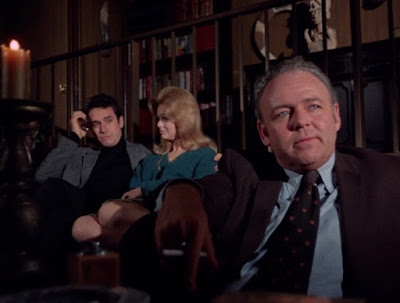
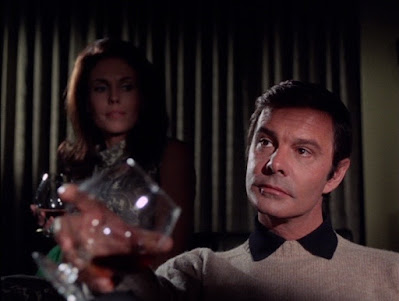
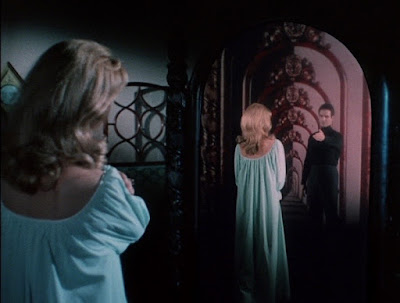
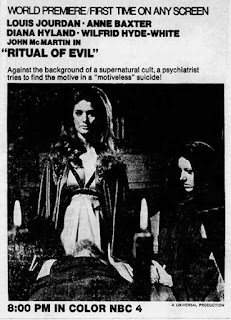
Ritual of Evil, screened on NBC in 1970, was the second TV movie featuring Louis Jourdan as psychiatrist/occult investigator Dr David Sorell. The original intention had been to make an ongoing series under the title Bedevilled. Unfortunately that series never eventuated. The producer of Fear No Evil was apparently so disappointed that he quit Universal and when the decision to make a second Dr Sorell TV movie David Levinson took over as producer. Ritual of Evil would also have a different writer, Robert Presnell Jr, and a different director, Robert Day.

Ritual of Evil does resemble its predecessor in a number of crucial ways. In both cases there’s an avoidance of horror movie clichés such as monsters, werewolves, vampires, etc. The evil comes from people rashly dabbling in forbidden areas of knowledge. There’s an attempt to make the supernatural elements vaguely plausible and to deal with supernatural subjects in a very contemporary setting.

On a wild night Dr Sorell visits the house of one of his patients. Aline Wylie is twenty-four and she’s a bit of a wild child, and she’s also the heiress to an enormous fortune. Aline doesn’t seem to be home but David sees her aunt Jolene (Anne Baxter). Jolene lives with Aline, and also in the household is Aline’s kid sister Loey. Jolene is drunk as usual, and is muttering something about Walpergis Night.

If we’ve seen the first David Sorell TV movie, the excellent Fear No Evil, then we’re going to find the mention of Walpergis Night rather significant. David Sorell is a psychiatrist but he has an interest in the occult and he takes the occult rather seriously.

The next morning Aline Wylie is dead, an apparent suicide. Loey tells Dr Sorell that it’s all her fault, that she used black magic to kill her sister. Of course teenage girls get crazy ideas like that and nobody takes too much notice, but David Sorell has had personal experience of the results when people try summoning demons so he doesn’t dismiss such ideas lightly.


Loey is now the heiress but until she’s twenty-one Jolene will be her guardian. Loey doesn’t mind that but is she worried about what will happen if Jolene marries the creepy avaricious sleazy no-good Edward (John McMartin).

Everybody connected with this household seems to have disturbing dreams. David Sorell is not convinced that they’re just dreams. He tends to worry when people have dreams about human sacrifices. He’s more worried than ever when someone else connected to the Wylie household, folk singer Larry Richmond, turns up dead.

And then there’s the missing hippie. At least there might be a missing hippie. The sheriff doesn’t think so, but David Sorell not only thinks there is a missing hippie, he thinks there may be a dead missing hippie.


David discusses the matter with Harry Snowden (Wilfred Hyde-White). Harry is David’s mentor when it comes to the occult. It seems likely that there is some kind of demonology at work. There was a wild party at the Wylie house the night before Aline committed suicide but it may have been something more sinister than just a party. It may have been a Black Mass.

Photographer Leila Barton (Diana Hyland) seems to have a growing influence over Loey. Loey had been in the shadow of her more vivacious older sister Aline. Loey is at an awkward stage, starting to become aware of herself as a woman and starting to become aware of men. She’s pretty vulnerable to anyone with a strong enough personality.

Fear of Evil dealt with a mirror that possessed supernatural powers. Ritual of Evil plays a variation on this theme, with photographs being used to exercise demonic powers. It’s a good idea and it’s utilised skilfully and it gives the movie a contemporary feel - this is evil making use of modern technology.


Louis Jourdan is once again relaxed and likeable and charming as Dr Sorell. Belinda Montgomery does well as Loey, a tricky rôle because of the danger that the character woulds come cross as irritatingly precocious or bratty. Anne Baxter is extremely good as the rather sad Jolene, a woman who can’t quite figure out how her life became so messed up.

Like Fear No Evil this second movie is quite impressive visually for a TV movie, although Robert Day doesn’t quite have Paul Wendkos’s flair. Technically it’s still more ambitious and more polished than most TV movies.

There was a definite erotic subtext to Fear No Evil. In fact it wasn’t even subtext, it was right out there in plain view. There’s an erotic undercurrent in Ritual of Evil as well. Leila appears to have several sexual obsessions going and there’s just the faintest hint that she may have sapphic tendencies. Loey’s disturbing dreams, which are obviously the result of some kind of occult influence, definitely contain major sexual fantasy elements.


I don’t think Ritual of Evil is quite as good as Fear No Evil but it’s still definitely a well above average TV movie with a subtly creepy atmosphere and some decent chills.

Both David Sorell movies come on a single DVD or Blu-Ray disc with both movies getting a very informative Gary Gerani audio commentary. The transfers are excellent. This Kino Lorber double-header can be very highly recommended to fans of subtle atmospheric horror. These two movies are not just good movies by TV movie standards, they’re fine horror films by any standards.

I reviewed Fear No Evil here recently.

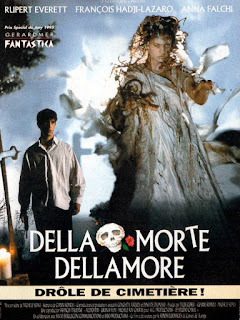
Dellamorte Dellamore (1994)

Michele Soavi’s Dellamorte Dellamore (released under the much more prosaic title Cemetery Man in the U.S.) is a zombie movie. Now I have to say upfront that I am not a fan of zombie movies. There are some exceptions. I absolutely adore movies dealing with voodoo. Those types of zombie movies I like. And I love Jean Rollin’s zombie movies but Rollin’s zombie movies are very very unconventional zombie movies. But the zombie movies that started to become so poplar in the wake of Night of the Living Dead, the movies about shambling flesh-eating zombies, hold no appeal for me.

Michele Soavi is however a director with interesting credentials. He was a protégé of Dario Argento, working on many of Argento’s movies in the 80s and early 90s. He is often spoken of as a director with at least some of Argento’s visual flair.

And Dellamorte Dellamore has the reputation of being an unusual zombie movie. A kind of black comedy zombie movie but with a bit of philosophical heft to it as well, and a certain amount of eroticism. So, given that I’ve had Anchor Bay’s DVD release of this movie siting unwatched on my shelf for literally years it seemed like it might be worth actually sitting down and watching it.


Francesco Dellamorte (Rupert Everett) is the caretaker at a small cemetery. It’s not such a bad job really. It suits him. He’s not really a very sociable guy. Recently some slightly disturbing things have been happening at the cemetery. Some of the dead, after seven days, have started coming back to life. Well perhaps not quite back to life. They’re zombies. They’re not too much of a problem. If you shoot them they go back to being dead and they stay dead.

Francesco is vaguely aware that he ought to report the matter to the relevant authorities. The trouble is that that would involve writing reports and filling in forms and all sorts of bureaucratic hassles. It might even put his job at risk. The easiest thing to do is to just shoot the zombies and rebury them and say no more about it. Francesco is a guy who doesn’t like to make his life more complicated than it needs to be.


Then comes the day when he spots a gorgeous young woman (played by Anna Falchi) at a funeral. It’s the funeral of an elderly man. Francesco assumes it’s the young woman’s father but she informs him that the man was actually her husband. She then goes on to tell Francesco how her husband was incredibly good in bed, a skilful and tireless lover. She’s obviously missing his physical attentions. So her behaviour is slightly odd but Francesco doesn’t let that worry him. Grief does strange things to people. What matters to Francesco is that she’s totally gorgeous and he wants to sleep with her more than he’s ever wanted anything in his life.

This seems like an unattainable goal, unto, the day he mentions in passing that the cemetery has a fine ossuary. A building filled with assorted skeletal remains. She is very very anxious to see the ossuary. It excites her very much indeed. In fact it gets her incredibly hot. Maybe making love on her husband’s grave might seem insensitive but she assures Francesco that she has never had any secrets from her husband.


From this point on the movie gets progressively stranger. For a while it tries being a horror film. Then it tries black comedy. Then it tries adolescent existentialism. The zombie thing kind of gets forgotten. Maybe none of it is real anyway. It’s more like a crazy hallucinogenic dream. There’s lots of gore and some genuinely disgusting gross-out moments. I think the director is trying to be zany. The sad thing is that the crazier the movie gets the less interesting it gets. Instead of the inspired lunacy which Soavi was presumably shooting for we get an incoherent mess.

And once we decide that none of it can be real then there’s no reason to care what happens next. Maybe Francesco is really suffering. Maybe he’s just insane.

The first time Francesco shoots a living person instead of a zombie, by mistake, it has a certain shock value. Then he just keeps shooting people for no reason.


As a comedy it didn’t work at all for me. Comedy is a very individual thing and maybe this is just not the kind of comedy that appeals to me. As horror it doesn’t work because it’s too farcical and it’s impossible to feel any terror or suspense or shock. As an exercise in absurdism it falls flat because it’s too silly and cartoonish.

There are a few good visual moments early on. For the first half hour the movie has an interesting off-kilter vibe. It just ends up (to my way of thinking) trying to do too many things and trying to be too many things.

Lots of people really like this movie. I can’t really recommend it but I’m not going to advise you to avoid it because it might really work for you. Most people seem to like this movie a lot more than I did.

It just didn’t work for me.

Sunday, 28 August 2022

Girl Slaves of Morgana Le Fay (1971)

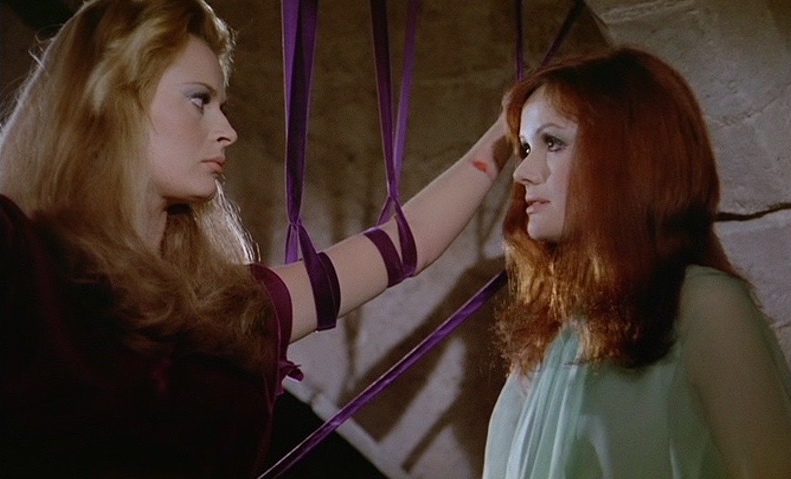
Girl Slaves of Morgana Le Fay (Morgane et ses nymphes) is a 1971 French erotic horror movie with a definite surrealist tinge. It’s a movie that gets overlooked even by people who usually like this sort of thing.

I don’t know much about the movie’s director, Bruno Gantillon, but this seems to have been his only foray into this genre.

Two girls, Françoise (Mireille Saunin) and Anna (Michèle Perello), are on a motoring trip. They stop at a gloomy inn. There’s a slightly sinister-looking dwarf giving them the eye. We will later learn that his name is Gurth (Alfred Baillou). The landlord advises the girls to leave at once, and not to go through the village.

The girls drive through the forest and get hopelessly lost. They start to get worried when they realise they’ve driven past the same landmarks half a dozen times. It’s the middle of the night and they’re running out of petrol. They take shelter in a dilapidated barn. It’s all a bit miserable and it’s cold but they cuddle up together, and the cuddling gets a bit intense and you know what happens next.

Next morning Anna has disappeared. Françoise is very upset. The sinister-looking dwarf tells her to follow him. He’ll take her to her friend. Instead he takes her to a lake where a boat, apparently propelled by magic, takes her to a castle. Apart from the dwarf the inhabitants of the castle are all female. And all young and pretty. Morgane (Dominique Delpierre) seems to be in charge.


Gurth seems to have a very enjoyable time watching the sapphic cavortings of Morgane’s girls.

We assume that Morgane is some sort of witch. She appears to have some magic powers. She seems to be able to manipulate time, or at least she can manipulate a person’s perceptions of time.

Gurth is her faithful servant, or at least that’s what appearances suggest. He might of course be a sorcerer. His position is rather ambiguous.

Morgane has her three girls, her love slaves - Yaël, Sylviane and Sarah. How they feel about Françoise’s arrival is yet to be seen. There’s the potential for jealousies.

And what of Anna? What has become of her? Her fate will be important.

And where do the old women fit in? Morgane’s queendom is a queendom of youth and beauty.


As you might expect Françoise’s arrival leads to turmoil. There were perhaps power struggles already simmering but if Françoise is to become Morgane’s favourite there will certainly be trouble.

This is not really a horror movie. It has some affinities to Jean Rollin’s movies of the same period but many of Rollin’s movies are not actual horror movies either (movies such as The Iron Rose or The Escapees). Girl Slaves of Morgana Le Fay definitely belongs to le cinéma fantastique (as do Rollin’s movies). It’s a movie that takes place in a different reality, the world of faery for want of a better word. Morgane’s queendom is a faery queendom. It’s not evil, but it’s not like our world. The rules are different. It can seem cruel. It is a world of beauty, love and sex. It may seem shallow, but maybe Morgane’s world is concerned with things that really matter while our world is concerned with trivia. It just depends on your point of view.


Morgane is not evil, but she is cruel and capricious and she simply does not operate according to human rules.

So it’s not a horror movie in the sense of dealing with overtly terrifying or horrifying things, but it is a disturbing movie.

The sense of otherworldliness is achieved quite effectively. We are constantly tempted to judge Morgane and Gurth and Yaël, Sylviane and Sarah but then we find ourselves reminded that human judgments are simply irrelevant in the world of faery.

This is also very much a world of women, a world of female passions and female jealousies.

This is one of those movies that offers classy arty softcore erotica. Beautiful women engaging in low-key lesbian love play, with hints of perversity. There’s a lot of nudity. I don’t think any of the nudity is gratuitous. It’s a fantasy movie but it’s an erotic fantasy movie. The nudity is essential (not that I have a problem with gratuitous nudity anyway).


The acting is quite good. We do feel that these are characters from a dark fairy tale rather than from the real world, which is as it should be. Dominique Delpierre as Morgane and Alfred Baillou as Gurth are particularly good, giving performances that are wonderfully ambiguous.

The movie enjoyed modest success in France but was never released in the U.S. or Britain. It was therefore entirely unknown in the Anglosphere until Mondo Macabro released it on DVD some years back. Their excellent DVD release should have rescued this movie from obscurity but unfortunately it still remains almost unknown.

Girl Slaves of Morgana Le Fay is a movie that does not deserve to languish in such obscurity. It’s a hypnotic subtly disturbing dream-like movie shot in a wonderful 15th century castle. It’s a superb example of le cinéma fantastique.

Mondo Macabro’s DVD release can still be found at a reasonable price and it offers an excellent transfer.

Girl Slaves of Morgana Le Fay is very highly recommended.

Thursday, 25 August 2022

The Bird with the Crystal Plumage (1970)

If you mention the giallo genre the chances are that the first director most people with think of is Dario Argento. In fact Argento made only a handful of pure gialli. He very quickly started to movie in the direction of supernatural horror. His most famous and most celebrated film, Suspiria, is a supernatural horror movie rather than a giallo. By the time he returned to the giallo genre with Tenebre everybody else had stopped making them.

And if you mention Dario Argento’s name people are going to think of gore. He was famous for making gore artistic and even, in a perverse way, beautiful. But Argento’s first few gialli contain very little gore.

His first foray into the world of the giallo was The Bird with the Crystal Plumage in 1970.

This movie opens with one of the finest visual set-pieces in all of cinema. And there’s virtually no gore. It’s simply a very cleverly staged scene. Sam Dalmas (Tony Musante) is an American writer living in Italy. Walking along the street he notices something in an art gallery. When he takes a closer look he realises he is witnessing a murder. A woman is being murdered. He can see what’s happening but he can’t do anything about it. Between Sam and the murder are two sheets of plate glass. The front part of the gallery is like a gigantic show room with a glass front facing the street. He manages to get through the first glass window only to find himself trapped between two huge panes of glass. He can see the murder but he can’t hear what is happening in the gallery. He can see out onto the street but he cannot hear anything happening on the street and nobody in the street can hear him.


It turns out not to be a murder. Not quite. Sam came along just in time to scare the killer off. The victim, a woman, has been stabbed but she will recover.

Inspector Morosini (Enrico Maria Salerno) is very anxious to hear Sam’s account of the crime. There have been three recent unsolved murders. The victims were women. It seems likely to the police that Sam has just prevented a fourth murder.

Sam’s evidence is frustrating, to the inspector and to Sam himself. He knows there was something wrong with the scene he witnessed. Something that didn’t fit. But no matter how hard he tries he can’t put his finger on what it was. Inspector Morosini thinks that whatever it was could be the key to solving three murders, if only Sam could remember.


Sam is having a very busy day. After leaving the police station someone tries to decapitate him with a meat cleaver.

Sam can’t stop thinking about that scene he witnessed. He is happy to help the police but he becomes so obsessed that he does some investigating on his own (with Inspector Morosini’s blessing). He receives threatening telephone calls rom the murderer, warning him off. There’s a vital clue in those phone calls, both Sam and Inspector Morosini are sure of it, but it’s another elusive clue. The police subject the tapes of the phone calls to rigorous analysis. Their technical people know there’s a clue there, but they just can’t pin it down.

There’s a kind of double race against time spect to this movie. Inspector Morosini has to solve the case as quickly as possible because the murderer is adding new victims all the time. Sam has to solve the case before the murderer decides to add him to his list of victims.


The resolution of the puzzle is handled with considerable skill.

In this movie Argento isn’t trying to do anything dazzlingly original in terms of content. It was his first movie and mostly he’s content to work with standard thriller tropes - the hero witnesses a crime and the killer is out to silence him, there’s a threat to the hero’s girlfriend, the hero decides to play amateur detective, there are two parallel investigations (by the police and by the hero). At his stage Argento seems to be trying to position himself as the Italian Hitchcock - don’t worry too much about the plot because it’s the visuals that matter and include at least one show-stopping visual set-piece.

Argento wrote the screenplay, based on Fredric Brown’s novel The Screaming Mimi, and the twists at the end are delightfully devious. Argento might generally be more concerned with style than substance but in this movie he’s provided himself with a nifty plot as well. In fact the plot is more coherent and better structured than one expects in a giallo.


This is a movie that is much less bloody than it appears to be. When the murders occur we get the impression that they’re bloody but actually the bloodiness is almost entirely suggested rather than shown. We think we’ve seen something much more graphic than we actually have seen (just like Hitchcock’s famous shower scene in Psycho).

It’s that initial murder scene in the art gallery that is going to grab your attention but there’s plenty more visual brilliance to come. For a guy making his first feature film Argento’s mastery of the visual language of the thriller genre is very very impressive.

The acting is OK, but it’s not a movie you’re going to watch for the acting.

Most of the characteristic giallo ingredients are in place here, there’s very effective suspense, it looks great and overall The Bird with the Crystal Plumage works in a very satisfying way. Highly recommended.

Monday, 22 August 2022

Naked Came the Stranger (1975)

Naked Came the Stranger was one of the hardcore movies made by Radley Metzger under the name Henry Paris. In these films Metzger was trying to make hardcore porn movies that were also good movies. That was challenging enough, but he made things even more difficult for himself by trying to do them as sex comedies.

The literary story behind the film is quite fascinating. Naked Came the Stranger was a massive bestseller purportedly written by a woman named Penelope Ash. It was later revealed to be a hoax. The book was written by twenty-four newspaper reporters and was intended as a satire on the kinds of trashy novels that enjoyed such huge success at the time. As it turned out the joke was on the newspapermen - after the hoax was revealed the book’s sales skyrocketed.

The fact that the novel was essentially a series of disconnected vignettes made it ideal for Metzger’s purposes.

Gilly (Darby Lloyd Rains) and Billy (Levi Richards) are a husband-and-wife team who do a daily radio interview show from their home (such programs were quite a big thing in radio at the time). Their marriage has hit a bit of a rough spot and Billy is having an affair with their production assistant Phyllis (Mary Stuart). Gilly decides that the best way to save her marriage is to start having affairs herself (it was the 70s and people really did believe such stuff back then). She decides to start seducing all her male friends and acquaintances. With somewhat mixed success.


Metzger wasn’t just adding a few gags to a sex movie. He was very serious about making this film work as a comedy. That led him to take some big risks, just as playing many of the sex scenes almost entirely for laughs. The danger of course is that the scenes will lose their erotic intensity, and that is indeed what happens. There is for example a scene in which Gilly tries to give a waiter a blow job but fails utterly. It would be difficult to think of anything more unerotic than an attempted blow job that ends in embarrassing failure. In story terms and comedic terms the scene works brilliantly but as a sex scene it’s pretty limp.

The blow job on the bus scene is more successful and still manages to be very funny. It’s a remarkable scene, actually shot on a double-decker bus driving through the streets of Manhattan, and it does effectively combine eroticism and comedy.


Gilly’s attempt at a little S&M action with another male acquaintance really is screamingly funny.

As the story progresses the mood changes a little, becomes a little more serious, and the sex scenes start to be a bit more emotionally intense. This is a comedy but there’s also a love story here. There’s also a message that might be a little surprising for a 1970s hardcore porn movie, the message being that sex is much better when you’re emotionally involved and it’s even better when you’re married.

Metzger shot his Henry Paris movies in Super 16mm and he is at pains to point out that there is a world of difference been ordinary 16mm and Super 16. Super 16 offers quality that is only marginally inferior to 35mm but with enormous advantages in cost and in the lightness of the equipment. Super 16 is the reason Metzger was able to make these movies with production values that are vastly superior to what you expect in hardcore movies.


This movie gave Metzger the opportunity to do something he’d always wanted to do - a lengthy sequence shot silent and in black-and-white. It works superbly, especially with the wonderful vast almost empty rooms with just one item of furniture in each (a table and a bed). The sequence is a sexual encounter but it’s also rather romantic. This sequence was shot in a huge ballroom in a New York hotel and it’s an absolutely superb setting.

Mention should also be made of the dancing in the empty swimming pool scene, a genuinely rather poignant moment.


In a Radley Metzger hardcore porn movie you actually have to talk about the acting because the performers really do have to act. And they do a pretty decent job of it. Darby Lloyd Rains is not your typical porn star by any means but she is funny and she is likeable. The other cast members are all at the very least competent and usually more than competent.

Metzger’s hardcore movies bear no resemblance whatsoever to any other hardcore films. It’s partly that they represent a radically different aesthetic. Metzger had definite artistic pretensions. What made him unique in the adult film business is that he actually had the talent to get away with such pretensions. He was not the only adult film-maker to try to mix sex and comedy but Metzger’s approach to comedy was sophisticated and witty. Metzger’s Henry Paris movies remain a unique and fascinating experiment. Naked Came the Stranger can be considered to be a successful experiment and was a definite step forward after the first Henry Paris film, The Private Afternoons of Pamela Mann. It paved the way for Metzger’s masterpiece, the delightful The Opening of Misty Beethoven. Recommended.

Distribpix's DVD presentation offers an excellent transfer and includes a director's commentary track and a host of other extras.

Friday, 19 August 2022

West End Jungle (1961)

West End Jungle is a fascinating representative of that interesting genre, the faux-documentary. It’s also reminiscent of the mondo movies that would become so popular in the wake of the release of Mondo Cane in 1962. But West End Jungle was released in 1961 so it actually slightly pre-dates the mondo movie crazy.

West End Jungle purports to be an exposé of the scandalous sinful world of prostitutes and strippers. It’s a classic exploitation movie in the style of the classic American exploitation movies of the 1930s, 40s and 60s. It tells us in shocked tones about some “social evil” while of course offering us as much salacious material on that subject as the film-maker could get way with. The American exploitation movie-makers, such as the notorious Forty Thieves, figured out the way to do this. You offer the viewer lots of sinfulness and skin while covering yourself by including a morally disapproving voice-over narration or a moralising intro and epilogue. If you get arrested for obscenity you can then claim you are performing a public service by exposing vice. Given the insanity of the mindset of censors you had a good of getting away with it. The morally censorious intros or narrations are what was known in the world of the carnies as a square-up.

Producer Arnold L. Miller (1922-2014) was one of the leading figures in 1960s British exploitation film-making. Along with his collaborator Stanley A. Long (1933-2012) he perfected the sex and sin exposé film, adding some touches of the bizarre to spice things up.

West End Jungle begins with the narrator telling us, in shocked tones, about the evil of prostitution in London. He throws in every moralistic cliché in the book. Decent women cannot walk the streets at night because of those wicked prostitutes. Of course viewers ate this stuff up. In 1961 people were as interested in sex and naked women as they have always been and always will be but they loved to take a morally superior tone. And making life miserable for prostitutes and strippers has always been a popular occupation. Perhaps one day it will be possible for sex to be regarded in a calm rational manner, regarded as a normal part of life, in Britain and America but there’s no sign of that day getting any closer. It’s depressing to consider that public and official attitudes towards prostitution and sex work in general are just as narrow-minded today as they were in 1961 when this movie was made.


The loathing and fear of sex, the hatred of women and the seething contempt for lonely men really is laid on thick. The narrator is practically foaming at the mouth. But of course that was the only acceptable approach to sex at the time. Sex was dirty and disgusting. Prostitutes and strippers needed to be punished and humiliated. Any other approach would have resulted in the banning of the film.

The movie is of course mostly faked, in order to make sure that there was not a shred of human warmth and sympathy displayed.

Even having gone to such elaborate lengths to satisfy the puritanical censors this movie is still astonishingly tame. There’s absolutely no nudity whatsoever.

None of this was enough to satisfy the British censor who banned anyway. The British public had to be protected from the disturbing knowledge that there was such a thing as sex.


You can’t help wondering at the response of audiences at the time. Presumably audiences were so desperate to see something at least vaguely sexual that they simply ignored the narration.

The movie begins by telling us, with a great deal of relish, about the British Government’s latest measures to stamp out sex in Britain, by (naturally) making life as miserable as possible for prostitutes.

But, alas, when prostitutes were driven off the streets they discovered other ways to find clients. It’s almost as if people actually like sex, a horrifying thought in 1961.

We get a glimpse of “clip joints” and strip clubs, painted as dens of sin and iniquity.

We also discover that respectable businessmen provide call girls to other businessmen with whom they want to close a deal. This also providers useful ammunition for blackmail. In this case the call girl is Lisa. She lives in a luxury flat, wears gorgeous clothes, drinks champagne, has a maid and appears to be the most confident self-assured young woman you could ever meet. We are however assured that her life is nothing but degradation and misery.


Naturally we’re not supposed to believe a single word the narrator tells us. Arnold L. Miller was in the sex business and the movie was all about exploiting sex. Miler had the crazy idea that people liked sex and liked seeing it on the screen. If you’re in on the joke then the narration, and the phoney dialogue, will provide you with a great deal of amusement.

If you buy the Extended Edition DVD you get a number of extras. The interviews with Miller and with Lord Wolfenden (the man responsible for the banning of street prostitution) are interesting. There’s a short film by Miller but it’s about plastic surgery and is of no interest or relevance.

One of the extras is very interesting indeed. It’s the 1976 colour documentary Get ’em Off, a history of strip-tease. Shot mostly at the famous Nell Gwynne strip club it was made at a fascinating moment in the history of strip-tease. The girls were now showing everything, and offering more than just tantalising glimpses of frontal nudity. But strip-tease had not yet abandoned its theatrical roots.The girls were still putting a lot of thought and effort into their routines, they were trying to make their routines distinctive, they could actually dance. They were still trying to put on a genuine show. They still thought of themselves as entertainers. And some of the routines shown here are amazingly bizarre and fascinating. The film includes lots of frontal nudity but it’s mostly worth seeing for its sheer exuberant excess.


It’s definitely worth buying the Extended Edition to get this gem of 70s British sexploitation.

Miller and Long went on to make more faux-documentaries including the rather interesting Primitive London and London in the Raw.

West End Jungle is an intriguing time capsule, it’s both very funny and rather sad when you consider the lengths film-makers had to go to in order to deal with sexual subjects. It’s worth seeing for that reason, and the extras make the disc worth buying.

Monday, 15 August 2022

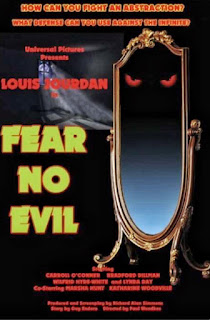
Fear No Evil (1969)

Fear No Evil belongs to the much-despised category of TV movies. So why would a company like Kino Lorber decide that an obscure long-forgotten 1969 TV movie is worth a Blu-Ray release, with an accompanying audio commentary? Have the folks at Kino Lorber taken leave of their senses or is Fear No Evil actually worthy of such treatment? We shall see.

It certainly starts promisingly, with a man fleeing in terror in a darkened building, with some Dutch angles to make it that little bit more disorienting. This opening scene is definitely more striking and more atmospheric in a subtly weird way than we would normally expect in a TV movie.

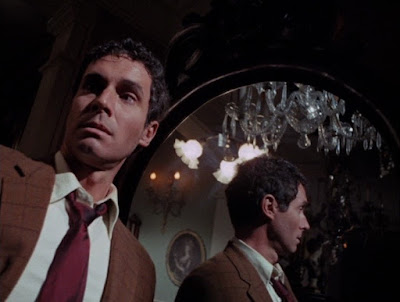
Then we see a man, obviously confused and afraid (and we assume it’s the same man), hammering on the door of an antiques store in the middle of the night. When the proprietor reluctantly lets him in the man buys an ornate full-length mirror. He can see something in that mirror that no-one else can see. Instead of his reflection he can see a man, a rather suave dark-haired man. He sees himself, and yet it’s not himself.

The frightened man is physicist Paul Varney (Bradford Dillman). It’s possible of course that Varney is seeing things because he’s drunk, or because he’s been doing drugs, or because he’s crazy. But he has to buy that mirror.

When the mirror is delivered the next day his girlfriend Barbara (Lynda Day) is not overly impressed.

Paul works with Myles Donovan (Carroll O’Connor) and Myles is taking Paul and Barbara to what he hopes will be an amusing party.

The host is Dr David Sorell (Louis Jourdan), a psychiatrist with an interest in the occult. He developed his interest in the occult as a result of a case a few years earlier, a case he refuses to talk about.


Dr Sorell has fun playing games with his party guests, demonstrating just how superstitious people really are, even people who consider themselves to be totally rational.

Then Paul is killed in an automobile accident. Barbara is devastated. She goes to live with Paul’s mother. Neither woman wants to be alone. Paul’s belongings have been sent to his mother’s house. Including that mirror.

Barbara starts to have some rather disturbing experiences. She sees Paul in the mirror. More than that, she can enter the mirror and touch him.

She decides it might be wise to consult Dr Sorell. She fears she is going mad.

As Dr Sorell soon realises, the problem is that she enjoys these experiences. Whether they are hallucinations, or ghostly manifestations, or paranormal phenomena, or vivid wish-fulfilment fantasies Barbara does not want them to stop. The truth is that experiences are not just emotionally comforting but also erotically gratifying.


Barbara is aware that she may be in some danger, at least as far as her sanity is concerned. But she cannot give up her times with Paul in the mirror.

You expect vampire stories to have an erotic undercurrent but you don’t necessarily expect that in a ghost story. And you don’t expect a 1969 American TV movie to be diving into the world of erotic horror. But this is indeed an erotic horror movie. It’s subtle and low-key, there’s no actual sex and no nudity, but the erotic undercurrent is very obvious and very overt. Dr Sorell even suggests to Barbara that she is merely having very vivid (and somewhat perverse) sexual fantasies.

Of course you could ask if this is actually a ghost story. At first it seems like it might be a ghost story but it soon becomes apparent that it’s not exactly ghosts we’re dealing with. It’s something terrifying and inexplicable.

Of course what we have is a woman who is having strange experiences, and a psychiatrist who believes that the woman is being as honest as she can be about what she experiences but he also feels that it’s possible that she may not have any understanding of what is happening to her. Dr Sorell has no evidence whatsoever that he is dealing with anything other than a delusional woman. So this is one of those horror movies that for most of its running time leaves us uncertain whether we are dealing with the supernatural, or the world of dreams and delusion, or possibly even a sinister plot to send a woman mad.


Eventually the movie will have to commit itself one way or the other but I’m not going to tell you whether the events really are supernatural or not.

We certainly are dealing with people who believe in the occult. At least some of the characters are definite believers. Others are on the fence. Dr David Sorell comes across as a guy who would probably prefer not to believe, but he’s neither a dogmatic believer not a dogmatic non-believer.

Louis Jourdan surprisingly enough did quite a bit of horror work on TV, most notably in the 1977 BBC-TV Count Dracula (in which he was absolutely superb). He’s very good in Fear No Evil, playing a sympathetic character. Carroll O’Connor is solid as Paul’s friend Myles. Lynda Day is extremely good as Barbara - she’s so sweet and innocent and yet at the same time she convinces us that Barbara is a woman of very strong passions, both emotional and sexual. Her passionate nature makes her reluctant to give up her love for Paul, even if he is dead. Wilfred Hyde-White is fun as David's friend and occult expert Harry Snowden.

The special effects are simple but effective and the mirror scenes are particularly well done and spooky.


Director Paul Wendkos worked mostly in television and made countless TV movies. He was clearly more than a hack. In this movie he shows plenty of flair and style. A rather flat lighting style was characteristic of TV (and TV movies) in this period but Wendkos manages some very effective atmosphere. He’s always trying to keep things interesting, and he’s always trying to keep things moving along.

Richard Alan Simmons wrote the screenplay from a story by Guy Endore and it’s a story that has just enough ambiguity to keep us interested without leaving us feeling that we’ve been cheated.

There were plans to produce a series of TV movies, with the working title of Bedevilled, with Dr David Sorell dealing with psychiatric cases involving hints of the occult, the supernatural or the paranormal. In fact a second movie, Ritual of Evil, was made and the Kino Lorber release includes both Fear No Evil and Ritual of Evil. Bedevilled could have been extremely interesting since Fear No Evil makes it clear that the intention was to avoid monsters and concentrate on psychological and existential horror.

The audio commentary is by Gary Gerani (who always does lively commentaries).

So I can now answer the question I posed at the beginning. No, the folks at Kino Lorber haven’t gone nuts. Fear No Evil really is good enough to justify a fancy Blu-Ray release. It’s a very cool low-key horror gem and it’s highly recommended.