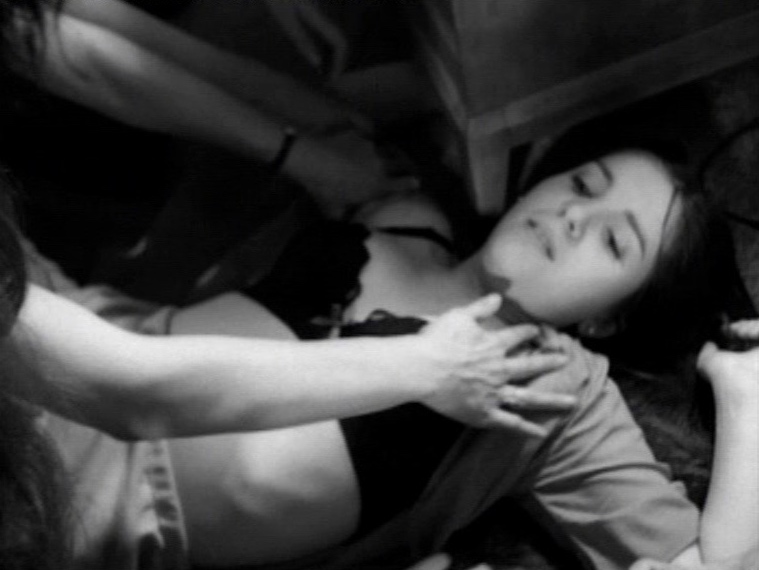
Lips of Blood (Lèvres de sang), released in 1975, marks the end of the first phase of Jean Rollin’s career as a director. This was the period in which Rollin tried to combine unconventional erotic horror with full-blooded surrealism. It’s the most interesting phase of his career.
For a while it seemed as though the financial failure of Lips of Blood would more or less end his career and this his only future would be churning out adult movies. He had a rethink and then bounced back in 1978 with Grapes of Death, which began a much more overtly commercial period.
There were various reasons for Lips of Blood box-office failure. It appeared at a time when X-rated movies were all the rage in France and the softcore erotic horror of Rollin and similar film-makers was of little interest to distributors. The movie also had a very troubled production history, with Rollin forced to work with an unenthusiastic and unco-operative crew.
Rollin co-wrote the script with the film’s star Jean-Loup Philippe. Rollin considered it to be the best script he ever filmed. In retrospect Lips of Blood is one of his best movies, a dream-like poetic vision.
The movie starts with a prologue, with a body being put into a coffin which is sealed in a room. The body is shrouded but does not appear to be dead. The significance of this prologue will not become clear until late in the movie.
A young man, Frederick (Jean-Loup Philippe), sees a photograph of an old ruin. It triggers an odd disturbing poignant childhood memory. Or does it? Frederick is sure he has never seen this ruined chateau before, but the memory is so vivid. The truth is that there are gaps in Frederick’s memories of his childhood.
Perhaps if he can find the photographer he will be able to find the chateau. The photographer tells him that she has been paid a lot of money to keep that information from him. But, if he meets her at the Aquarium at midnight, she might tell him.
The meeting at the Aquarium is a beautifully shot scene and it begins the movie’s plunge into an increasingly dream-like mood. Frederick finds it difficult to distinguish between reality, illusion, dream and memory. The memories might be true, or they might be false.
He remembers a young girl at the chateau. He was wandering lost. He was twelve at the time. She was a teenager. He developed a crush on her, as 12-year-old boys are wont to do. But his mother is evasive when he asks her about the incident now.
After the meeting at the Aquarium Frederick is pursued by a man with a gun, the pursuit being a series of strange transitions of settings.
And then the vampire girls appear. Four vampire girls. Including the Castel twins, always a bonus in a Rollin vampire movie.
Rollin was always obsessed with the past and in this movie the hero has to unravel a mystery from his own past. He does eventually do so. We do get an explanation towards the end. And then the movie takes another turn into the fantastic and the surreal with a typically poetic Rollin ending.
Rollin was definitely a surrealist but you can’t appreciate his movies unless you know something about his other obsessions. One of these obsessions could be called vintage pop fiction. Rollin loved the feuilleton, the cheap sometimes trashy always breathlessly exciting serial stories that were so hugely popular in 19th century France. Rollin was no arid intellectual. He was an intellectual, but one with a taste for the pleasures of pop culture.
His vampire movies are horror movies, but don’t expect to be terrified or confronted by buckets of blood. Rollin liked vampires because he liked the idea of the past and the present being hopelessly intertwined and vampires by their nature exist outside of time. Time has no meaning to a vampire. And Rollin also liked vampires because they were mysterious and romantic and poetic. If you compare this movie to vampire movies made by other European directors at the time, such as Jess Franco’s Female Vampire and Jose Larraz’s Vampyres (both great movies) it’s obvious that Rollin approached vampires in a very different way.
This is a movie about searching. Searching for the past, for memories, for identity, for meaning, for love. It’s both melancholy and strangely romantic.
This certainly qualifies as erotic horror. There’s an amount of female frontal nudity. But it’s part of the texture of the movie - Frederick’s memories are amalgams of lost love and eroticism. The vampires in this film are not particularly scary or evil but they are very erotic. From the time that the vampire first appeared in European literature (in Coleridge’s poem Christabel in 1797) eroticism was implicit in vampirism. Vampires symbolise both life and death and eroticism is the key to life.
The Redemption Blu-Ray offers a lovely transfer. Extras include a very brief introduction by Rollin, an informative interview with his frequent collaborator Natalie Perrey and excellent liner notes by Tim Lucas.
Lips of Blood is Rollin at his best. Very highly reommended.
Horror, sci-fi, exploitation, erotica, B-movies, art-house films. Vampires, sex, monsters, all the fun stuff.
Tuesday, 30 May 2023
Monday, 29 May 2023
70s disaster movies - The Hindenburg (1975)
I love 70s disaster movies but The Hindenburg (1975) doesn't quite come off, despite some interesting ideas.
This was a real disaster so we know exactly what's going to happen it tries to focus on why it may have happened.
Unfortunately the characters are not quite developed enough and there's no real action until the end so it fails to grab the viewer in the way it needed to.
Here's my full review at Classic Movie Ramblings.
Thursday, 25 May 2023
Chained Girls (1965)
Chained Girls is a 1965 sexploitation flick which purports to be a documentary dealing with the subject of lesbianism. So it’s a mockumentary with a very serious voiceover narration because this isn’t exploitation, this is serious social science. Yeah right.
This movie is from producer George Weiss (who produced Glen or Glenda) and was directed by New York-born Joseph P. Mawra, best known to cult film fans as the director of four of the infamous (and spectacularly entertaining) Olga movies in the mid-60s, recounting the adventures of the sexual sadist crime queen Olga.
To prove how scientific this all is we get lots of statistics, most of them made up on the spot. Some may have been lifted from semi-serious exposés of the time, who knows? We also get lots of quotes from Freud. There’s plenty of on-the-street footage of New York City in the mid-60s which is fascinating as a time capsule.
There’s hardly any nudity. A few brief topless moments and one glimpse of the delectable June Roberts’ naked bottom and that’s it. But this is sexploitation legend June Roberts we’re talking about so her bottom is certainly a welcome sight. The sex scenes are just groping and fondling and kissing and cuddling but they do at times have a certain intensity and even an odd sleazy eroticism. We get endless scenes of girls stripping to their underwear, then putting their clothes back on, and then taking them off again.
The movie makes a vague attempt to capture the feel of the lesbian sub-culture of the time, rather different from later lesbian sub-cultures, with its emphasis on a strict delineation between butches and femmes (for some reason the butches are always referred to as dykes rather than butches). It goes without saying that the film-makers’ understanding of that sub-culture is sketchy at best but that makes it more fun.
The political incorrectness levels are totally off the scale and into the stratosphere, adding yet another layer of fun. It’s hard to imagine anyone taking this movie seriously enough to be offended by it but anything is possible.
The highlights of the film are the steamy phone booth make-out scene, an incredibly violent lesbian cat-fight and the lesbian gang-rape scene. We get told about the rampaging gangs of baby butches terrorising the city but sadly we don’t get to see any actual rampaging baby butches.
The movie’s finale is the coming out party. These were, so we’re told, compulsory for newly recruited femmes. The butches draw straws to determine which of them will initiate the new femme, the initiation taking the form of the terrified femme being gang-raped. Considering that the femme has gone to a lesbian party for the specific purpose of being initiated into the joys of sapphic sex I’m not quite sure why she’s so terrified but hey, it makes a great climax.
The butches in this movie are just as pretty and feminine-looking as the femmes and the only way you can tell them apart is that the butches are the scheming and often sadistic predators. You can tell the bull dykes though since they apparently smoke pipes.
It’s a mix of “documentary” footage and staged scenes and the staged scenes are the more amusing. There are the butches in the fashion industry, crazed with lust and desperately trying to get the models out of their lingerie. There are the college girl lesbians sharing dorm rooms although disappointingly they don’t seem to do much apart from wandering about in their underwear. There are the femmes cooking and keeping house for their butch mistresses. And of course respectable housewives sneaking out for some surreptitious lesbian loving.
The fact that there’s no real sex gives the movie a rather nice overheated atmosphere of suppressed desire. It’s all girls desperately wanting to get down to some serious lesbian sex and never quite getting there but getting teased into a frenzy.
This was 1965 so yes there are a few beehive hairdos and some cool mid-60s fashions.
Chained Girls is pretty ridiculous but it’s ridiculous in an amusing way. Something Weird paired this one on DVD with Daughters of Lesbos and an abundance of lesbian-themed short subjects - it’s a veritable smorgasbord of 1960s lesbian delights (and the shorts are even better than the two features). If sapphic smut is your thing (and I’m assuming you wouldn’t have read this far if it wasn’t) then you will want this disc.
Monday, 22 May 2023
Sheena (1984)
Sheena, released in 1984, is a movie that has few defenders. That’s perhaps a bit unfair. You have to remember that Sheena Queen of the Jungle was a comic-book heroine. She made her first appearance in that form in 1937. There were later some short stories and there was a 1950s TV series but she was first and foremost a comic-book heroine. She was in fact the first ever comic-book heroine (predating Wonder Woman by several years).
If the 1984 movie has a plot that seems like something out of a comic book I’d suggest that that was probably intentional.
Sheena was certainly conceived as a female Tarzan. All the jungle girls who would feature in American movie serials in the 40s and 50s (such as the excellent 1941 Jungle Girl) and in other media are essentially descendants of Sheena.
The movie starts with a prologue. Two American doctors, a husband and wife, are in Africa (in Zambouli territory) with their young daughter Janet. Janet’s parent discover an astonishing medical secret but are killed when a mountain caves in on them. Janet, renamed Sheena, is raised by the Zambouli’s female shaman. The Zambuli see the appearance of the child as the fulfilment of a prophecy about a golden girl who will protect the tribe. Since Janet/Sheena has golden hair she must certainly be the one.
Flash forward some years and Sheena (Tanya Roberts) has grown into a gorgeous blonde jungle queen.
There is trouble in the offing. Valuable mineral deposits have been found in Zambouli territory. The king of Tigora (which includes the Zambouli lands) respects the wishes of the Zambouli and will not allow mining in their lands. The king’s younger brother Prince Otwani however sees the chance to make a lot of money. If only he could get the king out of the way.
The king’s financée Zanda has a plan. She’s having an affair with Prince Otwani and she’d like the king out of the way as well. Her plan is to have the king killed and frame the Zambouli shaman for the crime.
A couple of American TV sports reporters are in Tigora doing a story on Prince Otwani, who had spent a lot of time in the States and had been a major football star. They accidentally get the assassination on videotape.
The shaman is arrested and imprisoned but Zanda and the prince had reckoned without Sheena, and Sheena’s animal allies.
Sheena and TV sports reporter Vic Casey (Ted Wass) find themselves on the run from the mercenaries hired by the prince. It all seems hopeless when they’re both captured but Sheena has the entire jungle on her side.
This is essentially a light kids’ adventure movie. It flopped at the time and critics hated it. Maybe U.S. audiences were not ready for big-budget comic-book movies. Or maybe the problem was that it wasn’t quite clear what the target audience was. It has a comic-book feel and while there’s lots of action much of that action has a Saturday morning kids’ TV feel to it. But the body count is rather high for such a movie and some of the violence is a bit graphic for a kids’ audience.
There’s also the nude scene. I’m the last person in the world to complain about a nude scene, especially when it’s Tanya Roberts getting naked. And it’s a very tasteful, innocent and rather charming nude scene. And it does serve a purpose, since Sheena at the time is only just beginning to become aware of herself as a woman. On the other hand the nudity might have made the distributors nervous about promoting Sheena as a kids’ movie.
You could argue that either the violence should have been toned down and the nudity dropped in order to make it more overtly family-friendly, or alternatively the violence and the nudity should have been amped up to aim for an older drive-in movie audience.
As it stands it’s still a likeable enjoyable jungle girl romp. It’s nicely paced and the location shooting in Kenya is impressive.
Tanya Roberts was given a hard time but critics for this movie but I think her performance is fine. Sheena is supposed to be a bit odd, a mixture of wildness and innocence, of naïvete and wisdom, and for my money Roberts gets that across effectively.
There’s nothing really wrong about any of the performances. Nobody was taking things too seriously and the performances reflect that, but it’s not a movie that we’re supposed to take seriously.
I have to be honest. I liked this movie quite a bit. Highly recommended.
If the 1984 movie has a plot that seems like something out of a comic book I’d suggest that that was probably intentional.
Sheena was certainly conceived as a female Tarzan. All the jungle girls who would feature in American movie serials in the 40s and 50s (such as the excellent 1941 Jungle Girl) and in other media are essentially descendants of Sheena.
The movie starts with a prologue. Two American doctors, a husband and wife, are in Africa (in Zambouli territory) with their young daughter Janet. Janet’s parent discover an astonishing medical secret but are killed when a mountain caves in on them. Janet, renamed Sheena, is raised by the Zambouli’s female shaman. The Zambuli see the appearance of the child as the fulfilment of a prophecy about a golden girl who will protect the tribe. Since Janet/Sheena has golden hair she must certainly be the one.
Flash forward some years and Sheena (Tanya Roberts) has grown into a gorgeous blonde jungle queen.
There is trouble in the offing. Valuable mineral deposits have been found in Zambouli territory. The king of Tigora (which includes the Zambouli lands) respects the wishes of the Zambouli and will not allow mining in their lands. The king’s younger brother Prince Otwani however sees the chance to make a lot of money. If only he could get the king out of the way.
The king’s financée Zanda has a plan. She’s having an affair with Prince Otwani and she’d like the king out of the way as well. Her plan is to have the king killed and frame the Zambouli shaman for the crime.
A couple of American TV sports reporters are in Tigora doing a story on Prince Otwani, who had spent a lot of time in the States and had been a major football star. They accidentally get the assassination on videotape.
The shaman is arrested and imprisoned but Zanda and the prince had reckoned without Sheena, and Sheena’s animal allies.
Sheena and TV sports reporter Vic Casey (Ted Wass) find themselves on the run from the mercenaries hired by the prince. It all seems hopeless when they’re both captured but Sheena has the entire jungle on her side.
This is essentially a light kids’ adventure movie. It flopped at the time and critics hated it. Maybe U.S. audiences were not ready for big-budget comic-book movies. Or maybe the problem was that it wasn’t quite clear what the target audience was. It has a comic-book feel and while there’s lots of action much of that action has a Saturday morning kids’ TV feel to it. But the body count is rather high for such a movie and some of the violence is a bit graphic for a kids’ audience.
There’s also the nude scene. I’m the last person in the world to complain about a nude scene, especially when it’s Tanya Roberts getting naked. And it’s a very tasteful, innocent and rather charming nude scene. And it does serve a purpose, since Sheena at the time is only just beginning to become aware of herself as a woman. On the other hand the nudity might have made the distributors nervous about promoting Sheena as a kids’ movie.
You could argue that either the violence should have been toned down and the nudity dropped in order to make it more overtly family-friendly, or alternatively the violence and the nudity should have been amped up to aim for an older drive-in movie audience.
As it stands it’s still a likeable enjoyable jungle girl romp. It’s nicely paced and the location shooting in Kenya is impressive.
Tanya Roberts was given a hard time but critics for this movie but I think her performance is fine. Sheena is supposed to be a bit odd, a mixture of wildness and innocence, of naïvete and wisdom, and for my money Roberts gets that across effectively.
There’s nothing really wrong about any of the performances. Nobody was taking things too seriously and the performances reflect that, but it’s not a movie that we’re supposed to take seriously.
I have to be honest. I liked this movie quite a bit. Highly recommended.
Sheena finally gets a decent anamorphic DVD release, from Umbrella in Australia. It looks lovely.
Incidentally the 1955 TV series Sheena Queen of the Jungle is worth a look if only for Irish McCalla in the title role.
Friday, 19 May 2023
Shocking Dark (1989)
Bruno Mattei’s Shocking Dark is a 1989 Italian rip-off of Aliens (and to a lesser extent The Terminator). In fact it was at one point released as Terminator II (a decision made by the producers without consulting the director or the writers).
There was nothing new about Italian film-makers ripping off popular movies. In the 70s they made lots of Exorcist rip-offs. And later some Star Wars rip-offs. But Shocking Dark is something new. It doesn’t just borrow ideas from other movies. Most of the movie is pretty much an exact copy of Aliens.
This movie doesn’t even pretend to be an homage to other movies. It’s more like grand larceny.
Of course the problem with exactly copying another movie is that once the audience figures out that that is what you are doing (and in this case it’s obvious by the time you’re a few minutes into the film) then they can pretty much predict everything that is going to happen. That is a problem here but it does get solved towards the end of the movie when the plot finally stops slavishly copying the plot of Aliens. This is the point at which one finally realises that this is also a rip-off of The Terminator, and also of the original Alien.
The setting at least is different, and it’s interesting. It all takes place in a vast complex of tunnels beneath the city of Venice. This is some time in the future when the lagoon has become so toxic that the city is entirely a dead city and has been evacuated.
The complex beneath the city was constructed by the Tubular Corporation. It was part of a plan to restore the city to life.
There are still a few people alive in the city. There’s a small team of scientists under Dr Raphelson working in that underground complex. But something has gone very wrong. Garbled bizarre distress calls have been picked up from Dr Raphelson’s party.
A team of crack soldiers from the Megaforce is dispatched on a rescue mission. They’re more or less like the Space Marines of Aliens. The team includes Private Koster, who is exactly like Private Vasquez in Aliens except she’s black rather than a Latina. But apart from that she’s a carbon copy of Vasquez.
Accompanying the Megaforce team is scientist Sara (this movie’s equivalent of Ripley) and a representative of the Tubular Corporation, Samuel Fuller (the equivalent of Burke in Aliens).
Naturally the Megaforce squad encounters monsters. They’re just like the monsters in Aliens, except they’re not aliens. But they operate the same way.
And naturally there’s a little girl to be rescued, Samantha (the equivalent of Aliens’ Newt).
Of course the Megaforce squad gets badly mangled by the monsters. They do however discover where those monsters came from. At which point the movie starts to depart from the Aliens template, and the Terminator angle finally kicks in. Sara and Samantha face a race against time, rather as Ripley faced in Alien.
Of course the special effects are not on par with Aliens, but they’re not too bad apart from the monsters which are very cheesy. The movie looks more impressive than you might expect considering it would have made for a tiny fraction of the budget that James Cameron had.
A lot of the scenes were shot underneath a railway station and in a semi-abandoned nuclear power plant. They’re good settings and they’re used well. The action scenes are exciting.
The ending works for me.
Severin’s DVD release (they’ve put it out on Blu-Ray as well) offers a good transfer with a few extras.
While it’s basically a stew composed of elements from three big-budget movies it all comes together in a reasonably entertaining way. Not a great movie by any means but if you have plenty of beer and popcorn on hand it’s recommended.
There was nothing new about Italian film-makers ripping off popular movies. In the 70s they made lots of Exorcist rip-offs. And later some Star Wars rip-offs. But Shocking Dark is something new. It doesn’t just borrow ideas from other movies. Most of the movie is pretty much an exact copy of Aliens.
This movie doesn’t even pretend to be an homage to other movies. It’s more like grand larceny.
Of course the problem with exactly copying another movie is that once the audience figures out that that is what you are doing (and in this case it’s obvious by the time you’re a few minutes into the film) then they can pretty much predict everything that is going to happen. That is a problem here but it does get solved towards the end of the movie when the plot finally stops slavishly copying the plot of Aliens. This is the point at which one finally realises that this is also a rip-off of The Terminator, and also of the original Alien.
The setting at least is different, and it’s interesting. It all takes place in a vast complex of tunnels beneath the city of Venice. This is some time in the future when the lagoon has become so toxic that the city is entirely a dead city and has been evacuated.
The complex beneath the city was constructed by the Tubular Corporation. It was part of a plan to restore the city to life.
There are still a few people alive in the city. There’s a small team of scientists under Dr Raphelson working in that underground complex. But something has gone very wrong. Garbled bizarre distress calls have been picked up from Dr Raphelson’s party.
A team of crack soldiers from the Megaforce is dispatched on a rescue mission. They’re more or less like the Space Marines of Aliens. The team includes Private Koster, who is exactly like Private Vasquez in Aliens except she’s black rather than a Latina. But apart from that she’s a carbon copy of Vasquez.
Accompanying the Megaforce team is scientist Sara (this movie’s equivalent of Ripley) and a representative of the Tubular Corporation, Samuel Fuller (the equivalent of Burke in Aliens).
Naturally the Megaforce squad encounters monsters. They’re just like the monsters in Aliens, except they’re not aliens. But they operate the same way.
And naturally there’s a little girl to be rescued, Samantha (the equivalent of Aliens’ Newt).
Of course the Megaforce squad gets badly mangled by the monsters. They do however discover where those monsters came from. At which point the movie starts to depart from the Aliens template, and the Terminator angle finally kicks in. Sara and Samantha face a race against time, rather as Ripley faced in Alien.
Of course the special effects are not on par with Aliens, but they’re not too bad apart from the monsters which are very cheesy. The movie looks more impressive than you might expect considering it would have made for a tiny fraction of the budget that James Cameron had.
A lot of the scenes were shot underneath a railway station and in a semi-abandoned nuclear power plant. They’re good settings and they’re used well. The action scenes are exciting.
The ending works for me.
Severin’s DVD release (they’ve put it out on Blu-Ray as well) offers a good transfer with a few extras.
While it’s basically a stew composed of elements from three big-budget movies it all comes together in a reasonably entertaining way. Not a great movie by any means but if you have plenty of beer and popcorn on hand it’s recommended.
Monday, 15 May 2023
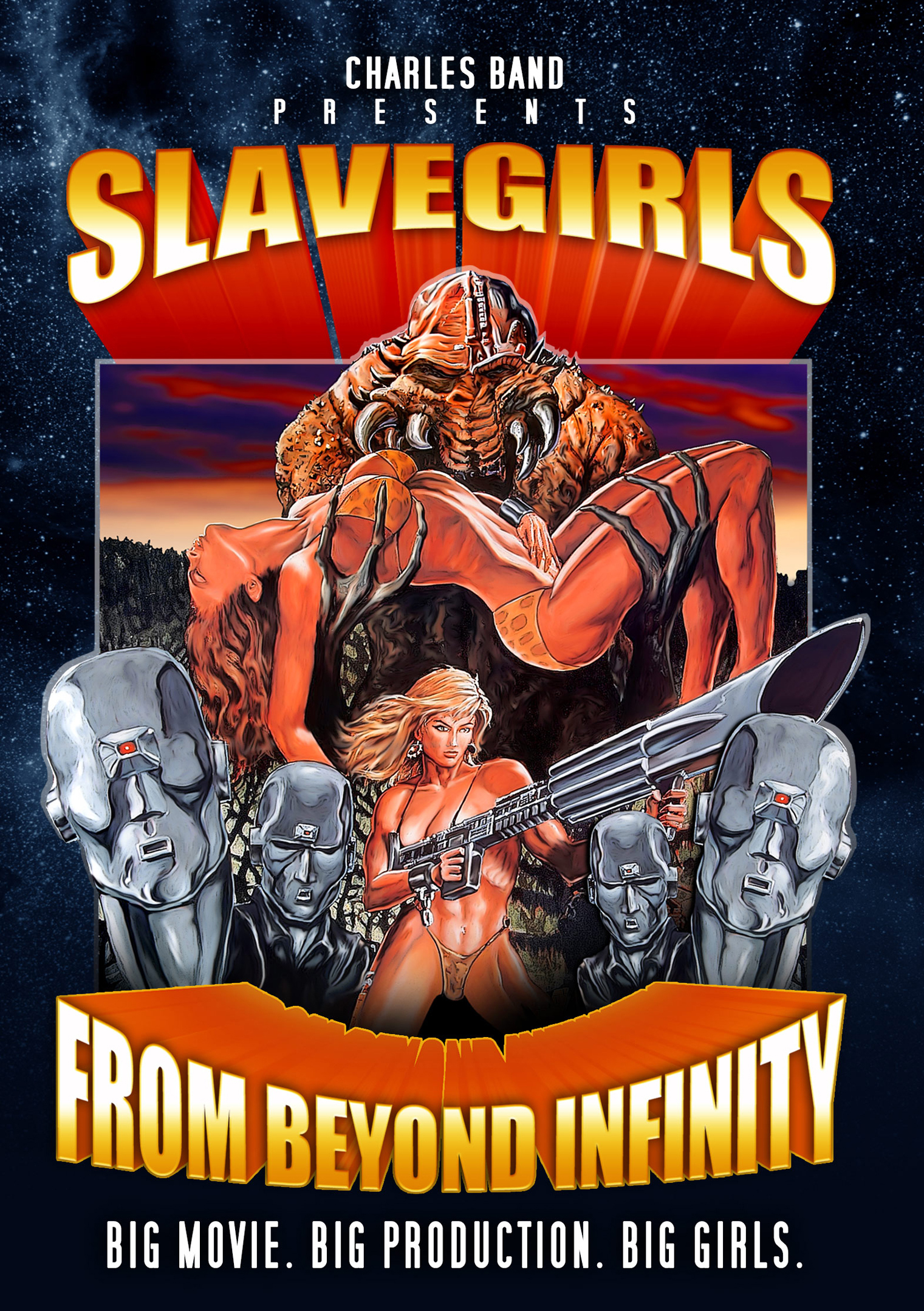
Slave Girls from Beyond Infinity (1987)
Most of the time I watch movies purely for entertainment. But occasionally I want a movie with a bit more substance and depth to it. Something a bit arty and intellectual. Which of course made Slave Girls from Beyond Infinity an ideal choice for tonight’s viewing.
This movie is one of countless movie adaptations of Richard Connell’s classic 1924 adventure thriller story The Most Dangerous Game.
The movie does indeed begin with two slave girls, Daria (Elizabeth Kaitan) and Tisa (Cindy Beal). They’re being held in a dungeon on a prison planet. But they don’t remain prisoners very long. They escape with ridiculous ease and steal a spaceship with even more ridiculous ease.
Sadly things go wrong and the girls crash-land on a remote uncharted planet. To be more specific, on an island on a remote planet.
The girls are unharmed and there’s a house on the island. Zed (Don Scribner) tells them they’re welcome to stay. Zed lives alone in the house with two robot servants but at the moment he was two other guests, Rik (Carl Honer) and his sister Shala (Brinke Stevens). Zed entertains his guest with hunting stories. He likes to hunt. He has lots of trophies.
If you’ve read Connell’s story or seen any of the multitude of movie and TV adaptations you’ll already have figured out that this is yet another version and you’ll know what it is that Zed likes to hunt.
Rik has his suspicions which he confides to out two heroines. There were four people on the ship in which he and his sister were wrecked. All four survived but two have since disappeared after joining Zed on hunting trips. Rik suspects that he’ll be next.
His suspicions are well founded. And then Daria and Tisa find themselves as Zed’s intended prey. He gives them a sporting chance. There’s a ruined temple containing a cache of sophisticated weaponry. If they can reach the temple the odds will shift in their favour. Zed likes a challenge, and he believes that women can be even more dangerous than men so he expects to enjoy that challenge.
The acting is what you expect. Don Scribner tries to play Zed as a charming psychopath, with some success. Elizabeth Kaitan and Cindy Beal can’t really act at all but they’re likeable.
There are several ways in which a movie such as this could have been approached. It could have been done as a gorefest, or as a sleazefest. I was rather expecting a sleazy women-in-prison movie but it contains absolutely none of the features that define that scuzzy but entertaining genre. This movie does not take any of these obvious approaches. The gore quotient is extremely low. There are a couple of brief topless scenes but that’s the extent of the nudity. There’s one sex scene but the guy keeps his trousers on and the girl keeps her panties on. The girls have some scary experiences but they’re not brutalised.
This is an extraordinarily tame movie. I can only surmise that the idea was to avoid an R rating at all costs.
Amazingly this ultra-tame movie aroused controversy in the U.S. Senate when it was shown on cable.
Slave Girls from Beyond Infinity doesn’t offer buckets of blood or any more than very mild nudity and it doesn’t boast spectacular action sequences so what does it have to offer? Mostly it’s the sheer likeability of the two girls and the good-natured tongue-in-cheek cheerful silliness of the whole exercise.
It’s a movie that offers mildly amusing mildly exciting fun which doesn’t make you feel like you need to take a shower afterwards. The two lead actresses do wear very skimpy costumes and they are pretty. Pretty in a natural way - there are no silicon-enhanced breasts in this movie.
The first significant film adaptation of Connell’s story was made in the pre-code era - The Most Dangerous Game (1932). Other versions which added varying degrees of trashiness (in a good way) are Bloodlust! (1961) and Seven Women for Satan (1976).
Full Moon’s DVD presentation offers a good anamorphic transfer. The only extra is a collection of snippets from Elizabeth Kaitan’s other movies. And Full Moon have released this movie on Blu-Ray as well!
Slave Girls from Beyond Infinity is pretty mild stuff but it has a certain goofy charm. Plus Zed's robots and the cheesy special effects are fun. It’s entertaining if you’re in the mood. I was in the right mood so I enjoyed it. It will never make anybody’s greatest movies of all time list but I’m still going to recommend it.
This movie is one of countless movie adaptations of Richard Connell’s classic 1924 adventure thriller story The Most Dangerous Game.
The movie does indeed begin with two slave girls, Daria (Elizabeth Kaitan) and Tisa (Cindy Beal). They’re being held in a dungeon on a prison planet. But they don’t remain prisoners very long. They escape with ridiculous ease and steal a spaceship with even more ridiculous ease.
Sadly things go wrong and the girls crash-land on a remote uncharted planet. To be more specific, on an island on a remote planet.
The girls are unharmed and there’s a house on the island. Zed (Don Scribner) tells them they’re welcome to stay. Zed lives alone in the house with two robot servants but at the moment he was two other guests, Rik (Carl Honer) and his sister Shala (Brinke Stevens). Zed entertains his guest with hunting stories. He likes to hunt. He has lots of trophies.
If you’ve read Connell’s story or seen any of the multitude of movie and TV adaptations you’ll already have figured out that this is yet another version and you’ll know what it is that Zed likes to hunt.
Rik has his suspicions which he confides to out two heroines. There were four people on the ship in which he and his sister were wrecked. All four survived but two have since disappeared after joining Zed on hunting trips. Rik suspects that he’ll be next.
His suspicions are well founded. And then Daria and Tisa find themselves as Zed’s intended prey. He gives them a sporting chance. There’s a ruined temple containing a cache of sophisticated weaponry. If they can reach the temple the odds will shift in their favour. Zed likes a challenge, and he believes that women can be even more dangerous than men so he expects to enjoy that challenge.
The acting is what you expect. Don Scribner tries to play Zed as a charming psychopath, with some success. Elizabeth Kaitan and Cindy Beal can’t really act at all but they’re likeable.
There are several ways in which a movie such as this could have been approached. It could have been done as a gorefest, or as a sleazefest. I was rather expecting a sleazy women-in-prison movie but it contains absolutely none of the features that define that scuzzy but entertaining genre. This movie does not take any of these obvious approaches. The gore quotient is extremely low. There are a couple of brief topless scenes but that’s the extent of the nudity. There’s one sex scene but the guy keeps his trousers on and the girl keeps her panties on. The girls have some scary experiences but they’re not brutalised.
This is an extraordinarily tame movie. I can only surmise that the idea was to avoid an R rating at all costs.
Amazingly this ultra-tame movie aroused controversy in the U.S. Senate when it was shown on cable.
Slave Girls from Beyond Infinity doesn’t offer buckets of blood or any more than very mild nudity and it doesn’t boast spectacular action sequences so what does it have to offer? Mostly it’s the sheer likeability of the two girls and the good-natured tongue-in-cheek cheerful silliness of the whole exercise.
It’s a movie that offers mildly amusing mildly exciting fun which doesn’t make you feel like you need to take a shower afterwards. The two lead actresses do wear very skimpy costumes and they are pretty. Pretty in a natural way - there are no silicon-enhanced breasts in this movie.
The first significant film adaptation of Connell’s story was made in the pre-code era - The Most Dangerous Game (1932). Other versions which added varying degrees of trashiness (in a good way) are Bloodlust! (1961) and Seven Women for Satan (1976).
Full Moon’s DVD presentation offers a good anamorphic transfer. The only extra is a collection of snippets from Elizabeth Kaitan’s other movies. And Full Moon have released this movie on Blu-Ray as well!
Slave Girls from Beyond Infinity is pretty mild stuff but it has a certain goofy charm. Plus Zed's robots and the cheesy special effects are fun. It’s entertaining if you’re in the mood. I was in the right mood so I enjoyed it. It will never make anybody’s greatest movies of all time list but I’m still going to recommend it.
Labels:
1980s,
adventure,
cult comedies,
sci-fi,
women in prison
Friday, 12 May 2023
The Snake Girl and the Silver-Haired Witch (1968)
The Snake Girl and the Silver-Haired Witch is a 1968 Japanese horror movie and it’s totally crazy. It was directed by Noriaki Yuasa.
Sayuri lives in an orphanage run by Catholic nuns. She’s not really an orphan. Her mother was involved in a serious car accident and lost her memory. Sayuri’s parents could not cope with raising their daughter so they put her in the care of the nuns.
Sayuri’s mother’s condition has now improved and she’s going home. She’s understandably very excited.
Sayuri’s dad is a scientist, specialising in the study of venomous reptiles. He’s off to Africa for a particularly important study and plays no part in the story about to unfold.
Her father’s laboratory is off-limits (it’s full of venomous snakes) but naturally Sayuri sneaks in to have a look.
Some slightly disturbing things start to happen. She thinks that someone has thrown a snake into her bed. And then there’s her sister Tamami. She had no idea she had a sister. Her older brother didn’t know either. But there is a sister. And the sister is rather strange.
Sayuru comes to believe that Tamami is a snake girl, but no-one believes her.
Sayuri sees snakes everywhere. She sees a girl with scales like a snake. And there’s a witch as well.
It’s obvious that Sayuri is in danger. It’s possible that her mother is in danger too. This is a kind of revenge story but it takes a while to find out exactly what the revenge is for, and who might be the principal target.
Things get steadily stranger and more frightening. Tamami seems to hate Sayuri for some reason.
And slowly Tamami’s backstory is revealed.
This is not really a horror movie in a conventional sense. It’s more of a dark fairy tale movie but there are other things going on.
The special effects and makeup effects are incredibly cheesy, but given the fairy tale feel of the story that’s perhaps more a feature than a bug. Realistic visceral horror effects would have wrecked the strange dreamlike atmosphere.
The movie was shot in black-and-white in the 2.35:1 aspect ratio. Filming it in black-and-white was perhaps a slightly curious decision (it may of course have been entirely due to budgetary restrictions). It does work in a way since it emphasises the artificiality of the movie.
The acting is OK. Given the oddness of the movie it’s possible that it needed actors who weren’t all that great, again in order to emphasise the artificiality. In this case it’s actresses rather than actors who take centre stage - all the key characters are female. It’s a very female-centric movie with a focus on female emotions.
The plot doesn’t make much sense but that’s possibly deliberate - we’re seeing everything through the eyes of a ten-year-old girl and she has no idea what is going on. She isn’t even entirely sure if all the things she sees are real. Maybe the grownups who tell her she’s imagining things are right. And of course the audience can’t be sure whether she’s a reliable narrator - she’s not lying but she could be seriously misinterpreting what she sees.
This film is available on DVD. The good news is that it’s in the correct aspect ratio and it’s 16:9 enhanced. The bad news is that it’s not a very good transfer. Contrast isn’t great and the darker the scene the worse the image quality, a real problem in a movie with so many scenes taking place at night. There’s now an Arrow Blu-Ray release and while I haven’t seen that edition I suspect that it’s the one to go for.
The DVD is in Japanese with English subtitles.
The Snake Girl and the Silver-Haired Witch is one weird movie. It’s all very low-budget and it’s not exactly technically polished but it certainly succeeds in creating an atmosphere of childish nightmare. It’s not really scary but it’s creepy at times. It’s worth seeing for its appealing strangeness. Recommended.
Sayuri lives in an orphanage run by Catholic nuns. She’s not really an orphan. Her mother was involved in a serious car accident and lost her memory. Sayuri’s parents could not cope with raising their daughter so they put her in the care of the nuns.
Sayuri’s mother’s condition has now improved and she’s going home. She’s understandably very excited.
Sayuri’s dad is a scientist, specialising in the study of venomous reptiles. He’s off to Africa for a particularly important study and plays no part in the story about to unfold.
Her father’s laboratory is off-limits (it’s full of venomous snakes) but naturally Sayuri sneaks in to have a look.
Some slightly disturbing things start to happen. She thinks that someone has thrown a snake into her bed. And then there’s her sister Tamami. She had no idea she had a sister. Her older brother didn’t know either. But there is a sister. And the sister is rather strange.
Sayuru comes to believe that Tamami is a snake girl, but no-one believes her.
Sayuri sees snakes everywhere. She sees a girl with scales like a snake. And there’s a witch as well.
It’s obvious that Sayuri is in danger. It’s possible that her mother is in danger too. This is a kind of revenge story but it takes a while to find out exactly what the revenge is for, and who might be the principal target.
Things get steadily stranger and more frightening. Tamami seems to hate Sayuri for some reason.
And slowly Tamami’s backstory is revealed.
This is not really a horror movie in a conventional sense. It’s more of a dark fairy tale movie but there are other things going on.
The special effects and makeup effects are incredibly cheesy, but given the fairy tale feel of the story that’s perhaps more a feature than a bug. Realistic visceral horror effects would have wrecked the strange dreamlike atmosphere.
The movie was shot in black-and-white in the 2.35:1 aspect ratio. Filming it in black-and-white was perhaps a slightly curious decision (it may of course have been entirely due to budgetary restrictions). It does work in a way since it emphasises the artificiality of the movie.
The acting is OK. Given the oddness of the movie it’s possible that it needed actors who weren’t all that great, again in order to emphasise the artificiality. In this case it’s actresses rather than actors who take centre stage - all the key characters are female. It’s a very female-centric movie with a focus on female emotions.
The plot doesn’t make much sense but that’s possibly deliberate - we’re seeing everything through the eyes of a ten-year-old girl and she has no idea what is going on. She isn’t even entirely sure if all the things she sees are real. Maybe the grownups who tell her she’s imagining things are right. And of course the audience can’t be sure whether she’s a reliable narrator - she’s not lying but she could be seriously misinterpreting what she sees.
This film is available on DVD. The good news is that it’s in the correct aspect ratio and it’s 16:9 enhanced. The bad news is that it’s not a very good transfer. Contrast isn’t great and the darker the scene the worse the image quality, a real problem in a movie with so many scenes taking place at night. There’s now an Arrow Blu-Ray release and while I haven’t seen that edition I suspect that it’s the one to go for.
The DVD is in Japanese with English subtitles.
The Snake Girl and the Silver-Haired Witch is one weird movie. It’s all very low-budget and it’s not exactly technically polished but it certainly succeeds in creating an atmosphere of childish nightmare. It’s not really scary but it’s creepy at times. It’s worth seeing for its appealing strangeness. Recommended.
Labels:
1960s,
gothic horrors,
japanese horror,
witchcraft movies
Subscribe to:
Posts (Atom)


.jpg)
.jpg)
.jpg)
.jpg)


.jpg)
.jpg)
.jpg)
.jpg)