Horror, sci-fi, exploitation, erotica, B-movies, art-house films. Vampires, sex, monsters, all the fun stuff.
Tuesday, 18 August 2026
The Haunted Castle (1969)
The setting is the 18th century, during the Tokugawa Shogunate. Almost all the action takes place in the castle, Saga Castle, occupied by Lord Nabeshima.
This film belongs to the fascinating bakeneko or “ghost cat” or “shape-shifting cat” genre. Yes, it’s an entire genre in both Japanese folklore and Japanese gothic horror cinema. And yes, I could easily become obsessed by this genre.
And, fascinatingly, I believe this was director Tokuzô Tanaka’s second “ghost cat” movie, the first having been made in 1958 (and also for Daiei Studio).
The Haunted Castle is based on a legend which, as in so many such cases, was widely believed to have its origins in actual events. Shôzaburô Asai wrote the screenplay,
The Ryuzoji clan was robbed of its lands and wealth by the scheming Lord Nabeshima (Kôichi Uenoyama). The blind Matashichiro Ryuzoji (Akihisa Toda) and his sister Sayo (Mitsuyo Kamei) now live on a small stipend.
Matashichiro is devoted to his pet cat Tama. This will become important.
Now Lord Nabeshima wants Sayo as one of his concubines. Matashichiro refuses to allow it. This refusal will lead to the deaths of both Matashichiro and his sister.
Before she does Sayo remembers a legend concerning cats and vengeful spirits. There is a way that Tama can exact vengeance on Sayo’s behalf.
The feline campaign of revenge begins.
The major weakness here is that some of the special effects involving the cat are rather feeble for fortunately Tanaka is smart enough to make these sequences extremely brief.
This is a movie that relies on moody cinematography and a general atmosphere of subtle menace rather than on gore. There is some gore but it’s not the dominating element.
It was shot in colour but it looks dark and shadowy. The action takes place almost entirely at night.
The movie also relies on some very clever set design. We never really get a film sense of the layout of the castle and this is undoubtedly deliberate. There are lots of shots of corridors but we’re never quite sure where they’re leading to.
Often we hear movement rather seeing it. Mostly we hear the cat but without seeing it.
And there’s something else going on. This is not just a demonic cat. This is a shape-shifting vengeful cat spirit.
Fear stalks the corridors of Saga Castle but no-one is quite sure what it is that they have to fear. There have been gruesome but inexplicable killings.
No-one trusts anyone else. That ghost cat may have assumed human form.
As with most Japanese gothic horror the makeup effects are impressive.
And the lapping of blood is nicely creepy.
Japanese gothic horror films have a flavour of their own and The Haunted Castle is a solid example of the breed. Recommended.
The Radiance Films Blu-Ray transfer looks lovely. There are three movies in this set. The Haunted Castle comes with a few reasonably interesting extras.
I’ve reviewed the other two movies in this set - The Demon of Mount Oe (1960, also directed by Tokuzô Tanaka) and Ghost of Kasane Swamp (1970).
Monday, 6 July 2026
Ghost of Kasane Swamp (1970)
Shinkei Kasanegafuchi has been filmed many times, the first version being a 1924 silent film. A famous version directed by Nobuo Nakagawa was made in 1957.
Kimiyoshi Yasuda directed two versions for Daiei Studio, a black-and-white 1960 film and a colour 1970 version, Ghost of Kasane Swamp.
It’s that 1970 version we’re concerned with here.
These events clearly take place during the period of the Tokugawa Shogunate (1603-1868).
A penniless samurai, Fukami, is heavily in debt to blind masseur and money-lender Soetsu. The samurai consoles himself by sleeping with the housemaid, Okuma. Then he comes up with a plan. He will offer Soetsu the use of his wife Sawano’s body in payment of the debt. He will then catch them in the act, play the outraged husband, and kill them both. This way he gets rid of a wife he’s grown tired of and he doesn’t have to pay the debt.
As a result of this murder a considerable amount of money belonging to Soetsu comes into circulation. Some of it falls into the hands of Soetsu’s daughter Oshiga. She’s a whore but she can now buy the brothel in which she works and set herself up as the madam.
The samurai’s son Shingoro has now shown up. He had been estranged from his father for years.
That initial double murder will set in motion a whole series of dramas. There are certainly ghosts seeking vengeance but it’s the dark motivations of the various characters that cause most of the trouble. Some are motivated by greed, some by revenge, some by lust. And some by a combination of all three.
It’s not just revenge but in many cases an obligation to seek revenge. An obligation which some of the characters carry out while others evade that duty.
There will be more murders, and many betrayals. There will be complex interlocking sexual relationships with plenty of potential for jealousy and mistrust.
Shingoro gets romantically involved with Oshiga. That later becomes a romantic triangle and in the meantime he encounters Okuma who is enraged that the money she stole has been stolen from her. Shingoro gets mixed up with Oshiga’s sister Osona as well. The possibilities for betrayal multiply.
While most of the characters’ woes stem from their own failings that does not mean that this is one of those movies in which there are no actual supernatural elements and characters are simply haunted by their own guilt. There are ghosts here although apparently earlier movie versions put more focus on the ghosts.
In this version it would appear that the ghosts mostly exert their influence indirectly although they do appear to the various characters at various times. And by the end of the story there are more than just two ghosts.
By 1970 audience expectations were changing and this time around Kimiyoshi Yasuda decided to put more emphasis on gore (although it’s moderate gore by later standards) and sex. This works quite well since sex is always an effective motivation in a horror film.
This is not a story in which the poor and downtrodden are exploited by the rich and powerful. There are no great feudal lords. Soetsu has money but no social status. Fukami clings to a semblance of social status but is penniless. Nobody has any money, unless they can get their hands on some of Soetsu’s money. They are all, male and female, just barely managing to survive.
This is a sordid tale and that gives it a nicely lurid feel.
Sadly a year after this film was released Daiei Studio went bankrupt. Television had had a devastating effect on the Japanese film industry.
Ghost of Kasane Swamp is fine rather sleazy gothic horror and it’s highly recommended.
The Radiance Films Blu-Ray transfer looks lovely. There are three movies in this set. The accompanying booklet includes a brief moderately interesting essay.
I’ve also reviewed The Demon of Mount Oe from this set.
Thursday, 11 June 2026
The Demon of Mount Oe (1960)
It’s based on a folk tale dating back at least to the 14th century. The director and the writers of the film have made sweeping changes to the story, presumably to a large degree to make it more appealing as a commercial feature film.
The movie begins with the cruel ruthless kampaku (a high court official) deciding to rid himself of his concubine, the Lady Nagisa. Not because she no longer appeals to him but because she is cursed. We will later discover that she was cursed by her husband who felt that having been dishonoured she had dishonoured herself further by not choosing death. The kampaku sends her to the chief of the Genji clan. He already has a concubine, Kotsuma, who is now worried that the Lady Nagisa, with her exquisite court manners, will outshine her.
The district is being terrorised by shape-changing demons and bandits. The demon lord Shuten-Doji (Kazuo Hasegawa) shares his impregnable mountain lair with the female demon Ibaragi.
The Genji general Raikô has the task of destroying this nest of bandits and demons. He will need Kotsuma’s help because there is a legend that only a woman can bring about the destruction of the demon lord.
Raikô has already had an encounter with Ibaragi during which he cut her arm off. She is very very annoyed about this.
There will be be epic battles between Raikô’s soldiers and the bandit army and several nasty battles against demons who have assumed monstrous forms (such as a gigantic spider).
So there certainly are unequivocally supernatural forces at work.
But there’s more than that going on. There are power struggles. There are several intersecting love stories. There is love betrayed, but it turns out to be less simple than that.
There are questions of honour and some of the characters will find that their attempts to behave honourably have had unfortunate consequences.
What seemed likely to be a straightforward good vs evil story gradually becomes much more complex with lots of shades of grey. Good characters do not necessarily always behave well and wicked characters are not necessarily as purely wicked as we thought.
This is a movie that makes no concessions to realism. This is a world from folklore, a fantasy world. It does not matter if the special effects are realistic because nothing in this film is supposed to look realistic. What does matter is that the special effects do look cool.
The visuals achieve just the right feel, as if we have stepped into another world.
This is like a fairy tale but with psychologically complex characters so the actors need to demonstrate some subtlety whilst still seeming like figures out of legend. They all do a fine job with Kazuo Hasegawa being especially impressive.
The Demon of Mount Oe is very ambitious. It tries to be more than just a supernatural tale and it succeeds pretty well. It’s unconventional approach makes it highly recommended
The Radiance Films Blu-Ray transfer looks lovely. There are three movies in this set. The accompanying booklet includes a brief moderately interesting essay on The Demon of Mount Oe but this is a movie that really needed an audio commentary. A bit of background on the historical background and on the Japanese concept of demons (very very different from the western concept) would I am sure have been welcomed by most viewers. I've also reviewed Ghost of Kasane Swamp (1970) from this set.
Tuesday, 7 October 2025
The Bride from Hades (1968)
It is necessary to keep in mind that ghosts in Japanese and Chinese folklore are not like western ghosts. They are corporeal. They can eat and drink. You can touch them. You can even have sex with them although it may not be advisable to do so. You can become emotionally involved with a ghost.
The setting is clearly sometime during the Tokugawa Shogunate.
Zenjiro, the ambitious second son of an important lord, married the daughter of a shogunate elder. It was a very advantageous match. Sadly Zenjiro died in an accident soon afterwards. Now the family has to decide what to do with his young widow. They do not want to give up the connection to the shogunate. The ideal solution would be for her to marry Zenjiro’s younger brother Shinzaburô. It would be a fine marriage for the young man. Shinzaburô does not seem to see it that way.
At a religious festival he encounters a young lady and her maid. Later they come to visit him unexpectedly. The maid, Oyone, unfolds a strange tale.
Her mistress Otsuyu is a high-born young lady but as a result of family misfortunes she was sold into a geisha house. She claims that she is still a virgin. Given the very complicated nature of the institution of the geisha that might be plausible. Either way she is being put under unbearable pressure to surrender her virginity to a customer.
Otsuyu also goes under another name in her professional life, a name taken from a species of beetle that changes its appearance dramatically in different lighting conditions. Perhaps this is a clue that Otsuyu’s story should not necessarily be taken at face value.
Then Shinzaburô makes an unnerving discovery. Otsuyu and Oyone have both been dead for a year. This is particularly unsettling in view of the fact that he’s had sex with Otsuyu. Having sex with a ghost is generally considered to be unwise.
What’s worse is that he has fallen in love with her.
But what does Otsuyu want? Ghosts in Japanese (and Chinese) folklore are not necessarily evil in a straightforward sense but consorting with them can be dangerous in various ways.
Japanese ghosts can fall in love with the living - is Otsuyu in love with him? She is certainly giving him that impression.
Shinzaburô also does not know the exact circumstances of Otsuyu’s death, and that could be important.
Shinzaburô already has a difficult choice to make, a choice which he considers to be a moral one.
A good gothic horror movie with a period setting should have a slightly other-worldly look and feel. Japanese gothic horror has a certain distinctive feel and Daiei’s movies in this genre have a very impressive visual style. The Bride from Hades is a great looking movie.
This is horror that relies mostly on creating an atmosphere of unease and a rather melancholy mood.
The makeup effects are restrained, and deliberately so. This movie is not trying to gross out the viewer but rather to be slightly creepy and unnerving.
Kôjirô Hongô is very good as Shinzaburô, a man who is a bit of an innocent. Miyoko Akaza is excellent as Otsuyu - seductive but in a way that makes us uneasy from the start.
The Bride from Hades is top-notch subtle gothic horror. And nobody does ghost movies better than the Japanese. Highly recommended.
This film is included in the must-buy Daiei Gothic Blu-Ray boxed set from Radiance Films.
Sunday, 20 July 2025
Ghost of Yotsuya (1959)
Iemon Tamiya (Kazuo Hasegawa) is a samurai down on his luck. He cannot find a position. He lacks the connections and the money needed to secure a decent position. He is a proud man but he is almost penniless and heavily in debt. He is basically a good honourable man but he is embittered by poverty and failure. Perhaps that clouds his judgment a little. His wife Oiwa (Yasuko Nakada) is ailing which adds to the pressures and the bitterness.
Iemon has become involved with some disreputable characters. He trusts them, which is a very foolish thing to do.
The loyal family servant Kohei (Jôji Tsurumi) is devoted to Oiwa. He is a good man but his devotion to his mistress may be just a little excessive. He would not think of doing anything dishonourable but his judgment my perhaps also be a bit clouded.
Oiwa’s health is failing. There is a medicine that could cure her but it is very expensive.
Iemon attracts the attention of Oume (Yôko Uraji), the beautiful young daughter of Lord Ito. Oume is in search of a husband. She has chosen Tamiya. The fact that he is already married does not deter her. She is a stubborn girl and she has become obsessed by Tamiya. She must have him.
Oume’s obsession grows. She is tempted to take drastic steps to separate Tamiya from his wife. Oume is headstrong and spoilt and selfish and she is a young girl carried away by love and lust. She might not be evil to begin with but she is vulnerable to temptation.
Iemon’s disreputable friends can see the potential for profiting from this situation.
The stage is set for tragedy.
In gothic horror the aesthetic is everything. If the aesthetic is lacking then any gothic horror film is worthless. The aesthetic is certainly no problem in Ghost of Yotsuya. This is a visually dazzling film. Like any good gothic horror film it was shot entirely in the studio and like any good gothic horror film is has a deliberately and exaggeratedly artificial look. The film was shot in colour so this is not the world of shadows of black-and-white gothic horror. This is a misty world of sickly disturbing colours.
The basis of the story was an 1825 kabuki play although the origins of the story go back much further in time than that.
The various film adaptations differ slightly. In some versions Iemon is much more of an out-and-out villain.
The problem for Daei studio was that Kazuo Hasegawa was a very big star. They were reluctant to have him play a mere villain. In Daei’s version Iemon’s character is softened somewhat. This actually woks quite well. He becomes almost a Shakespearian tragic hero, an Othello manipulated by the true villains. Iemon is no paragon of virtue. He is a bit of a fool. His bitterness has warped his character just a little. He is vulnerable to Oume’s seductive charms. He never becomes evil but his actions are unfortunate and have tragic consequences. And he is aware of his follies and is haunted not just by a ghost but by his own guilt about his cruel behaviour and his foolishness.
We feel some sympathy for him, and we feel a great deal of sympathy for Oiwa. She is not perfect. She is jealous and perhaps not sufficiently understanding of her husband’s frustrations but she is a woman who is horribly wronged.
It takes a long time for the supernatural elements to kick in but since we know that this is a ghost story that becomes quite effective. We can see the tragedy unfolding and we know that the ending will be disastrous.
The Ghost of Yotsuya is classic ghost story and it’s a classic Japanese ghost story that deals with themes of honour and ambition as well as jealousy and emotional betrayal. Highly recommended.
The Radiance Blu-Ray looks gorgeous (and this is a visually stunning movie in a weird fantastic otherworldly way). There are some decent extras.
The Radiance Blu-Ray set also includes the excellent The Snow Woman (1968).
Thursday, 19 June 2025
The Snow Woman (1968)
The first thing to note is that in Japanese (and Chinese) folklore the supernatural is treated in a way quite different from western folklore. Ghosts are not necessarily malevolent. And ghosts are corporeal. They can have sex. They can fall in love. Getting involved with ghosts can be dangerous, but not always. The boundary between the natural and supernatural worlds is not clear-cut. There are supernatural entities that are vaguely similar to the old western idea of the land of faerie - these entities are not evil as such but they’re dangerous because although they can look human their motivations are entirely alien. Witches are not quite the same as westerns ideas of witches.
And of course there’s no Satan as such, and not quite the same obsession with evil. There’s obviously no trace of the Christian concept of sin. Evil exists, but it’s viewed in a slightly different way.
The supernatural world can be tricky to deal with. It has to be approached with caution.
The setting is presumably some time during the Tokugawa Shogunate. It is certainly some time in the past. The Snow Woman begins with two men caught in a snowstorm in a forest. Shigetomo is a master sculptor. Yosaku (Akira Ishihama) is his pupil. Yosaku lives with Shigetomo and his wife. They are more or less his adoptive parents.
The two men are looking for a particular tree, a very special tree. From this tree Shigetomo will sculpt a statue of a goddess for a temple.
They encounter the Snow Woman. She is a supernatural creature although it might be an oversimplification to describe her as a witch. Yosaku survives the encounter. The Snow Woman thinks he’s so handsome that she cannot bear to harm him.
Shortly afterwards a very pretty young woman turns up at Shigetomo’s house. Her name is Yuki. It’s quickly obvious that Yosaku and Yuki are falling in love.
They get married and have a son.
On their wedding night Yosaku notices one odd thing about her. She is very cold. Not cold emotionally or sexually. She is a very loving wife. It’s just that her skin is strangely cold.
Of course we, the audience, know Yuki’s secret. She is, in some sense at least, the Snow Woman. She is not human. Or perhaps she is both a supernatural being and a human woman. During that encounter in the snowstorm she fell hopelessly in love with Yosaku. But she made a bargain with him, and part of the bargain was that he would remember nothing about that night.
Yosaku has been given the commission for that goddess statue that Shigetomo was supposed to carve. The commission has also been given to a rival sculptor. This is due to the machinations of the wicked Lord Jito. The sight of Yuki has awakened Lord Jito’s lusts. He will stop at nothing in order to have her. To achieve this he intends to destroy Yosaku.
Yuki must find a way to save herself and also her husband and herself.
The Snow Woman is a yōkai. These supernatural creatures can be malevolent, they can be benevolent or they can be neutral. Sometimes they’re merely mischievous. Sometimes they’re deadly. The Snow Woman in this movie is also somewhat vampiric.
The Snow Woman in the film does not just take on the physical form of a woman. She develops a woman’s emotions. We assume that in some way this is due to the power of love.
By 1968 filmmakers in Japan (and indeed in all countries) had developed astonishing skills in cinematography, lighting, makeup and practical effects. Skills which are now mostly lost. To do a remake of this movie today you would have to use CGI and it simply would not look as good.
Everything looks unreal, otherworldly and mysterious which is of course exactly right.
The Japanese were particularly good with makeup effects and the makeup work here is superb - it conveys an other-worldly feel without being in the least crude.
This movie was based one of Lafcadio Hearn’s retellings of Japanese ghost stories. If you haven’t read Lafcadio Hearn do so immediately. You will thank me. Start with Kwaidan.
This is a horror story, of sorts, although quite different from western horror films. Don’t expect non-stop thrills and gore. This is also a supernatural love story. Very highly recommended.
This film is included in the Radiance Film Japanese gothic horror Blu-Ray set. The transfer is immaculate.
Saturday, 17 May 2025
Belladonna of Sadness (1973)
Belladonna of Sadness was released in 1973. It was made by Mushi Production, an important company in the early history of anime. They made many of the best-known 1960s anime TV series, such as Astro Boy. Belladonna of Sadness was the third in Mushi’s Animerama series of adult-oriented anime feature films. All three films were commercial flops and the box-office failure of Belladonna of Sadness pushed the studio into bankruptcy.
It has something of a fairy tale feel, at least superficially. It’s based on Jules Michelet’s 1862 history of witchcraft, La Sorcière.
The setting of the movie is France in the Middle Ages and it reflects Michelet’s virulent anti-Catholic anti-monarchy views. Jean, a simple farmer, and Jeanne are about to be married. The wicked lord deflowers Jeanne (reflecting the popular but entirely false myth that feudal lords had this right). Jeanne responds by calling on Satan, although when he appears Satan tells her that he’s already inside her. Satan is like a cute little floating penis.
With Satan’s help Jeanne prospers but her wealth makes her unpopular with the people and attracts the jealousy of the lord’s wife. Jean becomes a wealthy tax collector and an alcoholic. Jean and Jeanne experience lots of ups and down until finally the movie just devolves into bad acid trip territory.
Finally we get a kind of bizarre nightmare orgy scene which is rather hair-raising.
To me Belladonna of Sadness doesn’t feel the slightest bit Japanese (which might explain why Japanese audiences didn’t bother seeing it). It’s clearly heavily influenced by European art cinema and by all kinds of counter-culture elements such as American underground comics.
This is a psychedelic freak-out movie. It’s not a movie, it’s a happening. Can you dig it?
There is a plot. The plot is not terrible. It’s your basic selling your soul to the Devil and getting mixed up in witchcraft kind of plot.
You can tell that the visual artists involved were real artists because so much of the artwork is incredibly crude and ugly and looks like it was done by a deranged five-year-old. Overall this is a movie that looks hideous. A large part of the problem is that that late 60s arty aesthetic has not worn well. The 60s aesthetic is terrific when it’s done with wit and style in a very “pop” way but when it’s done with serious arty pretensions it can be cringe-inducing.
The frustrating thing is that there are some very good visual moments. It does have to be said however that those moments are very hippie-dippie.
This movie uses a variety of animation techniques and only uses traditional cel-and-ink animation sparingly. It’s all very experimental and avant-garde.
It’s a movie that is quite divisive. Some people think it’s a masterpiece. Some people think it’s an embarrassing train-wreck. I lean more towards the embarrassing train-wreck theory. It is at times an interesting train-wreck. I tend to like movies that are interesting failures but this one really didn’t grab me. Maybe I just wasn’t in the right head space man.
This is a movie that was for many years little seen although despite legends to the contrary it was never a lost movie.
If you want to see this movie through to the end I’d advise getting in a large supply of mind-altering substances. Then you’re really be able to groove to it. Maybe. I can’t really recommend seeing this movie but I’d be reluctant to advise people not to see it. All I can say is that if it sounds like the sort of thing you enjoy then see it but if it sounds like the sort of thing you won’t enjoy then don’t see it. Belladonna of Sadness is just not my cup of tea.
The Discotek Blu-Ray offers a nice transfer with a number of extras. The audio commentary includes a lot of fascinating information about the tumultuous history of Mushi Production and the movie’s troubled production history.
Tuesday, 7 January 2025
Evil of Dracula (1974)
It begins with Mr Shiraki (Toshio Kurosawa) arriving to take up a post at a small girls’ school in a remote rural locale. Some odd things seem to be happening. A couple of days earlier the principal’s wife was killed in a car crash. She was with another man, not her husband. The principal is keeping her body in the cellar. He assures Mr Shiraki that that is the local custom.
One of the girl has disappeared. Apparently that’s a common occurrence. At least two girls vanish every year. It’s just one of those things. Nobody worries about it.
Mr Shiraki has an encounter with a half-naked woman who tries to attack him. She has fangs. But he thinks it was just a dream. It had to have been a dream.
He knows he shouldn’t but Mr Shiraki sneaks a look at the corpse of the principal’s wife. She bears a striking resemblance to the woman in his dream.
The local doctor, Dr Shimomura (Kunie Tanaka), tells Mr Shiraki about the local legends concerning vampires, dating back to the shipwreck of a European sailor two centuries earlier.
The doctor has his suspicions that the vampire legends might contain some truth. Perhaps the schoolteacher who ended up in the lunatic asylum might know something. Dr Shimomura thinks the teacher had a mental breakdown after finding out something shocking.
One of the girls at the school, Kumi (Mariko Mochizuki), has developed a major crush on Mr Shiraki. And one of her friends was found passed out, with strange puncture marks on her breast. Mr Shiraki is certainly convinced that he is dealing with vampires.
And Kumi and her friends are in danger. This vampire targets schoolgirls. We will eventually find out why.
Mr Shiraki’s only reliable allies are Dr Shimomura and Kumi. They’re not sure how many vampires they are up against. There’s a male vampire and there seem to be several lady vampires. The odds don’t look too good. And nobody is quite sure how to deal with vampires anyway.
The plot is a fairly stock-standard vampire movie plot. Michio Yamamoto is not trying to do anything ground-breaking. He does manage a reasonable amount of spookiness.
Putting vampires into a Japanese setting does provide some interest. There are plenty of suitably gothic visuals, with a Japanese flavour.
The male vampire looks a bit silly but the lady vampires look great - subtle creepy makeup that still makes them look sexy and seductive.
This movie adheres pretty closely to established western vampire lore. Which is a bit disappointing - a few more distinctively Japanese touches would have made things more interesting.
There’s no shortage of attractive women. There’s virtually no nudity (a couple of glimpses of nipples). There’s no gore. This is a rather old-fashioned horror movie for 1974.
The acting is adequate. Michio Yamamoto does not exactly do an inspired job as director but he’s competent.
Evil of Dracula is the weakest film in the trilogy. Vampires were an unusual feature in Japanese gothic horror in the 60s and 70s although they became slightly more common in anime movies and TV in the 80s and 90s.
Arrow have released all three movies in the Bloodthirsty Trilogy in a nice Blu-Ray boxed set with lovely transfers.
Evil of Dracula would not be worth purchasing on its own but it’s maybe worth a look if you’re buying the boxed set anyway.
I’ve reviewed the two earlier movies in the trilogy, The Vampire Doll and Lake of Dracula.
Saturday, 26 October 2024
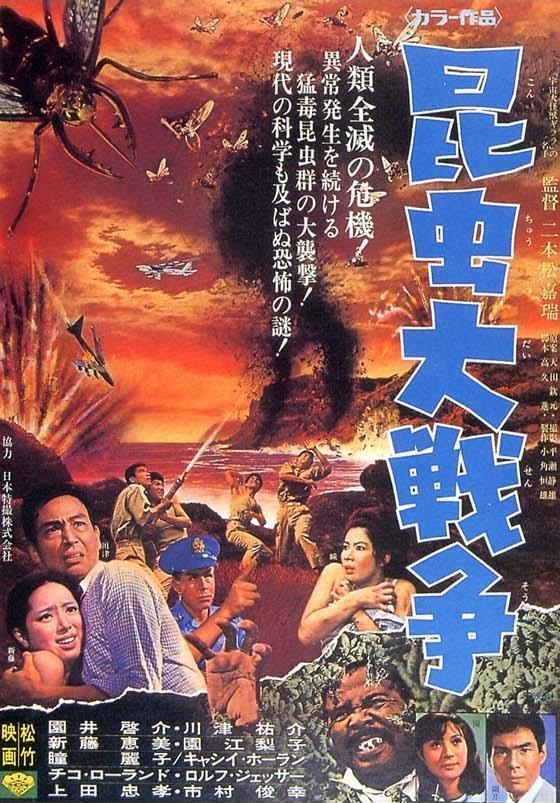
Genocide (1968)
Genocide begins with a swarm of insects causing an American B-52 bomber to crash into the sea near Kojima Island, just off the coast of Japan. The three crew members survive and reach the island. The B-52 was carrying a H-bomb.
The crash was witnessed by Joji (Yûsuke Kawazu), a young Japanese guy who collects insects for a scientist. At least his gorgeous young wife Yukari (Emi Shindô) thinks he’s collecting insects. Actually he’s canoodling with a blonde named Annabelle (Kathy Horan).
The Americans really want to find their H-bomb. They do find the three crew members but two are dead and the third, Charly, has lost his memory (we later find out he’s lost his mind as well).
Joji is now under suspicion of murder. Yukari knows about the blonde and she’s not happy about it but she still loves Joji. She appeals to Dr Nagumo (Keisuke Sonoi) for help. Nagumo is the scientist for whom Joji collects bugs. Nagumo is keen to help.
Dr Nagumo is more worried after he’s visited the cave in which the American airmen took shelter. He’s also worried about Charly’s condition. Charly has been seriously spooked by something. He is now terrified of bugs.
The bugs are definitely behaving oddly but there are humans on the island who are up to mysterious and possibly wicked things as well. At this stage we have no idea what they might be up to or which of the people on the island might be involved.
There are quite a few people acting strangely. There’s the creepy guy at the hotel. Maybe he just wants to get into Yukari’s pants but maybe he has another agenda as well. We know that Joji has been covering up his torrid love affair with Annabelle. He could be covering up other things. Dr Nagumo seems like a nice guy but we can’t discount the possibility he might turn out to be a mad scientist. We’re a bit suspicious of Annabelle. And the Americans get rather evasive when they’re asked about that H-bomb.
Up to this point the movie’s craziness level is in low gear but it will soon be kicked into overdrive. The motivations of the various characters are totally nuts. The nature of the mysterious happenings on the island turns out to be bizarre.
And then we get a full-blown psychedelic freak-out sequence.
The acting isn’t very good but it’s appropriate to the demented subject matter and I rather enjoyed Kathy Horan doing the dangerous blonde thing as Annabelle.
The special effects (and especially the miniatures work) are definitely iffy. That doesn’t matter in such an insane movie. It just adds to the fun. And some of the effects with the insects do work.
The plot is gloriously silly but you have to admire its boldness. Who says movies have to make sense?
Genocide is a wild crazy ride. The pacing is excellent. The craziness doesn’t let up. Thankfully there’s no comic relief. There’s an anti-war message but it doesn’t become tedious. There’s delightfully off-the-wall pseudo-science. It combines horror, science fiction and spy film elements. Genocide is just pure enjoyment. Highly recommended if you love insane psychotronic movies.
The DVD transfer is very good. So far I’ve watched three of the movies in the boxed set. The X from Outer Space (1967) and The Living Skeleton (1968) are both goofy fun while Goke, Body Snatcher from Hell (1968) is delightfully deranged.
Friday, 11 October 2024
The Living Skeleton (1968)
The Living Skeleton (Kyûketsu dokuro-sen), made in 1968, is one of these four movies.
You have to bear in mind that this is not a low-budget independent film. It was made by a major studio, with the resources of a major studio. It was made by people who had learnt their craft in a studio system. They were professionals. They knew how to make movies. It has a certain amount of major studio polish.
The Living Skeleton opens in fairly spectacular style. A freighter, the Dragon King, has been captured by pirates. The setting is contemporary - it’s worth remembering that piracy still goes on today. These pirates are particularly ruthless and the crew and the handful of passengers are massacred.
Three years later we meet a young woman named Saeko (Kikko Matsuoka). She lives in a small Japanese costal town. She is an orphan and along with her identical twin sister Yoriko was more or less raised by the village priest. He’s a Catholic priest - Japan has a large Catholic community.
Saeko is a nice girl but she has been troubled since her twin sister disappeared. The sister is assumed to have been drowned when the freighter on which she was travelling went down in a typhoon. Of course the audience knows that the twin sister was killed by those pirates.
Saeko has a boyfriend, Mochizuki (Yasunori Irikawa). He’s a decent guy and they plan to get married.
They go scuba diving and see something unexpected - skeletons.
Later they see a ship. Not on the bottom of the sea, but afloat. Maybe it’s the ship on which Yoriko met her fate. Saeko wants to reach the ship, she does so, and she is disturbed by what she finds.
Then things get spooky for a bunch of people all of whom have something to hide. What they have to hide is connected with the events on board the Dragon King.
Viewers will have their suspicions about what is going on but it may not be so simple.
This is one of those movies that plays around with genre. You think you know what kind of movie it is and then you start to think it’s not that sort of movie at all. And then you find yourself thinking it could belong to any one of several genres. Is anything supernatural going on? Certainly strange creepy things happen. We’re kept guessing. Maybe we’ll get a definite answer at the end. You’ll have to watch the movie yourself to find out.
There are some nicely crazy plot twists.
There’s a touch of ambiguity to at least one major character. We might understand a character’s motivations without entirely approving of the actions to which those motivations lead.
We have to talk about the special effects. There are some very obvious miniatures shots. I don’t mind that. In fact in a movie such as this where you’re not always entirely certainly that everything you see is real or truthful obvious special effects can be an asset. There are some really ambitious effects shots and they’re often quite effective and disturbing.
This film was shot in the ’scope aspect ratio in black-and-white, a combination I always find rather appealing. The cinematography is suitably moody.
This movie has a lot of the qualities you expect in a horror exploitation movie combined with some genuinely unsettling atmosphere. It has some outlandish moments and a few crazy moments.
Overall The Living Skeleton is entertaining with enough weird touches to make it a cut above average. Highly recommended.
The DVD transfer is very good. So far I’ve watched three of the movies in the boxed set. The X from Outer Space (1967) is goofy fun while Goke, Body Snatcher from Hell (1968) is delightfully demented.