Showing posts with label nunsploitation. Show all posts

Sunday, 12 October 2014

To the Devil a Daughter (1976)

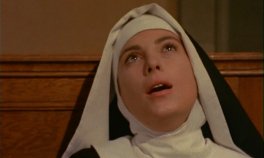
To the Devil a Daughter marked the end of the line for Hammer as far as horror movies are concerned. Rather ironic, given that the film was a major box-office hit. Many connoisseurs of Hammer’s movies consider this to be the worst of all their horror movies, and with good reason.

By the time this movie was made Hammer were certainly aware that the horror movie market had changed. To the Devil a Daughter was thus an attempt to make the sort of movie that audiences in the mid-70s seemed to crave. More specifically it’s an attempt to jump on the Exorcist bandwagon. Stylistically it marks an abandonment of everything that made Hammer’ films distinctive, and everything that made them good.

Father Michael Rayner (Christopher Lee) is an excommunicated priest who has established his own church, the Children of the Lord, in Bavaria. Father Michael was excommunicated for heresy, although describing his views as heretical would be something of an understatement. The screenplay is a little obscure on the exact nature of his beliefs but his new church would appear to be a rather elaborate attempt to disguise out-and-out Satanism.

Catherine Beddows (Nastassja Kinski) is a nun in Father Michael’s church. She was adopted by two church members but once a year, on her birthday, she returns to England to see her biological father Henry Beddows (Denholm Elliott). 


John Verney (Richard Widmark) is an American author who has achieved international success with his books on the occult. He is approached by a very agitated Henry Beddows with a request that Verney kidnap Catherine from the Children of the Lord in order to save her from a mysterious but very unpleasant fate. Verney, scenting a story that could provide material for a potential bestseller, agrees. With the assistance of his agent Anna (Honor Blackman) and her boyfriend David (Anthony Valentine) Verney succeeds in doing so but he seriously underestimates Father Michael’s powers. Verney is inclined to consider most Satanists as harmless if deluded eccentrics but he believes that a very small minority are truly dangerous. He realises too late that Father Michael belongs to that very small minority.

Of course we have no doubt right from the start that Father Michael intends Catherine to take part in some kind of forbidden ritual and we equally have no doubt that the ritual will be something rather nasty. Verney knows quite a lot about the occult but does he know enough to stop someone like Father Michael?


Hammer had had a major success with their 1968 adaptation of Dennis Wheatley’s The Devil Rides Out. Wheatley had been delighted by the results and had given his friend Christopher Lee the rights to do film versions of several of his occult thrillers, free of charge. In fact Hammer’s version of To the Devil a Daughter has little to do with Wheatley’s novel and Wheatley was appalled by the film. Christopher Lee was equally appalled by the film, believing that many of the scenes added to the story were obscene and disgusting. I have to say that I agree wholeheartedly with him.

Apart from being distasteful and crassly exploitative the screenplay is also garbled and worst of all the movie has an ending which is hurried and nonsensical.

This movie was an Anglo-German co-production (hence the choice of a German lead actress) and it seems to have made a lot of money for everyone except Hammer. Hammer were by this time having difficulties raising finances for their films and the financial deal they made on this occasion proved to be a very poor deal for the company.


The movie’s strong point is the superb cast. Richard Widmark hated every minute of the making of the film but he turns in a good performance. Christopher Lee is exceptionally sinister and malevolent. The young and very inexperienced Nastassja Kinski delivers a capable performance although her rôle requires very little of her. Denholm Elliott is excellent as the terrified and cowardly Henry Beddows. Honor Blackman and Anthony Valentine provide good support. It’s a dream cast but their efforts are largely wasted by the incoherent script (which gives the appearance that they were making it up as they went along which in fact was exactly what they were doing).

Director Peter Sykes had an undistinguished career and this movie suggests he was out of his depth.

Hammer were trying to match Hollywood with his movie and it does look quite expensive, with plenty of location shooting.


Hammer proved with this movie that they knew exactly what audiences wanted. It didn’t do them any good and to be honest if the company was going to have to make movies like this in order to survive it’s perhaps just as well that this turned out to be their final horror movie.

Anchor Bay’s DVD looks pretty good. Extras include a brief “making of” featurette that includes interviews with Honor Blackman, Anthony Valentine (who has some amusing Richard Widmark anecdotes) and a rather embarrassed Christopher Lee.

To the Devil a Daughter marks a sad ending to the Hammer horror story. This one is best avoided unless you have a thing for crass Exorcist rip-offs.

Friday, 5 August 2011

Sins of Sister Lucia (1978)

The existence of a sub-genre of Japanese anti-Catholic nunsploitation movies, such as Sins of Sister Lucia (Sudojo Lucia: kegasu), might at first glance seem surprising but once you become familiar with the world of 1970s Japanese exploitation movies it starts to make sense. Such movies appealed to the strongly anti-western, anti-authoritarian, anti-traditionalist, Marxist ideology that is so characteristic of 1970s Japanese cinema.

The better Japanese directors of that era infused their movies with enough style and enough weirdness to make them enormous fun in spite of the heavy-handed political messages. But in the hands of lesser directors it could get a bit tedious.

A particular problem with nunsploitation movies is that there are really only a couple of basic nunsploitation plots and most movies in this sub-genre adhere fairly closely to a rigid formula. Again it’s not a problem if you have someone as talented as Norifumi Suzuki in the director’s chair, as is the case with his gloriously outrageous School of the Holy Beast.

Sins of Sister Lucia, from Nikkatsu Studios, shows dramatically what could go wrong in the hands of an unimaginative director such as Koyu Ohara.

This film suffers from yet another problem. Any nunsploitation movies is going to be sleazy. That’s part of the fun. But there was a tendency in some Japanese exploitation movies for the sleaze to become merely vicious and unpleasant rather than fun. That’s definitely the case here.

The plot is pretty standard. Rumiko is the daughter of a corrupt politician. She not only steals the bribe money he had stashed away, she also stabs one of his cronies. She must be punished, but without a scandal, so she is sent to a nunnery. She is now Sister Lucia. It’s the sort of nunnery you find in nunsploitation movies - the nuns are all ex-crazed and most are lesbians. It’s all symbolic of the hypocrisy and corruption of all authority, at least in the eyes of radical film-makers in the 70s.

The arrival in the nunnery of two violent criminals on the run leads to more violence and more sex, until mercifully the police arrive and the movie ends.

There is one extremely good scene, in which the other nuns entrap Lucia in a huge spider’s web of woolen yarn. It’s the one moment of true visual inspiration in the movie. Apart from that it’s all rather pedestrian.

You’d expect copious quantities of sleaze and you certainly get it, but mixed with just a little too much nastiness for my tastes.

Mondo Macabro’s DVD presentation, as always with this company, looks superb and includes some nice extras.

If you want to explore the world of Japanese nunsploitaton you’re much better off seeking out a copy of the movie to go for is School of the Holy Beast (which is also available on DVD).

Saturday, 22 January 2011

Images in a Convent (1979)

There’s no movie genre with more potential for sleaze than the nunsploitation genre. The surprising thing is that this genre has produced quite a few rather good movies.

Ken Russell’s The Devils being the one unquestioned masterpiece, but Norifumi Suzuki’s School of the Holy Beast, Jess Franco's Love Letters of a Portuguese Nun and Gianfranco Mingozzi's Flavia the Heretic all manage to be more than just exercises in sleaze (although they certainly possess sleaze in abundance).

Such a claim cannot seriously be made for Joe D'Amato's Images in a Convent (Immagini di un convento).

There is a plot, of sorts, but mostly it’s an excuse for sleaze. Lots of sleaze.

A young woman named Isabella is committed to a nunnery to keep her out of the clutches of her lascivious uncle. Then a mysterious young man who has been grievously wounded is taken in by the Mother Superior. And strange things start to happen. The nuns start to devote their time to acts of debauchery. It has to be said that they don’t appear to need much encouragement. Eventually an exorcist is called in but he has his work cut out for him, having to perform his rites while a dozen naked nuns try to tempt him with the pleasures of the flesh. Nobody ever said an exorcist’s life was an easy one.

There’s no need to discuss the acting, since a willingness to get naked was obviously the sole criterion used in casting this movie.

Joe D'Amato's prime concern as director seems to have been to include as much sleaze as possible without worrying too much about anything else. There is one good shot in the movie, a shot of a corridor in the nunnery, and Joe D'Amato clearly liked it so much he repeats it several dozen times. It does provide the movie’s one effective scene though, with the exorcist marching down the corridor being besieged by sex-crazed and mostly naked nuns. It sounds tacky, and it is, but it has a certain undeniable power.

Aside from that what you get is nudity and sex, by the truckload. I was going to say that this movie belongs to the harder end of the softcore porn spectrum but it might e more accurate to describe it as belonging to the softer end of the hardcore spectrum. Some scenes are certainly unequivocally hardcore.

All of which probably makes this sound like a pretty awful movie. It’s definitely not Citizen Kane but it never claims to be anything more than an exercise in eurotrash exploitation and it can’t be denied that it delivers the goods in the exploitation front.

My copy came in the Media Blasters Nunsploitation Classics boxed set. The transfer is dreadful but it does surprisingly include some extras, most notably a documentary on Joe D'Amato. The boxed set is marginally worth grabbing if you can find a cheap copy and if you’re a devoted fan of the nunsploitation genre.

Wednesday, 29 September 2010

The True Story of the Nun of Monza (1980)

Bruno Mattei’s The True Story of the Nun of Monza (La vera storia della monaca di Monza) might not be the sleaziest nunsploitation movie ever made, but it’s plenty sleazy enough.

Virginia de Leyva is heiress to the feudal domains, and title, of the lord of Monza. For some obscure reason her family has decided she should enter a convent, and the Church receives a very handsome amount of money for approving the deal.

The convent chosen is perhaps not the most shining example of the virtues of the religious life. The nuns seem to spend most of their time indulging in intrigues and having sex (with each other or with any men who happen to be available). And the local priest Don Arrigone who also acts as confessor to the nuns is an even less worthy example. His best friend Giampaolo Osio is an unabashed rake. Don Arrigone and Giampaolo regard seducing nuns as a highly attractive sporting activity.

Giampaolo has no great difficulty talking his way into Sister Virginia’s bed. Apart from being possessed of a fairly healthy sexual appetite Sister Virginia is also ambitious an not overly scrupulous. And having the natural confidence that comes of being a noblewoman she appears to have a bright future ahead of her in the Church. When the Mother Superior falls ill it’s no great surprise that Sister Virginia is seen as her natural successor. To strengthen her position she appoints one of her more enthusiastic supporters, Sister Benedetta, as her second-in-command. It will come as no great surprise that Sister Benedetta is not exactly a model of virtue either.

So far life in the convent of Monza seems rather pleasant. When Virginia’s father dies and she becomes the new feudal lady of Monza things are looking even brighter. With immense wealth and power in her hands Virginia as the new Mother Superior seems to be almost unstoppable. Then disaster strikes. She falls pregnant. Attempts to keep the pregnancy a secret are successful until the baby is due and a young novice offers her services as midwife. The novice has ambitions of her own, and she also wants Giampaolo Osio in her own bed. And she gets him, but events are now running out of control. A cabal of older nuns who disapprove of the new regime at the convent have made contact with the Inquisition. The Inquisitor is certainly going to find plenty of things to keep him busy at this convent.

It’s the usual nunsploitation sleaze recipe but it’s also a better made film than you might expect. Bruno Mattei might not have a shining reputation as a director but he manages to come up with some quite evocative images. It’s really a rather professional looking effort for a low-budget exploitation sleazefest.

The acting is reasonably competent as well. Zora Kerova is quite striking and handles the lead role quite adequately. Franco Garofalo as the lecherous priest and Mario Cutini as his even more lecherous buddy are suitably degenerate. Garofalo adds a nice helping of guilt and self-hatred to the mix.

There are no deep messages here apart from the fairly obvious ones about sex and power, but it’s an entertaining enough little movie in its own depraved way.

I picked it up as part of a three-movie nunsploitation DVD package from Media Blasters. The set also includes The Nuns of Saint Archangel and Joe d’Amato’s notorious Images in a Convent. I have no idea if these are the optimum DVD releases for these movies but the set was ridiculously cheap and is undoubtedly a worthwhile investment for those who just can’t get enough of the nunsploitation genre.

Thursday, 27 May 2010

Jess Franco's The Demons (1972)

The Demons (Les démons) is classic nunsploitation eurosleaze from Jess Franco, dating from 1972. As usual with this sort of movie there’s a political subtext about power and the abuses of power, combined with copious quantities of nudity and sex.

The historical and geographical backgrounds to this one are a bit muddled. It seems to be based partly on the career of the notorious Lord Chief Justice Jeffreys in 17th century England (he was also the subject of Franco’s The Bloody Judge). But it appears to take place at least partly in France and/or Spain, and much of the actions centres on a nunnery, which makes 17th century England an unlikely setting. But hey, this is the movies, so let’s not get too hung up on history and geography.

Two orphaned sisters, Kathleen and Margaret, have been brought up in a nunnery. Their education was paid for by a mysterious anonymous donor, and the truth about their parentage is unknown. In fact their mother had been burnt at the stake as a witch. She had died cursing those whom she blamed for her fate, notably Judge Jeffreys, the powerful Lady De Winter and her henchman Thomas Renfield. Lady De Winter is so concerned about the curse that she decides it might be a good idea to destroy any children of this witch, and she believes that the two young nuns Kathleen and Margaret may be the witch’s daughters.

Lady de Winter and Renfield visit the convent and Kathleen, who has admitted to being troubled by sexual dreams, is accused of witchcraft. But while Lady de Winter is anxious to destroy Kathleen there’s a complication. She’s equally anxious to get this young and very pretty supposed witch into her bed. And Renfield is just as anxious to bed the young nun. Lady de Winter and Renfield have a complicated relationship of their own. They are lovers, and they share all their pleasures. Her ladyship makes it clear that Kathleen is a pleasure that Renfield will not be permitted to keep to himself.

There are numerous plot twists as the unfortunate young nun finds herself imprisoned and tortured, then freed, then recaptured. Several times over. Lady de Winter and Renfield are not the only ones taking a keen interest in her. There’s also a handsome young artist, and Lady de Winter’s father.

While all this is happening Margaret is being called to the service of Satan. After having sex with Satan she promptly seduces the Mother Superior (who has clearly been sexually obsessed by both Kathleen and Margaret).

There are ample opportunities for nuns to disrobe and to cavort in bed with other nuns and with just about anyone else who is available. And Uncle Jess takes advantage of every single opportunity.

The movie boasts a fairly strong cast. Howard Vernon is reliable as ever, playing Lady de Winter’s father Lord Malcolm De Winter. Karin Field is delightfully wicked and lascivious as Lady de Winter. Anne Libert as Kathleen and Britt Nichols as Margaret give solid performances.

This film was apparently banned in Britain until 2008. The torture scenes are fairly graphic, and there’s an extraordinary amount of sex and nudity, but it’s still difficult to imagine why it was ever thought necessary to ban it.

It’s now been released there on DVD by Redemption, in a reasonably impressive-looking transfer.

While the historical details are hopelessly garbled the plot itself is surprisingly coherent. And quite apart from having lots of exploitation elements it’s quite entertaining with plenty of action. This is eurosleaze with extra added sleaze, but it’s fun.

Sunday, 29 November 2009

Killer Nun (1978)

Killer Nun (Suor Omicidi) is a 1978 release that was included on the British Director of Public Prosecutions’ list of banned video nasties in the 80s. It’s now been released uncut, and watching it demonstrates the utter insanity of British censorship practices. It barely even qualifies as a horror movie, much less a video nasty.

One can only assume that the very thought of evil nuns was enough to threaten the entire fabric of British civilisation.

This is actually a very unusual nunsploitation movie. Most nunsploitation flicks have an historical setting and they generally take pace within the confines of a nunnery. This one has a contemporary setting, in a hospital. It’s a psychiatric hospital, and Sister Gertrude (Anita Ekberg) is the head nurse. She had an operation a shirt time previously to remove a brain tumour. The tumour was benign, and she has made a full recovery. But she doesn’t believe it. She is obsessed by the idea that she is dying. She has also developed a rather nasty morphine habit, and this combined with her health obsessions has made her somewhat unstable.

She has also been troubled by sexual thoughts. The fact that she shares a room with Sister Mathieu, who is obviously in lust with her and has a disconcerting habit of wandering about naked, doesn’t help. But Sister Gertrude is not interested in Sister Mathieu. She wants a man. Desperately. And when you add these sexual cravings to her other problems it’s not entirely unexpected when she begins to crack up. She steals a ring from a dead patient, and buys herself lots of drugs and a slinky dress, and indulges in some steamy anonymous sex with a guy she picks up in a bar.

This is bad enough, but patients have started to die rather mysteriously. By falling out of windows, or with their heads smashed in. The hospital administrators and the Mother Superior are determined to avert a scandal. They’re not going to allow a few dead patients to damage the shining reputation of the hospital or of the nursing order. The patients on the other hand are starting to show signs of rebellion, and when more deaths occur it becomes more and more difficult to prevent the police from being involved. And given Sister Gertrude’s increasingly erratic behaviour a police investigation could be very inconvenient. Sister Mathieu is doing her best to protect Sister Gertrude, while also doing her best to find a way of getting into Sister Gertrude’s bed.

This is more a psychological horror/murder mystery than a classic nunsploitation film, even though it does contain many of the essential features of the nunsploitation genre (lesbian nuns and a fairly modest amount of nudity). There is some gore, but hardly enough to explain how it could ever have been considered as a video nasty.

Hardcore gorehounds will be disappointed by this one, and those hoping for a nunsploitation sleaze-fest will be equally disappointed. That’s not to say it’s a bad movie. You just have to accept it on its own terms. If you accept it as a psychological thriller with some giallo influence then it’s reasonably effective.

The casting is eccentric but surprisingly successful. Anita Ekberg is rather good, resisting the temptation to indulge in full-on scenery chewing. Joe Dallesandro as the head doctor gives one of his better performances.

Director Giulio Berruti doesn’t seem to have had much of a career but he does a competent job. The movie would probably have enjoyed greater success had the exploitation elements been more strongly emphasised but it stands as an interesting oddity, and it’s worth a look if you enjoy off-beat 1970s Italian cinema.

The Shameless DVD presentation claims to be complete and includes previously cut scenes. Bizarrely enough the cut scenes (which are the only ones in Italian with English sub-titles while the rest of the movie is dubbed in English) are totally innocuous! The picture quality is acceptable, but the sound quality leaves something to be desired. It’s just a little muddy at times.

Monday, 28 April 2008

Satánico Pandemonium (1975)

Satánico Pandemonium is another slice of Mexican nunsploitation from the 70s brought to us by the good people at Mondo Macabro. It’s not as over-the-top as the marvellous Alucarda. In fact it’s surprisingly restrained and subtle in execution. There is gore, but it’s used sparingly and therefore it actually has an impact when it is used (if only a few other film-makers would learn this simple lesson). A young nun with a reputation for extreme piousness encounters a naked man in the woods. He turns out to be Lucifer, and he sets out to tempt her. His temptations include the pleasures of the flesh, but they also include power – he offers to secure for her the position of Mother Superior. She battles the temptations, but not very successfully, and soon finds herself caught up in events that are running out of control. The movie was helmed by veteran Mexican director Gilberto Martínez Solares, with a screenplay by his son Adolfo Martínez Solares. An interview with the latter is included as an extra, and he has some fascinating snippets of information about the filming, such as the fact that many of the nuns were actually played by prostitutes from a notorious brothel. Satánico Pandemonium is one of those movies that combines exploitation with some political critiques of society in general and the Church in particular, and it combines the two quite effectively. The actual meaning of the movie remains ambiguous, but I can’t say any more for fear of giving away spoilers. While it isn’t quite in the same class as Alucarda it’s still a great little piece of trash cinema and it’s lots of fun. It hardly needs to be added that Mondo Macabro have done another sensational job, the movie looks terrific, and there are some very worthwhile extras.

Saturday, 15 September 2007

Love Letters of a Portuguese Nun (1977)

Jess Franco’s Love Letters of a Portuguese Nun (Die Liebesbriefe einer portugiesischen Nonne) tells the story of a young woman, Maria Rosalea, in 17th century sent to a convent against her will. She soon discovers that these nuns have dedicated themselves to serving Satan rather than God, and they have plans to sacrifice her chastity to the Evil One. Anyone who regards Jess Franco as a technically incompetent film-maker really need to see this movie. It’s not just a well made film, it’s a beautifully made film. For once Franco has a decent budget to work with, and the results are ravishing. The movie avoids the creepy cobwebs-and-ruins gothic look of so much 60s European gothic horror - this is a movie of gorgeous architecture bathed in brilliant sunshine, and sumptuous-looking sets, which makes the events seem all the more horrific. The movie visits the same sorts of territory as Ken Russell’s 1971 masterpiece The Devils, with religious hysteria and sexual repression leading to inevitably ghastly results. Compared to The Devils it’s quite restrained, although admittedly the DVD version has been rather savagely cut. Franco makes his point efficiently and economically. The film benefits from some very fine acting. William Berger as the sexually depraved priest who acts as confessor to the nuns and Ana Zanatti as the Mother Superior are exceptionally good, but it’s Susan Hemingway as the young Maria Rosalea who walks off with the acting honours. She gives a powerful and moving performance. There’s no scenery-chewing in this picture – the actors play it straight and they have the acting chops to carry it off.

The Anchor Bay DVD release looks absolutely marvellous. The colours are glorious, and there are really no problems at all with the picture quality. This is Franco in a serious mood, and it’s a disturbing and effective movie. It’s a treat for all serious Franco-philes, and indeed for all serious horror fans. And of course it’s a must for everyone who loves movies about devil-worshipping nuns - and let’s face it, who doesn’t?

Wednesday, 1 August 2007

The Devils (1971)

Ken Russell’s The Devils was one of the most controversial movies of the 1970s, and its power to shock has been diminished by time. Russell was often accused of setting out to shock just for the sake of shocking, which I think is nonsense. His purpose in this movie was extremely serious. It’s a very angry movie, the anger being directed at those who mix religion and politics, and use religion for corrupt and dishonest and mercenary purposes, and those who use religion to destroy those who stand in the path of their pursuit of power.

The movie is based on real events in the city of Loudon in 1634. A popular priest who had made powerful enemies was accused of bewitching the nuns in a Ursuline convent. Oliver Reed gives the performance of his career as the priest, Father Urbain Grandier. Vanessa Redgrave is truly terrifying as the Mother Superior of the convent whose sexual frustration overpowers her and leads her to actions with horrifying consequences. The sets, designed by Derek Jarman, are quite simply superb, and the combination of Russell’s extraordinary visual imagination with Jarman’s is electrifying. The impact of the film comes largely from the images – this is a very cinematic film. It’s a powerful film, and it’s a very great film.