There have been several film adaptations of H. Rider Haggard’s classic 1885 tale of adventure King Solomon’s Mines. The 1937 version has its admirers and it’s reasonably enjoyable but it has its problems and Sir Cedric Hardwicke is badly miscast as Allan Quatermain. The 1950 version is much better with Stewart Granger being perfectly cast in the lead role, and looks great. And then there’s the 1985 version.
This is a Cannon production, which depending on your tastes is either very promising news or very worrying news. This 1985 version is much less admired than the earlier films but there was some impressive talent involved. Maybe he’s no Stewart Granger but Richard Chamberlain was no slouch when it came to playing in adventure movies. Sharon Stone was not yet a big name but you can see signs of her star quality. You’ve got Herbert Lom as a villain, always a huge plus. And John Rhys-Davies is always fun in these kinds of movies. You’ve got J. Lee Thompson directing. This is the guy who directed The Guns of Navarone. The man knew how to make exciting action-adventure movies.
This 1985 version is not exactly a faithful adaptation of the novel, as we shall see. Not surprisingly given that it was made in 1985 this is very much an attempt to capture a Raiders of the Lost Ark vibe.
The setting would appear to be German East Africa and since there are cars and aircraft but the Great War is never mentioned we can guess that the events of the film are supposed to take place shorty before the outbreak of war, probably around 1912 or thereabouts.
Jesse Huston (Sharon Stone) is a student archaeologist from Iowa. She has apparently hired Allan Quatermain (Richard Chamberlain) to help find her archaeologist father who has disappeared in Africa. He had been looking for a map revealing the location of King Solomon’s Mines, having devoted most of his career to the search for the mines. Hardly anybody actually believes the mines exist. Jesse’s father believes they exist, and he is convinced that he has acquired a map that really will lead him there.
The local German commander, Colonel Bockner (Herbert Lom), believes in the mines. As does the sinister scheming Dogati (John Rhys-Davies). They want that map.
Allan Quatermain doesn’t believe in the legend but Jesse is his client and although she’s exasperating he’s determined to help her.
Wild adventures ensue, with Jesse getting captured several times, a horse-drawn car chase, a car chase, an aerial dogfight, various pitched battles, fight scenes on a train and encounters with lions. Jesse and Quatermain almost get eaten several times, and not always by animals.
Of course they eventually find King Solomon’s Mines and of course it turns out to be a very dangerous discovery, with Colonel Bockner and Dogati not being the only threats.
The whole movie is crazy and don’t expect a taut coherent plot, and don’t expect a movie that makes any concessions at all to realism or plausibility. It’s closer in feel to the wonderful movie serials of the 1930s and 40s than to Rider Haggard. Scenes are included because they’re fun, not because they have the slightest connection to the plot.
Cannon obviously could not match the budget Spielberg had on Raiders of the Lost Ark but this movie still looks expensive. Whatever the budget was most of it ended up on the screen. The visuals are impressive. OK, some of the special effects are a bit iffy but for a modestly budgeted movie they work well enough. And they are fun. I’d rather have fun cheesy special effects than fancy effects done without imagination.
J. Lee Thompson is a director whose work has been seriously underrated. He knows the importance of pacing. The action doesn’t let up. As soon as our hero and heroine escape from one danger they are plunged into some new terror.
Richard Chamberlain makes a perfectly adequate hero. Sharon Stone is charming and cute as the likeable Jesse, a girl with an extraordinary talent for getting herself into trouble. Herbert Lom hams it up outrageously, which is as it should be.
This movie did extremely well at the box office. Critics hated it, insisting on comparing it to the 1950 movie even though it should have been glaringly obvious that the 1985 movie has its tongue planted firmly in cheek and is deliberately silly, goofy and cheesy. This unabashedly a B-movie.
Get yourself plenty of beer and popcorn, switch off your critical faculties and just sit back and enjoy the fun. This is a hugely enjoyable load of nonsense and I loved it. Very highly recommended.
The Olive Films Blu-Ray is barebones but offers a lovely transfer.
I've also reviewed the 1937 version and the 1950 version.
Horror, sci-fi, exploitation, erotica, B-movies, art-house films. Vampires, sex, monsters, all the fun stuff.
Showing posts with label swashbuckling adventure. Show all posts
Friday, 31 May 2024
Tuesday, 7 May 2024
Devil’s Possessed (1974)
Devil’s Possessed (El mariscal del infierno) was written by Paul Naschy (who also starred) and directed by León Klimovsky. It’s a story of horrific crimes committed in 15th century France by the king’s marshal Barón Gilles de Lancré (Naschy). It was released in 1974.
This movie is either a swashbuckling adventure with quite a few horror elements or a horror film with quite a few swashbuckling adventure elements.
It’s based very loosely on the real-life case of Gilles de Rais (1405-1440), notorious as one of the most prolific mass murderers in history although at various times since then doubts have been raised about his guilt.
In the movie Gilles de Lancré is disillusioned by what he perceives as the king’s lack of gratitude for his political and military services. Gilles withdraws from public life and becomes increasingly obsessed by alchemy and occult practices. He employs the services of renowned alchemist Simon de Braqueville (Eduardo Calvo) who assures Gilles that he will have access to power and unlimited riches. But a price will have to be paid. The magical operations will require the sacrifice of virgins.
Gilles is horrified but his ambitions overwhelm his horrors. He is aiming at nothing less than the throne of France. His ambitions are encouraged by the beautiful but scheming Georgelle (Norma Sebre).
Gilles finds himself with two problems. Firstly the powers and riches promised by de Braqueville have not materialised. Gilles is told that more virgins will have to be sacrificed. Gilles remains confident but he grows impatient, and he has spent most of his fortune financing de Braqueville’s experiments.
Secondly, it turns out that he is not really cut out for a career of evil. He is troubled by nightmares.
Gilles, despite his achievements as a soldier, is in some ways a weak and foolish man. He is easily led. And he is very easily manipulated by a ruthless woman like Georgelle.
Soon he has a third problem, the arrival of his old comrade-in-arms Gaston de Malebranche (Guillermo Bredeston).
Gilles hopes that de Malebranche will take service with him and become his right-hand man. Gaston however is disturbed by what he has seen in de Lancré’s castle and what he has seen in the countryside. The peasants are being crippled by taxation and there is much evidence of the brutality of de Lancré’s men. Gaston is a straight arrow. His instinct is to oppose tyrants and if his old friend Gilles has become a tyrant he will certainly oppose him.
Gaston joins a band of rebels living in the forest. At this point the movie starts to borrow heavily from the Robin Hood legend, with Gaston leading an outlaw band against a wicked tyrant. Gaston disguises himself in order to participate in a joust organised by Gilles in a scene that is very reminiscent of Robin Hood entering the archery contest organised by the Sheriff of Nottingham.
The noble and lovely Graciela (Graciela Nilson) plays a role that brings Maid Marian to mind.
Of course the evil in the Robin Hood legend is also driven by ambition - Prince John’s determination to seize power. Devil’s Possessed is like Robin Hood with 1970s gore and graphic brutality.
Gilles de Lancré is not exactly a tragic figure. He has freely chosen evil and he displays horrific cruelty. We don’t feel inclined to be too sympathetic towards him. At the same time we do get a sense that perhaps he was at one time a good man. Naschy manages to make him look like a man haunted by his own evil. He also has no trouble convincing us that Gilles is man whose hold on sanity is becoming ever more tenuous. There are perhaps a few echoes of Macbeth in Gilles de Lancré.
Georgelle isn’t the least bit haunted by her evilness. She relishes it. Norma Sebre does a great job here.
Guillermo Bredeston as Gaston de Malebranche does the noble swashbuckling hero thing adequately enough.
Devil’s Possessed has effectively horrifying moments, it has a real atmosphere of evil, it’s fast-moving and it’s action-packed. It has fine performances and it has Naschy in top form. There’s also a rather nice touch at the end. Highly recommended.
This film is included in Shout! Factory’s Paul Naschy Collection II Blu-Ray boxed set. The transfer is very good.
I consider León Klimovsky to be a rather underrated director. I’ve reviewed a number of his movies - Vengeance of the Zombies (1973, with Naschy) is very good and I enjoyed The Vampires’ Night Orgy (1973) and Werewolf vs Vampire Woman (1971)
I’ve reviewed quite a few Paul Naschy movies, including the intriguing gothic horror/giallo hybrid Panic Beats (1983) and the terrific werewolf-in-Japan flick The Beast and the Magic Sword (1983).
This movie is either a swashbuckling adventure with quite a few horror elements or a horror film with quite a few swashbuckling adventure elements.
It’s based very loosely on the real-life case of Gilles de Rais (1405-1440), notorious as one of the most prolific mass murderers in history although at various times since then doubts have been raised about his guilt.
In the movie Gilles de Lancré is disillusioned by what he perceives as the king’s lack of gratitude for his political and military services. Gilles withdraws from public life and becomes increasingly obsessed by alchemy and occult practices. He employs the services of renowned alchemist Simon de Braqueville (Eduardo Calvo) who assures Gilles that he will have access to power and unlimited riches. But a price will have to be paid. The magical operations will require the sacrifice of virgins.
Gilles is horrified but his ambitions overwhelm his horrors. He is aiming at nothing less than the throne of France. His ambitions are encouraged by the beautiful but scheming Georgelle (Norma Sebre).
Gilles finds himself with two problems. Firstly the powers and riches promised by de Braqueville have not materialised. Gilles is told that more virgins will have to be sacrificed. Gilles remains confident but he grows impatient, and he has spent most of his fortune financing de Braqueville’s experiments.
Secondly, it turns out that he is not really cut out for a career of evil. He is troubled by nightmares.
Gilles, despite his achievements as a soldier, is in some ways a weak and foolish man. He is easily led. And he is very easily manipulated by a ruthless woman like Georgelle.
Soon he has a third problem, the arrival of his old comrade-in-arms Gaston de Malebranche (Guillermo Bredeston).
Gilles hopes that de Malebranche will take service with him and become his right-hand man. Gaston however is disturbed by what he has seen in de Lancré’s castle and what he has seen in the countryside. The peasants are being crippled by taxation and there is much evidence of the brutality of de Lancré’s men. Gaston is a straight arrow. His instinct is to oppose tyrants and if his old friend Gilles has become a tyrant he will certainly oppose him.
Gaston joins a band of rebels living in the forest. At this point the movie starts to borrow heavily from the Robin Hood legend, with Gaston leading an outlaw band against a wicked tyrant. Gaston disguises himself in order to participate in a joust organised by Gilles in a scene that is very reminiscent of Robin Hood entering the archery contest organised by the Sheriff of Nottingham.
The noble and lovely Graciela (Graciela Nilson) plays a role that brings Maid Marian to mind.
Of course the evil in the Robin Hood legend is also driven by ambition - Prince John’s determination to seize power. Devil’s Possessed is like Robin Hood with 1970s gore and graphic brutality.
Gilles de Lancré is not exactly a tragic figure. He has freely chosen evil and he displays horrific cruelty. We don’t feel inclined to be too sympathetic towards him. At the same time we do get a sense that perhaps he was at one time a good man. Naschy manages to make him look like a man haunted by his own evil. He also has no trouble convincing us that Gilles is man whose hold on sanity is becoming ever more tenuous. There are perhaps a few echoes of Macbeth in Gilles de Lancré.
Georgelle isn’t the least bit haunted by her evilness. She relishes it. Norma Sebre does a great job here.
Guillermo Bredeston as Gaston de Malebranche does the noble swashbuckling hero thing adequately enough.
Devil’s Possessed has effectively horrifying moments, it has a real atmosphere of evil, it’s fast-moving and it’s action-packed. It has fine performances and it has Naschy in top form. There’s also a rather nice touch at the end. Highly recommended.
This film is included in Shout! Factory’s Paul Naschy Collection II Blu-Ray boxed set. The transfer is very good.
I consider León Klimovsky to be a rather underrated director. I’ve reviewed a number of his movies - Vengeance of the Zombies (1973, with Naschy) is very good and I enjoyed The Vampires’ Night Orgy (1973) and Werewolf vs Vampire Woman (1971)
I’ve reviewed quite a few Paul Naschy movies, including the intriguing gothic horror/giallo hybrid Panic Beats (1983) and the terrific werewolf-in-Japan flick The Beast and the Magic Sword (1983).
Labels:
1970s,
gothic horrors,
paul naschy,
swashbuckling adventure
Friday, 27 October 2023
Sinbad of the Seven Seas (1989)
Sinbad of the Seven Seas is a 1989 Cannon Films adventure fantasy with an interesting history. It was originally a Luigi Cozzi project. Cannon then decided it would be cool to do a series instead. Cozzi dropped out and Enzo G. Castellari came in as director. Cannon took a look at the huge amount of footage that Castellari had shot and decided it was totally unreleasable. Cozzi was brought back to try to rescue something from the disaster.
With those things in mind you’d expect this movie to be a trainwreck. In fact it’s magnificent.
Cozzi’s first step was to add a prologue which tells us that this is a story told by a mother to her little girl. That’s perfectly appropriate for an Arabian Nights tale since the Thousand and One Nights had a similar framing story, the tales being stories told by Scheherazade to the king.
The plot is stock standard stuff. The city of Basra is a joyous place ruled over by a kind and wise caliph until an evil wizard named Jaffar (John Steiner) casts a spell that turns the city into a cauldron of evil and misery. Jaffar also intends to force the caliph’s beautiful daughter Princess Alina (Alessandra Martines) to marry him. Alina is currently engaged to a prince named Ali who is a member of Sinbad’s crew.
Sinbad is off adventuring when all this happens. He is shocked and dismayed when he returns to Basra.
Naturally he is determined to thwart Jaffar’s plans but the problem is that Jaffar has used his magic to scatter the sacred jewels of Basra to the four corners of the Earth. Only the sacred jewels can restore peace, sanity and happiness to Basra. Sinbad and his brave crew set off to retrieve the jewels. That’s all there is to the plot.
What follows is a series of crazed action set-pieces as Sinbad and his men battle assorted monsters, ghostly knights and wicked sexy amazons. The amazons are particularly dangerous - their main weapon is seduction.
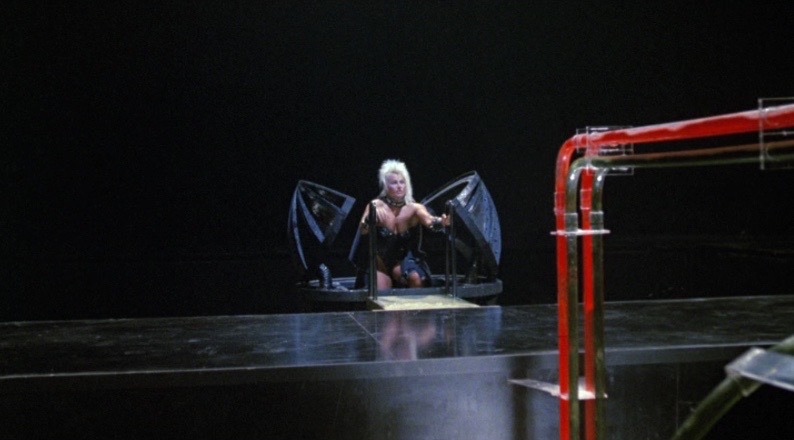
This is obviously not an expensive movie but it looks wonderful. Jaffar’s lair looks more like a mad scientist’s laboratory from a 1930s movie serial than a wizard’s haunt but that just adds more fun and craziness.
The very imaginative production design looks strange and exotic, as it should. There’s no real attempt to maintain the Arabian Nights look. The movie is like a mashup of elements from multiple fairy tales and adventure stories from lots of different historical periods and settings with a few science fiction elements thrown in as well. Anything that seems like it might be fun gets thrown into the mix. Vikings are cool, so let’s have a Viking in the movie. Mediæval knights are cool so we’ll have some of those as well. Mad scientists are fun so let’s make the villain a combination of a mad scientist and a sorcerer.
Some of the effects are cheesy but mostly the effects are clever, inspired and pretty convincing. The monsters are varied and they look terrific. The scenes with the ghostly knights are superb. The knights are just empty suits of armour but they’re very creepy.
All the action scenes are done with style and imagination.
The pacing doesn’t let up. The plot is so simple that there’s no need to waste time with boring exposition. The movie rushes from one frenetic action sequence to another. We know that Ali and Alina are in love so there’s no need for endless romantic buildups. When Sinbad encounters a crazy good wizard with a beautiful daughter we know that she and Sinbad will fall for each other so there’s no need to slow things down while they figure that out.
Muscle-bound bodybuilder Lou Ferrigno had starred in Cozzi’s wild insane Hercules movies. He makes a more than adequate hero. John Steiner chews every piece of scenery he can get his hands on. The actors playing Sinbad’s crew (which includes a dwarf, a Viking and a samurai) put everything into their performances. Alessandra Martines doesn’t have to do much more than look beautiful and frightened which she manages to do quite successfully. The amazon queen is suitably seductive.
Jaffar is an amusing villain. He’s very evil but very cowardly.
The violence is all cartoonish without any gore. There’s no nudity, there are no sex scenes. This is a fairy tale told to a kid.
Sinbad of the Seven Seas makes very little sense but it’s crazy fun from start to finish. Highly recommended.
The 101 Films DVD has no extras apart from the trailer but the transfer is excellent.
I’ve also reviewed Cozzi’s Hercules (1983) and Starcrash (1978). They’re both fabulous movies.
With those things in mind you’d expect this movie to be a trainwreck. In fact it’s magnificent.
Cozzi’s first step was to add a prologue which tells us that this is a story told by a mother to her little girl. That’s perfectly appropriate for an Arabian Nights tale since the Thousand and One Nights had a similar framing story, the tales being stories told by Scheherazade to the king.
The plot is stock standard stuff. The city of Basra is a joyous place ruled over by a kind and wise caliph until an evil wizard named Jaffar (John Steiner) casts a spell that turns the city into a cauldron of evil and misery. Jaffar also intends to force the caliph’s beautiful daughter Princess Alina (Alessandra Martines) to marry him. Alina is currently engaged to a prince named Ali who is a member of Sinbad’s crew.
Sinbad is off adventuring when all this happens. He is shocked and dismayed when he returns to Basra.
Naturally he is determined to thwart Jaffar’s plans but the problem is that Jaffar has used his magic to scatter the sacred jewels of Basra to the four corners of the Earth. Only the sacred jewels can restore peace, sanity and happiness to Basra. Sinbad and his brave crew set off to retrieve the jewels. That’s all there is to the plot.
What follows is a series of crazed action set-pieces as Sinbad and his men battle assorted monsters, ghostly knights and wicked sexy amazons. The amazons are particularly dangerous - their main weapon is seduction.
This is obviously not an expensive movie but it looks wonderful. Jaffar’s lair looks more like a mad scientist’s laboratory from a 1930s movie serial than a wizard’s haunt but that just adds more fun and craziness.
The very imaginative production design looks strange and exotic, as it should. There’s no real attempt to maintain the Arabian Nights look. The movie is like a mashup of elements from multiple fairy tales and adventure stories from lots of different historical periods and settings with a few science fiction elements thrown in as well. Anything that seems like it might be fun gets thrown into the mix. Vikings are cool, so let’s have a Viking in the movie. Mediæval knights are cool so we’ll have some of those as well. Mad scientists are fun so let’s make the villain a combination of a mad scientist and a sorcerer.
Some of the effects are cheesy but mostly the effects are clever, inspired and pretty convincing. The monsters are varied and they look terrific. The scenes with the ghostly knights are superb. The knights are just empty suits of armour but they’re very creepy.
All the action scenes are done with style and imagination.
The pacing doesn’t let up. The plot is so simple that there’s no need to waste time with boring exposition. The movie rushes from one frenetic action sequence to another. We know that Ali and Alina are in love so there’s no need for endless romantic buildups. When Sinbad encounters a crazy good wizard with a beautiful daughter we know that she and Sinbad will fall for each other so there’s no need to slow things down while they figure that out.
Muscle-bound bodybuilder Lou Ferrigno had starred in Cozzi’s wild insane Hercules movies. He makes a more than adequate hero. John Steiner chews every piece of scenery he can get his hands on. The actors playing Sinbad’s crew (which includes a dwarf, a Viking and a samurai) put everything into their performances. Alessandra Martines doesn’t have to do much more than look beautiful and frightened which she manages to do quite successfully. The amazon queen is suitably seductive.
Jaffar is an amusing villain. He’s very evil but very cowardly.
The violence is all cartoonish without any gore. There’s no nudity, there are no sex scenes. This is a fairy tale told to a kid.
Sinbad of the Seven Seas makes very little sense but it’s crazy fun from start to finish. Highly recommended.
The 101 Films DVD has no extras apart from the trailer but the transfer is excellent.
I’ve also reviewed Cozzi’s Hercules (1983) and Starcrash (1978). They’re both fabulous movies.
Monday, 29 August 2016
Against All Flags (1952)
Against All Flags, made by Universal in 1952, is one of Errol Flynn’s later swashbucklers. And an Errol Flynn pirate movie is always worth a watch.
This one starts with Flynn being flogged. We soon find out that the flogging is voluntary. Lieutenant Brian Hawke (Flynn) has volunteered to infiltrate the notorious nest of pirates in Madagascar. The flogging is necessary to make it seem convincing that Hawke would jump ship to join the pirates.
Hawke manages, albeit with some difficulty, to persuade the pirates that he really is a legitimate cut-throat and deserter. He is given the post of navigator on the ship of Captain Roc Brasiliano (Anthony Quinn). Brasiliano is delighted when they encounter what promises to be a very rich prize. It’s the personal vessel of the emperor of India, the Great Moghul himself. Hawke tries to persuade him that capturing this ship would be a very very bad idea. The Honourable East India Company would devote the whole of its very considerable resources to hunting down anyone who performed such a rash act. They would have to do this to placate the Great Moghul or the whole British position in India would be in peril. In 1700, when this movie is set, India was not part of the British Empire but was dominated commercially by a private company, the aforementioned Honourable East India Company (generally known as John Company).
In fact capturing this ship would be an even worse idea that even Hawke imagines. Among the ladies of the harem on board is Princess Patma (Alice Kelley), the daughter of the Great Moghul. If any harm were to come to her all hell would break loose. The princess has the habit of threatening to have anyone who annoys her flung into the cobra pit and she’s not kidding. She not only has the power to do this, she’d be quite wiling to do so.
Hawke manages to save the princess’s life but he can’t save her from the slave market to which Captain Brasiliano, more than a little unwisely, intends to consign all the young ladies he has captured. Hawke’s position is made more awkward by the fact that the princess has taken quite a shine to him. This is especially awkward since Hawke needs to ingratiate himself with the fiery red-headed Spitfire Stevens (Maureen O’Hara).
Spitfire is one of the infamous Captains of the Coast - the high council of the Madagascar pirates. She doesn’t actually take to the high seas as a pirate but she owns her own pirate ship and makes a very comfortable living from the proceeds of piracy. Captain Brasiliano has been pursuing her for some time, without much success. He’s naturally inclined to resent Hawke as a formidable romantic rival. Spitfire is most certainly interested in Hawke but she’s quick-tempered and ferociously jealous and is obviously going to cause Hawke some major problems.
Hawke’s task is to find a way to neutralise the formidable defences of this pirate’s nest so that a British man-of-war currently lurking just over the horizon can sail into the harbour and clean out this troublesome lair of cut-throats and desperadoes. Since he also has to find a way to rescue the princess and win the hand of Spitfire he has quite a lot on his plate.
By this time Flynn’s riotous lifestyle was starting to catch up to him. He was 43 but looked ten years older. In fact he looks just a little too old, and a little too tired, for this kind of role. There’s nothing really wrong with his performance but the sparkle and the devil-may-care nonchalance of his earlier swashbucklers like Captain Blood and The Sea Hawk is no longer quite there. Fortunately Anthony Quinn and Maureen O’Hara are on hand to take up the slack, which they do with considerable style.
Quinn is deliciously over-the-top as the villainous Captain Roc Brasiliano. In fact the problem is that Quinn is just a bit too good - he totally steals the picture and even though he’s the villain we can’t help wanting him to win.
O’Hara gives a lively and rambunctious performance as the notorious Spitfire Stevens.
Which brings us to one of the difficulties Hollywood faced when making pirate movies. Pirates are by definition criminals and the Production Code mandated that criminals could not be allowed to succeed or to escape punishment for their crimes. This meant that somehow or other the hero had to be a bold and daring pirate but at the same time be an honest law-abiding citizen. This was no problem with Captain Blood since Rafael Sabatini’s novel dealt with a legitimate hero forced very unwillingly into piracy. This was the kind of device that had to be shoe-horned into every pirate movie. The hero of Against All Flags presents no great difficulties in this respect since he’s more or less an undercover agent posing as a pirate and we know from the start that he’s on the side of law and order. It does however mean that he comes across as being possibly just a bit treacherous - he does win the trust of the pirates and then betray that trust.
It presents more of a difficulty with Spitfire Stevens. She’s the heroine but she’s very much a pirate. We also know that she’s somewhat inclined to violence - she’s killed at least one man in a duel and as one of the Captains of the Coast she has undoubtedly condemned more than a few men to death. Not to mention the fact that she’s a willing participant in slave-dealing. Making her the virtuous heroine was quite a challenge and it doesn’t quite come off. By 1952 the Production Code was starting to loosen up a bit. I suspect that five years earlier Universal would have had some real problems with the Production Code Authority over this character, especially since she doesn’t display much remorse for her piratical career. Actually she doesn’t display any remorse at all.
The necessity for the criminal pirates to be shown as the bad guys also presents a problem when the chief villain, Captain Roc Brasiliano, is a lot more fun than the hero. Of course villains are often more fun than the hero but in this case he’s a fairly sympathetic villain, arguably a more sympathetic character than the hero.
This movie has had several DVD releases, most notably as part of Universal’s four-movie Pirates of the Golden Age boxed set (which also includes the rather entertaining Buccaneer’s Girl).
Against All Flags is not one of the great pirate movies, certainly not in the same league as Captain Blood, but it provides a pleasing and fairly consistently entertaining mix of action and romance. Recommended.
Wednesday, 1 June 2016
Krull (1983)
The 1983 British-US co-production Krull seems on the surface to be an attempt to jump on the sword-and-sorcery bandwagon that was kicked off by Conan the Barbarian a year earlier. In fact it’s more a sword-and-planet than a sword-and-sorcery film and has more in common with Star Wars. As we shall see, it has a very great deal in common with Star Wars.
Krull is the latest planet to fall victim to the Slayers, led by the mysterious Beast. The Slayers are from some unknown planet (we know this because at the beginning of the movie we see the arrival of their reasonably impressive-looking spaceship that doubles as their castle). Two kings of Krull have decided, not without misgivings, to unite their kingdoms under the joint rule of their children, Colwyn (Ken Marshall) and Lyssa (Lysette Anthony). The wedding between Colwyn and Lyssa will seal the deal but the ceremony is brutally interrupted by an attack from the Slayers. The Slayers not only leave nothing but devastation behind, they also kidnap Lyssa.
Colwyn survives but is sunk in despair. It is up to an Old Wise Man, Ynyr (Freddie Jones), to try to convince him that he must Fulfill His Destiny (yes this movie has a Prophecy) and that he can overcome the Slayers. Or at least, he has a better chance of doing that than anyone else. To do all this he will need a potent weapon that will serve as an equally potent symbol - the semi-legendary Glaive.
Colwyn will need to recruit an army. Since the Slayers are supposedly an almost invincible military force you’d think he’d need a real army but he decides a dozen thieves and cut-throats will be enough. In fact the Slayers prove to be typical movie bad guys (a bit like the Imperial Stormtroopers in Star Wars) - while they can easily overcome a disciplined army defending a strong fortfification they turn out to be utterly useless when pitted against a disorganised rabble in the open - even when they’ve managed to ambush that rabble!
The big challenge for Colwyn will be to find the Black Fortress so he can destroy the Beast. The Black Fortress doesn’t stay in the one spot for more than a day. Only the blind seer can tell where it will be and first they have to find him. The usual adventures and complications ensue.
Director Peter Yates had an interesting if uneven career. His filmography includes the action classic Bullitt (1968) so his ability to direct exciting action sequences was never in doubt.
With Derek Meddings in charge of the visual effects you’d expect this movie to impress in this area, and generally speaking those expectations are fulfilled. Meddings had done the special effects for most of the 1960s Gerry Anderson television shows as well as for the Bond films of the 70s.
The miniatures are excellent, the sets look splendidly weird and most of the special effects stand up pretty well today.
Ken Marshall is a pretty decent action hero. Lyssette Anthony looks kind of ethereal and kind of sensual and mischievous all at the same time. She’s not required to do much acting but she’s fine. Alun Armstrong does well as Torquil, erstwhile leader of Colwyn’s bandit army. David Battley isn’t too irritating as the comic relief in competent magician. Bernard Bresslaw’s height (he was 6 ft 7 in) landed him the role of the Cyclops. Freddie Jones however got the plum role and does a very competent job, being careful not to make Ynyr too loveable or too gratingly wise.
If it sounds like Krull is just a collection of fantasy clichés strung together that’s because that’s exactly what it is. We have a Prophecy, a Hero With a Destiny, a Beautiful Princess in need of rescuing, a Magical Talisman, a Quest, a Wise Good Magician, a Blind Seer and even a harmless incompetent magician to serve as Court Jester. We have an Evil Dark Lord well supplied with minions. There’s hardly a single fantasy cliché that isn’t here.
It doesn’t matter. It’s all done with energy and enthusiasm and style, the story moves along at a brisk pace, the action sequences deliver the goods and the visuals are terrific. If anything the predictability of the plot is an asset. It’s like a fairy tale where knowing what is going to happen adds to the enjoyment.
While the basic plot outline is predictable the details add some interest. The scenes with the Widow of the Web are very well done. Krull adds nothing new to the genre but it’s consistently entertaining and always great fun. Highly recommended.
Labels:
1980s,
adventure,
sci-fi,
swashbuckling adventure,
sword and sorcery
Friday, 20 May 2016
Zorro’s Fighting Legion (1939)
There are those who claim that Zorro’s Fighting Legion is the best of all movie adventure serials. I don’t agree but this 1939 Republic serial is still worth a watch.
Zorro was created by pulp writer Johnston McCulley and made his debut in print in the novel The Curse of Capistrano, serialised in the pulp magazine All-Story Weekly in 1919. It was published in book form under the title The Mark of Zorro after the immense success of the 1920 feature film with that title starring Douglas Fairbanks. McCulley went on to write another sixty or so Zorro stories.
The serial makes several quite significant changes to McCulley’s original creation, most of these changes being (in my opinion) ill-advised. One of the most refreshing and original things about the Zorro stories is their setting - California in the 1820s during the period when it was a territory under Mexican rule. The serial is set, less interestingly, in Mexico itself. Zorro is in reality nobleman Don Diego Vega. Don Diego pretends to be a rather ridiculous figure - excessively bookish, extremely foppish and thoroughly indolent. He is such an absurd figure that no-one takes him seriously, which is of course his intention. In reality he is a master swordsman, a fine shot with a pistol and a magnificent horseman. As depicted in the serial Don Diego is still rather foppish but at times he comes across as being a bit too sensible and serious - he’s not quite ridiculous enough to convince us that no-one would see through his deception.
The other major change is that the Indians are on the side of the bad guys in the serial (although arguably they’re being manipulated by the real bad guys and so are not actual bad guys) whereas in McCulley’s stories Zorro is very sympathetic indeed to the Indians. In fact Zorro is very much the champion of the poor and the oppressed, regardless of race. This crucial aspect of the Zorro character is much weakened in Zorro’s Fighting Legion - Zorro is certainly portrayed as being a good guy but he is fighting for the Mexican government rather than directly for the oppressed.
These changes dilute the unique flavour of Zorro and turn the serial into more of a straightforward western.
Having said all this there’s still a great deal to enjoy here.
William Witney and John English directed and the appearance of their names on the credits of a Republic serial was always a good sign. You knew the action scenes would be plentiful, imaginative and skillfully executed and that the cliffhanger endings would be top-notch and the hero’s narrow escapes at least reasonably plausible. All these virtues are very much in evidence here.
The story is reasonably interesting. A faction is plotting to overthrow the Mexican government and part of their strategy is to disrupt the shipment of gold from the mines in San Bendolito province, shipments on which the government is absolutely dependent. To further this nefarious scheme the conspirators are making use of the Yaqui Indians, convincing them that the legendary Don Del Oro, a kind of god/superman, will lead them to victory and freedom.
The oddest element in the story is that Zorro is no longer a solitary masked crusader - he is now the leader of the Legion, a large band of loyal well-armed followers.
Production values are adequate by serial standards. One gets the impression that most of the money was spent on making the action sequences convincing. This was certainly a sensible approach - any serial stands or falls on the quality of its action scenes.
Don Del Oro himself is fun, being a man inside a kind of golden suit of armour and looking rather robotic.
Reed Hadley’s performance as Zorro/Don Diego is a highlight. Even if he doesn’t always quite manage to make Don Diego sufficiently indolent and foolish he is certainly entertaining and he does have the charisma to make him an excellent Zorro.
This serial has had quite a few DVD releases. Unfortunately, as is the case with most serials, no-one has ever thought it worth the expense of doing a proper restoration so picture quality tends to be a little dubious. My copy is the Alpha Video release and picture quality is most definitely dubious although admittedly that’s compensated for to some extent by the very low price.
Zorro’s Fighting Legion is not quite up to the standards of the very best Republic serials like Spy Smasher but it is consistently entertaining and exciting. Highly recommended.
Monday, 30 November 2015
Don't Lose Your Head (1966)
Don't Lose Your Head, released in 1966, was the thirteenth of the Carry On films and the first to be distributed by Rank, Anglo-Amalgamated having dropped the series because its new managing director disliked them. Rank initially planned to drop the Carry On prefix from the titles but soon changed their minds when they discovered that the Carry On name was a major drawcard. Don't Lose Your Head was later retitled Carry On...Don’t Lose Your Head and released in the US as Carry On Pimpernel.
The film is obviously a spoof of The Scarlet Pimpernel but since he did not have the rights to Baroness Orczy’s books producer Peter Rodgers somehow managed to convince her estate that the movie had nothing whatever to do with the Scarlet Pimpernel!
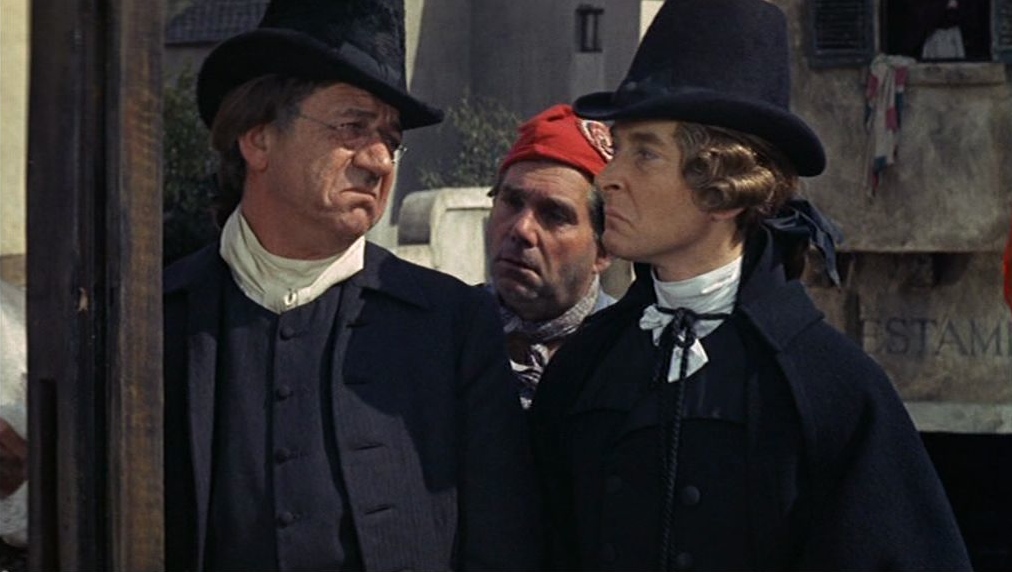
The movie is set during the Terror in Paris, with French aristocrats being slaughtered en masse. The man in charge of the executions is the implacable Citizen Camembert (Kenneth Williams), assisted by the bumbling Citizen Bidet (Peter Butterworth). Two bored foppish English noblemen, Sir Rodney Ffing (Sid James) and Lord Darcy Pue (Jim Dale), decide to do something about this. Soon the Black Fingernail is rescuing French aristocrats from under the very nose of Citizen Camembert.
While rescuing the Duc de Pommfrit (Charles Hawtrey) from the guillotine Sir Rodney meets and falls in love with the beautiful Jacqueline (Dany Robin). Citizen Camembert intends to use Jacqueline as bait in a trap to capture the Black Fingernail, but first they must learn his identity. Camembert and Bidet set off for England in order to discover this essential fact, along with Camembert’s mistress Désirée Dubarry (Joan Sims). Camembert travels in disguise as a French aristocrat. While Camembert tries to trap the Black Fingernail the Black Fingernail is trying to trap him.
Having an actual plot helps things along. And being a spoof of swashbuckling adventures this movie has more action than previous Carry On films. The action scenes combine actual action with (naturally) lots of visual humour and the combination works very well. The movie ends with a long and remarkably ambitious action set-piece which is not only funny but a pretty decent swashbuckling adventure fight scene into the bargain.
The script is of course packed to overflowing with double entendres. Talbot Rothwell had by this time become the regular writer for the series and this is typical of the fine scripts he provided during this period.
The best of the Carry On movies were, in my opinion, those with historical settings. They tended to look rather more opulent than those with contemporary settings and somehow the distinctive Carry On humour seems to work best in period costume. Of course the historical Carry Ons also tended to have stronger plot lines which gave them a bit more discipline and this in turn seemed to make the outrageous acting performances even funnier.
Don't Lose Your Head is actually quite lavish visually with some attractive location shooting and (by low-budget movie standards) some truly sumptuous costumes and sets. And Alan Hume’s cinematography is impressive, especially given the very tight shooting schedule.
The genius of producer Peter Rogers was his ability to achieve fairly high production valuers while keeping budgets very low. Rogers’ financial tight-fistedness caused some tensions with cast members who felt they should have been paid more but the low budgets were essential to the success of the series since they more or less guaranteed that the films would always turn a profit.
This entry in the cycle features most of the regulars and they’re all in splendid form. It would be quite unfair to pick out any one performance as a standout - by this time the regular Carry On repertory company was functioning like a well-oiled machine and it’s the teamwork that provides the magic.
The ITV Studios Home Entertainment Carry On Complete Collection DVD boxed set includes all the Carry On movies plus the short-lived Carry On Laughing TV series. The anamorphic transfer for Don't Lose Your Head is impressive and extras include a commentary track with star Jim Dale.
Don't Lose Your Head has always been one of my favourite Carry On movies. It looks great, it’s delightfully funny and as a bonus it has some fun action scenes. It’s a thoroughly enjoyable swashbuckling romp with the characteristic cheerfully but innocently risque Carry On verbal humour. Highly recommended.
Labels:
1960s,
carry on movies,
cult comedies,
swashbuckling adventure
Tuesday, 24 November 2015
Buccaneer’s Girl (1950)
Buccaneer’s Girl offers us Yvonne de Carlo as a lady pirate, which should have been an excellent idea. And fortunately that’s exactly what it proves to be.
OK, she’s not quite a lady pirate. Not exactly, but sort of. She’s Deborah McCoy, a stowaway on a ship that gets captured by the infamous pirate Frederic Baptiste (Philip Friend). Baptiste orders her put into the ship’s boats with the rest of the crew of the captured ship. It should be explained that as pirates go Baptiste is rather humane - when he takes a ship he ensures that the crews are given plenty of provisions to allow them to reach land in safety. Deborah however contrives to stay aboard Baptiste’s ship. She’s not an easy girl to get rid of.
Deborah does eventually reach New Orleans where she is taken in by Madame Brizar (Elsa Lanchester), who undertakes to train her to be a high-class entertainer. She is already an entertainer, but a decidedly low-class one. It’s probably reasonable to assume that Madame Brizar’s girls are courtesans rather than entertainers but this being essentially a family movie the point is left suitably vague.
Deborah has visions of snaring the fabulously wealthy ship owner Narbonne. She seems fated however to keep running into Baptiste, who is not the person she thought he was. Of course Deborah and the dashing pirate are going to fall in love but there are many complications to be disposed of first.
There is a complicated connection between Narbonne and Baptiste, based on a desire by the pirate to settle old scores and right old injustices. Baptiste might be a pirate but he’s not a villain.
Much of the film is is concerned with a romantic triangle and with Deborah’s adventures in New Orleans. There are some action scenes to come though and they’re quite well done. Unfortunately there really needed to be a bit more action.
Director Frederick de Cordova’s small output of modestly budgeted features included several swashbucklers. By the mid-50s he had switched (very successfully) to television. He handles Buccaneer’s Girl perfectly competently.
Philip Friend is an adequate swashbuckling hero. He’s certainly no Errol Flynn but then this movie is considerably less ambitious than Flynn’s adventure movies. Elsa Lanchester is delightful as the dotty but rather kind Madame Brizar. The supporting cast is competent.
The movie however definitely belongs to Yvonne de Carlo. It was intended as a starring vehicle for her, she’s the one who has to carry the film, and she does so with style and enthusiasm. Deborah might not be a modern-style kickass action heroine but she’s fiery and feisty, she’s resourceful, and she’s capable of looking after herself pretty well by relying on brains rather than muscle. In general she’s just the type of gal to make a perfect companion for a pirate. She also gets involved in a memorable cat-fight with Baptiste’s old girlfriend.
This was not a big budget movie but the studio backlot stands in pretty well for New Orleans and production values are reasonably high. It was shot in Technicolor and it looks good.
Deborah gets to do some singing and dancing although her numbers suggest that Madame Brizar might need to give her a bit more tutelage in that area.
The movie fizzles out a bit towards the end - in a pirate movie we feel entitled to expect a more exciting action finale.
Buccaneer’s Girl is part of Universal’s four-movie Pirates of the Golden Age DVD boxed set (with the four movies on two discs). There are no extras but the transfer is top-notch.
This is a light-hearted romantic adventure romp with a bit of humour. Don’t expect anything in the same league as Captain Blood but this film delivers very satisfactory B-movie entertainment with Yvonne de Carlo in sparkling form. Highly recommended.
Sunday, 18 October 2015
The Conqueror (1956)
RKO’s 1956 epic The Conqueror has the reputation of being one of the worst movies ever made. That judgment is perhaps a little unfair. While it certainly has its problems and cannot in all honesty be described as a good film, it does have a certain fascination.
Part of this movie’s terrible reputation is undoubtedly due to the assumption that any film that Howard Hughes was involved in must be a bad film. There’s also the undeniably incongruous casting of John Wayne as Genghis Khan. The movie’s tendency to play fast and loose with historical accuracy (which it does to an even greater extent than most epics) hasn’t helped its reputation. And lastly there’s the legend (which may or may not be true) that the movie was shot on an old atomic testing site and that as a result almost half of those involved in the production subsequently died of cancer.
In fact The Conqueror’s failure as an epic has little to do with any of these factors.
The movie opens with Temujin, later to be known as Genghis Khan, still a rather minor Mongol chieftain. He captures Bortai (Susan Hayward) during a raid. Given that her father murdered Temujin’s father it’s perhaps not surprising that initially they don’t hit it off too well. Temujin however is convinced that Bortai really is the woman for him.
Temujin is determined to avenge his father’s murder. He has also been convinced by his blood brother Jamuga (Pedro Armendáriz) that he is a man of destiny who will one day rule a vast empire. That day seems a long way off as most of Temujin’s schemes seem to end in disaster.
Both Temujin and Jamuga have a remarkable capacity for getting themselves captured by their enemies. Temujin’s plans to gain the ageing but powerful Wang Khan (Thomas Gomez) as an ally also face formidable obstacles and dangers, the principal danger coming from Wang Khan’s wily and unscrupulous shaman (played by John Hoyt). Meanwhile Bortai is still far from reconciled to the idea of being Temujin’s wife and is likely to cause trouble.
While the movie is called The Conqueror it has to be said that Temujin doesn’t do much conquering. The decision to focus on the early part of the career of the man who would become Genghis Khan is reasonable enough but it does involve one major problem - it reduces the opportunities for spectacular battle scenes. In fact the movie is a bit light on action in general and most of what there is is small-scale stuff. It’s more like a swashbuckling adventure movie than a genuine epic but there’s still not enough action. Concentrating on Temujin’s relationships with Bortai and Jamuga (which is what this film does) could have provided the chance to explore Genghis Khan the man rather than the legend but if you’re going to make an epic about a great conqueror you do need to provide at least some focus on the military and political prowess that allowed him to build up one of the greatest empires in history.
Dick Powell was by no means a poor director. The Enemy Below, which he made in the following year, is an absolutely riveting wartime adventure. He does not seem quite at home with the epic genre however. In actual fact there were very few directors with a real flair for the epic. It’s not enough to spend a lot of money (and the Conqueror was an expensive film) and it’s not enough to have lavish sets and costumes. A few years later Anthony Mann would demonstrate in El Cid how an epic should be made. Mann captured the true epic feel in a way that Powell fails to do.
While the scenery in Utah is impressive enough it presents another problem - it just looks too American, too much like the setting for a western. The necessary exotic feel is just not there.
An epic also needs the right kind of star. John Wayne was a much better actor than Victor Mature but Mature would have been a better choice for the lead - he understood the style of acting that epics require. Howard Hughes however wanted John Wayne. Hughes was probably half right. Wayne had the ability to play larger-than-life characters and he certainly had the ability to portray complex heroes (and Hughes clearly wanted Genghis Khan to be a hero). The trouble is that Wayne tries too hard and his performance ends up seeming tentative and confused. Wayne appears to be thinking too much about his performance.
Susan Hayward on the other hand was the perfect female lead for an epic and if you can get past the fact that she looks even less like a Tartar princess than Wayne looks like a Mongol her performance works quite satisfactorily.
The supporting players are quite good. They bring the right kind of hamminess to their roles.
This is, even by 1950s standards, an astoundingly politically incorrect film. If you’re the kind of person who demands that the movies of the past should conform to modern sensibilities than you’ll have huge problems watching this movie. The fact that Temujin believes that the right way to handle women is to handle them roughly, and the fact that this makes him just the sort of man Bortai wants, may well induce fits of apoplexy among some modern viewers. It’s probably worth pointing out however that the real Genghis Khan was probably not a guy who worried too much about political correctness.
The Conqueror doesn’t really work as an epic and John Wayne is definitely not quite right for the title role but this movie is not as bad as its reputation suggests. In its own way it’s quite a bit of fun to watch. Despite its faults its very notoriety makes it worthy seeing and the ways in which it misses the target make it rather entertaining. Recommended.
Labels:
1950s,
adventure,
swashbuckling adventure,
sword and sandal
Subscribe to:
Posts (Atom)