Showing posts with label vincent price. Show all posts

Monday, 25 January 2021

The Masque of the Red Death (1964)

The Masque of the Red Death was the second-to-last of Roger Corman’s Edgar Allan Poe movies. Vincent Price stars (he starred in all but one of these movies). It was made in Britain in 1964 with a fine mostly British cast and with Nicolas Roeg doing the cinematography. Charles Beaumont and R. Wright Campbell wrote the screenplay.

Corman was a wizard at stretching a budget and this film manages to look a lot more expensive than it was.

Prince Prospero (Vincent Price) rules a medieval Italian city state and he rules it to satisfy his taste for decadence, cruelty and cynicism. And also to serve his master, Satan. Prospero’s nihilistic view of life is about to be uncomfortably confirmed. Plague has begun to ravage the land. It is the Red Death, which produces a red rash (followed by a lingering death).

Prospero and his nobles and hangers-on are safe in the prince’s castle, or so they assume. And Prospero believes that Satan will protect him.

Prospero has taken a pretty young peasant girl, Francesca (Jane Asher), away from her family. He is sure she will amuse him. Juliana (Hazel Court) does not share Prospero’s enthusiasm for the girl. She fears losing her place in the prince’s affections. She will do anything to prevent that from happening. Absolutely anything.


This is a movie that wasn’t really embraced by audiences at that time. There’s very little plot. This is not quite a normal horror movie. It’s all about atmosphere - the atmosphere of decadence and cruelty and the atmosphere of fear. Plague is a lot more terrifying than mere monsters. Prospero’s character is established, plague ravages the countryside, Prospero and his friends party and Prospero plans a great celebration, a masque. And then we get the inevitable ending. The entire plot could have been condensed into half an hour or less. While most horror movies up until the 70s relied more on atmosphere than gore audiences still expected some kind of dramatic payoff. They expected some mayhem and they expected monsters of some sort. It’s not surprising that this movie left them mystified and dissatisfied.

It’s not that it’s a bad movie. It’s a very very good movie, in fact a great movie, but it’s not the sort of movie that the mid-60s audience for such movies would have been prepared for.

It actually has just a hint of a European feel to it. There are some very obvious nods to Bergman’s The Seventh Seal. Corman was more arty as a director than his later reputation as a shlock producer would suggest. The Masque of the Red Death is almost a European art film, but aimed at the drive-in market.

This film truly has a wonderful cast. Patrick Magee is in top form as the cynical depraved courtier Alfredo. Jane Asher captures the wide-eyed innocence of Francesca. Hazel Court, one of the great scream queens, is as reliable as ever as the jealous and vindictive Juliana. There’s my old favourite Nigel Green as well.


And of course there’s Vincent Price, giving a performance with the hamminess toned down somewhat. It’s always important to remember that Price only gave so many hammy performances because that’s what was usually demanded of him. If a director wanted something more subtle he could certainly provide it and when he was being subtle he was a lot creepier. Compared to most of the directors he worked with Corman expected a bit more from Price and Price invariably delivered.

What’s interesting about Prospero is that he seems to get more pleasure from seeing the degradation of others than from any actual personal indulgences in sensual pleasures.


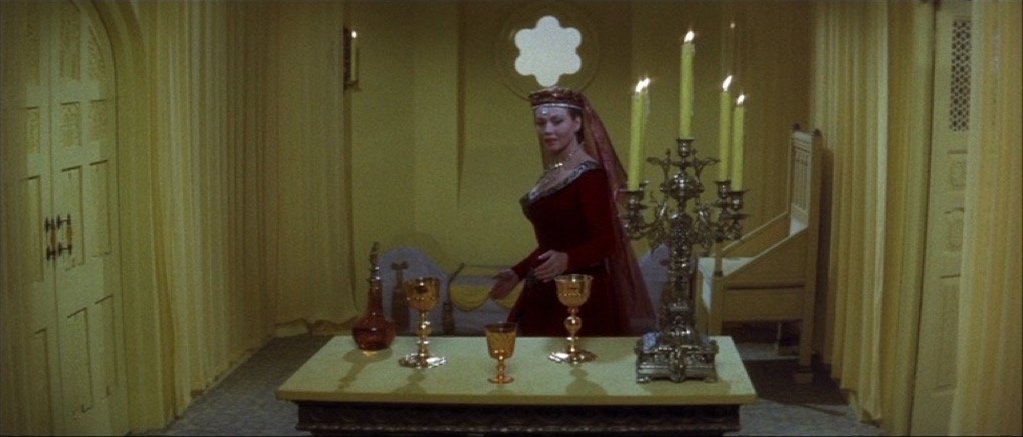
The use of colour in this film is extraordinary, particularly the differently coloured rooms each of which is intended to serve a different depraved purpose. And there is very little red in the movie. Prince Prospero abhors the colour red. It reminds him uncomfortably of the Red Death. When we get an occasional slash of red it has the desired impact. With Corman’s own keen visual flair, with Nic Roeg behind the camera and with Corman’s regular production designer Daniel Haller on hand you expect a visual feast and that’s what you get.

The best of Corman’s string of Edgar Allan Poe films - this film along with The Fall of the House of Usher, The Pit and the Pendulum, The Haunted Palace, The Premature Burial and The Tomb of Ligeia - constitutes one of the most impressive cycles of gothic horror movies in cinema history. It’s certainly worthy of comparison to the Universal horrors of the 30s and to the Val Lewton RKO horror films of the 40s. Corman was quite ambitious as a director and with these movies he tried not to keep repeating himself. The Pit and the Pendulum is classic straightforward horror, The Fall of the House of Usher is a moody exercise in gothic doom and The Masque of the Red Death is full-on decadence (with perhaps an anticipation of where the 60s counter-culture was going to end up going).

The Masque of the Red Death is the most impressive of all the Corman Poe films. Very highly recommended.

Saturday, 12 September 2020

The Fall of the House of Usher (1960)

The Fall of the House of Usher (sometimes referred to simply as The House of Usher), released by American International Pictures in 1960, is not just a very good horror movie it’s a very important one. It launched Roger Corman’s Edgar Allan Poe cycle, one of the most significant horror movie cycles of all time. It also established Vincent Price as one of the great horror icons.

Although this film has some obvious affinities to a haunted house movie it’s actually something quite different. The Usher house is not haunted by ghosts or malevolent spirits but by the tragedy of the Ushers themselves.

Philip Winthrop (Mark Damon) arrives at the oppressively gloomy Usher mansion to see his fiancée Madeline Usher. He is at first refused admittance to the house. He is told that Madeline is too ill to see anyone. Madeline’s brother Roderick Usher (Vincent Price) explains matters to Philip. He cannot marry Madeline. The Usher blood is tainted.

Roderick Usher suffers from a morbid derangement, a distressing over-acuteness, of the senses. He can eat only the blandest food. He is over-sensitive not just to light but to all visual impressions. His hearing is excessively acute and even the slightest sound almost drives him mad. The only sounds he can endure are his own musical compositions, and very strange melodies they are. He is oppressed by odours of all kinds. He tells Philip that Madeline suffers from the same condition. For members of the Usher family there is no escape from this fate which inevitably leads to madness and death.


Roderick Usher is most certainly not a monster. He may be insane, or may have been driven insane by his fate, but he is essentially a kind, sensitive, intelligent and deeply cultured man. Which of course makes his suffering all the more poignant. He feels too much.

Roderick tells Philip that he and his sister are dying although Philip assumes that is is just a morbid fancy on the part of Roderick. What does seem certain that the house itself is slowly dying, slowly crumbling.

This is not a horror movie that relies on overt terror. It relies instead on a mood of gloom, despair and decay. It might not have many scares but it has creepiness and dread in abundance. Philip wishes to take Madeline away, believing that he can thereby save her, but he is told that this is impossible. It seems that the Ushers cannot escape their fate.


There are those who see Price’s performance as hammy, but it isn’t. He could be hammy when that was what was required but he was perfectly capable of being subtle. His performance here is exactly what the film needs. It’s certainly bizarre and outrageous, but Roderick Usher is one of the more bizarre characters in fiction. He has to be permanently on the verge of an hysterical breakdown, but never quiet going over the edge. Price knows precisely what he is doing. Usher is also not a monster. He is a deeply tragic doomed figure and we have to feel sympathetic towards him.

There are only three other cast members. Mark Damon as Philip, Myrna Fahey as Madeline and Harry Ellerbe as the aged family retainer Bristol are all pretty good.

This was a fairly low budget movie but compared to the minuscule budgets Corman was used to he had an almost unimaginably vast amount of money at his disposal and if there was one thing at which Corman excelled it was making a limited budget go a very long way.


He also had the advantage of having an extraordinary array of talent available to him on this film - screenwriter Richard Matheson (and horror screenwriters don’t come much better than Matheson), cinematographer Floyd Crosby and production designer Daniel Haller (who went on to direct the very underrated Lovecraftian horror flick The Dunwich Horror). And of course he had Vincent Price as his star. With people of that calibre involved it’s a lot easier to make good movies.

This is not a movie that will satisfy those who demand gore with their horror. This movie is the ultimate in atmospheric horror. It is also a masterpiece of decadence (fittingly, since Poe was a master of both the gothic and the decadent).

Extra interest is added by the fact that the story of the Usher evil comes from Roderick - how much of his story is real and how much is due to his disturbance of mind? Does the evil come from the Ushers, or the house, or from some outside influence. The dream sequences (very effectively done) add to the ambiguity.


Matheson made a few changes to Poe’s story. In Poe’s tale the Philip Winthrop character (he is actually an unnamed narrator) is not Madeline’s fiancé. He and Roderick Usher were school friends many years earlier and Roderick has begged Winthrop to visit him in an attempt to dispel his mood of impending doom.

The old Region 4 DVD which I have is letterboxed but it’s a very nice transfer. There has been a Blu-Ray release from Arrow in the UK, if you can find it.

This movie may not offer geysers of blood but it is an effectively chilling film. It was a major hit for Corman. This and his subsequent Poe films established him as a master of gothic horror. This movie offers more subtle delights than the roughly contemporaneous Hammer gothic horrors. That’s not to say that it’s superior to Hammer’s efforts, merely that Corman had his own distinctive approach.

The Fall of the House of Usher is in its own way quite superb. Very highly recommended.

Wednesday, 13 June 2018

The Bat (1959)

By 1959 the Old Dark House movie was getting rather long in the tooth as a concept but it was a genre that seemingly just wouldn’t die. The 1959 The Bat, directed by Crane Wilbur and starring Vincent Price and Agnes Moorehead, was yet another version of the venerable stage hit written by Mary Roberts Rinehart and Avery Hopwood. There had been a silent version in 1926 and a sound version (with the title The Bat Whispers in 1930).

Agnes Moorehead plays popular mystery writer Cornelia van Gorder who has rented a spooky mansion called The Oaks. She and her secretary Lizzie (Lenita Lane) are alone in the house because the entire domestic staff has quit. They’re afraid of The Bat, a mysterious killer who has been terrorising the local community. They’re also afraid of actual bats, following a newspaper report that the bats in this area are infected with rabies.

The Oaks belongs to the local bank president, a man named Fleming. He’s gone off on a hunting trip with his physician, Dr Malcolm Wells.

A very large amount of money has been embezzled from the bank and the nice young bank vice-president, Victor Bailey, has been arrested for the crime.

There are at least three major sub-plots and the connections between them are pretty tenuous.


There are all the standard ingredients of the Old Dark House film. There are secret passageways and masked villains and lots of running about and screaming.

It’s Vincent Price and Agnes Moorehead who make this movie worth seeing, insofar as it’s worth seeing at all. The other cast members are distinctly unmemorable.

Price gives one of his more understated performances but of course he still manages to be pretty creepy.

Moorehead was a much admired actress and this film gives her a rare chance to play a leading rôle. And she has a great deal of fun as the feisty mystery novelist.


Crane Wilbur, who write and directed The Bat, had a lengthy career in film, starting as an actor and moving on to directing. A lengthy career, but not a particularly distinguished one.

Creaky is the word that is inevitably going to be used when describing this movie. Not only does it belong to a genre whose glory days were the 1930s, it really does feel very 1930s stylistically as well. There’s a heavy reliance on shadowy outlines of sinister figures to provide scares. Compared to the horror movies that were being made by Hammer at about this time it must have seemed pretty tame even to contemporary audiences.


Of course any Old Dark House movie is going to have that problem of feeling dated. It’s an inherently very old-fashioned concept. The original play made its Broadway debut in 1920, so it actually pre-dates what we think of as the golden age of the detective story. The difficulty with trying to revive The Bat as a movie in 1959 is that it was either going to feel very old-fashioned, or it was going to end up with a high camp feel. The movie mostly ends up just being old-fashioned.

I personally like old-fashioned things, and I have a certain fondness for the genre but even back in the 30s Old Dark House movies were something of a hit and miss proposition.


There are numerous public domain version of the his movie floating around. Surprisingly enough it’s actually had not only an official DVD release but a Blu-Ray release as well. The version I saw was a public domain copy and the quality was atrocious. The question you have to ask yourself is whether you would bother spending real money buying the Blu-Ray or the apparently excellent Anchor Bay DVD. This really is not the kind of movie you’re likely to watch again and again.

If you’re a hardcore fan of Vincent Price or Agnes Moorehead you might get some enjoyment from this movie, otherwise you’d have to be a pretty enthusiastic devotee of Old Dark House films to bother with this one. If you want a really good Old Dark House movie, check out One Frightened Night or Tomorrow at Seven.

Thursday, 14 July 2016

The House of the Seven Gables (1940)

The House of the Seven Gables, released by Universal in 1940, is based on Nathaniel Hawthorne’s gothic novel of the same name.

We begin with a family curse. In 17th century New England wealthy landowner Jaffrey Pyncheon cheated a poor man, Matthew Mule, out of his land by accusing him of witchcraft. Matthew was hanged but before he died he cursed Pyncheon. Pyncheon built his house, Seven Gables, on Matthew Maule’s land. On the day the house was completed Pyncheon died, his mouth filled with blood, in apparent fulfillment of the curse.

Many years later, in 1828 to be precise, the house is still occupied by the Pyncheon family. The current head of the family has run up ruinous debts. His heirs Jaffrey (George Sanders) and Clifford (Vincent Price) have differing views as to what should be done. Clifford wants the house to be sold to clear the debts. Clifford is a composer and would prefer to move to New York. Jaffrey is against the idea. He claims to be concerned with family honour and tradition but in reality he wants to gain possession of Seven Gables because of the family legend that there is a fortune in gold hidden somewhere in the house. Jaffrey has inherited the worst of the Pyncheon faults - insatiable greed.

Matters come to a head, tragedy follows and Clifford finds himself serving a life sentence for murder. He is innocent but he has made the mistake of becoming an obstacle to Jaffrey’s greed. 


Jaffrey’s plans don’t work out quite as neatly as he’d hoped and he doesn’t get Seven Gables after all. Cousin Hepzibah (Margaret Lindsay) gets the house. Hepzibah and Clifford were to have been married. Hepzibah stands by her man while Jaffrey continues on his scheming way.

Coincidences are part and parcel of melodrama so you won’t be surprised to learn that a descendant of Matthew Maule, the man who cursed the first Jaffrey Pyncheon, plays an important role. 

This is a tale of revenge, spanning two decades, but with a few twists.


George Sanders is at his most suave and most villainous and is a delight. Vincent Price gets to play the hero (this was some years before he became a horror icon). Margaret Lindsay gives a satisfactory performance as the patient faithful Hepzibah. Dick Foran was a lightweight actor and as Matthew Maule he’s totally overshadowed by Sanders and Price. In fact everyone is overshadowed by Sanders and Price, not thyat it matters because they’re the key characters and it’s their fates that concern us most.

The screenplay doesn’t quite capture the full flavour of Nathaniel Hawthorne’s novel. This is Hawthorne Lite but the ingredients are still there for a fine story.


This is gothic melodrama with the emphasis on the melodrama. Had Universal made this movie a few years earlier it would doubtless have been given the full horror treatment and might well have been one of the studio’s classic horror titles. As it stands the horror is somewhat downplayed although it’s by no means absent. 

It’s also a little surprising that the movie has few of the classic Universal horror visual signatures. Even the house itself does not seem particularly sinister - in fact it really needed to be made more sinister to bring out the gothic atmosphere. Universal however had by this time decided that horror was no longer a commercially viable formula for A -pictures.


The Region 2 DVD release offers a very satisfactory transfer. The only extras is an entertaining ten-minute interview with Vincent Price from a British talk show.

Horror fans will see this film as a wasted opportunity on Universal’s part and will be left wondering just how much fun George Sanders and Vincent Price could have been together had they been given the chance to play their roles in full-blown horror mode. As it stands it’s still an enjoyable melodrama with a few horror undertones and Sanders and Price are still very very good. Fans of these two great actors won’t want to miss this film. Recommended.

Friday, 18 July 2014

Tower of London (1939)

Universal’s Tower of London, released in 1939, is an historical drama rather than a horror movie. However the presence in the cast of Boris Karloff and Vincent Price, as well as Basil Rathbone, makes it of considerable interest to horror fans. Roger Corman directed an inferior remake in 1962.

The story of the rise and fall of Richard III is so dramatic that it would be almost impossible to make a dull movie on the subject. And this movie is certainly far from dull.

Basil Rathbone has the starring role as Richard, Duke of Gloucester (later to become King Richard III). His brother King Edward IV (Ian Hunter) reigns. The previous king, the mad Henry VI, is a prisoner in the Tower of London. Henry VI’s son tries to wrest the throne from King Edward but is defeated and killed by Gloucester at the decisive Battle of Tewkesbury.

Edward IV has two young sons so the succession seems assured and clear-cut. The King however is suspicious of his brother the Duke of Clarence (Vincent Price). He is not suspicious at all of the Duke of Gloucester, although he should be. Gloucester is a skillful and subtle plotter and he is determined to gain the throne for himself. In a rather nice touch the movie has Gloucester manipulating puppets in a puppet theatre, each puppet representing one of the people who stands between him and the throne.


There are numerous fairly complex sub-plots. I’m not really sure it would be possible to keep track of the complex inter-relationships and the byzantine machinations of the leading figures without having a reasonably good knowledge of the history of the period. The motivations of many of the leading characters are exceptionally complicated. This is especially true of the Duke of Clarence.

Despite the complexities of the plot the movie moves along at a brisk pace and there is plenty of drama.

Basil Rathbone was always a splendid villain, and in this movie Richard is most certainly a villain. He is cold-blooded and calculating, and a patient and remorseless schemer. This is one of the more subtle screen portrayals of Richard III and one of the most believable - Rathbone’s performance makes it possible to understand how Richard could have got away with his plotting for so long, hiding it under a veneer of charm. 

Vincent Price plays Clarence as something of a fop, a man whose ambitions would be dangerous if he had the strength of character to back them up. The scene in which Clarence’s love of Malmsey wine catches up to him is rather well played.


The movie’s claims to being a horror movie rest mainly on Boris Karloff’s performance as Mord, the Duke of Gloucester’s chief executioner and general-purpose evil henchman. Mord is partly crippled by a misshapen foot, a clever echo of Gloucester’s own deformity (although Gloucester’s hunchback is downplayed in this movie). Mord is a classic Karloff villain.

The weakness of the movie is that we’re not really left with any sympathetic characters to identify with. Rathbone’s performance is good but it’s perhaps makes him an overly two-dimensional villain with the result that the audience might find itself not caring too much who comes out on top in the movie’s endless power struggles. The closest thing we have to a hero is John Wyatt (John Sutton), but he’s rather bland and too much of a peripheral character to count as a real hero.


Rowland V. Lee directed the production from a screenplay by his brother Robert N. Lee. Rowland V. Lee’s career included a number of horror and adventure movies, including the superb Son of Frankenstein, so he must have seemed a sound choice to helm this one. He does a competent if uninspired job. The battle scenes benefit from being dark and chaotic but suffer from being markedly unexciting. Universal were trying to keep the budget within reasonable bounds but they were also to a large degree aiming the movie at their traditional horror market which may also explain why it was shot in black-and-white. The production ran well over schedule and over budget although it managed to turn a profit.

Towards the end Tower of London suddenly becomes more of an adventure movie, in fact a bit of a medieval heist movie. And Boris Karloff and Basil Rathbone deliver some genuine horror moments.


This movie features in Universal’s five-movie Boris Karloff Collection DVD boxed set. The transfer is quite superb. The boxed set itself is a worthwhile buy for horror fans.

Tower of London is a fairly entertaining historical melodrama with enough gruesome touches to keep horror fans happy. Rathbone and Karloff are the main reasons for seeing this film although Vincent Price has his moments as well. Had it been released on its own I wouldn’t recommend this as a purchase but since it’s included in a boxed set that is worth buying for other reasons there’s no reason not to give this one a watch.

Monday, 14 July 2014

Dragonwyck (1946)

Dragonwyck is one of the great gothic romance movies. It’s one of three classic Hollywood gothic romances of the 1940s, the others being Jane Eyre and Rebecca. A gothic romance is not necessarily a horror movie. Rebecca is not a horror movie. Dragonwyck on the other hand is both gothic romance and horror. It is also one of the few great ghost movies made by Hollywood during the heyday of the studio system.

Ernst Lubitsch was to have directed the movie but withdrew due to illness thus giving Joseph L. Mankiewicz the chance to direct his first feature. Mankiewicz also wrote the screenplay. Dragonwyck was released by 20th Century-Fox in 1946.

The studio saw the movie as very much a vehicle for Gene Tierney who was one of their brightest stars at the time. Gregory Peck was to be her co-star but before filming began he was replaced by Vincent Price. With all due respect to Gregory Peck the decision to go for Price as the male lead was a very fortunate one. 

The movie is set in 1844. Tierney plays Miranda Wells, a farm girl from Connecticut. Her parents are respectable buy by no means wealthy. Her father Ephraim (Walter Huston) is a god-fearing man but underneath a slightly forbidding exterior he has a good heart and his concern for his daughter’s welfare is genuine. The arrival of a very unexpected letter throws the family into some turmoil. The letter is from Nicholas Van Ryn (Vincent Price), a very wealthy man and a distant cousin. Van Ryn’s letter contains an offer to take one of the two Wells daughters into his home for an extended period. She will act as a governess/companion to Van Ryn’s child. Living with Van Ryn and his wife will offer the daughter enormous social advantages.


Miranda has never been entirely satisfied by life as a farmer’s daughter and she is desperately keen to take advantage of this opportunity. Ephraim is not impressed by the idea at all but Miranda is a girl who knows how to get her own way.

Miranda’s arrival at Dragonwyck, the forbidding gothic mansion that is the Van Ryn family seat, is quite a culture shock for her. Miranda’s lack of education and even more particularly her lack of the social graces will make things somewhat uncomfortable for her. 

And there are definite tensions at Dragonwyck. Nicholas Van Ryn and his wife Johanna (Vivienne Osborne) seem very ill-matched. Their daughter Katrine (Connie Marshall) is a very strange child, disturbingly melancholy and emotionally distant. 

There is also considerable unrest on the part of Nicholas Van Ryn’s tenant farmers. In this part of the United States a form of feudal landholding remains in existence. The system dates back to the early Dutch settlement in the 1630s. There is widespread political agitation to change this system and Van Ryn’s tenants are openly rebellious. Dr Jeff Turner (Glenn Langan) is one of the chief agitators and there is a great deal of hostility between Dr Turner and Nicholas Van Ryn. This will cause complications when the doctor gets drawn into the increasingly tense situation at Dragonwyck.


Dr Turner is clearly taking a romantic interest in Miranda Wells, but Nicholas Van Ryn is just as obviously also interested in her. And Van Ryn clearly has little interest in his wife.

Gene Tierney copes well with a difficult role. She has to make Miranda convincingly naïve without making her seem overly foolish and she also has to make Miranda 

Unlike the heroine of Rebecca, Miranda is not a passive victim. She is somewhat naïve but in the early scenes with her family we have already seen that she can be very persuasive when it comes to getting something she wants. Persuasive almost to the point of being manipulative. She is rather more complex than she seems at first to be, and her part in the tragic events that unfold at Dragonwyck is not entirely passive. The challenge for Gene Tierney was to make Miranda naïve without being foolish and mildly manipulative without being sinister, and all the while retaining the audience’s sympathies. It’s a deceptively  difficult rôle and Tierney handles it confidently.


While Gene Tierney got top billing Vincent Price has the most crucial part. It’s a kind of dress rehearsal for so many of his later horror movie rôles and he already has the tragic but sinister and decadent aristocratic vibe working to perfection. Nicholas Van Ryn is a monster but he’s a complicated monster. 

Glenn Langan is both irritating and bland as the rabble-rousing Dr Turner.

The political sub-plot involving the rebellious tenant farmers asserting what they see as their democratic rights was apparently in Anya Seton’s source novel but it feels rather clumsy. Its main purpose seems to be to show us that Nicholas Van Ryn is a wicked aristocrat, and also to suggest that he is a relic of the past. And indeed he is, as are most classic gothic heroes. Personally I found it had the opposite affect to that which was intended - it made me more sympathetic to him, it made him seem more a victim of his past than a mere monster. Or perhaps that was part of Mankiewicz’s intention, to make Nicholas a more complex monster.


Arthur C. Miller’s black-and-white cinematography is superb. The sets, the costumes, the art direction in general, are all magnificent. This is a gloriously and extravagantly gothic movie.

Dragonwyck was released on DVD as part of the three-movie Fox Horror Classics Volume 2 set (which also includes Chandu the Magician and Dr. Renault's Secret). The transfers are excellent. The Dragonwyck DVD includes a host of extras including a commentary track by Steve Haberman and Constantine Nasr. Habermann displays a genuine and pleasing knowledge of the gothic literary heritage.

Dragonwyck is outrageous gothic melodrama, enlivened by great performances by Gene Tierney and Vincent Price. Highly recommended, more perhaps for its style than its content.

Monday, 5 May 2014

The Invisible Man Returns (1940)

The Invisible Man Returns hit cinema screens in 1940 and was the first of Universal’s sequels to their 1933 hit The Invisible Man. Their horror films of the later 1940s soon became characterised by somewhat tedious and laboured attempts at humour but when the studio, now under new management, first began to revive the horror cycle their approach was rather more serious. And The Invisible Man Returns benefits from this fairly serious treatment.

Sir Geoffrey Radcliffe (Vincent Price) is about to be hanged for the murder of his brother, his motive presumably being to gain control of the family’s lucrative northern England colliery. He is innocent of the crime but the evidence against him was telling. On the morning scheduled for his execution Radcliffe mysteriously vanishes from his prison cell.

His escape was made possible by Dr Frank Griffin (John Sutton), the brother of the unfortunate scientist who had discovered the secret of the invisibility serum in the original film. The invisibility serum made Geoffrey’s escape easy but now he faces two awkward problems. Firstly, unless he can find his brother’s real murderer he will remain a hunted man. The second problem is even more distressing - the invisibility serum causes madness of the homicidal variety. Frank is working feverishly to find an antidote but time is against him.


Helen Manson (Nan Grey) loves Geoffrey and has always believed in his innocence. She shelters the invisible fugitive, now the subject of a large-scale manhunt under the direction of the determined Inspector Sampson of Scotland Yard (Cecil Kellaway). Geoffrey gets a break when he extracts some vital information from the colliery’s drunken and none-too-honest watchman Spears (Alan Napier). This information casts suspicion on Geoffrey’s suave cousin Richard Cobb (Sir Cedric Hardwicke).

While Geoffrey is making some progress towards clearing his name it is clear that the madness, the unfortunate side-effect of the invisibility drug, is starting to take hold. It is now a race against time to gain the evidence of his innocence before the madness takes over completely.


German-born writer Curt Siodmak, an important figure in 1940s Hollywood horror, co-wrote the screenplay with Lester Cole. The screenplay mixes subdued melodrama with (thankfully) restrained humour. Austrian-born director Joe May spoke little English, a potential problem that was somewhat eased by the lucky coincidence that Vincent Price spoke fluent German. May was however a painstaking director and this combined with the elaborate special effects the film required caused the production to fall behind schedule and run over budget. Despite this the movie was well received by critics and did well at the box office.

John P. Fulton’s Oscar-nominated special effects may have been costly but they proved to be money well spent and surpassed his work on the original 1933 The Invisible Man. They still look quite convincing today.


Cedric Hardwicke got top billing but has little to do. He is overshadowed by Vincent Price, despite the fact that we only see Price in the flesh for less than a minute. Price, swathed in bandages, did all the invisibility scenes himself and proves that even having only his voice to work with he could still dominate the screen. Price’s ease with comedy helps things along. Nan Grey makes an appealing female lead. Cecil Kellaway is less jovial than usual but provides solid support as Inspector Sampson.

Universal provided a fairly generous budget and the movie looks slick and polished. The coal-loader sequence required an expensive but very impressive set and provides an exciting and visually satisfying climax.


The special effects are the movie’s strongest asset and they are the major drawcard, along with the opportunity to see (or at least hear) a very young Vincent Price in one of his first horror roles.

The madness, and more importantly the fear of the descent into madness, induced by the invisibility serum probably should have been developed in greater depth. The desire to make Geoffrey Radcliffe a sympathetic hero was presumably the reason this element received relatively little attention.

Shock’s Region 4 DVD provides an excellent transfer without any extras.

The Invisible Man Returns lacks the stylistic flourishes of James Whale’s original but it’s a solid and entertaining sequel. Recommended.

Friday, 19 July 2013

Confessions of an Opium Eater (1962)

Adapting Thomas De Quincey’s 1821 Confessions of an Opium Eater for the screen would have presented considerable challenges, to say the least. Perhaps wisely the makers of the 1962 film Confessions of an Opium Eater made no attempt to do so. What they did instead was to make a movie very loosely inspired by De Quincey’s classic. It really has very little to do with De Quincey’s book although it does also involve opium. The results are bizarre but fascinating.

A hundred years after the publication of the famous book Gilbert De Quincey (Vincent Price), a descendant of Thomas De Quincey, arrives in San Francisco’s Chinatown. He has lived a life of adventure in China and other parts of the East but he is still searching. What he’s searching for he has no idea. What he finds is the strangest adventure of his life.

A tong war has broken out. At issue is the auction of girls for wives. The girls are kidnapped in China and then sent to San Francisco where they are destined to be married to the highest bidder. A Chinese-American journalist, George Wah, has been campaigning against the auctions and has been killed for his troubles. Gilbert De Quincey bears a tattoo identifying him as belonging to the tong responsible for the auctions but whether his loyalties lie with the tong is a matter of some doubt, not least to Gilbert De Quincey.


Whatever his loyalties De Quincey does not like the idea of the auctions. He finds himself becoming more deeply embroiled than he intended in the conflict over the auctions. After meeting the beautiful, enigmatic and quite possibly evil Ruby Low (Linda Ho) who appears to be the effective leader of the tong he decides to investigate the activities of the late George Wah. He breaks into George Wah’s office by means of a kite (yes, really). He finds an unfortunate Chinese girl destined for the auction that night and then he and the girl are forced to take refuge in a secret compartment, a secret compartment that leads to a hidden elevator that leads in turn into the city’s sewers.

After various further adventures involving girls in suspended cages and a meeting with an ageing Chinese midget who claims to be a prized sing-song girl he finds himself in an opium den. After he samples the merchandise we are treated to a delightfully strange opium dream sequence.


Of course there are times when we can’t help wondering if the entire movie is an opium dream. Only Gilbert De Quincey could tell us if this is so or not. Or perhaps even he could not answer that question. The strength of the movie is that it manages subtly to suggest such a possibility without ever giving us any clear indication if we are on the right track or not. Perhaps none of us can truly say if our lives are reality or illusion?

The events in which De Quincey gets caught up are certainly strange enough to be a dream, although once the viewer accepts this world as real they do follow with a certain logic.


This movie overall is a crazy mixture of action, drug dreams and general weirdness. The whole movie, not just the opium dream sequences, has the feeling of a drug-induced fantasy. Albert Zugsmith had the kind of varied career that made him the ideal director for such a strange film (he worked as a lawyer, a newspaper publisher and a band publicist as well as producing and directing exploitation movies). We’re never entirely sure whether we’re meant to believe anything that is happening, which presumably was Zugsmith’s intention. Robert Hill wrote the screenplay and can therefore take some of the credit for the film’s oddness.

While it’s unlikely that star Vincent Price had any more idea than anybody else what this movie was about he adapts extremely well and his unique screen presence is well-suited to such odd material. Linda Ho makes a deliciously over-the-top villainess.


This movie is available on DVD in the Warner Archive made-on-demand series. It’s an excellent anamorphic print. Picture quality (the movie was shot in black-and-white) is exceptional.

Confessions of an Opium Eater is a truly bizarre but undeniably intriguing and totally unclassifiable movie. Cult movie fans will certainly want to check his one out, especially given the fact that it has apparently never been released on home video before. A highly recommended slice of cinematic weirdness.

Wednesday, 22 May 2013

The Mad Magician (1954)

The Mad Magician, made in 1954, was an attempt by Columbia to cash in on the success of The House of Wax, which in 1953 had established Vincent Price as the new king of horror. It follows a very similar formula, and like The House of Wax it was shot in 3-D.

Don Gallico (Vincent Price) is about to make his debut as a magician, as Gallico the Great. Gallico has spent years inventing magic tricks for other magicians. He is a partner in a form that specialises in this business. Gallico the Great’s first performance is going well but just before he does his greatest trick, The Lady and Buzzsaw illusion, his business partner Ross Ormond (Donald Randolph) arrives at the theatre with an injunction. Gallico now discovers that the contract he had signed with Ormond gives Ormond ownership of every illusion he creates. Gallico the Great had been scheduled to make his Broadway debut at the 44th Street Theatre but now The Lady and Buzzsaw illusion will be performed at that theatre by The Great Rinaldi (John Emery).

Something inside of Gallico snaps and he murders Ormond.


Part of Gallico the Great’s act involved impersonations of other magicians. Gallico had devised extraordinarily life-like masks to aid him in his impersonations and now he will use those masks to get away with murder. Or so he hopes.

He has one big problem to deal with - his wife Claire (Eva Gabor) had divorced him to marry Ormond (the resentment engendered by this provided part of the motivation for his murder of Ormond). Claire know him too well to be fooled by a mask. And he has yet another problem - a landlady who is a writer of detective stories. Alice Prentice (Lenita Lane) not only writes about murder - she considers herself to be an expert on the subject and her snooping will cause Gallico a great deal of discomfort.


Gallico’s assistant in his act was to have been Karen Lee (Mary Murphy). Karen’s boyfriend is a New York cop, a Detective-Lieutenant, Alan Bruce (Patrick O’Neal). Bruce finds himself investigating a murder, but not the murder of Ross Ormond. Ross Ormond is dead, but the police don’t know that and they consider him to be the chief suspect in another murder case.

This is a perfect role for Price and he makes the most of it. Don Gallico is a classic Vincent Price villain, an essentially good man whose mind is twisted by disappointment and who becomes a monster. The other actors are all quite adequate but this movie belongs to Vincent Price.


The illusions are a major highlight of the movie. They’re deliciously twisted and macabre. A magic act based on a small-scale replica of a crematorium might be in very bad taste but it works wonderfully well in a horror movie. The Lady and the Buzzsaw illusion makes use of delightfully macabre props as well.

After getting off to a very impressive start with 20th Century-Fox in the 40s German-born director John Brahm’s career had its ups and downs, mostly downs, but he did have a genuine flair for horror.


This movie has been released in Sony’s made-on-demand DVD range. The transfer is strictly 2-D but it looks pretty good even if the price is absurdly excessive.

The Mad Magician is not one of Vincent Price’s great movies but it’s entertaining and it’s worth a look, especially if you’re a fan of horror involving stage magic. Recommended.

Sunday, 5 May 2013

Master of the World (1961)

Movies based on the works of Jules Verne had been very successful at the box office in the 50s so in 1961 AIP decided to get in on the act with an adaptation of Verne’s Master of the World. This was to be a spectacular action movie, but done on a very low AIP budget.

Therein of course lies the problem. Had a studio like Disney done this film it might have been every bit as good as their superb 1954 20,000 Leagues Under the Sea. AIP just didn’t have the money or the resources, or the expertise, of Disney. Despite this Master of the World is still a good deal of fun.

We start in a small town in Pennsylvania, a town sheltering under the slopes of a huge mountain known as the Great Eyrie. Loud rumbling noises are heard and the earth begins to shake. It looks like the Great Eyrie is about to erupt. Which is strange, since the mountain range of which it forms a part is not volcanic. How can a mountain that is not a volcano erupt? And what is the explanation of the booming voice heard at the time?

The US government, not unnaturally, wants to find out. They send out a man from the Department of the Interior to investigate. The man is John Strock (Charles Bronson). Strock decides that the best way to find out what is going on inside the Great Eyrie is to go have a look-see. That’s a sound idea, but the Great Eyrie is unclimbable. That’s awkward, but Strock is undaunted. If he can’t climb the mountain he’ll fly over it. Since this is 1868 the only way to do that is in a balloon.


He calls on the services of a ballooning society. The president of this society, an arms manufacturer named Prudent (Henry Hull), has designed a modern motor-driven balloon in conjunction with Phillip Evans (David Frankham). Evans is engaged to be married to Prudent’s daughter Dorothy (Mary Webster). Dorothy insists on coming along and soon she, her father, Evans and John Strock are flying over the mountain peak. At which time they are shot down by missile fire.

The four intrepid balloonists survive the crash of their balloon and wake up in what appears to be a ship. But this is no ordinary ship. It is an airship, the Albatross, and they are now the guests (or in practical terms the prisoners) of the airship’s captain, Robur (Vincent Price). The Albatross is many years ahead of its time. It is powered by electricity generated by some kind of magnetic engine.


Robur is not just a brilliant eccentric inventor and explorer. He is a man with a mission. His mission is to stamp out war, and he intends to do this no matter how many people he has to kill in the process. Robur intends to blackmail the governments of the world into disarming by threatening them with destruction from the skies. Like most people who want to save the world Robur doesn’t bother to ask if the world if the world wants or indeed needs to be saved.

It is apparent to our four adventurous balloonists that somebody has to stop Robur, and it’s going to have to be them. This is made more difficult by the fact that Evans and Strock dislike and distrust each other.


While Vincent Price will always be best remembered for his horror roles he was also superb in adventure movies as a tragic, flawed hero (as in War Gods of the Deep). Robur is dangerous and deluded but he is also charismatic and charming. He can be capriciously cruel but he is also capable of kindness, and even on rare occasions remorse. It’s a fine performance.

Charles Bronson might seem to a modern viewer to be miscast, but it has to be remembered that when this movie was made he hadn’t yet been stereotyped as the dark brooding killer type. He actually makes a decent adventure story hero. Mary Webster is quite adequate, Henry Hull is fun as Mr Prudent, but sadly David Frankham is rather bland as Evans.


The special effects were always going to be potentially the weak link. They are in fact variable but better than you might expect in a movie made under the budgetary constraints imposed by AIP’s lack of resources. There are some very obvious matte paintings, especially in the opening scene, but on the whole they’re reasonable enough. Most importantly the miniatures work is excellent. The Albatross looks very impressive and very convincing, in fact more convincing that it would probably look if done with modern CGI. Director William Witney does a competent job. With a script by the always interesting Richard Matheson Master of the World is really a surprisingly good movie. Great entertainment ad highly recommended.

MGM’s made-on-demand DVD offers an excellent anamorphic transfer.