Friday, 5 July 2024

The Horrible Dr Hichcock (1962)

Riccardo Freda is generally regarded as one of the lesser Italian genre directors of the 60s and 70s. One reason for this might be that for years his gothic horror masterwork The Horrible Dr Hichcock (AKA The Terror of Dr Hichcock AKA L'orribile segreto del Dr Hichcock) could only be seen in very poor quality grey market releases. It’s now available on Blu-Ray and it’s worthy of re-evaluation.

It deals with classic gothic themes in a rather daring way for 1962.

Professor Bernard Hichcock (Robert Flemyng) is one of the most eminent surgeons in London in the 1880s. He is pushing the boundaries of surgery and of anaesthesia. He has a laboratory attached to his house. His work is somewhat experimental and there are risks. Sadly an experiment goes wrong and his beloved wife Margaretha dies. The professor can no longer stand living in the house and disappears. He is presumably now living in retirement somewhere.

Twelve years later he is back in London, with a pretty new wife. He met Cynthia (Barbara Steele) when he was treating her for a nervous disorder. Cynthia is very much in love with her husband.

Bernard Hichcock is clearly a man haunted by the past. The house is filled with pictures of his first wife Margaretha. This upsets Cynthia - Margaretha may be dead but she still seems to be a rival for her husband’s love.


There is a locked room in the house which Cynthia is forbidden to enter. Being a woman she naturally enters it. It’s all a bit disturbing. Other things make her uneasy - she is convinced she sees the figure of a woman in the house and in the grounds of the estate but her husband assures her that that is impossible.

There’s also a creepy housekeeper, Martha, who seems to resent Cynthia’s presence.

Professor Hichcock’s behaviour becomes more unstable. His colleagues, especially his chief assistant Dr Kurt Lowe (Silvano Tranquilli), worry about him. Cynthia is becoming quite frightened. She fears that there is something threatening in this household and of course she’s right. She really is in danger, but what kind of danger?


Freda obviously never met a gothic visual clichè he didn’t love. He lays on the gothic trappings very think indeed. Which is fine. The gothic is a genre in which nothing succeeds like excess. The Horrible Dr Hichcock is overcooked and overdone and overblown but that just makes it more alluring to fans of Italian gothic horror.

I can’t help wondering if this movie was influenced by the style and mood of Roger Corman’s The Fall of the House of Usher. It has a similar vibe.

I suspect a very definite Poe influence as well. While Hammer gothic horror was very concerned with good vs evil Poe was more interested in decadence, madness and doom and Corman’s Poe adaptations reflect that. The Horrible Dr Hichcock reflects some of that as well.


This movie takes things a lot further in the direction of madness and very unhealthy sexual obsessions. Italian film-makers at this time were still limited by censorship in terms of showing nudity and sex but they were able to push sexual themes much further. This movie pushes them a long way indeed.

Having a screenplay by the great Ernesto Gastaldi certainly helps. This is perhaps more of a Gastaldi film than a Freda film.

While it’s obvious that the professor has a bit of a thing for dead girls the movie perhaps doesn’t make it sufficiently clear that this is what led to the unfortunate demise of his first wife. There are rumours that the film fell behind schedule which resulted in several important scenes not being filmed.

This movie also very obviously owes a debt to Hitchcock’s gothic masterpiece Rebecca.


Barbara Steele is excellent as always and as always looks extraordinary. Robert Flemyng is suitably creepy, tortured and on the verge of complete madness. Necrophilia is not exactly conducive to retaining one’s sanity.

Freda does have to be assigned to the second rank of Italian genre directors but The Horrible Dr Hichcock succeeds by virtue of its sheer excessiveness. It has plenty of flaws, it’s not a great movie in any conventional sense, but it is outrageous and enjoyably deranged. Highly recommended.

The Olive Films Blu-Ray is barebones but looks lovely. The English soundtrack is the only audio option but that’s no real problem given that even the Italian language versions of Italian genre films of this era were post-dubbed.

Wednesday, 3 July 2024

Cyber City Oedo 808 (anime OVA, 1990)

Yoshiaki Kawajiri's Cyber City Oedo 808 is top-tier cyberpunk anime.

Criminals recruited as cyber-cops. Lots of paranoia and violent action in a high-tech dystopia. And there are also vampires! Of a sort. And a love story. Of a sort.

Lots of style, tragedy, mystery and weirdness.

Read my full review at Cult TV Lounge.

Monday, 1 July 2024

Armitage III: Poly-Matrix (1996)

Several things need to be cleared up in regard to Armitage III: Poly-Matrix right from the start. Firstly, despite the title, this is not the third film in a series. In fact it’s the first film in a two-movie series. It’s called Armitage III because the heroine, Armitage, is a Third. I’ll explain that later.

Secondly, it started life as an OVA (original animation video) with a total running time of 120 minutes. In 1996 it was edited down to 90 minutes as a feature film. The editing required some dialogue changes which made it impossible to use the Japanese language track from the OVA. As a result there is no Japanese language version of the Armitage III: Poly-Matrix feature film. Since the feature film was clearly aimed at English-speaking markets such as the United States and Australia that was no problem. And while so many 1980s/1990s animes were given truly atrocious English dubs by American and British distributors this one has a perfectly acceptable English dub. Armitage is voiced by Elizabeth Berkeley and her partner Ross Sylibus is voiced by Kiefer Sutherland. They’re both fine, and Berkeley is actually rather good - she sounds like an anime heroine.

It also seems likely that the OVA was shot in the 1.37:1 aspect ratio and cropped to 1.85:1 for the feature film release. Some shots certainly look like they might be cropped.

Armitage III: Poly-Matrix is very much in the cyberpunk mode. The setting is Mars at some future date. Mars now has huge cities and a large population. A significant segment of the population comprises robots. These are mostly Seconds (second-generation robots). They’re quite suitable for undemanding routine work and there’s a lot of tension as a result - the humans on Mars resent the robots for taking jobs away from them.

There are also Thirds (third-generation robots). They are almost indistinguishable from humans and are regarded with enormous suspicion.

Chicago cop Ross Sylibus has just arrived on Mars to join the Martian PD. He has personal reasons for not liking robots.


He is partnered with Naomi Armitage, a tiny but formidable female described by one of the other cops as a terror in hot pants. Armitage doesn’t wear too much in the way of clothing. Too much clothing cramps her style.

On arrival on Mars Ross finds himself in the middle of a pitched gun battle. Left behind is the corpse of a famous female country singer, except that it’s not a corpse but the remains of a robot.

Someone seems to be trying to destroy all the Thirds. That’s a crime problem that needs to be solved but there are other puzzles as well. Why are all Thirds female? And Why exactly were they created? The Seconds were quite adequate when it came to performing most of the functions required of robots. There was no obvious need for robots that were indistinguishable from humans.

The audience will be pretty aware from the start that Armitage is in fact a Third. Ross however does not know this and when he finds out it comes as something of a shock. He has to figure out exactly how he feels about the fact that he has been partnered with a non-human.


Armitage has always known that she was a machine but she has never quite come to terms with it. She feels like a woman. She has emotions. She has a woman’s emotions. She wants to be accepted as a cop but she’d like Ross to accept her as a woman as well. That’s not to say that she fell instantly in love with him or had an overwhelming urge to sleep with him but being female is important to her. It becomes more important to her. Ross becomes more important to her.

The plot is quite complex. There are all kinds of secrets and conspiracies and there are important things that Armitage needs to discover about herself. She needs to know these things for her own sake, and for the sake of Mars.

One of the things Armitage doesn’t know is why she even has emotions. A robot doesn’t need emotions. A cop doesn’t need emotions. This seems like a design flaw. She is definitely a robot but she is definitely a woman as well, and she was deliberately designed that way.


This is anime so you won’t be surprised to find out that Armitage’s learning experiences involve a huge amount of mayhem and a lot of explosions. The Japanese have no problems whatsoever with the idea of combining mayhem with intelligent provocative themes. Armitage III is typical cyberpunk anime in the sense that it combines rollercoaster action sequences, extreme violence and sexiness with big ideas and complex emotions.

Japanese cyberpunk was heavily influenced by Blade Runner both aesthetically and thematically. Blade Runner, Ghost in the Shell and Armitage III all deal with similar questions - what makes us human? And all three movies deal with female characters having to grapple with the question of whether they are women or machines, and having to grapple with what this means in terms of their emotional lives. All three movies tackle these questions in slightly different ways. Armitage III has never attracted the same degree of critical adulation as those other two films and that may perhaps be a little unfair.

All three movies also deal to some extent with the Uncanny Valley phenomenon - the idea of a robot that is almost totally physically indistinguishable from a human is inherently disturbing and if the resemblance is total it becomes even more disturbing. Anyone who has encountered AI-generated art knows just how disturbing the Uncanny Valley effect can be.


The great thing about this movie is that it’s Japanese. An American movie would have handled the subject matter in a much more predictable and safe way.

Oddly enough the makers of this film claimed to have been influenced by Lovecraft and there are a couple of Lovecraft references that are fun to spot.

Having been made as an OVA this production did not have a feature film budget but on the whole the visuals are quite satisfactory.

Armitage III: Poly-Matrix is a pretty good cyberpunk anime that does not deserve to languish in obscurity. Highly recommended.

The Madman Australian DVD release dates back a few years. It’s letterboxed but the transfer is fine.

Friday, 28 June 2024

Goke, Body Snatcher from Hell (1968)

Goke, Body Snatcher from Hell (Kyuketsuki Gokemidoro), released in 1968, is one of a handful of movies that marked a short-lived and tentative attempt by Japan’s Shochiku studio to tap into the burgeoning science fiction/horror/monster movies market. 

Four of these movies are included in Criterion’s Eclipse Series 37 DVD boxed set When Horror Came to Shochiku.

Goke, Body Snatcher from Hell has very definite claims to being both science fiction and horror. It features both flying saucers and vampires.

It opens with a commercial airliner in trouble. There’s been a bomb threat. There’s a crazed gunman aboard. The sky has turned blood-red. Birds are committing suicide by deliberately flying into the airplane. They’re being shadowed by a UFO. And all this before the opening titles!

The plane crashes in a remote desolate area. There are quite a few survivors but how long they can hold out without any food or water is an open question. There’s also still the problem that there may be one or more murderous crazies among the survivors.

Not surprisingly the survivors do not cope very well.


Then the airliner’s pretty stewardess sees something so weird and terrifying that she can’t even describe it. We, the audience, saw it too and we can understand why she freaked out.

The passengers and crew are being stalked by someone (or something) but while they know they’re up against something sinister they have no idea what it is.

You won’t be surprised to hear that it’s not long before one of the passengers meets an unpleasant end. There’s more terror to come. While they really do face a deadly threat their own fears make things much worse.


The basic plot holds few surprises. What makes this movie interesting is that the survivors are such a weird bunch of people and the interactions between them get a bit bizarre. There’s an obsessed space biologist who is convinced that aliens really exist. There’s a psychiatrist and he’s really enjoying himself - he’s fascinated by the spectacle of people being unable to cope with stress and turning on each other and destroying each other. He’s a rather disturbing guy.

And then there’s a very creepy trio. There’s Mr Mano, a corrupt politician, and there’s crooked defence contractor Mr Tokuyasu and his wife Noriko. Tokuyasu is trying to bribe Mano into awarding his company a huge defence contract. He’s prepared to do anything to get that contract, including offering Noriko’s sexual favours to Mano. Mr Mano makes enthusiastic use of this offer, right there on the plane.


There’s also the pilot. There’s the stewardess, Miss Asakura. And finally there’s a pretty blonde American woman whose husband has just been killed in Vietnam.

Some of the visual effects are a bit crude but some are genuinely striking and creepy, with a definite late 60s psychedelic vibe. Some of the makeup effects work, some don’t. The blood-red sky really does look sinister and unsettling.

This is very much a late 60s movie, which is both a good thing and a bad thing. The bad part is some clumsy political messaging. The attempt to link the Vietnam War with the alien invasion theme is a bit cringe-inducing. The stuff about political corruption is exaggerated to the point of parody.


I did mention vampires, and there are vampires. Of a sort. I suspect the vampire angle may have been included in the hope of making the movie easier to sell in international markets.

There are a couple of moments that are vaguely similar in tone to American sci-fi and horror movies of that era such as Night of the Living Dead (although Goke, Body Snatcher from Hell is much more interesting and imaginative). This is also a movie that at times plays out with a nightmare feel except that it’s real.

Goke, Body Snatcher from Hell manages to be genuinely weird, off-kilter and at times creepy. Recommended.

The 16:9 enhanced DVD transfer is excellent. The film was shot in colour and colour is used very effectively throughout.

Wednesday, 26 June 2024

Goku Midnight Eye (1989)

Goku Midnight Eye is a 1989 anime OVA directed by Yoshiaki Kawajiri and written by Buichi Terasawa (who also wrote the manga).

An OVA was similar to a TV mini-series but intended for direct-to-video or later direct-to-DVD release. Goku Midnight Eye comprises two roughly hour-long episodes. Despite being intended for direct-to-video release the OVA was a perfectly respectable format in Japan and they were made on reasonably generous budgets. Compared to a TV series they were much less constrained by censorship and could be a lot more daring. Because the budgets were lower than feature film budgets they allowed a bit of risk-taking when it came to subject matter.

Goku Midnight Eye is definitely cyberpunk. And it’s real cyberpunk. The digital technology is not just there to add coolness - it’s integral to the story. The influence of William Gibson is fairly obvious. As in Kawajiri’s Cyber City Oedo 808 we’re dealing with a society that is perhaps a bit too dependent on computers. The danger of over-reliance on computer technology is a common theme in 80s cyberpunk. Of course we now know that those dangers are worse than anyone in the 80s could have imagined.

There’s usually a touch of film noir cynicism and pessimism in cyberpunk. In this case there are slight hints of a fiIm noir aesthetic as well.

Midnight Eye I introduces us to our hero Goku, a private eye (adding to the hardboiled/noir flavour) who used to be a cop. He worked for the S.I.U., a specialised elite unit. 


Various members of Goku’s old squad have recently committed suicide. Too many. Clearly there’s something sinister going on. Goku isn’t a cop any longer so it’s none of his business so naturally he gets himself involved in the case. He teams up with another S.I.U. squad member, a sexy lady named Yoko.

Goku always wears a jacket and tie but never bothers with a shirt. Yes, there is a touch of bad boy rebel to him as well as a definite maverick cop turned lone wolf vibe.

All the cops who killed themselves were investigating a man named Hakuryo, a rich businessman who is probably involved in some very shady dealings.

It doesn’t take long for Goku to encounter the feather lady. She’s very pretty, almost naked and there are these peacock feathers that seem to surround her. The wisest thing is not to look at her but it’s impossible not to. If you do look at her you’re in big trouble.


In an indirect way that’s how Goku loses his left eye. He is given a new one although he has no idea who gave it to him or how or why. It’s not an ordinary eye. It’s not just a bionic eye - it’s much much more than that. Goku is now at least partially a cyborg and he has access to just about every computer in the world.

There’s plenty of action and plenty of impressive visuals.

Midnight Eye II is a rollercoaster action ride. A young woman, Ryoku, hires Goku to save her brother Ryu. Goku has the feeling that she is not telling him the whole truth and is possibly not telling him any truth at all. He soon discovers major holes in her story.

Ryu and Ryoku had been adopted years earlier by a senior military figure. Her brother was supposedly taking part in some top-secret military experiments. It seems that the idea was to turn him into a perfect killing machine. Ryoku believes that Ryu is about to embark on an orgy of violence and destruction.


There’s obviously a lot more to the relationships between these people than meets the eye.

Goku’s problem is that Ryu really is just about unstoppable. Goku has formidable abilities of his own thanks to his computer implant but he’s going to have to find something really special to take on Ryu.

And of course Goku is by no means certain that Ryu truly is evil.

Given that this is a Yoshiaki Kawajiri anime you might be wondering if it’s going to be sleazy, if there will be nudity and sexual kinkiness and if it’s going to cross the boundaries of good taste. You need have no fears. It is indeed sleazy, there is nudity, there’s sexual weirdness and it doesn’t just cross the boundaries of good taste, it rides roughshod over those boundaries.

The motorcycle girl is a highlight. I’m not talking about a girl who rides a motorcycle. She is a motorcycle. She’s a cyborg and she’s part motorcycle.


Goku is a hero with some definite film noir flavouring, and definite affinities with classic Hollywood private eyes of the 40s. He has a fatalistic almost existentialist streak. He’s a romantic and a cynic. He thinks he should keep away from women but he can’t, and they always lead him into trouble. He sticks his nose into things that aren’t his business. He keeps getting knocked down. He keeps getting up again but sometimes he thinks it just isn’t worth it. Given the choice he’d rather save the woman he loves than save the world. Sometimes he thinks that whichever way he jumps he’ll end up losing. He’s an interesting character with a bit of complexity.

The women give off a slight film noir vibe as well. They don’t exactly fit the femme fatale mould but they’re still dangerous dames.

Goku Midnight Eye is very very stylish, very violent, very sexy and very exciting. What more could you want? Highly recommended.

I’ve also reviewed Yoshiaki Kawajiri’s Cyber City Oedo 808 and Wicked City.

Goku Midnight Eye is available on Blu-Ray and it looks great

Sunday, 23 June 2024

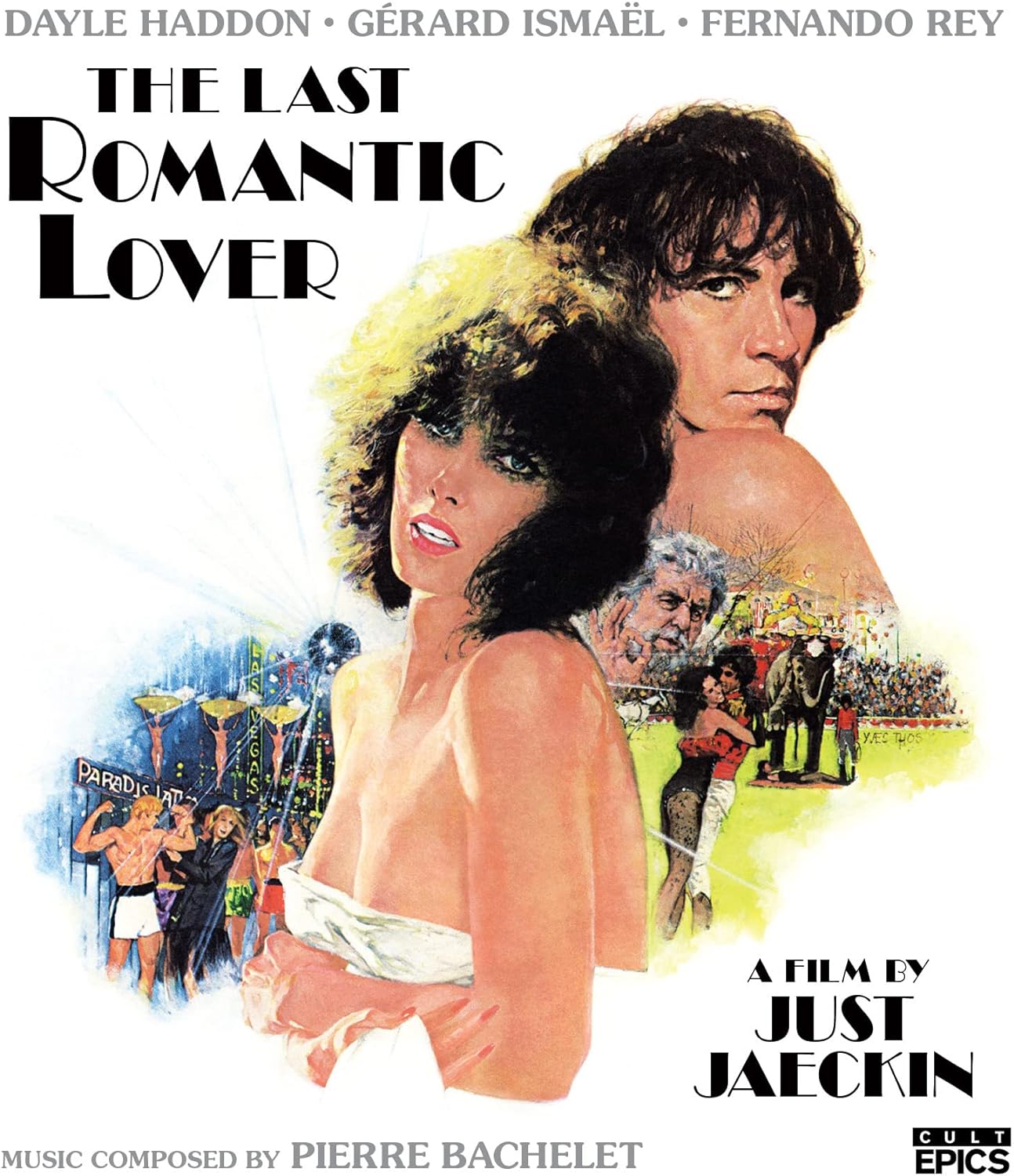
The Last Romantic Lover (1978)

The Last Romantic Lover was Just Jaeckin’s fourth feature film. His third film, the superb Madame Claude (1977), had represented a slight change in direction. The Last Romantic Lover (based on an original story by Jaeckin) marks a much more radical departure from his earlier work.

Jaeckin was steadily growing in confidence and rapidly becoming one of the interesting film-makers in France. It didn’t do him any good. He was never going to be forgiven by critics for Emmanuelle. French critics were determined not to give him an even break and critics in other countries mostly followed suit. No matter how good his movies were critics were going to despise them. In general he is still unfairly dismissed as a maker of trash movies while critics gush over much less talented and much less interesting directors. The Last Romantic Lover is a wonderful movie that still gets very little attention.

The film begins with a visually stunning sequence of a circus funeral, but the dearly departed is not a human member of the company but the circus’s lion. It’s the first of many off-kilter subtly surreal moments.

The circus faces ruin but the circus’s owner Max (Fernando Rey) has a plan. He will persuade the circus’s lion tamer Pierre Mowgli (Gérard Ismaël) to enter The Last Romantic Lover competition. Pierre will win and the first prize is $30,000 which will pay for a new lion and clear the circus’s debts. There are thousands of entrants in this competition but the circus’s resident clairvoyant has assured Max that Pierre will at least make it to the final twelve.

The competition is the brainchild of magazine editor-publisher Elisabeth (Dayle Haddon). Most reviewers seem to assume it’s a women’s magazine but at one point it’s described as a “tit mag” so it seems more likely it’s a men’s magazine.


Elisabeth believes that women are lacking romance in their lives. The competition will find the country’s greatest romantic lover. Elisabeth is partly right. There is a lack of romance in the modern world. As we will discover Elisabeth feels that romance is lacking in her own life. Elisabeth is right about the importance of romance, but she does not really understand the true meaning of the word. She lives in the shallow fashion/media world. Romance means good-looking sexually desirable men. As the story unfolds she will learn what romance is all about.

The competition occupies the first half of the movie. It’s a lavish stylistic tour-de-force as the men are put through their paces.

Pierre does not want to win, because he knows this is not what romance is all about.

I think it’s a huge mistake to read this as a feminist movie. It’s certainly not feminist in the narrow ideological sense. It’s not anti-feminist either. It has other fish to fry. This is a movie about romance - not just the romantic love between a man and a woman but romance in a much broader sense, romance as an attitude towards life.


There are definitely two entirely separate worlds here. Elisabeth’s world is all about money, fame, success and achievement. She has no time for a proper personal life. At one point when she and her boyfriend make love they have to get it over and done with in 13 minutes so she can get to an important meeting. Sex is like everything else - it has to be done briskly and efficiently and on schedule. Elisabeth can’t figure out why she isn’t happier.

Pierre’s world is the world of the circus. No-one cares about money or fame. The circus people are happy because they are doing what they love. Max runs a circus because it’s in his blood. If he lost the circus he’d die. Pierre can’t imagine wanting to be anything other than a lion tamer.

This might sound strange but at times this movie reminded me just a little of Jean Rollin’s subtle surrealism. There’s a sense that the world of the circus is a world of magic, detached from the everyday world, a world in which things can happen that cannot happen in the real world. It’s a world of romance in the truest and widest sense of the word. All the scenes in the circus have a slight other-worldly feel. Maybe this world is less real than Elisabeth’s world. Maybe it’s more real. There’s a slight fairy tale vibe (which you also get in Rollin’s movies).


This is also a classic romantic comedy which obeys the conventions of that genre. In fact I would describe it as a screwball comedy. There’s more than a hint of Howard Hawks in this film. Jaeckin loved cinema’s past and I’m sure that this is all very deliberate. Elisabeth will have to make an important choice. Her happiness depends on making the right choice. It’s not just a matter of choosing the right man but of choosing the right world.

And then there’s the ending. You’ll have to make up your own mind exactly what it means but I think it’s perfectly in tune with the feel of the movie.

Gérard Ismaël and Dayle Haddon have terrific chemistry. They’re both delightful. Elisabeth is an interesting character. Early on she’s hard-driving and ambitious but she is never a bitch. There’s a certain underlying kindness in her.


There’s almost no nudity and the sex scenes are very restrained (and very romantic and playful).

As much as I adore Gwendoline (and I do absolutely adore it) I think The Last Romantic Lover may now be my favourite Just Jaeckin movie. It really is strange, magical, entrancing and insanely romantic. Jaeckin was one of the best and most innovative French directors of his era and he was certainly the most visually brilliant and stylish. It’s interesting than even his stylishness was held against him, leading to accusations that style was all he had to offer and that his movies lacked substance. This is quite inaccurate and it also misses the point (and it’s a point that a lot of critics miss) that style is crucial. Style is substance.

The Last Romantic Lover is very highly recommended.

The Cult Epics release (on DVD an Blu-Ray) offers an excellent transfer and quite a few extras.

Friday, 21 June 2024

Snapshot (1979)

Snapshot is a 1979 Australian thriller which is a lot more interesting than its reputation would suggest. The surprises here are not the plot twists but the way in which the characters just don’t behave quite like conventional thriller characters.

The opening sequence is rather shocking, with a horrific fire and an hysterical woman. Most of the movie is an extended flashback.

This is a difficult movie to discuss because it has quite a few plot twists and to offer a hint that may prove to be a spoiler for one twist would then spoil the other twists as well, so I’m going to be very vague about the plot.

Angela (Sigrid Thornton) works in a hairdressing salon and she’s always broke. She lives with her mother and her kid sister and the atmosphere at home is very uneasy and very unhealthy.

Her friend Madeline (Chajntal Contouri) a rich successful model. She is trying to persuade Angela to give modelling a try. Angela eventually agrees and is then shocked when her first very well-paid modelling job for an advertising agency requires her to be photographed topless. She is persuaded to do the job and she becomes a minor sensation. She appears to have a glittering modelling career in front of her.


This is where the movie springs its first surprise. We assume this will be yet another movie in which a naïve girl tries to break into modelling and is drawn into a world of sex and debauchery and decadence. But that doesn’t happen. The advertising shots are tasteful and at no time is she pressured into doing girlie magazine stuff or sex movies or anything like that. The photographer who does the shoot is definitely an eccentric but he’s totally harmless. He doesn’t try to exploit or manipulate her.

Angela’s real problem is that someone is stalking her. She’s pretty sure she knows who it is and she’s not overly worried. She think it’s an ex-boyfriend but while he’s persistent and annoying she doesn’t think he would ever try to hurt her. The audience however has seen the opening scene of the movie so we’re more worried than she is.


Angela has another problem to deal with. Madeline wants to put their friendship on a different, shall we say more intimate, level. She wants them to be more than just good friends. Angela isn’t that way inclined.

The stalking becomes a bit scarier. Angela finally figures out that maybe she’s in real trouble but she may be working on a false assumption and may end up putting herself in worse danger.

Eventually we get back to that opening scene.


I think that what a lot of people failed to notice about Snapshot is just how weird it is. People saw it as being a very conventional by-the-numbers thriller, but it’s actually in its own low-key way quite unconventional. It plays around with some of the conventions of the genre. It certainly plays around with the conventions of the psycho killer genre. It sets up straightforward thriller situations but they play out in odd unexpected ways. The problem perhaps is that it’s a movie that needs to be seen a second time to be fully appreciated. On a repeat viewing you notice how often it appears to conform to genre conventions but in subtle ways it doesn’t do so.

The stalker driving a Mr Whippy ice cream van is a wonderful touch. The secret room with all the photos of Angela is an idea that had been used before but the fact that every single square inch of the room, including the floor, is covered by the photos and the fact that they’re all exactly the same photo repeated endlessly makes it striking and especially creepy, and the movie’s major visual set-piece takes place in this room.


Producer Antony I. Ginnane had a big international hit with Patrick in 1978 and another with Thirst in 1979. Snapshot came in between those two films and while it was reasonably successful it wasn’t quite the major hit that had been hoped for. The reasons for this are pretty clear. Snapshot is a bit too low-key for its own good. Compared to European thrillers of its era (and Europe was a major market for Ginnane) it just lacks a bit of edge, it doesn’t have the same adrenalin-rush excitement and it really only has one major visual set-piece.

Snapshot is also an erotic thriller (everything in the plot is driven by erotic obsession) that isn’t very sexy. There is the celebrated Sigrid Thornton topless scene. Interestingly that scene didn’t bother Thornton in the slightest. In fact she got the role because of her relaxed attitude towards nudity. But that’s it for the whole movie. In strictly commercial terms this movie really needed to be a bit raunchier.

The ending is wonderful. I can’t tell you why for fear of spoilers but it does represent a major shift in the entire perspective and tone of the movie.

While it needed to be spiced up a little I liked Snapshot quite a bit. Highly recommended.

Umbrella’s Blu-Ray look great and includes a stack of very worthwhile extras.