Friday, 2 May 2025

Savage Beach (1989)

Savage Beach is the fourth of Andy Sidaris’s twelve Triple B (Bullets, Bombs, and Babes) movies. Like the previous two movies in the series it focuses on blonde bombshell DEA agents Donna (Dona Speir) and Taryn (Hope Marie Carlton).

It was shot mostly on location on Molokai.

Donna and Taryn operate an air cargo business as a cover. They have to fly urgently needed medical supplies to a remote island. They run into a storm and their Cessna is forced down. They’re lucky enough to make a crash landing on a tiny uninhabited possibly uncharted island. They were hundreds of miles off course so it could be quite a wait for a rescue plane.

They have the uneasy feeling that they are not alone on the island. Their suspicion is well-founded. And soon there are lots of people on the island, all of them almost certainly bad guys.

What our two heroines don’t know is that they have stumbled onto something very big and very secret. Something official, but now it’s been complicated by a criminal conspiracy. During the Second World the Japanese military hid a hoard of gold looted from the Philippines on a remote island (yes the same island where the girls’ plane crash-landed). The government of the Philippines wants the gold back. The US Government wants to help them to find the gold but there is at least one criminal gang after that gold as well.


And possibly more than one criminal gang.

Donna and Taryn have no idea what is going on but there are unpleasant men with guns running about the island, they’ve been captured and tied up more than once and shot at and they’re getting quite annoyed about it. One of the bad guys even calls Donna a bimbo. She can handle being tied up and having guns pointed at her but when you call her a bimbo you have crossed a line you should never cross.

This is a pretty good script by Sidaris. It sets up endless opportunities for mayhem and double-crosses. On the island we have our two blonde heroines, there are two gangs of murderous cut-throat bad guys and then there’s the strange old guy who might be a good guy or a bad guy. And there’s the beautiful dark-haired bad girl. We’re not sure which of the gangs she belongs to.


Some of the bad guys might be good guys and some of the guys who claim to be good guys might be bad guys.

Luckily the girls are well-armed. They have an automatic rifle and several pistols and Taryn has a crossbow that fires explosive crossbow bolts. Which of course means we’re going to get some explosions. But then this is an Andy Sidaris movie so you knew there were going to be explosions.

There is also, naturally, some martial arts action because why would you not add some of that to the mix?


It goes without saying that as well as lots of action this movie includes lots and lots of bare breasts (and some brief frontal nudity). How could you possibly add a nude scene to a scene with two girls in the cockpit of a Cessna in flight? Andy Sidaris manages it. He likes those kinds of challenges.

It doesn’t hurt that all of the women are extraordinarily attractive.

What really makes these Andy Sidaris movies so great is that Andy and his wife Arleen (who acted as producer) knew all the tricks of low-budget filmmaking. They knew how to get high production values and a very polished professional look without spending big bucks. They had their operation running like a well-oiled machine. Andy’s Triple B movies look a whole lot more expensive than they were.


For a low-budget movie Savage Beach really is beautifully shot.

They were also pretty good at casting. No-one would suggest that Dona Speir and Hope Marie Carlton were great actresses but they gave performances that were just perfect for this type of movie. And that applies to most of the cast members. They’re not angling for Oscar nominations but they’re entertaining.

All of the Triple B movies are available in a terrific DVD boxed set from Mill Creek, with excellent transfers. Most have now been released by Mill Creek on Blu-Ray. It’s the Blu-Ray release that is being reviewed here. Both the DVD and Blu-Ray releases include an audio commentary by Andy and Arleen Sidaris and they provide an astonishing amount of fascinating information on the shooting of the movie.

Savage Beach is absolutely top-notch entertainment. Highly recommended.

I’ve reviewed lots of Andy Sidaris’s earlier movies - Seven (1979), Malibu Express (1985), Hard Ticket to Hawaii (1987) and Picasso Trigger (1988). They’re all fun with Hard Ticket to Hawaii being the best.

Tuesday, 29 April 2025

Mission to Mars (2000)

Mission to Mars is Brian De Palma’s 2000 science fiction epic and it’s a very very obvious homage to Kubrick’s 2001: A Space Odyssey.

The first thing that needs to be said is that De Palma was brought into the project late in the game when the previous director quit. The screenplay had already been finalised. The sensible thing to do would have been to drop the script into the wastepaper basket and start again but De Palma did not have that option. He was stuck with the script (which includes some horrifically awful dialogue). And the cast. De Palma was given an increase in the budget and perhaps that’s what tempted him. It’s a temptation he should have resisted.

The first manned mission to Mars in 2020 ends in disaster. Nobody knows what happened exact that whatever it was was strange and inexplicable. There is a possibility that one crew member survived.

NASA launches a rescue mission and it’s a fiasco. The survivors of the rescue mission do manage to reach Mars. They find the survivor of the first mission and he has a weird story to tell. Something about a force emerging from a mountaintop. He thinks he has found at least the beginnings of an explanation.

And then we find out what it was all about. It’s all deep profound cosmic stuff.


There are countless shots and images that are either direct homages to 2001 or are at least heavily inspired by Kubrick’s movie. Unfortunately Mission to Mars just doesn’t recapture the visual magic and inspiration of Kubrick’s movie. And, even though it was made more than 30 years later, the special effects are just not up to the standards of the Kubrick film.

Kubrick’s spaceship was cooler. Both Kubrick’s and De Palma’s spaceships are partially rotating to achieve artificial gravity. Both movies include scenes demonstrating the disorienting feel of astronauts living inside a rotating cylinder. Pe Palma manages these scenes quite well. Both movies include the kind of gigantic rotating space station that we were promised we would get in the future but the space station scenes in 2001 have a lot more style and wit.


In both movies the interplanetary spaceship runs into major problems. In 2001 the problems occur when the spacecraft’s onboard artificial intelligence, HAL, goes rogue. Very cleverly we never get a precise explanation of why he goes rogue. We are left to speculate. Was it just a random failure or does it have a much deeper significance? In Mission to Mars the spaceship runs into a meteor storm, just like in every 1950s sci-fi B-movie. This is not exactly inspired writing.

In both movies there’s an attempt to save an astronaut drifting helplessly in space, but in Mission to Mars it’s more sentimental and more corny and more conventionally heroic.

Mission to Mars also has an equivalent of the famous monolith from 2001.


There are elements homaged from various other science fiction movies as well. In fact there is nothing at all in this movie that could be called original.

Somehow, despite a vast CGI budget, Mission to Mars manages to be visually uninteresting. The better scenes are way too reminiscent of better scenes in better movies.

Both movies end up getting into philosophical and scientific speculation about our origins and our destiny. Kubrick’s movie ends on a mysterious enigmatic note. De Palma’s movie spells everything out, and it’s not worth spelling out. 2001 is a movie you can watch over and over again. It’s a movie you want to think about. Trust me, once you’ve seen Mission to Mars you will never want to rewatch it. You will never want to think about it. You will just want to forget it.


Given the awful script and cringe-inducing dialogue it’s difficult to judge the acting. The characters are mere clichés. I guess the cast members were doing their best.

The ending of Mission to Mars is unbelievably bad. It’s embarrassing and trite.

We all make mistakes. This movie was a very big mistake for De Palma. Perhaps science fiction was just not his forte.

I’m a De Palma fan but it’s difficult to recommend Mission to Mars.

I watched the German Blu-Ray which looks very nice.

It’s interesting to compare this film to John Carpenter’s Ghosts of Mars made about the same time. Both movies are generally regarded as misfires by major directors. Ghosts of Mars has some real problems but I think it’s the better film.

Sunday, 27 April 2025

Ergo Proxy (TV series, 2006)

Ergo Proxy is a 2006 Japanese cyberpunk anime TV series. 

This is cyberpunk with quite a few other added flavourings.

This is a complex intelligent puzzling fascinating grown-up anime with multiple layers of meaning and lots of narrative uncertainty. And lots of ambiguity.

You can find my full review at Cult TV Lounge.

Thursday, 24 April 2025

Someone’s Watching Me (1978)

Someone’s Watching Me is an early John Carpenter film (he wrote and directed it). It’s a made-for-TV movie and it’s a suspense thriller.

This is obviously Carpenter doing a riff on Hitchcock’s Rear Window. This is Carpenter’s voyeurism film.

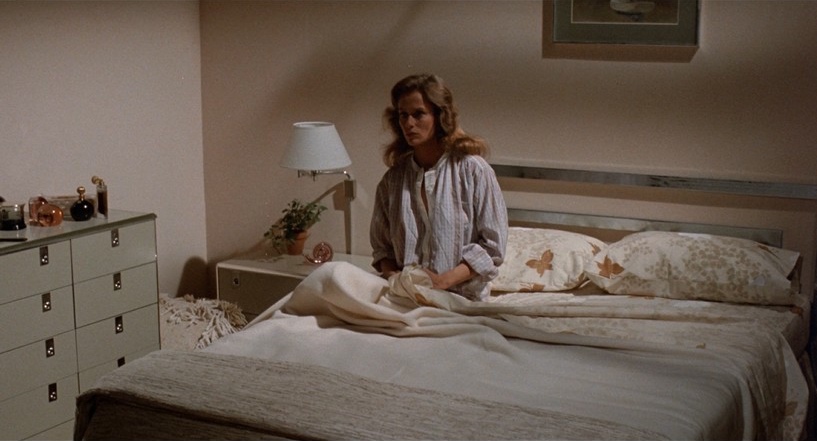
Leigh Michaels (Lauren Hutton) has just arrived in LA to start a job as a live TV director. Using a generous bonus from her previous job she takes a luxury apartment in the swanky Arkham Towers (and yes I’m sure the Lovecraft reference is deliberate). This is an enormous high rise apartment building and it’s very high-tech. It has elaborate security.

But as Leigh finds out she is not safe there at all.

She gets creepy nuisance phone calls. Not threatening or obscene, but subtly creepy. She gets mysterious notes delivered to her. She receives expensive gifts, supposedly from a travel company. She starts to suspect that this guy knows all about her. He knows everything that she does.

The scary part is that he makes no direct threats. She has no idea what he actually wants. He might be a relatively harmless weirdo. He might be very dangerous. There’s no way of knowing.


It takes her a while but eventually she figures out that the guy is watching her from another apartment building. But it’s a high-rise building as well. This guy could be in any one of hundreds of apartments.

The police can’t help because she doesn’t know who the guy is and he has not yet broken any actual laws.

Her new boyfriend Paul (David Birney) is sympathetic but he’s a philosophy professor not an action hero.

Her best friend Sophie (Adrienne Barbeau) is very supportive but it’s difficult for any of them to do anything really useful.


Of course everybody who has ever discussed the subject of movies about voyeurism has made the very obvious point that all movies are voyeuristic - we are watching other people’s lives. And of course a film director is not just watching the lives of the characters but also manipulating them. An interesting twist that Carpenter adds here is that Leigh is a television director, so she herself is a kind of voyeur and a kind of manipulator.

Technically this movie is impressive. Carpenter does a more than competent job as director. He understands pacing and he understands the basic techniques of suspense. The suspense scenes work. The basic setup is very promising.

There are however major flaws. There is not a single interesting characters in the movie, and not one of the characters really comes to life. By the end of the movie we do not know a single thing about Leigh. She’s a complete blank. Her apartment looks like a hotel room. It does not look like someone actually lives there. There are no personal touches.


Her friend Sophie is pleasant but she really just functions as a plot device.

Leigh’s boyfriend Paul is a harmless nonentity. We learn nothing about him. There is no erotic or romantic heat between Leigh and Paul. Even after they begin an affair they behave more like casual acquaintances.

This is an extraordinarily lifeless sexless movie. Maybe Carpenter wanted to avoid making an exploitation movie but the problem is that as a result the stalker’s motivation remains inexplicable. There is not the slightest indication that he has even the mildest sexual interest in her. So what is his motivation? OK, he wants to control her, but why? His notes to her are polite but impersonal. Maybe he hates women, but we get no indications that this is so. Maybe he has a romantic obsession with her, but we also get no indications that this might be the case. Maybe he feels powerless? Maybe, but we’re offered no evidence.

The idea that the stalker wants to stalk Leigh from a safe distance and is afraid to get close to her is a good one. Unfortunately it isn’t developed.


The vagueness of his motivation somehow makes the threat less scary.

It’s difficult to judge the acting since the characters are so underwritten.

I’m a huge admirer of Carpenter’s work but I’m inclined to think that realistic thrillers about real people were definitely not his forte. It’s easy to see why he moved rapidly away from this type of movie.

Someone’s Watching Me is well-crafted and reasonably entertaining but there’s something missing. Carpenter completists will want to seek it out and it is interesting as a movie made before Carpenter really found his voice, but it is very much lesser Carpenter.

The Scream Factory Blu-Ray offers both 1.33:1 and widescreen aspect ratios. Both look terrific. 1.33:1 is how it was originally broadcast.

Sunday, 20 April 2025

Run Swinger Run! (1967)

Run Swinger Run! is a 1967 sexploitation feature written, produced and directed by Barry Mahon. 

This one falls into the roughie sub-genre but it’s rather sedate as roughies go.

It opens with a beautiful almost naked girl lazing by the pool. A gunman takes a shot at her. She flees.

Her name is Laura. She makes her escape and on the highway she gets a lift from a respectable-looking guy named Mike. Laura tells Mike the sad story that led her to being on the run. Most of the movie takes the form of an extended flashback.

It all started a few years earlier when her mother had to take in boarders. One of the boarders, a sleazy middle-aged guy, forces himself on her. This leads her to a shocking and very upsetting discovery. She really enjoys sex. Laura has discovered that she is a Bad Girl.

She leaves home and arrives in LA hoping that her friend Mary would take her in. Unfortunately Mary is part of a dope-pushing ring. Laura isn’t going to have anything to do with that. Once again she has to flee.


In a bar another middle-aged man, named Schneider, offers her a proposition. She could earn a thousand dollars a week. Laura isn’t a sweet young innocent. She figures the job means working as a prostitute. That doesn’t bother her too much.

She’d have been more worried if she’d known Schneider was a gangster and working for a really big-time gangster. She’d also have been more worried if she’d known what happened to her predecessor. Schneider’s girls are in practice slaves. They sign contracts for several years assuming that at the end of that time they will be free. That is a very optimistic assumption. And a very unrealistic assumption. Once they have worked for Schneider they know way too much abut his organisation.


This is a lot more than a prostitution racket. It’s much more dangerous than that. Gun-running is involved.

Laura starts to think that it’s about time to flee once again, but this time it won’t be so easy.

What’s unusual about this movie (by the standards of the roughie sub-genre) is that it has a pretty decent, and pretty coherent, plot. In fact it could have been the basis for a fine thriller. But this is a sexploitation movie so the plot is essentially a device to have young ladies in situations where they will take their clothes off.


The problem is that the execution is rather stodgy and clunky. The crude sets (in fact it’s most likely the movie was shot in someone’s house) don’t help. You can’t entirely blame Barry Mahon for this. Movies like this were made on minuscule budgets with incredibly tight shooting schedules. There was neither the time nor the money to attempt ambitious visual set-pieces.

Even labouring under such constraints some sexploitation directors could make lively fun movies. They did this by adding a certain amount of craziness. Mahon doesn’t do this. He was clearly content just to get the movie shot as quickly and as long as it contained the requisite exploitation elements it would make money. The aim was to make money, not art.


And the exploitation elements are certainly there. There are lots of very attractive young women who spend most of the movie almost naked. This was 1967 so there’s no frontal nudity. There is however an abundance of bare breasts.

Despite what some silly online reviewers will tell you this is a movie that is almost entirely lacking in sleaze and scuzziness. Extraordinarily this film has some online reviewers clutching their pearls. People these days seem to live incredibly sheltered lives.

The lack of sleaze and scuzziness is in fact the main problem here. Run Swinger Run! is just much too tame, and was ridiculously tame even in 1967. It's still moderately entertaining.

This movie was released on one of the old Something Weird double-header DVDs, paired with Sex Club International. Run Swinger Run! gets a decent enough transfer. The movie was shot in black-and-white and the 1.37:P1 aspect ratio is quite correct.

Thursday, 17 April 2025

Gradiva (2006)

Gradiva, released in 2006, was Alain Robbe-Grillet’s final feature film.

In all his films Robbe-Grillet always made sure the audience knew from the start that they were not going to get anything resembling a realist film from him. He was going to be playing games with narrative. There were going to be multiple layers of reality and unreality. Maybe none of it is real. In fact of course none of it is real because this is a movie. These people are actors. It’s a made-up story.

The setting is Morocco, in the present day. John Locke (James Wilby) is a professor researching a book on the painter Delacroix. He has heard of some hitherto unknown sketchbooks by the artist. It’s an exciting discovery. If they’re authentic. He isn’t sure if they’re authentic or not.

They contain sketches done by the artist during his time in Mogador. But Delacroix is not known to have ever visited Mogador. The sketches are of a woman with whom he had a affair. The woman was later executed. If she ever existed.

We are introduced to a beautiful blonde woman (played by Arielle Dombasle). She is writing a story. For all we know she might be writing the screenplay for Alain Robbe-Grillet’s movie Gradiva. Later she tells another woman that she is writing her memoirs but she does not believe memoirs should be about the past. They should be about the future.

Locke sees this beautiful blonde woman and pursues her through the streets of Marrakech. He loses her but ends up in Anatoli’s establishment. Anatoli is an art dealer. Or he might be a white slaver. Or he might be a doctor. His establishment might be a brothel or it might be a theatre.


There are young women being whipped. They might be slaves. They might be actresses pretending to be slaves, or slaves pretending to be actresses.

Locke lives with Belkis, a cute Arab girl. She might be his slave or his mistress. Either way she is clearly in love with him. He is very fond of her but whether he is in love with her or not is uncertain.

The beautiful blonde woman tells Locke that she is an actress but while she does some film and theatre work she is mostly a dream actress. She earns her living acting in other people’s dreams. Her name is Leila, or perhaps Gradiva. She may be the ghost of Delacroix’s long-dead mistress.


Leila may at this moment be acting in one of Locke’s dreams.

There have been a number of murders. Locke has seen some of the corpses of the dead girls although they might be actresses.

Locke certainly has dreams. Some may be drug-induced. It’s also possible that the dreams have been induced by Delacroix’s sketches. Art is a powerful drug.

Of course, since this is a Robbe-Grillet film, there is plenty of sado-masochistic eroticism but since this is a Robbe-Grillet film we have serious doubts as to whether any of the whippings are real. The young women might be actresses. This could be a movie in which actresses are playing the roles of actresses.


Robbe-Grillet felt that his movies used the erotic as raw material but were not erotic films as such because there was always a critical distance. The erotic material does not seem real and there is no attempt to persuade us that any of the erotic encounters are real. There is an air of artificiality which is the exact opposite of the effect at which an erotic movie would be aiming.

For me the key to Robbe-Grillet’s work, and the reason I enjoy his work so much, is his playfulness. He enjoyed making movies. He wanted people to enjoy watching them. He wanted his viewers to enjoy the game.

By 2006 Robbe-Grillet was totally out of touch with contemporary tastes in cinema. That’s why this movie is vastly superior to almost all 21st century movies. What’s even better is that his whole aesthetic was out of fashion. Robbe-Grillet assumes that his audience will have no difficulty in coping with movies that operate on multiple levels and in which reality and dream and fantasy and illusion and art form an intoxicating cocktail. He also assumes that there is no need to give the viewer any clues as to where reality ends and dream takes over. He sees no need to spoon-feed the audience.


And of course it is always a mistake in a film such as this to offer the audience such clues. The whole point is that life and art and dream defy explanation. We’re not supposed to expect any clear-cut explanations. That would spoil everything.

The location shooting in Morocco is a plus. Any Robbe-Grillet movie is going to be a visual treat and this is no exception.

Gradiva is a mesmerising film. It’s very arty but it’s also witty and it’s fun. Art films are allowed to be enjoyable. Highly recommended.

The Mondo Macabro DVD offers a lovely transfer and includes an excellent in-depth interview with Robbe-Grillet.

I’ve reviewed almost all of his movies. La Belle Captive remains my favourite but I have a very definite soft spot for L’immortelle and Successive Slidings of Pleasure (1974) is dazzling. I also highly recommend his novel La Maison de rendez-vous (available in an English translation).

Monday, 14 April 2025

Crimes of Passion (1984)

Crimes of Passion is a 1984 Ken Russell movie and as such it is impossible to assign it to a genre. New World Pictures probably thought they were going to get a straightforward erotic thriller. That is certainly what a brief synopsis of the plot might have suggested. One can only assume that they had never seen any of Ken Russell’s pictures and had no idea what they were actually going to get.

It’s really more a black comedy.

Bobby Grady (John Laughlin) is around 30. He lives the American Dream. He has a security business. He has a perfect wife, Amy (Annie Potts), and two great little kids. They live in a nice suburban house. Bobby has always been a straight arrow and it’s paid off. He played football in college. He married his high school sweetheart.

So why is he attending a group therapy session? He’s just there to support a buddy. Bobby doesn’t have any problems. And then he lets the mask skip. He and his perfect suburban wife no longer have perfect suburban sex. They no longer have sex at all.

Bobby has never been aware of it but he has been living a lie. He’s been wearing a mask of perfect middle-class happiness to cover up the fact that all the passion has long since departed from the marriage. He and Amy have been wearing masks. They have been playing a game of make-believe.

Then he takes a security assignment, to check out a woman named Joanna Crane (Kathleen Turner) suspected of industrial espionage. That’s how Bobby meets China Blue. China Blue is Joanna Crane. China Blue is her secret identity. Her mask. Or perhaps Joanna Crane is China Blue’s mask.


China Blue gives Bobby the best sex he has ever had in his life. That’s when Bobby realises how empty his life had become.

Bobby is not the only man obsessed with China Blue. There’s also the Reverend Peter Shayne (Anthony Perkins), a crazed preacher. Or perhaps just a crazy man who has convinced himself that he is a preacher. The Reverend’s mission is to save China Blue. He is a saviour, and possibly sees himself as an avenging angel. The Reverend is tortured by his sexual desires.

As I said, it’s a setup for a conventional erotic thriller but Ken Russell takes it in wild crazy directions.

Kathleen Turner and Anthony Perkins share top billing. Kathleen Turner is simply amazing.

China Blue is not just a mask won by Joanna. China Blue then plays various parts for various clients, depending on what she thinks will excite them. Sometimes she tells them stories of her past traumas that led her into a life of prostitution but her stories are pure invention.


All the characters are sheltering behind a mask of some kind, playing roles, and often there are masks on top of masks. When he takes the surveillance job Bobby dons another mask - the hardboiled private eye. He doesn’t do it convincingly (because he’s not a tough guy) but it’s telling that at a time when he feels powerless in his relationship he resorts to play-acting as a cynical tough guy. What he needs in his life is honesty, but that’s too scary.

My initial impression was that the Reverend was a character that just didn’t work and that the performance of Tony Perkins was more parody than anything else. In fact, had this been a straightforward erotic thriller this performance would have been enough to sink the movie. But this is a different kind of movie and in a way the character does work. We don’t have to believe in him.

We don’t have to believe that anything in this movie corresponds to real life. The look and tone of the movie suggest a fever dream, or even a twisted fairy tale. The Reverend is perhaps a fairy tale monster, or perhaps a nightmare conjured from the unconscious. There is even a slight hint of a comic-book feel (and the Reverend could certainly have been a comic-book villain).


It’s significant that Joanne’s house looks like a fairy-tale castle. She has constructed for herself a world of fantasies and make-believe. Perhaps her China Blue persona is her eroticised fantasy of being a fairy-tale princess.

And the suburban life of Bobby and his wife is their version of a perfect fairy-tale world but they’re miserable because they’re not really living happily ever after. The perfect love needed to sustain their fantasy has vanished. Their sex life has been built on lies because without the love they’ve just been going through the motions.

Like so many of Ken Russell’s movies it’s impossible to fully appreciate this film without taking into account that Russell was raised a Catholic. The movie is not just littered with religious iconography. Religious themes are all-pervasive. Russell belongs to the rich tradition of Catholic film-makers, a tradition that includes Lang and Hitchcock. It’s a tradition that is now a thing of the past, and cinema has as a result lost much of its power and magic.


The use of colour is absolutely extraordinary. On a limited budget Russell still manages to deliver a visual extravaganza. Dick Bush’s cinematography is superb.

Crimes of Passion has a quality I really really love in a movie - a sense that the story takes place in a world very much like the real world but there’s just something slightly off-kilter. This is hyper-reality or exaggerated or heightened reality. It’s almost, dare I say it, an anticipation of the David Lynch approach.

This is certainly not a movie that is anti-sex. There’s nothing wrong with Joanne’s taste for kinky sex, but it doesn’t satisfy her because she needs passion and love as well.

Crimes of Passion is one of Ken Russell’s best movies. Very highly recommended.

Arrow’s Blu-Ray offers both the unrated cut and the slightly raunchier director’s cut, with an audio commentary by scriptwriter Barry Sandler and the man himself, Ken Russell.