Showing posts with label barbara steele. Show all posts

Thursday, 19 March 2026

Castle of Blood (1964)

When considering Barbara Steele’s career in Italian gothic horror movies it’s easy to focus too much on Mario Bava’s Black Sunday. It’s a brilliant movie but she made at least three others that are just as good - Camillo Mastrocinque’s An Angel for Satan (1966) and the two she made for Antonio Margheriti - The Long Hair of Death (1964) and Castle of Blood (1964). It’s Castle of Blood (the original Italian title was La Danza Macabra) that concerns us for the moment.

Castle of Blood opens with Edgar Allan Poe sitting in a pub in London trying to convince his friend, reporter Alan Foster (Georges Rivière), that his stories of the macabre are not fiction but account of true events. OK, so I don’t know how on earth Edgar Allan Poe could have come to be sitting in an English pub but after the huge success of Roger Corman’s Edgar Allan Poe movies if you wanted to sell a gothic horror movie in the U.S. market you had to give it a Poe connection.

Also present in the pub is Lord Thomas Blackwood (Umberto Raho) who happens to own a haunted castle. It has lain empty and untenanted for years. Blackwood challenges Foster to a wager. All Foster has to do is to spend one night in the castle.

Blackwood warns him that many have accepted this challenge and not one has survived to tell the tale.


Foster figures this will be easy money. Once he enters the castle Margheriti (quite correctly) starts to lay on the gothic trappings very thick indeed. Cobwebs, mysterious creakings, portraits that seem to be looking back at the viewer, doors opening and shutting for no reason. Foster is a sceptic and a rationalist and a man of science. He is not worried.

Then he meets Lord Thomas Blackwood’s relative Elisabeth Blackwood (Barbara Steele). This is odd. The castle has been completely empty for years. Even the servants are long gone. Foster is puzzled but when you find yourself sharing a castle with a smokin’ hot gothic babe who gives every indication that she is in the mood for love you can be forgiven for not sitting down and thinking about what’s going on.

Then Julia (Margarete Robsahm) shows up. She’s blonde but just as hot as Elisabeth but there’s some real tension between the two women. We will later find out that Julia wants something from Elisabeth that Elisabeth is not prepared to give her. Elisabeth very definitely prefers men.


And it’s soon obvious that the castle has numerous inhabitants. And it’s obvious to the viewer that there is something unnatural, or supernatural, going on. Are these people really alive? Are they really there? Foster doesn’t want to consider a supernatural explanation because he is still a determined sceptic, and he doesn’t want to think there’s anything unnatural about Elisabeth because he’s fallen madly in love with her. And they’ve had hot steamy sex. So he is sure she cannot be a ghost.

While we know that the supernatural really is at work are these people ghosts in the conventional sense? They have one or two unusual non-ghosty habits which I won’t say more about because it might involve a spoiler. But if they are ghosts they are oddly corporeal ghosts. Foster really does have sex with Elisabeth. It’s not quite a straightforward ghost story - it’s something much more interesting.


Margheriti directs with a great deal of assurance. He was in fact a master of the gothic horror genre, for which he doesn’t always get enough credit.

The atmosphere isn’t just creepy it’s also mysterious and puzzling.

Barbara Steele is at the top of her game and this is one of her sexiest performances. Georges Rivière is excellent, managing to be bewildered without seeming to be a fool.

It’s a great looking movie. In 1971 Margheriti remade this movie in colour as Web of the Spider (1971). He later admitted that it worked much better in black-and-white but Web of the Spider is by no means a total failure.


Castle of Blood/La Danza Macabra
is a masterpiece of moody atmospheric gothic horror. Very highly recommended.

This movie is part of Severin’s Danza Macabra vol 2 boxed set. We get the rather heavily edited US cut of this film, with the title Castle of Blood, but more importantly we get the original Italian cut, La Danza Macabra (with English subtitles and an English-dubbed option) , which includes important scenes that were cut from the US version. There are lots of extras, the highlight being a lengthy video essay by Stephen Thrower but we also get to hear Barbara’s Steele’s reminiscences of the movie. She has very fond memories of working with Antonio Margheriti (she says that the three directors she most enjoyed working with were Margheriti, Mario Bava and Roger Corman).

Saturday, 6 April 2024

The Long Hair of Death (1964)

The Long Hair of Death is a 1964 Italian gothic horror film directed by Antonio Margheriti and starring Barbara Steele.

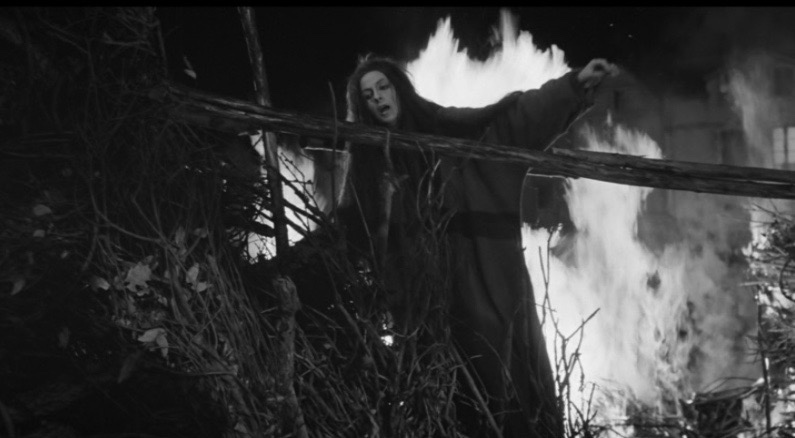
The main story takes place in the year 1499 but there is a prologue dealing with important events a few years earlier. Count Franz had been murdered. The murderer had diverted suspicion on to an innocent woman, Adele Karnstein. Adele was accused of being a witch and burnt. Another young woman had in her possession important evidence. This young woman also came to an untimely end. Both Count Franz’s brother Humboldt and Humboldt’s son Kurt (George Ardisson) were involved in these nefarious plots. Adele vows that retribution will seek out Humboldt and Kurt, in the last year of the century.

We then jump forward to 1499. The region is being devastated by plague, which may or may not be the result of Adele’s dying curse.

Kurt is obsessed by Lisabeth Karnstein (Halina Zalewska), the daughter of Adele. He is determined to marry her. She finds him repulsive. He marries her and he is able to possess her body but she vows he will never have her heart.

Then a mysterious young woman (played by Barbara Steele) appears at the castle. Her name is Mary. Kurt takes a more than passing interest in her. She seems to reciprocate his love, or at least his lust.


Lisabeth’s feelings towards Kurt seem conflicted. On their wedding night she was horrified by the thought of being touched by him. Despite this she is certainly not going to let any other woman have him.

A romantic triangle develops but we know from the start that it’s not a straightforward romantic triangle. Those events in the past are casting their shadow on the present. We also suspect that something supernatural is going on. This is one of those gothic horror movies that keeps us guessing until the end about whether this is really a supernatural horror story. If supernatural elements really are involved we may have our suspicions about how those elements will play out, but we can’t be quite sure.

There is also the possibility of madness playing a part as key characters start to unravel.


Romantic triangles do tend to get messy and can lead one or more participants to consider the possibilities of murder. More than one participant in this particular triangle might have reason to contemplate such a step. In fact all three might have such motives.

There’s plenty of sexual tension as Kurt’s obsession with Mary grows.

This is a fine part for Barbara Steele. She looks perfect in Renaissance-period gowns and she exudes dangerous eroticism and mystery.

George Ardisson as Kurt has a demanding role. Kurt is tortured by love, lust, guilt and fear and he slowly begins to fall apart. Ardisson doesn’t seem to have had a very distinguished career but he’s effective here.


Halina Zalewska is fine as Lisabeth but she is inevitably overshadowed by Barbara Steele’s stellar performance.

The original story was by Ernesto Gastaldi, one of the great Italian screenwriters of this era (and a highly acclaimed novelist as well). Tonino Valerii and Antonio Margheriti were responsible for the screenplay. It’s a good story with some reasonably nasty and effective twists.

I’m quite an Antonio Margheriti fan. Yes, some of his movies are schlocky and trashy but they’re never less than entertaining and he did make some wonderful movies in a variety of genres, including one of my all-time favourite science fiction movies, The Wild, Wild Planet (1966). He also made a pretty decent early giallo, Naked You Die (1968). Margheriti was very competent and had the ability to get good results on low budgets. The Long Hair of Death is one of his best efforts as a director. Margheriti deserves more attention as an important figure in European cult cinema.


The film was shot in black-and-white and Riccardo Pallottini’s cinematography drips with gothic atmosphere.

This movie ticks all the right gothic horror boxes and it’s creepy and moody and suitable doom-laden. The pay-off at the end is perfect. Add the excellent performance by Barbara Steele and you have here a very very fine gothic horror movie that deserves a lot more love. Very highly recommended.

The Long Hair of Death was available for years in very poor quality DVD transfers. Raro Video have released in on both DVD and Blu-Ray and their release looks terrific.

Monday, 22 January 2024

An Angel for Satan (1966) revisited

An Angel for Satan is a 1966 Italian gothic horror movie starring Barbara Steele and directed by Camillo Mastrocinque.

The setting is a small lakeside fishing village in Italy in the late 19th century.

Roberto Merigi (Anthony Steffen) has just arrived. He is there to restore a statue that was found in the lake by some fisherman. The statue is a female nude. Roberto will be staying at the Montebruno castle as the guest of the Count (Claudio Gora). Roberto is looking forward to the assignment. The statue is exquisite.

The villagers are none too pleased. There is a legend attached to that statue, a legend involving a curse. The villagers are convinced that the statue should have been left in the lake.

There is another new arrival, the count’s niece Harriet Montebruno (Barbara Steele). Harriet is the actual owner of the castle and she is now old enough to take possession of her inheritance.

Roberto gets a surprise when he meets Harriet. She is the spitting image of the woman who posed for that statue. The explanation is simple. It is a statue of one of Harriet’s ancestresses, who lived two centuries earlier.


The recovery of the statue certainly does unleash evils upon the village. The very next day two fishermen are drowned. Other horrors follow.

All sorts of smouldering jealousies and resentments and sexual tensions blaze up.

Roberto is fascinated by the statue and inevitably he becomes fascinated by Harriet. Harriet is beautiful and charming, most of the time. Her behaviour is however puzzlingly inconsistent. There are times when she behaves like a temptress.

It might be the late 19th century but the villagers still live in a world of mediæval superstitions. They have no doubt that witches exist. They come to suspect that there is a witch among them today. They have no doubt that curses have real power. They have had evidence of the evils this particular curse has already unleashed.


We know what is going on, or we think we do. At the end of the movie we really do know what was going on. Or we think we do.

There are very strong erotic undercurrents to this movie. This was 1966 so it’s handled in a very tame manner. There is no actual nudity, although there is plenty of implied nudity. The movie still manages to be an effective and disturbing exercise in psycho-sexual horror.

It’s a demanding part for Barbara Steele and she handles it with assurance. I might also add that she radiates sexuality.


The other cast members are quite adequate.

This is a somewhat unconventional gothic horror movie. The plot is not especially complicated but it also manages to be not entirely straightforward.

Don’t expect buckets of blood or any gore. This movie doesn’t need such things. It has an unsettling atmosphere and a sense that something bad is going to happen but we have absolutely no idea what that thing is going to be. Personally it’s that kind of atmosphere rather than fountains of blood that I look for in a horror movie. There is evil here, but it’s diffuse and subtle.


Director Camillo Mastrocinque was getting towards the end of a very long career when he made this movie. The man knew how to make movies.

The movie was shot widescreen in black-and-white. The cinematography is moody and impressive, giving the film the stifling feel that it needs.

This movie has had several DVD releases. It’s now available on both DVD and Blu-Ray from Severin and that’s clearly the edition to buy.

An Angel for Satan is a very very fine example of 60s Italian gothic horror plus it offers one of Barbara Steele’s best performances.

Monday, 8 April 2013

Black Sunday (1960)


It’s almost superfluous to write a review of Mario Bava’s Black Sunday (La maschera del demonio). This movie has already garnered so much adulation. I’d seen it before of course, but now I’ve had the opportunity of seeing it on Blu-Ray.

The plot is hardly original and would itself be much imitated. It was very loosely based on Nikolai Gogol’s famous short story The Viy but by the time it made it to the screen very little if anything remained of Gogol’s story.

This was Bava’s first official assignment as a director although he had already completed a couple of movies begun by other directors. It was to be his only black-and-white movie and it demonstrates his artistry in that medium.

A man and a woman are burnt for witchcraft in the 16th century. They pronounce the usual curses upon their persecutors, and their persecutors’ descendants. Asa’s chief persecutor had been her brother who held the office of Grand Inquisitor.


Two hundred years later the witch Asa will have her chance to execute her vengeance. The Princess Katia is the spitting image of Asa (both women being played by Barbara Steele). A middle-aged doctor and his young colleague unwittingly offer Asa her chance. The doctor cuts himself and the blood falls on Asa’s long-dead face, reawakening the witch to life (life of a sort anyway). What Asa now needs is a new body, and Princess Katia’s will do her just fine - thus neatly combining vengeance with her desire for renewed life.

Bava had been director of photography on Riccardo Freda’s I Vampiri in 1956 but the Italian horror boom really started to take off in the wake of the success of Hammer’s 1950s gothic horror films. Black Sunday shows an obvious Hammer influence but being shot in black-and-white it also shows the influence of the old Universal horror movies.


Bava did the cinematography for Black Sunday as well as directing so the movie’s visual style can be entirely credited to him. And the visual style is of course stunning. Bava offers us some very memorable images. Apart from the famous scene that introduces Barbara Steele to the film (the scene with Princess Katia and her two mastiffs) there’s also a particularly wonderful sequence of a carriage in the mist. The entire movie is a succession of wonderful images.

Barbara Steele’s extraordinary looks, her ability to appear both beautiful and evil with such ease, was obviously a huge contributing factor to the movie’s success. There was apparently some tension between Steele and Bava which might explain why he never worked with her again. The other cast members are all quite competent but it’s Steele who dominates the movie.


Arturo Dominici as Asa’s lover Javutich is almost as striking in appearance as Steele.

By the standards of 1960 this movie was fairly strong stuff and several scenes were considered to be too strong for the US theatrical release. In some later movies Bava would overdo the gore but in Black Sunday he uses shock effects sparingly and they therefore have maximum impact.

An interesting point raised by Tim Lucas in the accompanying commentary track is the surprising but apparently considerable influence of Disney’s Snow White on Italian horror in general an this film in particular.


The US Blu-Ray release comes from Kino. It really offers very little that a good DVD release couldn’t have offered. Picture quality is good but there is a little graininess at times. If you already own the movie on DVD I wouldn’t bother upgrading to this Blu-Ray edition. Extras are also sparse, the only one of importance being Tim Lucas’s commentary track. Lucas certainly knows Bava’s work well but I was slightly disappointed by the commentary track. It offers no great revelations about the movie. Perhaps I expected too much,

A great horror movie from a director whose name is synonymous with visual brilliance.

Monday, 30 January 2012

Nightmare Castle (1965)

In the last few years we have finally seen decent DVD releases of some of Barbara Steele’s best horror films (although sadly so far no sign of the wonderful Riccardo Freda flick The Terrible Dr Hichcock). Severin’s 2009 release of Nightmare Castle (Amanti d'oltretomba) is particularly notable.

Barbara Steele is Muriel Arrowsmith and she’s married to a 19th century mad scientist, Dr Stephen Arrowsmith. An evil mad scientist. And she knows he’s mad and evil. Sadly she doesn’t know just how evil.

She has taken a lover, the hunky David. When Stephen catches them in flagrante delicto his reaction is perhaps just a trifle excessive. He tortures them both to death.

Unfortunately for Stephen he doesn’t actually own Hampton Castle. Muriel owned it, and now it has passed to her insane sister Jenny (also played by Barbara Steele). This doesn’t suit Stephen or his girlfriend Solange (Helga Liné) but Stephen has a plan. Jenny’s madness should make it easy to gain control of Muriel’s estate. In fact an even better solution presents itself once he meets the blonde bombshell Jenny (yes, Barbara Steele is a blonde for most of this movie) and sees that she’s rather a dish. This solution does not met with Solange’s approval.

Solange is in fact a old woman but being a mad scientist Stephen has restored her youth and beauty, by means of the blood of his ex-wife. This might not turn out to be a permanent restoration of her youth however, which makes her even more hostile to the exotic beauty Jenny.

Stephen and Solange still plan on making use of Jenny’s madness to make sure of their control of the estate, and they call in her old psychiatrist, Dr Dereck Joyce. Dr Joyce is charming and good-looking and seems to take a lightly greater interest in Jenny than is strictly necessary on medical grounds.

Stephen does face one unexpected problem. Jenny had certainly had a breakdown a few years earlier but she is now perfectly sane.

He still believes he can drive her insane and get what he wants but there’s been a worrying development. Muriel’s tomb is empty. He knows she’s dead, but will that stop her revenge?

One of the many good things about this movie is that the English version (the only one on the DVD) features Barbara Steele’s own voice, offering us a rare opportunity to give a true judgment on her acting abilities. This is one of her best roles. Paul Muller, as always, makes a delightfully sinister villain.

As director Mario Caiano explains in the accompanying interview much of the distinctive look of the movie was entirely fortuitous. With a very short shooting schedule and very little money there was no chance for cinematographer Enzo Barboni to do complex lighting setups. So mostly he just put a single 5000 watt light up high in a corner. The result is stark shadow that really enhance the atmosphere. A great example of the ability of good low-budget film-makers to make a virtue out of a necessity.

The extras include two interviews. The first is with Barbara Steele. In her early seventies she is still feisty, fiery, intelligent, amusing and rather charming. What’s especially pleasing is that she feels no need to apologise for her horror films and actually seems quite proud of them. She has some generous things to say about the various horror directors she worked with, including Mario Bava, Antonio Margheriti, Riccardo Freda and Roger Corman. And she has some amusing anecdotes about the unpredictable and wildly eccentric Freda (whom she obviously admired) and of course about Fellini (for whom she worked on ). She’s also very generous in her comments about her fans and is delighted that she still receives 40 fan letters a week.

The second interview is with director Mario Caiano, a rather genial character who remembers the movie fondly.

The major highlight of this DVD though is the transfer - widescreen, uncut and looking splendid. A vast improvement on previous DVD releases of this film.

Nightmare Castle might not be a masterpiece but it’s a fine gothic chiller with psychological overtones and a very enjoyable horror movie.

Thursday, 27 October 2011

The She-Beast (1966)

Michael Reeves has a huge reputation among horror fans, a reputation based entirely on one film, Witchfinder General. It was his third and final film before his death at the age of 25. His second movie, The Sorcerers, is less known but is an underrated gem. Sadly the same cannot be said for his 1966 debut film, The She-Beast (La Sorella di Satana).

The She-Beast was made in Italy. Reeves, whose ambition and determination to break into directing were breath-taking, apparently turned up one day with a suitcase containing £17,000 of his own money and announced that he intended to make a movie. His friend Ian Ogilvy would star (in fact Ogilvy appeared in all three of Reeves’ movies), but Ogilvy was completely unknown and he needed a big name to attract some attention, In Italy the biggest name in horror was Barbara Steele and somehow he persuaded her to do it (she has no idea how he did it since she has only the haziest recollection of making the film). Steele was paid $1,000 for one day’s work but wasn’t told that it was going to be a very very long day’s shooting, 22 hours in fact!

Reeves had a screenplay already but Amos Powell was brought in as a kind of script doctor. In fact the script arguably needed a whole team of script doctors and that’s just one of the problems with this movie.

So, the plot. We open with the execution of a witch in Translyvania, and as is traditional in horror flicks she makes use of her dying breath to curse the villagers and their descendants. Two hundred years later a young English couple, Veronica (Barbara Steele) and Philip (Ian Ogilvy) decide that Translyvania would be a wonderfully romantic place to spend their honeymoon.

Their hotel is a bit of a disappointment. It’s basically a hovel. They decide to make the most of it and pretty soon they’re doing what you’d expect a honeymooning couple to be doing but the mood is somewhat spoilt when Veronica notices that the hotel manager (who rejoices in the name of Ladislav Groper) is watching them through the window. In a fit of righteous husbandly indignation Philip beats up Groper. Groper takes his revenge by sabotaging their car and on the following day they end up driving into the lake Philip escapes but Veronica is drowned.

At least that’s what is assumed to have happened, but the corpse seems to have disappeared. On the previous day they had encountered an eccentric local nobleman named Count von Helsing. His family were hereditary vampire and witch hunters. He now informs Philip that Veronica can still be saved.

The biggest problem here is that it’s not really clear what Reeves is trying to achieve. It’s obviously not meant to be taken as a straightforward horror movie. It’s obviously meant mostly as a comedy. I suspect he was trying for the Theatre of the Absurd feel that Polanski captured so well in his early films like Knife in the Water and more particularly Cul-de-Sac (which came out in the same year as The She-Beast). Reeves was an obsessive cinephile so he was probably familiar with Knife in the Water. That absurdist feel is all very well but to maintain it in a comedy you need to keep the humour fairly dark, but then we’re treated to a pure Keystone Kops chase sequence which doesn’t fit.

There’s also a fair amount of satire here although I’m not sure exactly who his main targets were, the communist regimes of eastern Europe or British tourists.

Horror comedy is not easy to pull off successfully and Reeves just wasn’t experienced enough to do it. It has its moments but really it’s only worth watching for curiosity value.

Dark Sky’s DVD release is truly superb when compared to the earlier DVD appearances of this movie which were atrocious. The commentary track features both Ian Ogilvy and Barbara Steele and is more entertaining than the movie.