Showing posts with label book on cult movies. Show all posts

Saturday, 13 November 2021

Jean Rollin's Little Orphan Vampires (novel)

Little Orphan Vampires is a 1993 novel by Jean Rollin (1938-2010). Rollin is better known in the English-speaking world as the director of strange surreal erotic horror movies with the emphasis on the surrealism and with a twisted fairy tale feel to them. In his native France he enjoyed more success as a novelist, working in the fantasy and horror genres. As his health failed he concentrated on the writing of novels.

Rollin was a huge fan of the French movie serials and of the 19th century and early 20th century pulp fiction serial stories known as feullitons.

Little Orphan Vampires was the first of a series of six short novels dealing with two blind orphan girls who are vampires. In 1997 Rollin returned to film-making with his movie version of the tale, under the title Two Orphan Vampires.

Henriette and Louise are blind orphan girls living in an orphanage. No-one knows where they came from or even if they’re sisters or not. The kindly Dr Dennery, an eye specialist, decides to adopt them. He is genuinely moved by compassion but he is also fascinated by the case since there is no apparent physical cause for the girls’ blindness.

On the night before they leave the orphanage we discover several odd things about these young orphans. Firstly, that although they are completely blind during the day they can see very well at night. Secondly, they feed on blood. Thirdly, they are killers.

Leaving Dr Dennery’s house for nocturnal adventures is not difficult. The kindly doctor never imagines for one moment that two blind girls could or would sneak out of the house so it never occurs to him to check that they remain in their bedroom at night. Their favourite huntings grounds are cemeteries. They’re smart enough to pick victims who are vulnerable enough to be overpowered by two young girls. Their biggest advantages as huntresses is that one of them suddenly appears to a prospective victim that victim is unlikely to be on his or her guard against a poor little blind girl.

When they’re not hunting they indulge in bloodthirsty fantasies about being Aztec goddesses. It’s a lifestyle that suits them although eventually they grow bored and start to take greater risks.

The conventional vampire lore was firmly established by the 1930s, by both books and movies. Vampires were immortal creatures, neither dead nor alive, they fed on blood, they feared religious symbols, they abhorred garlic, they slept in coffins, daylight was dangerous or even fatal to them. By the 1970s vampire fiction and vampire movies were starting to play around with these conventions. In 1971 in his film Vampyros Lesbos Jess Franco gave us a lady vampire who loves sunbathing.

Rollin played all sorts of games with the conventions of the vampire genre and in Little Orphan Vampires the exact nature of Henriette and Louise is very ambiguous. Are they vampires or murderesses? They drink blood, but do they need to do so? They can go out in the daylight but they are helpless due to their day time blindness. Is the strange fact that they are blind during the day but have excellent vision at night a sign of their supernatural natures or some rare medical condition? Are they immortal? They seem physically normal in most respects. Are they vampires or is it just a shared delusion?

Rollin’s movies are often regarded as belonging to the lesbian vampire sub-genre but that’s quite misleading. The eroticism in Rollin’s films is too diffuse for such a categorisation. Are Henriette and Louise lesbians? They certainly do not have sex with each other (or with anyone). Their close emotional bond could be explained just as easily by the likelihood that they are sisters (or believe themselves to be sisters in some mystic sense). The book has a sense of strange unhealthy eroticism but it’s a kind of non-sexual eroticism.

They are both evil and innocent. They do not see themselves as having any connection with any human beings other than each other. They cannot comprehend the idea of morality, or of any emotion apart from their fierce devotion to one another. They are complete outsiders. They enjoy killing, with a simple animal pleasure.

Rollin was always fascinated by female doubles. His protagonists are frequently two girls who might be sisters, or they might be lovers, or thy might be something else entirely. They might be two halves of a single personality. Or reflections of each other. Rollin liked to keep the true nature of these female doubles as mysterious as possible.

Rollin was also fascinated by vampires but you should never expect anything resembling a conventional vampire tale from Rollin, in either his fiction or his movies. Some of his vampires are real. Some think they are vampires but they aren’t. Some don’t know they’re vampires. The vampirism may be an illness. Rollin was quite prepared to throw a few science fiction elements into the mix so a Rollin vampire might well be an artificial creation. His vampires can be evil, or simply amoral, or they may inhabit an entirely different moral universe. They can fall in love. And they can have sex. But do not jump to the conclusion that Rollin produced mere vampire porn. The eroticism in his stories and movies is much more subtle and diffuse and strange and mysterious to be dismissed as porn.

Rollin was enormously influenced by the surrealists and his films do have definite art-house credentials. He was just as influenced by trashy pulp fiction serials. He had a sensibility that combined pop, pulp and artiness. You’re not really going to appreciate this novel unless you accept this. Little Orphan Vampires is as literary as it is trashy.

Little Orphan Vampires has been published in an English translation by Redemption. It’s a great pity that the subsequent books in the series have not yet been translated.

If you like your vampire fiction as weird and unconventional as possible but you still demand that it should be fun then Little Orphan Vampires is worth seeking out. Highly recommended.

Saturday, 16 March 2013

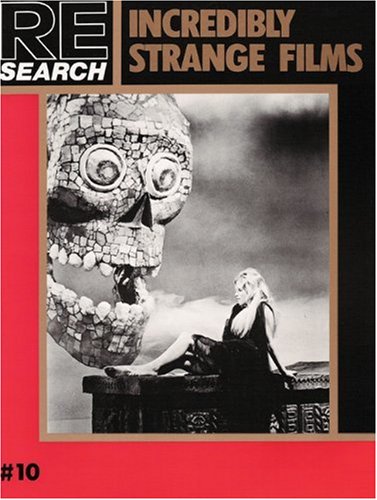
Incredibly Strange Films

Re/Search #10: Incredibly Strange Films was one of the books that launched the cult movie boom (along with Danny Peary’s Cult Movies). Like Peary’s books its great strength is that the authors actually like these movies. They’re not trying to make fun of them.

The book covers just about every cult movie genre you can think of - sexploitation, biker films, juvenile delinquent movies, even beach party movies.

The book was published in 1986, at a time when most of the movies it was dealing with were exceptionally difficult to find. It’s obvious that in many cases the authors have only seen a handful of movies by many of the film-makers they’re writing about. Jean Rollin for example is mentioned in passing as a director who sounds interesting but the authors had been unable to find a single one of his films. Today of course all his movies have been released on DVD and many of them on Blu-Ray as well. It certainly makes you appreciate the DVD age a lot more.

On the other hand the 1986 publication date did have one major advantage - most of the film-makers covered in the book were still alive and were able to be interviewed for the book. It includes interviews with Russ Meyer, Doris Wishman, Joe Sarno, Ted V. Mikels and many others. These interviews are the major reason for buying the book today.

The introduction includes some silly political nonsense but mercifully the rest of the book is free of this bunkum.

There are some interesting movies covered here, movies I hadn’t heard of before. Despite its age this book is still worth getting hold of.

Saturday, 7 November 2009

A Youth in Babylon

David F. Friedman is one of the legends of exploitation cinema. A Youth in Babylon is the first half of what was intended to be a two-volume autobiography although the second part never materialised. The book is like his movies - brash, unsubtle, shameless and joyously trashy.

Friedman started his career in movies respectably enough as a publicist for Paramount, but respectability and life as a wage slave never did appeal to him and in the mid-50s he accepted an offer to work for Kroger Babb, one of the greats of the exploitation movie business. Babb made a fortune from what was a movie version of a travelling medicine show, the centrepiece of which was a corny 15-year-old cinematic morality play called Mom and Dad which he marketed as an educational sex film, accompanied by a lecture by famed sex hygiene expert Elliot Forbes. Audiences were given the opportunity to buy paperback books explaining the mysteries and wonders of reproduction, at just a dollar each or two dollars for the set of two. Since the books cost nine cents to produce the show was a huge money-spinner. Babb had the reputation of being a showman who could sell absolutely anything, a talent that the young Friedman already possessed in abundance but which blossomed under such expert guidance.

The exploitation movie business of the 1920s through to the early 60s was essentially an offshoot of the world of circuses, sideshows and travelling carnivals, and this carney world was Friedman’s natural environment. Friedman went on to be one of the pioneers and leading figures in the sexploitation movie business of the 60s and 70s, producing and writing (and occasionally directing) a series of immensely profitable nudie-cuties and roughies. With his partner in crime Herschell Lewis he also invented the gore movie.

Friedman comes across as a loveable rogue, with no illusions about himself or his movies but with an infectious zest for life. He has some wonderful anecdotes about the fabled
Forty Thieves, the shameless hucksters who created and maintained the bizarre but fascinating exploitation movie genre. They were essentially conmen, selling movies with virtually no sexual content but convincing audiences they were about to see a veritable feast of naked flesh. They were imbued with the carney spirit. You were either “with the show” meaning you were one of those who understood the rules of the game, or you were a mark.

It’s all highly entertaining and it provides a wealth of information on this vanished cinematic world. The book covers Friedman’s career up to the mid-60s. It’s a great pity that the projected second volume has never appeared. A Youth in Babylon is highly recommended to any serious cult movie fan.

Tuesday, 8 September 2009

Big Bosoms and Square Jaws: The Biography of Russ Meyer

Big Bosoms and Square Jaws is Jimmy McDonough’s biography of cult movie legend Russ Meyer. You couldn’t write a boring book about Meyer, and while the definitive biography has probably yet to be written this one is certainly worth reading if you’re a fan.

You only need to look at his movies to realise that Meyer was a strange guy. McDonough at times seems to me to be just a little judgmental, especially in regard to Meyer’s attitude towards women. Clearly he had issues in this area, but on the other hand most of the women who starred in his films seem to remember the man with considerable affection, and seemed to be happy to accept him even with his many sexual idiosyncracies.

McDonough does offer some interesting insights into Meyer’s childhood and his very odd relationship with his and his sister (who tragically ended her life in a mental hospital). I don’t think he really explains what made this complex and fascinating man tick, but it’s a good starting point.

The best part of the book is the account of the making of the movies. Meyer’s film-making method sounds like a mixture of endurance test and organised chaos. There’s also quite a bit on his early career as a photographer for men’s magazines such as Playboy.

And of course there are the wonderful women who played such an important part in his life and work. They were every bit as delightfully strange as Meyer himself, which is probably why they were able to work with him! You can’t help falling in love with women like Haji and Kitten Natividad. Now I want to watch all his movies all over again!

Wednesday, 5 August 2009

Sleaze Artists

Sleaze Artists: Cinema at the Margins of Taste, Style and Politics is a collection of essays on the subject of horror and exploitation movies, edited by Jeffrey Sconce. As is usual with this type of book the articles are of varying interest, and intellectual density and/or obscurity.

There’s an essay on the troubled but fascinating history of Maro Bava’s masterpiece Lisa and the Devil, in its various incarnations. The essay on sound and image in video nasties I’ve already spoken about. Other essays cover Doris Wishman’s sexploitation movies from a feminist perspective, the career of Todd Haynes, movies about homosexuality in the military, Aztec mummy movies and sundry other topics.

It’s reasonably interesting, but nowhere near as good as Xavier Mendik and Graeme Harper’s Unruly Pleasures: The Cult Film and its Critics or Tombs and Tohill’s superb Immoral Tales: European Sex and Horror Movies 1956-1984, or the Necronomicon series of books edited by Andy Black.

Tuesday, 30 June 2009

Necronomicon

Necronomicon is billed as The Journal of Horror and Erotic Cinema. I believe there have been book-length collections so far. Book One contains eighteen essays, covering such disparate movies as The Evil Dead, Daughters of Darkness, Witchfinder General, Last Tango in Paris, The Bride of Frankenstein and Hitchcock’s Psycho, and directors from Herschell Gordon Lewis to Dario Argento. There are two excellent essays on Jean Rollin, and a good survey of adaptations of the work of H. P. Lovecraft.

Some contributors are a bit heavy on the film theory jargon and the psychoanalytical interpretations, but on the whole it’s still a reasonably stimulating selection of articles. It’s not like there’s a surplus of books on this subject, so if you have an interest in these types of movies, especially the exploitation horror of the 60s and 70s, then it’s probably worth trying to find a copy.

Sunday, 28 June 2009

"Bold! Daring! Shocking! True!": A History of Exploitation Films, 1919-1959 by Eric Schaefer

"Bold! Daring! Shocking! True!": A History of Exploitation Films, 1919-1959 by Eric Schaefer is one of those books that tells you pretty much everything you need to now about a particular subject. It succeeds because Schaefer doesn’t try to cover too much ground. He doesn’t attempt a history of all exploitation movies, but focuses on a very specific type.

The movies he is concerned with are what he describes as the classical exploitation films, a very particular and peculiarly American phenomenon. These were movies that were not just made outside the studio system. Everything about them marked them as being different. They were distributed in a completely different way, and the style of film-making was quite distinct from what had become the Hollywood norm. Most notoriously, they are not subject the Production Code an in fact they focused almost exclusively on subject matter that was specifically prohibited by the code - drugs, prostitution, venereal disease and of course nudity. By the 1950s new types of exploitation movies were emerging, and by the beginning of the 60s the classical exploitation movie had vanished forever.

Schaefer describes in detail the way this shadowy alternative film industry worked, and then goes on to examine the types of movies that were produced. It’s a story enlivened by a collection of colourful and cheerfully disreputable characters. He neither glamourises nor condemns the movies, but he does point out the fascinating contradictions they contain. He also points out that the exploitation movies were a constant thorn in the side of the major Hollywood studios.

He does get a little ideological at times, but generally it’s quite readable and non-judgmental. It’s an intriguing subject, and it’s a book I recommend highly.

Tuesday, 5 August 2008

Unruly Pleasures: The Cult Film and its Critics

A book review this time. Unruly Pleasures: The Cult Film and its Critics edited by Xavier Mendik and Graeme Harper is a collection of essays on, obviously, cult movies. Although all the essays were written by academics they’re mercifully free of the psychoanalytic jargon that makes so many scholarly books on film such heavy going. In fact they’re relatively free of academic jargon in general. Imagine a bunch of academics who are also enthusiastic and unashamed fans and you have a fair idea of the tone of most of the articles.

Jonathan Crane on Russ Meyer and Jonathan Raynor on car cult films are particularly good. There’s also an interesting article by Julian Petley on snuff movies, pointing out that in fact there’s never been any real evidence (outside the fevered imaginations of tabloid journalists and morals crusaders) that such movies actually exist.

I was also fascinated by Leon Hunt’s piece on kung fu movies, mainly because it’s a subject I knew nothing whatever about. Other movies discussed include The Exorcist, Paul Verhoeven’s Showgirls, David Cronenberg’s Crash and From Dusk Till Dawn.

As with any such collection some essays are more interesting and more compelling than others, and it’s nothing less than a scandal that they’ve omitted Jess Franco and Jean Rollin, but overall it’s fascinating and stimulating and I recommend it highly.