Showing posts with label non-hammer brit horror. Show all posts

Saturday, 10 February 2024

Prey (1977)

Prey is a 1977 British science fiction-horror movie directed by Norman J. Warren and it doesn’t quite conform to conventional genre expectations.

An alien spacecraft with a single crew member lands somewhere in the English countryside. The alien is confused and disoriented and lashes out violently when he feels himself threatened. As a result of his misinterpretations of human behaviour he kills two people.

He finds refuge in an isolated farmhouse. Jo (Sally Faulkner) and Jessica (Glory Annen) are the only inhabitants of the farmhouse. They are lesbians. They’re not sure what to make of the alien (who calls himself Anders and is played by Barry Stokes). He looks entirely human and they have no reason to suspect that he is anything but human but his behaviour is rather odd.

The atmosphere in the farmhouse was tense even before Anders arrived. It becomes more tense. Anders has wandered into the middle of an emotional minefield.

Anders becomes the catalyst for further emotional dramas although he actually doesn’t participate. But his presence in the house is quite enough.

Anders is more the manipulated than the manipulator. Jo goes out of her way to humiliate him in order to try to make him seem ridiculous and unattractive in Jessica’s eyes.


And we’re still not entirely sure what his intentions are.

Of course the dramas will come to a head, but not quite in the way we might expect.

There are certainly science fictional and horror elements in this movie but much of the focus is on the emotional dramas at the farmhouse.

The relationship between Jo and Jessica is clearly very troubled. Before Anders’ arrival Jessica announces that she wants to leave for a while, to spend some time on her own. Jo’s reaction is extremely hostile. Jo is clearly jealous and possessive. Jo hates men. It’s obvious that she thinks that Jessica is a bit too fond of men. The two women sleep not just in separate beds but in separate bedrooms. There seems to be a lack of physical intimacy between them.


Jo seems a little unstable and definitely inclined to anger. She is clearly a time bomb ticking away, a bomb that could explode at any moment.

In a 1970s exploitation movie you expect a lesbian sex scene and you get one and it’s moderately graphic but it’s rather different from the usual run of such scenes. There’s an extreme emotional intensity. It’s as if their frantic love-making is a desperate attempt to convince themselves that their relationship is still viable. This is not just a sex scene thrown in out of commercial necessity. This is two real very troubled people having sex.

There are only two sex scenes but both are crucial and both pack a punch, in very different ways.


I think it is legitimate to wonder if this movie would have worked just as well, or possibly better, as a straightforward erotic thriller without the science fiction elements. I think it’s possible, but on the other hand the fact that Anders is an alien explains why he makes no overt sexual advances to either woman. And that works quite well. It emphasises that Jo’s jealousy is irrational. It emphasises the paranoid nature of her anxiety that Jessica will betray her sexually or leave her.

The acting is pretty good. Barry Stokes is weirdly detached, as you]d expect from an alien who understands nothing of people. Sally Faulkner is nicely intense with subtle hints of derangement that slowly become more marked. Glory Annen (in her film debut) is excellent. There are really only three characters in the movie which puts a lot of pressure on the three leads but they come through with flying colours.


This was a very low-budget movie made insanely quickly but it’s another movie that demonstrates that talent and commitment matter more than money when it comes to making movies.

Norman J. Warren did not direct very many movies. More than anything else this probably reflected the catastrophic state the British film industry was in by the mid-70s. Especially the British popular film industry. By the late 70s obtaining funding for genre movies was extremely difficult; by the mid-80s it was impossible. But he did make Satan’s Slave (1976) which is an awesome movie. And he did make the totally insane Inseminoid.

Prey is weird and disturbing but it’s a pleasingly interesting and oddball movie which is highly recommended.

The Vinegar Syndrome Blu-Ray looks fabulous and includes some worthwhile extras including an audio commentary by Norman J. Warren and Sally Faulkner.

Sunday, 2 April 2023

It! (1967)

It! belongs to a rather obscure horror movie genre, the golem movie. There haven’t been very many such movies. There was The Golem co-directed by Paul Wegener and Henrik Galeen in 1914. Paul Wegener and Carl Boese directed a remake in 1920. There was The Legend of Prague, directed by Julien Duvivier in 1936, and one or two others.

The golem is a Jewish legend, or a series of Jewish legends, of inanimate figures usually of clay that can be brought to life. The most famous such story is of a golem created by the 16th century rabbi of Prague, Judah Loew ben Bezalel. This golem served to defend the Jews of Prague who were under threat at the time. This is the version of the legend on which It! is based.

It! was written, produced and directed by Herbert J. Leder and released by Seven Arts in 1967.

Professor Grove (Ernest Clark) is a museum curator in London. His assistant is Pimm (Roddy McDowall). There is a major fire in the warehouse in which some of the museum’s collection is stored. Only one piece survives the fire, a very large 16th century European primitive statue.

Professor Grove is killed in an accident, an accident involving the statue.

Pimm is an amateur occultist. He lives with his mother, a spiritualist and medium. His mother is in poor health. Very poor health. In fact she’s dead. But Pimm is a devoted son and continues to care for her.


As you may have gathered Pimm is just a bit mad.

Pimm is in love with Professor Groves’ daughter Ellen (Jill Haworth). She is clearly not interested. Pimm is somewhat upset that his feelings for Ellen are not reciprocated.

He has another reason to be bitter. He assumed that he would succeed Professor Groves as curator but the job is instead given to Weal (Aubrey Richards), a humourless martinet who takes a dislike to his young assistant.

Pimm is convinced that the statue has certain powers. There’s a Hebrew inscription on the statue which leads Pimm to believe that it is a golem. In fact he has reason to suspect that it is the golem created by Judah Loew ben Bezalel.


According to the inscription the golem can be brought to life by placing a scroll in its mouth. All one has to do is find that scroll and Pimm thinks he knows how to find it.

The golem has no will of its own. If it is activated it will serve the man who activated it.

For a man like Pimm this is a major temptation. The golem could help him get all those things he wants, like the curator’s job. And Ellen. Pimm figures that the way to succeed with women is to impress them. His ideas on the things that a woman would be impressed by are a little strange and disturbing.

Pimm does have a problem. An American museum has made an offer for the golem and they’ve sent an expert to close the deal. That expert might not just take the golem away, he might take Ellen as well.


Pimm also discovers that while the golem can give him unimaginable power that power comes at a price.

The biggest strength of this movie is Roddy McDowall. He was just so good at playing frustrated inept characters like Pimm. Jill Howarth is reasonably good as Ellen. The other cast members are adequate enough.

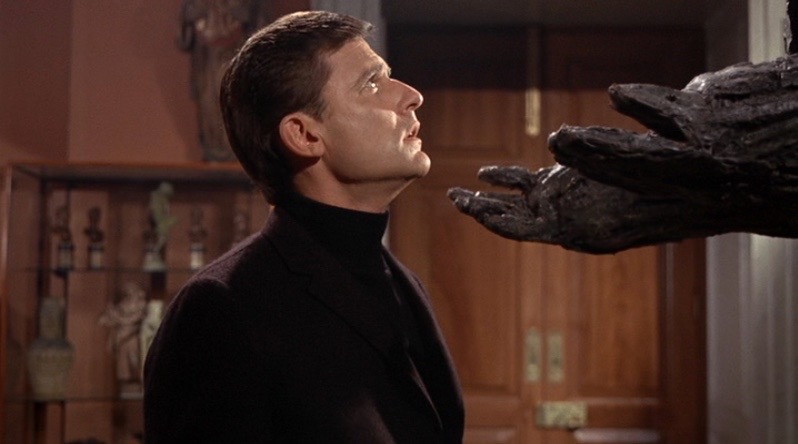
The golem itself looks cool and genuinely scary and menacing. It even looks fairly convincing when it walks. The special effects are OK. For what was obviously a modestly budgeted movie It! looks reasonably impressive. Leder has wisely avoided being too ambitious with visual set-pieces. He’s stuck with things that can be done without spending a fortune. The bridge scene however is very iffy since it really was too ambitious to be carried off successfully.


The stuff about Pimm’s dead mother is an obvious attempt to give the movie a Psycho vibe. It’s an unnecessary distraction which just makes the movie seem a bit confused. But I guess Leder thought it would help the movie at the box office. It would have been better to concentrate on Pimm’s feelings of sexual and career inadequacy which are the elements that actually provide his motivations.

This movie has just enough slightly off-the-wall moments and a performance by Roddy McDowall which is nicely unhinged. Maybe not quite a neglected horror gem but It! is interesting and fun, slightly unusual and generally pretty entertaining and it’s recommended.

It! was released on DVD in the Warner Archive series paired with another overlooked 1967 horror film, The Shuttered Room (which is also worth seeing making this disc a very tempting buy).

Tuesday, 31 January 2023

The Shuttered Room (1967)

The Shuttered Room is a 1967 horror movie set in America but shot in England. It’s one of those 1960s British films made partly with American money. Fittingly it has a mixed English and American cast.

The Shuttered Room belongs to that interesting horror movie sub-genre, the Lovecraftian horror film. There are surprisingly few movies in this sub-genre and there are very few indeed that can be considered entirely successful. Lovecraftian horror is not easy to translate to film. It should be noted that The Shuttered Room, the short story on which the movie was based, was actually written by August Derleth although apparently based on some fragmentary story ideas of Lovecraft’s. Derleth was more than anyone else responsible for ensuring that Lovecraft’s literary legacy would be an enduring one. Derleth was a fine writer of weird fiction in his own right.

The inhabitants of the isolated island village where the action takes place are clearly seriously inbred and if they ever were civilised they have reverted to superstitious savagery. Whether they’re dangerous because they’re evil or because they’re extremely stupid is not clear. This movie therefore has a very Lovecraftian atmosphere of superstitious malevolence and degeneracy but thematically it’s not truly Lovecraftian. This seems to upset some viewers who see this as a weakness but you have to keep in mind that it’s not based on an actual Lovecraft story but on an August Derleth story. This is Derlethian horror rather than Lovecraftian horror. If you accept that then you’ll enjoy the film more.


Wealthy New York magazine editor Mike Kelton (Gig Young) has brought his young bride Susannah (Carol Lynley) back to her hometown, a tiny village on a tiny island totally isolated from mainstream society. Dunwich Island isn’t just decades behind the rest of the country, in some ways it’s centuries behind. The locals take things like curses and witches for granted.

Susannah was born Susannah Whately and she has inherited a decaying old mill belonging to her family. The Whately family has lived on Dunwich Island for as far back as anyone can remember. Everybody on the island is either a member of the Whately family or related to them in some way. This is the kind of community in which first cousins have married each other rather too often.


From the start it’s clear to Mike and Susannah that the locals are pretty weird and that here’s a vaguely menacing atmosphere. And they have been warned by Susannah’s weird dotty Aunt Agatha (Flora Robson) not to stay in the mill house for even one night, because of the Whately Curse. But Mike and Susannah aren’t worried. They’re sophisticated New Yorkers. They think the locals are colourful and amusing rather than dangerous. They think that the talk of curses just makes the mill house seem more interesting and romantic.

There are two main plot strands. One involves the origin of the curse and the danger this may pose to Susannah. It’s clear that there is something dangerous in the old house but whether it’s a supernatural evil or some kind of monster or a purely human evil is an open question.


The second plot strand centres on sex. Ethan (Oliver Reed) is a wild rather crazed young man and he’s the leader of the young men of the island who are essentially a roaming band of thugs. It’s obvious that Ethan is sexually obsessed by Susannah and intends to have her. It’s also obvious that his gang of thugs expect that after he’s finished wth her they’ll get their turn. It’s a setup that definitely anticipates Peckinpah’s Straw Dogs.

The two plot strands do intersect towards the end and the climax of the movie is exceptionally well managed.

The cast is interesting. Oliver Reed made plenty of horror movies and thrillers in the early to mid 60s so it’s no surprise to see him listed as one of the three stars. It’s also no surprise that he is perfectly cast. The presence of Gig Young and Carol Lynley is slightly more surprising. Both Young and Lynley had moderately successful careers that never quite launched them into stardom but both are actually rather underrated. Lynley is good here. There’s nothing terribly wrong with Gig Young’s performance except that Mike has to do a fair bit of action hero stuff and Young is just too old to do that convincingly.


Director David Greene spent most of his career in television but while he made few feature films those that he did make tended to be incredibly interesting, movies such as his quirky spy thriller Sebastian (1968) and the absolutely superb fairy tale-like I Start Counting (1969). Greene does a great job on The Shuttered Room. He keeps things visually interesting and when he uses an unusual camera angle he does so very for good reasons and it never seems gimmicky. David Greene really should have had a glittering career in film.

As long as you’re not expecting pure Lovecraftian horror The Shuttered Room is thoroughly enjoyable, stylish and creepy.

It was released on DVD in the Warner Archive series paired with another overlooked 1967 horror film, It!

The Shuttered Room is highly recommended.

Saturday, 5 November 2022

Symptoms (1974)

Symptoms is one of several British movies made by Spanish director José Ramón Larraz. His best-known British movie is of course Vampyres (1974).

Symptoms is a horror movie but that doesn’t become really obvious until quite late in the movie. This is very much a slow-burn horror chiller.

Anne (Lorna Heilbron) goes to stay with her friend Helen (Angela Pleasence) in Helen’s remote country cottage. We realise right from the start that Helen is a bit odd. There could be several reasons for her oddness. She might be ill. She might be crazy. There might be supernatural influences at work. She might be legitimately afraid of her odd-job man Brady (Peter Vaughan). He does seem a bit sinister (of course Peter Vaughan was remarkably good at being slightly sinister). We do know that there’s a body in the lake. As the movie progresses several possibilities will occur to us as to how the body get there and who put it there.

Anne realises that Helen is worried about something. She seems to need Anne’s constant presence.


There’s a slight suggestion that whatever is going on could be related to sex. When Helen notices Brady looking at her she seems to overreact. Maybe she’s afraid of Brady (possibly with good reason) or maybe she has problems dealing with men.

There’s also the question of Cora. Cora is Helen’s friend. Cora often stayed with her. Cora doesn’t seem to be around any more, or is she? Anne has an odd sensation that she and Helen are not alone in the house. That’s unlikely but possible. It’s a big old house and only parts of it are in use.

Nothing very much happens for a long time, except that the atmosphere becomes more and more oppressive and mysterious. We feel that something startling, possibly something, is about to happen but it’s just a feeling. We have no hard evidence to go on.


We’re not surprised when something does happen but Larraz still manages to shock us. This has been a subtle atmospheric film and then suddenly it explodes into blood-drenched violence. And we’re still not entirely sure what actually happened.

There’s more blood to come. And we will get our answer, although perhaps not a complete answer.

The three central performances are superb. Angela Pleasence manages to make Helen a woman for who we feel quite a bit of empathy but it’s empathy mixed with unease. She apparently found Larraz difficult to work with but she still feels great admiration for his visual genius.


Peter Vaughan is wonderfully enigmatic. Brady could be entirely harmless or he could be very dangerous indeed. Vaughn was very good at that sort of thing, playing characters who seem a bit frightening but might not necessarily be evil. Everything Brady does could be interpreted as harmless or menacing.

Lorna Heilbron is very solid as Anne.

Larraz brought a European sensibility to his British movies that gives them a unique European/British hybrid feel. While Vampyres gets us straight into the action (and the bloodletting) and Symptoms is very slow-paced there are a few interesting unexpected thematic similarities between the two films.


The BFI releases includes the movie on both Blu-Ray and DVD. There are lots of extras. There’s a lengthy documentary but it was so pretentious and self-consciously arty that I bailed out after five minutes. The extras focus mainly on Vampyres rather than on Symptoms. The interview with Angela Pleasence is quite interesting.

Symptoms isn’t as successful as Vampyres but it creates a wonderfully overheated hothouse atmosphere. Both movies deal with female sexuality but in very different ways. Vampyres is overt. Symptoms is very subtle.

Symptoms is definitely worth seeing. Highly recommended.

Tuesday, 8 June 2021

The Wicker Man (1973)

The Wicker Man, directed by Robin Hardy and written by Anthony Schaffer, is one of the most admired British horror movies of the 70s. In fact, it is possibly the single most admired British horror film of that decade. There are even those who claim it to be the greatest British horror film of all time, and it’s a claim that has some validity.

There are now three different versions of this film in existence. There’s the 87-minute theatrical cut, the 99-minute director’s cut and now a 94-minute “final cut” has emerged which is claimed to be the closest to the original intention of the film-maker. It doesn’t matter which version you prefer because the recent Studiocanal 2-disc Blu-Ray release includes all three cuts.

The Wicker Man was made in 1973 and then, due to problems with the distributor, it simply vanished from sight. It was pretty much unseen until the end of the 70s. When people finally did get to see it, in a very unsatisfactory form, its greatness was soon recognised and its reputation has since grown steadily as better prints became available.

Sergeant Howie of the West Highland Police (Edward Woodward) arrives by seaplane at the tiny island of Summerisle to investigate a report of a missing child, Rowan Morrison. When shown photographs of her nobody on the island will admit to having ever seen the girl.

Sergeant Howie is a devout Christian. He is a little on the priggish side but he’s sincere and well-meaning. He is shocked to discover that the inhabitants of Summerisle are pagans. There is no longer a church or a minister on the island. Christianity has been banished entirely.


Presiding over this pagan society is Lord Summerisle (Christopher Lee). He’s a jovial enough fellow and much-loved but he has all the power of a mediæval lord. Summerisle is a kind of petty kingdom which recognises no authority other than Lord Summerisle.

Sergeant Howie realises that the islanders have been lying to him. They do recognise Rowan and he’s sure that they do know what happened to her. Howie isn’t certain what happened to Rowan but he is beginning to have dark suspicions that she has been murdered. His suspicions are both correct and incorrect.

Howie is determined to solve the mystery of Rowan’s disappearance but he’s not going to get any coöperation at all from the locals. In fact they will hinder his investigation at every step.

Howie simply cannot deal with this pagan society. It offends him as a Christian but his response to Summerisle is a little more complex than that. This is 1973 and Howie has obviously dealt with non-believers before. The people of Summerisle are not just touchy-feely New Age neo-pagans or hippies play-acting at paganism. They are hardcore pagans. They worship nature, which leads them to worship sex. They take their worship of sex to extremes. They are every bit as extreme in their beliefs as Sergeant Howie.


Howie is not just a Christian, he is a policeman. It’s not just the paganism of the islanders that shocks him but also their obvious contempt for the police and for any authority other than Lord Summerisle.

Howie may be bigoted in the sense that he will not and cannot accept the very different religious beliefs of the islanders but they’re just as bigoted against his Christian beliefs. This is a clash of cultures in which neither side is capable of understanding the other and neither side is willing to respect the beliefs of the other side. There is intolerance on both sides.

That’s what makes this film so interesting. Depending on your own point of view you may be inclined to sympathise with either the Christian Sergeant Howie or the pagan islanders but whichever side you sympathise with your sympathies and prejudices will be challenged. Howie might be wrong to reject the islanders’ beliefs out of hand but he’s not wrong about everything. He might be right to reject the extreme beliefs of the islanders but he’s not right about everything either.

This rôle was tailor-made for Edward Woodward. He was always extremely good at playing characters who were much too tightly-wrapped, with their emotions much too tightly suppressed. He could not only do this, he could do it with a certain amount of subtlety and could give you the impression that the character was suffering from a great deal of inner turmoil. He could also give the impression that if such a person started to unravel he’d probably do so in a big way. And somehow he could make an audience care about such a character. The Callan TV series gave him a great opportunity to play such a character. Sergeant Howie is a very different man from tortured professional killer David Callan but both men are emotionally repressed and have difficulty in relating to others, not because they don’t want to but because they’re simply not able to.


Christopher Lee apparently considered this to be the best movie he ever made. He certainly makes the most of his rôle. Lord Summerisle, like Howie, is right about some things and wrong about others. He’s neither a simplistic villain nor a simplistic hero.

Britt Ekland is excellent as the innkeeper’s sexy daughter who tempts Sergeant Howie. Is she a free spirit trying to liberate Howie or is she a cruel temptress who enjoys torturing him by flaunting her sexuality at him?

There’s an impressive supporting cast including Diane Cilento, Aubrey Morris, Ingrid Pitt and Lindsay Kemp (who taught David Bowie mime).

Since this movie deals with a society that takes the worship of sex to an extreme there is of course a certain amount of nudity and sex but it’s absolutely integral to the theme of the movie and cannot in any way be considered gratuitous.

Britt Ekland’s ambiguous nude dance of seduction is certainly memorable.


The film was shot on location in Scotland and looks stunning. The music is excellent. There are a lot of old Scottish folk songs but the lyrics have been altered to give them a more overtly pagan feel. The music plays a major rôle is establishing the atmosphere.

This is a very literate horror film. There’s no overt horror until the end but the atmosphere, which starts out colourful and liberated, slowly and inexorably grows more sinister. The ending is a horror tour-de-force.

The Wicker Man is a provocative horror but it’s more than just a horror movie. It’s thematically complex and intelligent. It deals with belief and it deals with other important themes (although to reveal the most important theme of the movie would be to reveal a major spoiler). Anthony Schaffer’s script is brilliant and it’s only at the end that you realise just how brilliant it is as everything comes together perfectly and with a sense of inevitability and you finally realise what the story is really about.

It has to be said that there are problems with the Final Cut - it’s missing some very important early scenes which are important not only for what they tell us about Howie’s character but they’re also vital thematically. Those scenes are included in the Director’s Cut. The Final Cut looks terrific but the Director’s Cut has to be the preferred version.

The Blu-Ray presentation includes a host of extras including an audio commentary (for the Director’s Cut) featuring Edward Woodward, Christopher Lee and director Robin Hardy.

Very highly recommended.

Monday, 1 February 2021

Vampyres (1974)

Vampyres (also released as Daughters of Darkness) is a 1974 British gothic horror film but it was directed by a Spaniard, José Larraz, so it’s a kind of blending of eurohorror and British gothic horror sensibilities. It has the atmosphere of a Hammer horror movie but with much more gore and a hell of a lot more sex and nudity and generally depraved eroticism.

You might as well make it clear to the audience what kind of movie it is that they’re about to see. Vampyres does this with its opening pre-credits sequences - lots of blood and mayhem plus lesbian sex. If you weren’t aware that you were watching a lesbian vampire erotic horror movie you’re certainly aware of it now. This opening scene is actually very important. It’s a clue. But to what is it a clue?

After the credits we see a young couple, John (Brian Deacon) and Harriet (Sally Faulkner), heading off on a caravanning holiday. They pass a woman by the side of the road, hitch-hiking. The odd thing is that Harriet is sure there was another woman there, hiding behind a tree.

The hitch-hiking woman (we will soon find out that her name is Fran) is picked up by businessman Ted (Murray Brown). She wants a ride to her house. And quite a house it is. It’s your typical horror movie decaying gothic pile. Fran and Ted spend an enjoyable night together although Ted has the uncanny feeling that they’re not alone. He wakes up feeling extraordinarily tired and with a deep gash in his forearm. He also wakes up quite alone.


The camping spot that John and Harriet have chosen just happens to give them a rather nice view of Fran’s house and Harriet is very interested by it. It’s supposedly empty but she sees lights in one of the windows. And then Ted turns up, in need of first aid.

You’d think Ted would be sensible enough not to go back to Fran’s house after this but he is a man and Fran is extremely hot and he can’t help himself.

You’d also think that Harriet might have enough sense not to get too curious about a house that looks exactly like a haunted house, but she can’t help herself either.

Fran turns up just after sundown, and she has two friends with her. There’s Miriam and a male friend, Rupert.


Another night of debauchery follows, with more than just straightforward debauchery. Fran and Miriam are lesbians (or in Fran’s case definitely bisexual) and vampires. Men who get invited back to their house get what they were hoping for (hot sex with gorgeous women) but they get a bit more besides that they weren’t counting on.

The problem for our two lovely lesbian vampires is that Fran is a bit obsessed with Ted. She knows she should just kill him but the sex is so good! Fran likes sex as much as she likes drinking blood. The problem for Harriet is that her curiosity is gnawing away at her.

If you’re expecting a blood-drenched finale you won’t be disappointed.


What’s fascinating about Vampyres is that it’s utterly conventional and formulaic and at the same time it’s quite unconventional and it plays around with the standard formula. You’re never quite sure how to interpret what you’re seeing. Fran and Miriam are your standard vampires. They sleep all day and only come out to play at night. All the mirrors in their house have been taped over. They mesmerise their victims and they drink blood. Miriam has a Count Dracula-style cloak. All stock-standard vampire mythology stuff. But are they actually vampires? If not, what exactly are they? And what did that opening scene actually mean?

Marianne Morris had a fairly brief film career, which is a pity. It’s even more of a pity that Anulka Dziubinska (billed here simply as Anulka) also didn’t have much of a career. I should mention that despite her name the former Playboy Playmate of the Month is in fact English. One can’t help feeling that both ladies would have had much more lucrative careers in Europe. I can certainly see Anulka in a Jean Rollin vampire movie.


The old Magna Pacific Region 4 DVD release is quite OK but there is now a Blu-Ray release and it’s a movie that probably is worth getting in Blu-Ray, if only for the sumptuous English autumn scenes.

José Larraz also directed the bizarre 1974 Spanish erotic horror movie The Coming of Sin (AKA Violation of the Bitch).

https://princeplanetmovies.blogspot.com/2011/05/coming-of-sin-1978.html

Vampyres is an erotic horror lesbian vampire movie with the eroticism, the horror and the lesbianism dialled up to the max. There’s a lot of blood and a lot of naked female flesh. Those who like lesbian vampire movies with those qualities will love it. Those who like vampire movies that attempt something different will enjoy its many subtle ambiguities. Vampyres delivers the goods. Highly recommended.

Monday, 11 January 2021

Night of the Eagle (1962)

Night of the Eagle is a 1962 British movie based on Fritz Leiber’s superb 1943 novel Conjure Wife

This is a fine example of understated horror, made at around the same time that Robert Wise was making The Haunting and Jack Clayton was making The Innocents – the early 60s was truly a great time for subtle cinematic horror.

Norman Taylor is a university lecturer, whose main field of academic interest is the occult – but he is most emphatically not a believer in the supernatural. In fact he has dedicated his carer to debunking the occult and ridiculing what he sees as primitive and naïve superstition. 

His approach to the subject is psychological – to him belief in the supernatural is evidence of neurosis, of an ability or unwillingness to face reality. He believes in reason. He believes in reason emphatically. 


So when he discovers that his wife Tansy is a practising witch it comes as something of a shock, to say the least. Actually, to be strictly accurate, she is more of a conjure woman since her practices have more in common with voodoo and similar religious beliefs than with more traditional notions of classic European witchcraft (although the movie does at times seem to confuse these two quite distinct practices). Norman and Tansy had lived for some time in the West Indies, which is presumably where she picked up these beliefs.

Norman hasn’t been at the university for very long, but his career has been going very well indeed and although comparatively young he is in line for a very prestigious academic appointment. Tansy tries to explain to him that his career has prospered mainly because of her conjure magic, but naturally he dismisses this opinion as childish and unworthy of the wife of such a distinguished champion of rationalism. He persuades her to destroy her magical charms and to give up her magic.


Unfortunately from this point on things start to go badly awry for Norman – in fact just about everything that could go wrong does go wrong. When Norman realises that both his life and Tansy’s are in real danger, he must re-evaluate his attitudes towards magic.

This is a movie that makes virtually no use at all of special effects, relying instead on an intelligent script, good acting, moody and atmospheric black-and-white cinematography and skilful direction. There is also no gore, but there is a great deal of suspense as Norman desperately tries to find a way to save himself and his wife.


Peter Wyngarde (looking rather odd without his trademark Jason King moustache) is absolutely perfect as Norman. The character has to be both arrogant and likeable - not an easy trick to pull off but Wyngarde does it splendidly.

Janet Blair gives a restrained an effective performance as Tansy, and there’s a fine supporting cast. Margaret Johnston is quite over-the-top but delightfully entertaining as Flora.


Optimum’s Region 2 DVD offers a very good anamorphic transfer (the movie was shot in black-and-white).

Night of the Eagle (which was retitled Burn, Witch, Burn! for its US release) is a tense and gripping and very entertaining piece of subtle atmospheric British horror movie-making which I highly recommend.

Thursday, 23 March 2017

House of Darkness (1948)

House of Darkness is a 1948 British movie that is sometimes labeled as a horror movie. In fact it’s a melodrama with gothic overtones. It does however have some claims to be a ghost movie so it’s at least understandable that it’s been given the horror label.

There’s a framing story which is, as unfortunately framing stories often are, quite unnecessary. The music is provided by George Melachrino, a popular orchestra leader of the time, and the framing story is an excuse to bring Melachrino into the film. Admittedly music does play a fairly important role in the story.

The actual story takes place in 1901 (we know this because the events of the film take place shortly before the coronation of King Edward VII). A rather gothic-looking house is inhabited by a very troubled family. The middle-aged, querulous and ailing John Merryman (Alexander Archdale) inherited the house from his stepmother. The much younger Francis Merryman (Laurence Harvey) is extremely resentful that his mother did not leave the house to him. Francis is irresponsible and willful, and financially extravagant, and being dependent on John for money inflames his resentment even further. John’s timid and nervous brother Noel (John Teed) worries a good deal and conspires with his brother.


Things seem to be about to come to a head over the matter of a forged cheque which offers John the chance he has wanted for years  to force Francis out of the house. John’s steadily declining health (he has a very weak heart) means that his policy of forcing a confrontation with Francis is perhaps a little unwise.

Francis has a beautiful and devoted wife, Elaine (Lesley Osmond) who does her best to keep the peace. Noel is engaged to Lucy (Lesley Brook) but this seems likely to cause more problems - Noel wants Lucy to come and live in the house and Francis is not at all happy about having to share what he considers should rightfully be his house.


It’s an ideal setup for a murder thriller but this isn’t a murder story. What it is is a delightfully overheated melodrama. It does have murderous hatreds and hatred can kill in various ways. It has guilt and it has envy and in fact all the prime ingredients for fine gothic melodrama.

Such fame as director Oswald Mitchell has rests on his prolific output of comedies but in the same year as House of Darkness he also directed another full-blooded melodrama, The Greed of William Hart, which starred Tod Slaughter (probably the greatest melodrama star of them all). Mitchell does a perfectly competent job.


John Gilling wrote the screenplay. Gilling did some good work in crime films in the 50s but his most notable achievements were as a writer-director of gothic horror films for Hammer in the mid-60s.

This was Laurence Harvey’s film debut. He looks absurdly young, because he was absurdly young - he was 19 when he was cast in this film. His extreme youth works in his favour since many of Francis’s character flaws are due to the combination of immaturity, irresponsibility and simmering adolescent resentment and jealousy. Laurence Harvey is not everyone’s cup of tea as an actor. He had a very narrow range and usually came across as emotionally disconnected and cold. In the wrong roles these flaws were fatal, but on the rare occasions when he landed just the right role he could be remarkably effective (an example being the very underrated 1968 spy thriller A Dandy in Aspic. Fortunately he’s perfectly cast in House of Darkness and his performance is odd but compelling.


This is one of those movies which is deliberately ambiguous about the supernatural elements. Are there ghostly forces at work in the house? Or are the ghosts merely a product of over-stressed imaginations twisted by guilt, envy and hate?

Network’s DVD release offers a very good transfer with no extras.

House of Darkness probably has just enough ghostliness to qualify as a low-key gothic horror movie in the style of the 40s. It’s melodrama that is the predominant ingredient though, and as melodramas go it’s fun in its deliriously overheated way. Plus Laurence Harvey’s strange but intriguing performance is a bonus. Recommended.

Tuesday, 2 August 2016

The Night Has Eyes (1942)

The Night Has Eyes is a 1942 British thriller with a very strong admixture of the gothic. It’s notable for offering James Mason an early starring role, and it’s the type of role he would come to do very well.

Marian Ives (Joyce Howard) and Doris (Tucker McGuire), two young schoolteachers from an exclusive girls’ school, decide to spend their holiday on the Yorkshire moors. An odd choice for a holiday but Marian Ives (Joyce Howard) has her reasons. Her friend Evelyn died on the moors a year earlier, in mysterious circumstances. All very Wuthering Heights. Marian has the idea that she may be able to discover how Evelyn died. 

The village police constable warns the two not to go wandering on the moors - the weather is threatening and they could easily get lost and possibly fall into a bog and never be found. Of course they disregard his advice and of course they get lost and Doris does indeed fall into a bog, fortunately without fatal consequences. They come across the kind of isolated house you expect to find on the Yorkshire moors. Living in the house is a handsome but morose young composer, Stephen Deremid (James Mason). Stephen fought on the losing side in the Spanish Civil War and it’s left him bitter and self-pitying and he’s given up composing. He’s not exactly thrilled by the idea of having company but he can’t very well turn the two girls away in the middle of a storm.


The Wuthering Heights atmosphere becomes more and more pronounced and the gothic elements are very much in evidence.

Stephen denies having ever heard of Evelyn but it soon becomes apparent that he most certainly did met her. In fact she had stayed in his house. Stephen is a troubled man but is there more to it than that? Why does he fear the full moon? Why does he seem at times to be attracted to Marian and then he pushes her away? Does the house in fact contain a secret room? Are there other secrets hidden here? 

It might be a good idea for Marian and Doris to leave as soon as possible but the rains have caused the river to break its banks and the house is now cut off from the outside world.


Writer-director Leslie Arliss showed considerable promise in the 1940s, including major box-office hits like The Wicked Lady and The Man in Grey (both starring James Mason), but by the 50s his career was in decline. Melodrama mixed with gothic was his clearly his forte and he does a fine job here.

The plot is contrived and melodramatic but that’s the sort of movie this is. It’s supposed to be melodrama.

Joyce Howard is pleasant but just a little insipid. Marian is an annoyingly brainless heroine who behaves like a lovestruck schoolgirl. Tucker McGuire’s task as Doris is to add some comic relief which she does without being excessively irritating. Just to make sure we get enough comic relief we also have Wilfred Lawson as the lecherous odd-job man and a pet monkey as well. Mary Clare is OK as the good-hearted housekeeper who knows a lot more about Stephen than she lets on.


It’s James Mason who is largely left to carry the picture. His star quality is already clearly evident. Stephen Deremid feels too sorry for himself to be entirely sympathetic but Mason makes him suitably ambiguous, tortured and tragic.

The scenes on the moors have a very obvious shot-on-a-soundstage look to them but that works to the film’s advantage, giving it more of a subtly other-worldly feel. The gothic atmosphere is laid on very thickly indeed. The isolated house with its solitary inhabitant sunk in melancholy and self-pity is obviously very Brontë-esque. There are also hints of the Old Dark House genre especially when Stephen reveals that the house contains at least one secret room. Günther Krampf’s cinematography is effective. 


Network’s DVD presentation is standard for this company - it’s barebones but the transfer is excellent.

The Night Has Eyes is not an out-and-out horror movie by any means but it has a few real scares and enough hints of the gothic (and even a very faint of the supernatural) to make it of interest to horror fans. It certainly will have plenty of appeal to melodrama fans and it has a decent enough mystery plot. It also has James Mason going somewhat over-the-top but demonstrating the charisma that would quickly make him a major star. Recommended.

Wednesday, 22 July 2015

Asylum (1972)

Hammer’s great rival in the British horror movie market in the 60s and 70s was Amicus Productions. Amicus specialised in horror anthology films, all of which are worth seeing, but in my view the best of all their films was their 1972 release Asylum.

Asylum was written by Robert Bloch, best known as the author of Psycho but an excellent and versatile writer of fiction in various genres. The director was Roy Ward Baker, one of the top British directors of the period (and a man who did some notable horror movies for Hammer as well).

Asylum benefits from a particularly strong framing story. Young psychiatrist Dr Martin (Robert Powell) has applied for a position as a houseman at an insane asylum. On arrival he discovers that the director of the hospital is now a patient. The assistant director sets Dr Martin a challenge. He has to interview four patients, one of whom is the asylum’s former director. If Dr Martin can correctly identify which patient is the former director he gets the job. Each of the four patients then tells his or her story, these stories being the movie’s four segments.

In the first of these, Frozen Fear, Bonnie (Barbara Parkins) is a young American having an affair with a middle-aged Englishman, Walter (Richard Todd). Since Walter’s wife (Sylvia Sims) controls the money and refuses to give him a divorce they plot to kill her. This proves to be more difficult than they expected, which may or may not be because the wife is a student of voodoo. It’s a nicely macabre story, very much what you expect from Robert Bloch. Parkins was a competent actress. Richard Todd’s career may have been on the downslide but he was an excellent actor and he does well here.


In the second part, The Weird Tailor, Barry Morse plays a tailor name Bruno desperate for money who is delighted when the mysterious Smith (Peter Cushing) offers him a huge fee for a rather unusual suit. The suit is in fact very unusual indeed. Cushing is delightfully creepy and, as he so often did, he makes Smith a figure who is both terrifying and tragic. Barry Morse (a fine and underrated actor) is able to make Bruno almost pathetic but not quite and he does a fine job in emphasising Bruno’s desperation for money which warps his judgment.

The third segment, Lucy Comes to Stay, involves a young woman named Barbara (Charlotte Rampling). Barbara has been released from a mental hospital after a breakdown but her brother George (the delightfully smooth and urbane James Villiers) is not convinced that she has fully recovered. He employs a nurse to keep an eye on her. He had hoped that they had heard the last of Lucy (Britt Eckland) but his hopes are to be sadly disappointed. Rampling was not yet a star but she already has that slightly odd quality that always made her so interesting. Britt Eckland has rarely received much respect as an actress and that’s a trifle unfair. Her performance is more than competent.


The fourth segment (Mannikins of Horror) features the inimitable Herbert Lom as Byron, a man who believes he can transfer his mind into a toy robot. 

One of this film’s major asset is the stellar cast. Apart from those already mentioned there’s Geoffrey Bayldon as the hospital’s unctuous porter and Patrick Magee as the assistant director, Dr Rutherford. This is a movie in which everyone is so perfectly cast that it’s hard to pick a single standout performance. They’re all so good.

Asylum is an example of just how good a modestly budgeted movie can be with the right people involved. Director Roy Ward Baker, cinematographer Denys N. Coop, editor Peter Tanner and art director Tony Curtis were all professionals and the results are very good indeed. 


Camera tricks like Dutch angles generally need to be used judiciously but in this case, given the subject matter and the asylum setting, they’re entirely appropriate and are used to good effect. While much of the movie was made as Shepperton Studios there’s a considerable amount of location shooting as well. Amicus, like Hammer, were able to make cheap movies that looked more expensive than they were.

Amicus, very wisely, did not try to copy the Hammer style directly. Hammer were the masters of gothic horror so Amicus concentrated on contemporary chillers. This gives Amicus’s movies their own distinctive flavour.

Robert Bloch’s screenplay adapted four of his own earlier short stories. Lucy Comes to Stay was a story that he considered to be a kind of dry run for Psycho.


Dark Sky’s DVD presentation includes a brief but quite informative featurette on the history of Amicus Productions and an audio commentary with Roy Ward Baker and camera operator Neil Binney. Their recollections of the making of the film are still vivid and they are clearly (and with reason) quite proud of it. The transfer is good although not outstanding.

There’s no gore but there’s plenty of suspense and a nicely creepy atmosphere of crazed weirdness. You just don’t need gore in a horror movie if you know what you’re doing. Asylum is one of the most enjoyable of all British horror movies of this era. Very highly recommended.