Showing posts with label 1950s. Show all posts

Thursday, 27 March 2025

Revenge of the Virgins (1959)

Revenge of the Virgins is a 1959 B-western but it’s no ordinary B-western. This is a wild crazy nudie B-western written by the legendary Ed Wood Jr. It was directed by Peter Perry Jr and he’s almost as interesting as Ed Wood.

Now Ed Wood Jr is notorious for topping so many lists of the worst film directors all time. I can actually think of a couple of worse directors than Wood but he would definitely make my All-Time Five Worst Directors list. On the other hand, as a screenwriter and novelist he was surprisingly interesting and entertaining. You’ll always get touches of Ed Wood craziness and weirdness but he was quite capable of taking a deliberately tongue-in-cheek approach and as a writer his craziness could be, in its own odd way, inspired.

I don’t think I will ever again be tempted to watch another movie that he directed but if I see his name listed in the credits as screenwriter of a movie then I will seek out that movie. I consider The Violent Years, a juvenile delinquent movie that he scripted, to be a must-see movie.

Peter Perry Jr directed a whole slew of nudie movies in the 60s and they’re all good-natured and offbeat and enjoyable. Perry understood how to make a nudie movie that offered more than just naked ladies.

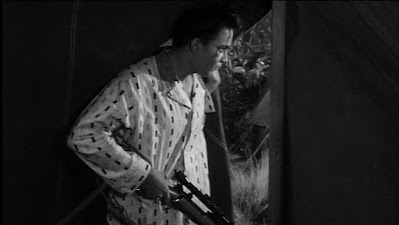
Revenge of the Virgins deals with an Apache tribe trying to stop gold prospectors from moving into its territory. There are only a handful of tribe members left. Less than a dozen in fact. They are all young, female and incredibly hot. They all spend the entire movie topless. The leader of the tribe is a blonde babe. She was kidnapped and raised by the tribe.


Melvin Potter (Charles Veltmann Jr) and his wife Ruby (Jodean Lawrence) have just arrived in a small town out West and hope to buy the saloon. They need money.

Grizzled old prospector Pan Taggart (Stanton Pritchard) may be able to help them. He knows where there is an abundance of gold for the taking. They will need to hire some gunmen. The local Apaches are not friendly.

The expedition sets out. Five men and a woman, all armed. They don’t trust each other too much, with good reason.

And then suddenly an arrow comes from out of nowhere and the expedition is one man short. They know the Apaches are now stalking them although they don’t know that the Apaches are all gorgeous young babes. They may be gorgeous bare-breasted babes but they’re dead shots with a bow and they’re smart enough not to contemplate a frontal assault. Their plan is obviously to pick off the members of the expedition one by one.


This would be the time for the expedition members to present a united front but they’re still planing to double-cross each other. And those Apache gals just keep stalking and shooting and then scooting.

That’s it for the plot but it’s a perfectly serviceable plot for a B-western.

What makes the movie interesting is the tone. Right at the start we get a voiceover that tells us that it may be just a tall tale told by old prospectors around the campfire. Clearly we’re not supposed to take the movie too seriously. But it does not become an out-and-out spoof nor does it indulge in out-and-out goofiness. In fact it gets rather dark at times. This is a story of a party of people being stalked by warriors who are smart, skilful, ruthless and remorseless. There’s a certain atmosphere of doom and desperation descending upon out gold-crazed adventurers. They haven’t even set eyes on the amazonian warrior girls who are slaughtering them one at a time.


When people talk about Ed Wood Jr there’s a tendency to focus on his most famous and most catastrophically inept movies as a director, such as Plan 9 from Outer space. It’s actually much more interesting to look at Wood’s forays into relatively conventional storytelling, both as director (in his attempt at a noirish crime thriller, Jail Bait) and as screenwriter (in the hugely entertaining girl juvenile delinquent movie The Violent Years) and as a novelist. What makes these efforts fascinating is that they are fairly straightforward but with a slightly off-kilter tone and occasional WTF moments.

Revenge of the Virgins follows that pattern. The plot is slightly outlandish but it does not venture into the world of the crazy and impossible. The tone is just slightly odd in an unsettling way. Is this trying to be a gritty dark-edged western or is it deliberately trying to be offbeat? Is it intended to be tongue-in-cheek? It’s hard to be sure, and that’s what makes it interesting.


Revenge of the Virgins
is also, in a weird kind of way, a girl gang movie. And Ed Wood was obsessed with girl gangs.

The Apache maidens are all extremely pretty and if you’re into bare breasts you won’t be disappointed.
An oddball movie but I found myself thoroughly enjoying it. Highly recommended.

I’ve reviewed the classic Ed Wood-scripted juvenile delinquent movie The Violent Years (1956) and his wild juvenile delinquent novel Devil Girls. And I’ve reviewed Jail Bait (1954), the only movie directed by Wood that is almost watchable.

I’ve reviewed quite a few of Peter Perry Jr’s sexploitation movies and I recommend all of them - The Notorious Daughter of Fanny Hill (1966), Kiss Me Quick! (1964), My Tale Is Hot (1964) and The Joys of Jezebel (1970).

Sunday, 5 January 2025

A Night in Hollywood (1953)

A Night in Hollywood is a 1953 burlesque movie.

This was an odd genre. These were actual burlesque shows, filmed in actual burlesque theatres but without an audience present (presumably because that would have caused major sound recording problems). They’re a chance to see what classical burlesque was really like. Burlesque was a mix of songs, comedy sketches and strip-tease routines.

The songs were usually terrible. The comedy was invariably atrocious. This was the so-called ”baggy pants” style of comedy and it’s an ordeal to sit through. There was only ever one reason for seeing a burlesque show (or a burlesque movie) - the strippers. Fortunately the strip-tease artistes were often excellent.

How much the girls could reveal varied from city to city and varied over time. In some cases the moment the girl took her dress off the police would move in and arrest everybody, in order to protect America from the mortal danger posed by half-clad women. In other cases the girl could strip down to a G-string and pasties. In rare cases they might get away with losing the pasties. They generally took off as much as they could get away with.


Since the girls were not naked they had to rely on provocative dancing to generate the necessary erotic heat. The things some of these girls could do with their hips and their posteriors can only inspire awe. These women played the female body like a musical instrument.

By 1953 when this film was shot burlesque was almost dead. Strip-tease would survive but old-time burlesque finally succumbed to the twin challenges of legal persecution and the rise of new forms of erotic entertainment. That makes watching the burlesque movies (mostly filmed between the very late 1940s and the early 50s) a rather poignant experience.


Nothing seems to be known about where this particular movie was shot. The fact that it’s partly in black-and-white and partly in colour suggests it was filmed on two separate occasions, possibly in different burlesque theatres.

It’s notable mainly for featuring two of the legendary burlesque queens, Misty Ayres and Tempest Storm. There are half-a-dozen strip-tease routines. Tempest Storm’s routine is by far the most daring.

My advice is to fast-forward through the songs and the comedy.


These movies do have enormous historical interest. This is a fascinating uniquely American art form now totally extinct.

Modern attempts to revive burlesque can never work because classical strip-tease relies on the tease. It relies on the fact that at a particular historical moment seeing pretty girls in very very skimpy costumes was a genuine erotic thrill. I have no moral problems with strip shows in which the girls take everything off but if the strippers end up fully nude it’s not burlesque. It’s no longer a tease. It has become something different. Not necessarily better or worse, but different.


A Night in Hollywood
is perhaps worth seeing for Tempest Storm but there are better burlesque movies.

This movie is included in Something Weird’s six-movie DVD set Strip Strip Hooray. I’d recommend some of the other movies in this set such as Everybody’s Girl (1950), Midnight Frolics (1949), B Girl Rhapsody (1952) and French Follies (1951) much more highly than this one. Image quality is acceptable.

Monday, 14 October 2024

Monster on the Campus (1958)

Monster on the Campus is a 1958 science fiction monster movie but it includes the words “directed by Jack Arnold” in the credits and that always inspires confidence. No matter how outlandish the ideas you know it will be a well-crafted movie.

This movie belongs to the smallest of all movie sub-genres - the coelacanth horror film. Yes, coelacanth, the famous “living fossils” - the fish species assumed to have been extinct for 60 million years before its rediscovery in the 1930s. These fish were at the time thought to have remained unchanged for several hundred million years. It was believed that they had not evolved at all. In this movie these odd fish spread horror and mayhem on an American university campus.

It all begins when the university acquires a fine specimen of a coelacanth. Professor Donald Blake (Arthur Franz) just can’t wait to start dissecting.

The coelacanth arrives in a truck, packed in a crate. While it’s being removed from the truck bloody water from the crate drips onto the roadway and Samson licks it. Samson is a German Shepherd, the much-loved mascot of a fraternity house. He’s a very friendly very gentle dog.


Shortly afterwards Samson turns savage. He has never done this before. He has to be locked in a cage for veterinary observation. Professor Blake notices something else very strange and inexplicable about the dog.

Professor Blake is feeling very tired and the campus nurse, Molly Riordan (Helen Westcott) offers to drive him home. Some hours later Molly’s dead body is discovered.

Professor Blake is now an obvious murder suspect but Detective Lieutenant Mike Stevens is inclined to think the professor is innocent. The fingerprint and footprint evidence seems to clinch the matter. Professor Blake is not the killer. But there is a killer loose on campus.

The footprints help to clear Blake but they mystify the cops. What kind of man could leave footprints like that?


Professor Blake comes up with a wild theory. I won’t spoil things by revealing his theory other than to say that it has to do with the peculiar nature of the coelacanth. The science stuff is this movie is delightfully silly and off-the-wall. You expect that in a 50s sci-fi monster movie, but in this case the insane pseudoscientific ideas are at least interesting and amusing and have some original elements.

The professor believes the giant dragonfly (two feet long) that flies into his laboratory window confirms his theory.

He tries to explain his theory to his department head and to his colleagues but they think he’s gone nuts.


His girlfriend Madeline (Joanna Moore) wants to stand by him but she thinks his theories are crazy as well.

Poor Molly was just the first victim of the mysterious monstrous campus killer.

Professor Blake eventually figures things out and comes up with a plan to destroy the monster.

The special effects and makeup effects are mostly laughably silly (especially the giant dragonfly) but surprisingly there’s a transformation scene that is superbly done.

The various cast members try to take it all very seriously which adds to the fun.


Jack Arnold made much much better movies than this but he does his best with the material he’s given.

The sheer lunacy of the premise is delightful. The fact that we’re meant to think the professor is a genius but his scientific methods are so sloppy adds more enjoyment.

This is not by any stretch of the imagination a great movie or even a particularly good one. It’s strictly a beer and popcorn movie. If that’s what you’re in the mood for it’s worth a look.

Universal's Classic Sci-Fi Ultimate Collection offers five films on DVD and all are worth seeing. The Monolith Monsters (1957) is particularly good. Monster on the Campus gets a very nice transfer (the movie is in black-and-white).

Friday, 7 June 2024

The Mole People (1956)

The Mole People is a 1956 Universal-International science fiction B-movie.

An archaeological expedition has made some surprising finds regarding a very obscure dynasty. I’m not sure where this is supposed to be taking place. They find a Sumerian inscription so one would guess Mesopotamia but it looks more like the Himalayas. After an earthquake they make another find - a very ancient oil lamp with another inscription which suggests that if they climb a rather forbidding mountain they will make some very exciting finds.

Three archaeologists - Dr Roger Bentley (B-movie stalwart John Agar), Dr Jud Bellamin (Hugh Beaumont) and Professor Etienne Lafarge (Nestor Paiva) - make the climb. They do find something pretty startling - an ancient city. And it’s inhabited. The people are still stuck in the Sumerian era and they’re superstitious and suspicious of strangers. In fact they don’t believe that strangers can exist. Their city is to them the entire world. Luckily, after first deciding to kill them, the king changes his mind and decides that these strangers must be messengers from the goddess Ishtar.

The city is located beneath the surface of the Earth, as a result of a catastrophic volcanic eruption five thousand years ago.


The city’s population is extremely small but there are also the Creatures of the Dark (they’re the mole people of the title although they’re never referred to as such). They were once human. Now they’re slaves.

The problem for the archaeologists is to keep the king thinking that they’re divine messengers. The high priest (played Alan Napier) doesn’t buy their story at all and favours killing them. Before killing them he wants their magic cylinder that contains Ishtar’s divine fire. It’s actually just an ordinary torch (or flashlight for American readers). It would be useful to keep the slaves in line. The inhabitants of this buried city cannot tolerate bright light. It terrifies them and can kill them.


Of course there’s a girl, Adad (Cynthia Patrick). She’s a slave. She’s not one of the mole people but she is one of the Marked Ones, who are presumably mutants of a sort. She certainly doesn’t look like a mutant. She’s blonde and cute and Dr Bentley is immediately smitten.

There are some dangers to be faced but there’s really very little action. This is a movie that doesn’t manage to create a great deal in the way of excitement or suspense.

The special effects are mostly very cheap although there are occasional effects shots that work. Matte paintings are used a great deal. It’s a technique I usually like but in this case the matte paintings are rather crude.


The disappearing into the ground trick however is pretty cool and works well on screen. The mole people are just guys in rubber suits but they look quite cool as well.

The acting is standard B-movie stuff, apart from Alan Napier who manages to be creepy and sinister and menacing. You get the feeling that this high priest enjoys putting people to death.

The basic idea is fine (in fact quite good) and while the script doesn’t do anything dazzling with it it’s serviceable enough. There is a surprising touch at the end.

Virgil W. Vogel directed. He spent most of his directing career working in television. A year after this film he directed the very entertaining lost world movie The Land Unknown (1957).


If you accept the fact that everything looks very artificial then this movie is a lot more enjoyable. In the scenes in the mine the artificiality becomes a definite asset, creating a nightmare underworld atmosphere.

Despite its faults and a certain talkiness this is an oddly likeable movie. It’s no masterpiece but it is reasonably good fun if you love 50s monsters movies and lost civilisation tales. Recommended.

This film is included in Universal’s five-movie Classic Sci-Fi Ultimate Collection DVD boxed set. The Mole People gets an acceptable transfer. It’s presented in 1.37:1. The movie was shot in black-and-white. It has I believe subsequently had a Blu-Ray release.

Tuesday, 28 November 2023

The A-B-C's of Love (1953)

The A-B-C's of Love, released in 1953, is one of the six burlesque movies included in the Something Weird DVD boxed set Strip Strip Hooray.

Lillian Hunt is the credited director and she’s credited on a lot of these burlesque movies. I know nothing else about her and I have no idea of the precise nature of her contribution to these movies. Directing a burlesque movie must obviously have been quite different to directing feature films.

In the case of most of the movies in this set we know which burlesque theatres were involved but in this case that information seems to be impossible to ascertain.

The burlesque movie had a brief blossoming in the late 1940s and early 1950s. These were actual burlesque shows filmed live in actual burlesque theatres. Although usually shot without a theatre audience what the movie gives you is exactly what the audience would have seen. This obviously gives these movies a great deal of historical importance. We don’t need to speculate on what a real burlesque show in the golden age of burlesque was like.

This is both the strength and the weakness of these movies. They show burlesque as it really was, both the good and the bad.


The good is represented by the strip-tease routines which offer a kind of innocent naughtiness and cheerful sexiness, qualities totally lacking in popular culture today.

These strip-tease artistes would have been horrified to be told they were part of the sex industry. They considered themselves to be in show business. They could dance and they devised and then worked up their routines the same way that any other live theatrical performer would have done. They were not just taking their clothes off. They were putting on a show.

For the most part they were quite unembarrassed by the taking off their clothes part. They were never completely naked. They would strip down to a G-string and pasties.


Having said that, how much the girls could get away with varied enormously from city to city. It was entirely up to the whims of the local authorities. On the rare occasions that they could get away with dispensing with the pasties they would do so. On even rarer occasions audiences in some places might get a “blink and you’ll miss it” glimpse of the girl without her G-string.

In a burlesque movie it’s G-strings and pasties. While considered somewhat scandalous at the time if released today these movies would get at most a PG rating.

The strip-tease routines have plenty of nostalgia value and some are pretty impressive.

The bad in burlesque is represented by the other entertainments on offer. The strip-tease routines were just part of a burlesque show. There would often be straightforward musical numbers and dance routines (this movie offers us a frenetic fully clothed tap-dancing routine).


The songs were usually not very good. Some of the dance numbers are OK.

But the worst part of burlesque was the comedy, and there was a huge amount of it. The comedy was usually provided by what were known as “baggy-pants” comics. There were dirty jokes but they were not the problem. The problem is that this style of comedy was excruciatingly unfunny. You wait for the punchline is these sketches but usually there is no punchline. Sitting through the comedy routines is an ordeal.

Comedy of course is a very individual thing. Maybe audiences of the time actually enjoyed this brand of comedy.

The burlesque movies give us the lot. You get half a dozen (occasionally more if you’re lucky) strip-tease routines but you get at least one straightforward musical number and a lot of comedy.


How good a particular burlesque movie is depends entirely on how good the strip-tease artistes are. They’re the reason you’re going to watch these movies. Everybody’s Girl (1950), Midnight Frolics (1949), 'B' Girl Rhapsody (1952) and French Follies (1951) are pretty good - the strippers are good and their routines are clever and erotic in that delightfully vintage 1950s way. The A-B-C's of Love is the weakest such movie I’ve seen so far. The strip-tease routines are not that great.

These burlesque movies won’t appeal to everyone but if you have an interest in burlesque or vintage erotica they’re essential viewing. And if like me you just enjoy oddball movie genres they’re intriguing. There are however much better movies in this genre than The A-B-C's of Love.

Saturday, 13 August 2022

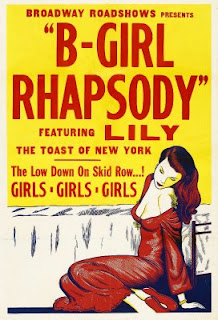
'B' Girl Rhapsody (1952)

'B' Girl Rhapsody is a 1952 burlesque movie. The burlesque movie was an odd phenomenon which blossomed briefly from the late 1940s to the mid-1950s. Most were actual burlesque shows that were filmed in actual burlesque theatres, without a live audience.

'B' Girl Rhapsody was shot at the New Follies Theatre in Los Angeles.

Burlesque itself was dying by this time, strangled by increasingly restrictive legislation pushed by society’s self-appointed moral watchdogs. So even in 1952 burlesque movies relied largely on nostalgia.

The burlesque movies do however offer an opportunity to get a taste of what burlesque was like, and they demonstrate both its appeal and its weaknesses. A burlesque performance certainly included strip-tease but it also included songs, variety acts and interminable painfully lame comic routines. It’s this that makes watching a burlesque movie a chore unless you’re wise enough to skip through the comic routines. The comedy is often crude but it’s embarrassingly unfunny.


Even without the efforts of moralising legislators burlesque would have died a natural death. By the beginning of the 1960s you could see a lot more nudity in girlie magazines and in sexploitation movies. The release of Russ Meyer’s The Immoral Mr Teas, the first nudie-cutie sexploitation feature in 1959, was another nail in burlesque’s coffin (which is slightly ironic given that Meyer’s first movie was in fact a burlesque movie.

One of the problems burlesque faced was that the girls were not able to show very much. It varied from city to city. In some towns as soon as the girl got down to bra and panties she’d be arrested. In other places the girls could take everything off. Mostly they only stripped down to pasties and a G-string, which by the mid 1950s was too tame to attract audiences.


The distributors of burlesque movies were also conscious of the danger of being arrested in a moral climate which considered the female body to be dangerous and wicked. As a result the burlesque movies tended to err on the safe side although they varied. In some you might catch a glimpse of a nipple, but it’s a case of blink and you’ll miss it.

The most interesting thing is seeing the girls’ dance routines which range from rather chaste to very risqué and can in some cases be remarkably energetic. And these girls can do some pretty impressive things with certain portions of their anatomies. You may have thought you seen these portions of the female anatomy jiggling but the tassel-twirling some of the girls can do is mind-boggling.


Since these movies were filmed in real burlesque houses the acton is confined to fairly small stages without spectacular stage settings. Most movies about burlesque give it the Hollywood treatment with the strippers performing on impossibly large stages with impossibly lavish props and backgrounds. Hollywood also tended to glamourise burlesque. In the burlesque movies there’s more of an atmosphere of seedy glamour with a touch of sleaze (not that there’s anything wrong with a touch of sleaze).

These movies were made on low budgets. This was the exploitation movie business with profitability depending on keeping those budgets to an absolute minimum. So these movies never did look like lush Hollywood productions.


The Something Weird DVD boxed set Strip Strip Hooray includes no less than six burlesque movies. Around seven hours of bumping and grinding. The transfers are generally pretty reasonable.

Burlesque movies are definitely a curiosity. They would even get a PG rating these days, containing in most cases no actual nudity. But burlesque was a fascinating cultural phenomenon which makes them worth a look. And burlesque does have a type of glamour that no longer exists. It’s worth seeing at least one of these movies, and 'B' Girl Rhapsody is a fairly typical example.

Saturday, 2 July 2022

The Bride and the Beast (1958)

The Bride and the Beast was scripted by Ed Wood and that today is its main selling point. The movies that Wood actually directed are absolutely terrible (although fascinating and entertaining in their own way). On the other hand an Ed Wood script in the hands of a relatively competent director could produce extremely interesting results, the girl juvenile delinquent classic The Violent Years (1956) being a prime example. As a director Wood didn’t have a clue. As a scriptwriter he was pretty good, if you like movies that are weird, fun, totally incoherent and sexually perverse.

Laura (Charlotte Austin) and Dan (Lance Fuller) have just been married and they’re off to Dan’s isolated but palatial house. He’s sent the servants home so they can be alone together. Well, alone except for Spanky.

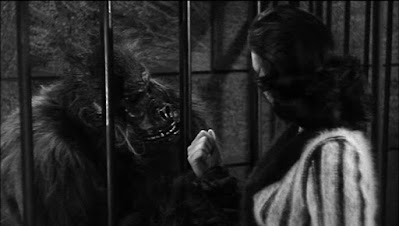
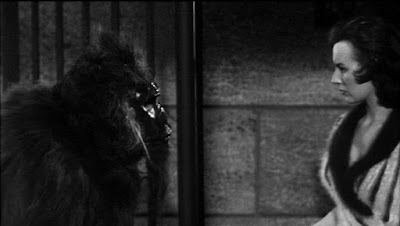
Spanky is Dan’s pet gorilla. He keeps Spanky caged in the cellar. Laura naturally wants to meet Spanky. It’s obvious that Laura and the gorilla find each other pretty interesting. Spanky has probably never seen a woman before, and he seems to like what he sees. Laura is fascinated by the gorilla, and perhaps just a tiny bit excited. 

Maybe she's even a tiny bit sexually excited.


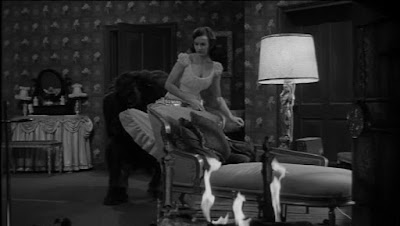
The gorilla gets loose and then we get a great scene in which he comes up behind Laura and lifts up the back of her nightie. This seems to get him very excited and he then rips off her nightie completely. This is too much for Dan. He goes for his gun.

As a result of this incident Dan decides that Laura needs to see a friend of his, a psychiatrist. Dr Reiner is an unconventional psychiatrist who thinks that the secrets to our problems lie in our past lives.

Dr Reiner decides to regress Laura to one of her past lives, with startling results.


It seems that in one of her past lives Laura was a lady gorilla. Dan is sceptical but Dr Reiner is a scientist after all.

You’d think that if you find out that your wife was once a gorilla you might think twice about taking her into the African jungle, but Dan is a big game hunter and he’s sure that Laura will love it.

Thanks to the miracle of stock footage the action switches to Africa.

The local authorities need Dan’s help desperately. They have two man-eating tigers to deal with. Yes, I know, tigers don’t live in Africa but the movie deals with that - these are tigers that escaped from a wrecked cargo ship.


After Dan and his gun-bearers have fired about a hundred rounds of ammunition at the tigers without hitting them once I found myself losing faith in Dan’s prowess as a big game hunter.

Worse is to follow. Laura decides to take a walk in the jungle, on her own. And yes, you guessed it, she runs into some gorillas. At this point what was already a bizarre movie becomes really bizarre in a manner that only Ed Wood could have managed.

It’s obviously a bad movie and structurally it’s a complete mess. The tiger hunt sub-plot is irrelevant and it goes on and on. But the first and last quarters are full of prime Ed Wood weirdness and lunacy. And the ending is, well you’ll just have to watch it.


The Bride and the Beast
comes to us on DVD paired with The White Gorilla. And there’s a commentary track for The Bride and the Beast, featuring (among others) the movie’s star, Charlotte Austin, who recalls her horror when she first read the script.

The great thing about the movies that were written by Ed Wood but directed by others is that they end up being totally Ed Wood movies, except that they’re technically competent. They’re loaded to overflowing with Ed Wood’s many and varied obsessions. In this case there’s even an angora sweater reference (Ed loved angora sweaters). This movie has Wood’s fingerprints all over it. And the Ed Wood weirdness really does make this one worth watching. Recommended.

Monday, 30 May 2022

French Follies (1951)

French Follies, released in 1951, is another burlesque movie. Burlesque movies were simply filmed burlesque shows, shot in burlesque theatres but without a live audience. A lot of these movies got made so clearly they found an audience. And they are now our only means of seeing this odd kind of theatrical show.

Obviously the audiences at burlesque shows were there to see the strip-tease artistes but an effort was made to give the impression that these were actual variety shows, with singers, musical production numbers and comics. When you watch the comedy routines you can’t help thinking that it’s just as well the shows included strippers as well. It’s hard to imagine anyone paying for such truly dire comedy. Burlesque comedy was dominated by the so-called baggy pants comics. Most of the sketches include a considerable amount of sexual innuendo which is possibly the only thing that might have given them novelty value at the time.

The strip-tease routines are of course extraordinarily tame. There is zero actual nudity. Of course no-one today wanting to see naked women is going to watch such movies - you watch them because they’re weirdly offbeat and they’re fascinating from a social history point of view. They give us not only a look at changing tastes in risqué entertainment but also an interesting insight into changing ideas of what constitutes female beauty.


In that respect this one is interesting. This being 1951 you might expect that the strippers would all be extraordinarily well endowed in the bust department. But, with one exception, they’re not. They have perfectly ordinary female body shapes. They do have good figures but they’re not exaggerated. And the girls have much more of a girl-next-door look than you might expect. This movie suggests that if you wanted to earn a living in strip-tease you didn’t need to be built like a sex goddess. What you needed was confidence, some ability to dance and some ability to project personality.

Their ability to dance varies wildly. Ruby Lee can’t dance at all, but her attempts to do so are so bizarre that they’re fascinating. Some of the others do put some pizazz into their routines. The most entertaining is Joanne Bridges, billed as the Sleepytime Gal. When Joanne does her bump and grind she means it. She really bumps and she really grinds. While some of the others are trying to be tasteful Joanne knows it’s all about the sex.


The costumes worn by the girls range from the mildly outrageous to the wildly outrageous. When you’re a stripper but you can’t actually get naked the costumes do matter and in burlesque the idea was to convey an impression of glamour, in fact with the glamour often being more important than the sexiness.

Since the performances were taking place on a stage (and a remarkably small stage in this case) there’s not much scope for fancy camerawork. In fact there’s no scope at all. They just set the camera up and started shooting. There are no close-ups and the camera doesn’t move. It’s very unexciting cinematically but on the other hand it does give you the feel of watching an actual burlesque show in a burlesque theatre.

Sunday, 26 December 2021

The Flaming Teenage (1956)

The Flaming Teenage is a 1956 American moral panic movie. This time the moral panic is about teenagers and alcohol. All it takes is one drink to set a good well-behaved young man on the downhill slide into the nightmare world of depravity and crime.

In fact this movie is more of a moral lesson about what to expect from the exploitation movie business, as we will soon see.

It starts, like so many similar films, with a guy in a suit sitting behind a desk informing the audience of the horrors they’re about to see and warning that this could happen to your son.

Then we see a teenager staggering down a road dead drunk picked up by the cops. The next day the kid’s dad decides to teach him a lesson - he takes on a tour of the city’s bars and night-clubs. Once Junior witnesses the degeneracy to which alcohol inevitably leads he’ll be too scared ever to touch a drink again.

Then we get the narrator back again to inform us that now we’re going to see the real-life story of Fred Garland, another chilling illustration of the perils of the demon drink.


Fred Garland is a very young man who has his own business - a small-town candy store. Fred has a nice girlfriend named Mary. But he isn’t happy. He hates small-town life. He dreams of making it big in the big city.

One night at a party someone slips something into his drink - alcohol! Fred and Mary only drink soda pop and fruit juice. That one taste of booze will destroy Fred’s life!

Fred sells the candy store and moves to New York. He becomes a theatrical producer and then a booking agent but by now he’s hooked on the booze. He stumbles from disaster to disaster and like everyone who makes the mistake of taking one drink he ends up as a dope dealer and a drug addict and winds up behind bars.


He doesn’t just wreck his own life - he breaks Mary’s heart and he breaks his parents’ hearts.

I believe this movie was originally shot in 1945 (under the title Twice Convicted) but unreleased at the time and then released in 1956 with additional footage to make it look like a new movie. This was not an uncommon practice in the classic exploitation movie days. In this case the formula was to take a very dull 1940s moral scare exploitation movie and add some contemporary footage with teenagers and crazy rock’n’roll music to convince audiences foolish enough to part with their money that they were going to see an exciting contemporary story of thrill-seeking teenagers.


The contrast between the new footage (with 1950s fashions and music) and the old footage (with fashions and music from more than a decade earlier) is quite jarring. There’s no logical connection whatsoever between the new footage and the old. The new footage is quite amusing with its ridiculously over-earnest tone. The old footage is just stodgy and melodramatic (but not melodramatic in a good way).

The acting, in both the new and old footage, is astonishingly amateurish.

Irvin S. Yeaworth Jr. (best known for directing The Blob) and Charles Edwards are the credited directors but I have no idea which of them directed which bits of this composite movie but I believe that Yeaworth probably only directed the Fred Garland footage. Yeaworth spent the latter part of his career making religious films which won’t surprise you after seeing The Flaming Teenage.


Alpha Video have released this movie paired this with another “these crazy teenagers today” moral scare movie, The Prime Time. The transfer is fullframe (which is quite correct) and it’s fairly typical of what you expect from Alpha Video - it’s dark and murky and image quality is a bit on the fuzzy side. But it’s watchable. Sound quality is OK.

The Flaming Teenage has a few (a very few) amusing moments but mostly it’s about as exciting as reading temperance tracts. If you’re expecting a fun juvenile delinquent flick you’re in for a disappointment. It doesn’t even have camp value. Not recommended but if you buy the disc to get The Prime Time and you’re incredibly bored and you can’t find anything else to watch then I guess you could risk it. Just make sure you have a generous supply of alcohol on hand.

Sunday, 27 December 2020

The Lonely Sex (1959)

The Lonely Sex is a low-budget (as in very low-budget indeed) gritty 1959 crime feature written and directed by Richard Hilliard. Hilliard made half a dozen films but perhaps his biggest claim to fame is that he wrote the screenplay for the deliriously entertaining The Horror of Party Beach.

The Lonely Sex is a nasty grimy little sleazefest. I should explain first up that I have no idea what most of the characters’ names are, apart from a girl named Annabelle. There’s not a lot of dialogue in this movie and Hilliard isn’t too strong on introducing his characters to us.

There’s this young guy who obviously has a huge problem with women. He tells a bored barmaid all about it. When he was a teenager he tried to join a gang but the initiation involved having sex with a hooker and he couldn’t manage to do the deed so he couldn’t joining the gang. His Dad found out about it and laughed at him.

He’s really interested in women but he has no idea how to approach them and they keep laughing at him and he just gets more obsessed.


At the beginning of the movie he sees a young couple in the woods. They’re not making out, just being romantic. This upsets our young protagonist. He goes back to his little shack and listens to a preacher on the radio but that upsets him more.

Meanwhile Annabelle has a problem. There’s this creepy middle-aged guy (we eventually find out his name is Matt) in the boarding house where she lives. He’s a friend of her father’s. We saw the guy right at the beginning of the film, spying on a girl getting undressed. This guy is obviously trying to hit on Annabelle. He tells her how much he likes seeing her in a bathing suit. And he keeps accidentally walking into her room while she’s undressing. He says he keeps forgetting which room is his even though he’s lived there for a couple of years.


Our main protagonist, the young guy with the problem, encounters a young woman in the woods. In a surprisingly effective scene (with music being used very effectively to misleads us as to his intentions) he tries to approach her but as usual he messes up and he gets really mad, with unfortunate consequences. He really needs help. Maybe everything he does is a cry for help? Or maybe he’s just a psycho?

Later he meets Annabelle in the woods. She falls over and knocks herself unconscious, he picks her up and takes her back to his shack. When he tries to talk to her we can see why he never has any success with women. He decides to keep her. He doesn’t seem to know what he wants to do with her, he just wants to keep her.


He consults a doctor, who happens to be Annabelle’s father. Annabelle’s father believes that psychos just need help and understanding. His friend Matt (the peeping tom) gets really angry with him for that. Matt believes that such people should be shot down like dogs.

It all seems likely to end very badly.

The unnamed protagonist is played by an actor named Karl Light. Nobody in this film can act but Light at least manages to appear convincingly deranged.


The movie does have a point to it. Whether you’re a psychotic weirdo or a respectable member of society depends on outward appearances. Is the protagonist a villain or a victim? Is it a crime to be creepy and inept? The points it’s trying to make may not be exactly profound but it does make them.

It’s all a bit amateurish but also at times surprisingly effective.

There’s some mild nudity (in two scenes that bookend the film and do so neatly enough). The violence levels are mild.

The print I saw wasn’t too hot but it was quite watchable. I’m told that the Vinegar Syndrome DVD release is better but I haven’t seen it.

In its own scuzzy way The Lonely Sex works. Recommended.

Monday, 9 November 2020

The Monolith Monsters (1957)

1950s American science fiction cinema gave us giant killer ants, giant killer spiders and other assorted giant killer critters. The Monolith Monsters, released by Universal in 1957, is the killer rocks movie. Killer rocks from outer space, to be precise.

A meteor comes down in the desert. The area is littered with strange black rocks. They’re interesting rocks and several people pick them up and take them home. Those people die horribly - turned into stone! One of them is a geologist from the US Department of the Interior who takes one of the rocks back to his office in a sleepy little desert town. His buddy and fellow geologist Dave (Grant Williams) wants to find out the answer to the mystery and his girlfriend, schoolteacher Cathy Barrett (Lola Albright), has a personal interest. One of the little kids, Ginny, she teaches looks like being the next victim of the killer rocks.

Dave enlists the help of his old professor. They must race against time to unravel the secret of the rocks if they’re going to save little Ginny. In fact it’s not just a matter of saving one little girl - these rocks grow and multiply and they’re a threat to Civilisation As We Know It.

The rocks grow into gigantic monoliths capable of crushing anything that gets in their way.


In a movie of this type there naturally has to be some simple and yet unlikely answer to the problem of stopping the monsters. That aspect is handled well, with lots of frustrating setbacks while the time just keeps ticking away. And those rocks just keep growing and going. And advancing. It seems that the entire town will be destroyed and the rocks won’t stop there. If they get to the other side of the mountains they’ll destroy everything in their path.

Not only do Dave and the professor need to find something that will stop the small rocks from growing in a laboratory - they need to find a way to destroy mountainous rock monoliths. The answer has to be something that will work on a really really large scale, and work quickly.

And Dr Hendricks, the specialist in Los Angeles treating little Ginny, has to find a way to cure the people who have have already been affected by the rocks and have already started turning into stone.


The premise is of course rather goofy. Although perhaps not really all that much goofier than the average monster movie. The idea of a meteor strike is at least plausible. What matters is that however silly the idea might be it’s extremely well executed. This is actually a rather well-made little film. It’s as if the people making it decided to try to make it into a good movie, and because they made a bit of an effort they largely succeeded.

It also works partly because it’s so bizarre. These rocks grow and multiply. They do stuff that rocks are just not supposed to do. And when something acts totally contrary to its nature in a way that is baffling and seemingly impossible you have an inherently creepy idea. And the very impersonality of the threat makes it scary. If you’re faced with a spider the size of a house you can at least look him in the eyes and hurl defiance at him. That’s an enemy you can face. You can’t do that with a rock. You just feel powerless. You can’t negotiate with this type of inanimate enemy or threaten it.


And these are rocks. You can’t shoot them. You can’t even get the army to bomb them or blow them up. When the rock monoliths break up they just produce more and more monoliths.

The acting is quite competent. The special effects are good and the miniatures work is excellent. It certainly doesn’t look like a Z-grade movie. John Sherwood only directed a handful of films which is a pity. He manages to make The Monolith Monsters suspenseful and fairly exciting, and it’s briskly paced as well. There’s even a genuine sense of menace.


Universal's Classic Sci-Fi Ultimate Collection offers five films on DVD including this one. The black-and-white transfer is excellent.

The Monolith Monsters could have been dull and silly but in practice it’s a considerably better film than it has any right to be. In fact it’s a rather good little movie. It’s a bit offbeat, in some ways more like a disaster movie than a monster movie. It’s also much more of an actual science fiction movie than the average 50s monster movie. Some thought has actually been put into creating an original and interesting threat from outer space. Highly recommended.