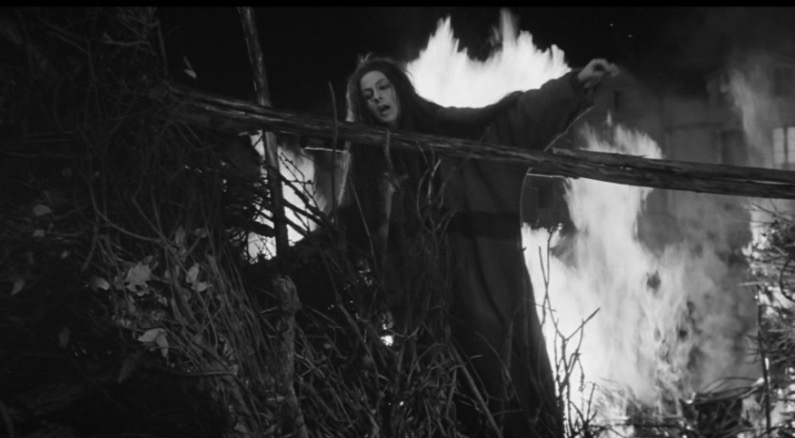
Showing posts with label witchcraft movies. Show all posts

Tuesday, 30 June 2026

The Seventh Victim (1943)

The Seventh Victim, released in 1943, was the fourth of the eleven movies (nine of them horror movies) made by producer Val Lewton at RKO in the 40s. It was Mark Robson’s directorial debut.

Lewton’s first RKO film was Cat People which was a huge hit. In commercial terms the series started to falter slightly after that. Lewton’s idea of taking a totally fresh and original, and subtle, approach to the horror genre was an artistic triumph but audiences were increasingly unimpressed.

The nine Lewton horror films gradually established major cult followings and are now immensely admired by cinephiles but it is worth bearing in mind that only Cat People and The Body Snatcher achieved massive commercial success at the time.

The Seventh Victim bombed at the box office. It’s easy to see why. It sounds like it’s going to be a murder mystery but it isn’t. It’s also not a conventional horror movie. It’s not a conventional anything. No matter how good such films are they’re difficult to promote and are likely to provoke audience resistance. These are the sorts of movies destined one day to become cult movies.

The Seventh Victim begins with what does seem like a straightforward mystery. Schoolgirl Mary Gibson (Kim Hunter) is told that the school has been unable to her sister Jacqueline. Jacqueline is her only living relative and pays her tuition fees. Mary decides to head for New York to find her.


She is befriended by lawyer Gregory Ward (Hugh Beaumont) who claims to be in love with  Jacqueline and to be equally anxious to find her. Ward seems like a very nice man.

Mary is also offered help by a down-at-hell private eye, Irving August (Lou Lubin). He is scruffy and seedy and looks very disreputable but he also sounds very confident and Mary probably figures all private detectives look like bums.

Mary meets several other men who have played some part in Jacqueline’s life. There’s failed poet Jason Hoag (Erford Gage) and psychiatrist Doctor Louis Judd. Since Judd is played by Tom Conway he could turn out to be a sinister figure but in a Lewton film it’s foolish to jump to conclusions.


Mary also discovers the room that Jacqueline rents but keeps permanently locked. The contents of the room provide the first unsettling moment in the movie and it’s very unsettling indeed, for Mary and for the viewer.

Gradually it emerges that Jacqueline had belonged to a group of Satanists known as the Palladists. It seems that Jacqueline is trying to break off her contact with this group.

The movie was criticised at the time for being incoherent. The fact that several scenes were apparently cut (including a longer ending) may have contributed to this but I suspect the cuts were deliberate. Those cut scenes were unnecessary and would have slowed the movie down. The Lewton movies had to come in with running times around 70 minutes. That was non-negotiable. And that was a good thing. They couldn’t afford to have an ounce of fat on them, and they don’t.


The ending as it stands works extraordinarily well and I think the movie is meant to remain enigmatic. In particular I think that Jacqueline is meant to remain something of a mystery. What led her to the Palladists?

It’s definitely not a plot-driven movie. Mood is everything here. None of the characters take any actions that really achieve anything. The attempts by Mary and her friends to rescue Jacqueline are confused and ineffectual.

This is a very morbid film. Most of the characters are either failures or disappointed by life or drifting through life in a mood of quiet despair. This incredible bleakness almost certainly contributed to the movie’s commercial failure just as it has contributed to its later cult status. Nobody made movies like in the 40s, but Val Lewton did.


What’s really fascinating is that these devil-worshippers are themselves so ineffectual. They are effete self-indulgent would-be intellectuals playing at wickedness. They would head for the fainting couches if they ever encountered true evil. Their devil-worshipping game of make-believe staves off the boredom and despair for a while. They think it gives their lives meaning but it doesn’t.

Forget the silly stuff about homoerotic subtexts that some reviewers try to read into this film. I don’t buy it because it would be out of place. This is a movie that has other fish to fry. This is a movie about people who are emotionally, spiritually and intellectually neutered. They’re empty vessels.

Mark Robson had edited the first three movies in the series for director Jacques Tourneur (whom he admired greatly) and Robson learnt his lessons well. He does an excellent job. And the cinematography is once more done by the great Nicholas Musuraca.

The Seventh Victim is awash with film noir nihilism. It’s tough viewing but it’s very highly recommended.

Wednesday, 16 July 2025

Witchery (La casa 4, 1989)

Witchcraft (AKA La casa 4 AKA Witchery) is an Italian gothic horror movie shot in the United States in English. 

It was Fabrizio Laurenti’s first feature film as director. The producer was Joe D’Amato.

The setting is an old abandoned hotel on an island in Massachusetts, about 50 miles from Boston. Leslie (Leslie Cumming) is there to research a book on witchcraft. She is there with her photographer boyfriend Gary (David Hasselhoff). Linda is a virgin. That’s not Gary’s fault. Lord knows he’s tried his best but Linda won’t play ball.

They forget to ask permission to visit the island.

A rich middle-aged couple, Rose and Freddie Brooks, have just bought the island. They’ve hired architect Linda Sullivan (Catherine Hickland) to restore the place. They arrive on the island along with their pregnant daughter Jane (Linda Blair), Jane’s young nephew Tommy and a real estate agent. The fact that Jane is pregnant will also become important later.

What they don’t know is that living in the hotel is an ageing witch, an ageing witch known only as the Lady In Black (Hildegard Knef). She’s a super-evil witch and she has big plans.


The witch is opening portals. Jane falls through one, witnesses horrifying scenes of torture, but is then returned to reality. The witch has other plans for her. Rose Brooks falls through another portal. She is not so lucky.

Meanwhile Linda and the young estate agent have grown bored and have retired upstairs for some bedroom shenanigans.

The witch seems to be picking these people off one by one, in ways that seem appropriate to her given their sins.

Of course you won’t be surprised to learn that these unlucky people are stranded on the island. Yes, the telephones lines are down and their boat has vanished.


This is a gruesome movie with some definite gross-out moments and some nasty torture scenes. It doesn’t really need to rely on these since it has an unoriginal but perfectly serviceable premise, a superb location, some very fine creepy atmosphere and some good suspense.

The cast is quite OK. I’ve always liked Linda Blair. David Hasselhoff as always has plenty of charm. They’re by far the most effective members of the cast.

One amusing touch is that we’re told that the locals are a superstitious lot. They’re simple fisher-folk. Typical gothic horror movie ignorant peasants in fact. But this is Massachusetts in the late 80s.


The hotel is truly wonderful. This is not a typical gothic horror crumbling medieval castle but the hotel is very spooky and very gothic in a distinctively American Gothic way. And while Laurenti may not be a great director he knows how to use this location to best effect.

This is, to be brutally honest, a pretty bad movie. But it does have some interestingly oddball touches and a fine sense of evil and menace. The pacing is brisk enough.

The whole opening of the portal thing is a bit hard to follow but it’s one of the oddball touches that I like about this movie. The supernatural is not supposed to be rational!


The bathtub and fireplace scenes are memorable.

This movie is obviously in the witchcraft and devil-worship in the modern world mould. It has some slight affinities to the 70s/70s folk horror moves such as The Wicker Man and the excellent 1966 Eye of the Devil but it can also been seen as a kind of Exorcist rip-off, with hints of an Omen rip-off. It’s weird in ways that are unnecessary and make no sense and that makes it fun in spite of its faults. Recommended.

The 88 Films Blu-Ray looks very nice. I believe that there’s a US Blu-Ray release from Shout! Factory.

Saturday, 17 May 2025

Belladonna of Sadness (1973)

If you go into Belladonna of Sadness expecting the kind of anime movie you’re accustomed to you’ll be confused and disappointed. This is not even remotely similar to what we now think of as anime. In fact it’s not even a true animated movie. It’s partly animated but relies to a huge extent on still images.

Belladonna of Sadness was released in 1973. It was made by Mushi Production, an important company in the early history of anime. They made many of the best-known 1960s anime TV series, such as Astro Boy. Belladonna of Sadness was the third in Mushi’s Animerama series of adult-oriented anime feature films. All three films were commercial flops and the box-office failure of Belladonna of Sadness pushed the studio into bankruptcy.

It has something of a fairy tale feel, at least superficially. It’s based on Jules Michelet’s 1862 history of witchcraft, La Sorcière.

The setting of the movie is France in the Middle Ages and it reflects Michelet’s virulent anti-Catholic anti-monarchy views. Jean, a simple farmer, and Jeanne are about to be married. The wicked lord deflowers Jeanne (reflecting the popular but entirely false myth that feudal lords had this right). Jeanne responds by calling on Satan, although when he appears Satan tells her that he’s already inside her. Satan is like a cute little floating penis.


With Satan’s help Jeanne prospers but her wealth makes her unpopular with the people and attracts the jealousy of the lord’s wife. Jean becomes a wealthy tax collector and an alcoholic. Jean and Jeanne experience lots of ups and down until finally the movie just devolves into bad acid trip territory.

Finally we get a kind of bizarre nightmare orgy scene which is rather hair-raising.

To me Belladonna of Sadness doesn’t feel the slightest bit Japanese (which might explain why Japanese audiences didn’t bother seeing it). It’s clearly heavily influenced by European art cinema and by all kinds of counter-culture elements such as American underground comics.


This is a psychedelic freak-out movie. It’s not a movie, it’s a happening. Can you dig it?

There is a plot. The plot is not terrible. It’s your basic selling your soul to the Devil and getting mixed up in witchcraft kind of plot.

You can tell that the visual artists involved were real artists because so much of the artwork is incredibly crude and ugly and looks like it was done by a deranged five-year-old. Overall this is a movie that looks hideous. A large part of the problem is that that late 60s arty aesthetic has not worn well. The 60s aesthetic is terrific when it’s done with wit and style in a very “pop” way but when it’s done with serious arty pretensions it can be cringe-inducing.


The frustrating thing is that there are some very good visual moments. It does have to be said however that those moments are very hippie-dippie.

This movie uses a variety of animation techniques and only uses traditional cel-and-ink animation sparingly. It’s all very experimental and avant-garde.

It’s a movie that is quite divisive. Some people think it’s a masterpiece. Some people think it’s an embarrassing train-wreck. I lean more towards the embarrassing train-wreck theory. It is at times an interesting train-wreck. I tend to like movies that are interesting failures but this one really didn’t grab me. Maybe I just wasn’t in the right head space man.


This is a movie that was for many years little seen although despite legends to the contrary it was never a lost movie.

If you want to see this movie through to the end I’d advise getting in a large supply of mind-altering substances. Then you’re really be able to groove to it. Maybe. I can’t really recommend seeing this movie but I’d be reluctant to advise people not to see it. All I can say is that if it sounds like the sort of thing you enjoy then see it but if it sounds like the sort of thing you won’t enjoy then don’t see it. Belladonna of Sadness is just not my cup of tea.

The Discotek Blu-Ray offers a nice transfer with a number of extras. The audio commentary includes a lot of fascinating information about the tumultuous history of Mushi Production and the movie’s troubled production history.

Saturday, 28 December 2024

Satanis: The Devil's Mass (1970)

Satanis: The Devil's Mass is a 1970 documentary on Anton LaVey and the Church of Satan, formed by LaVey in the late 60s.

LaVey is a fascinating figure who really belongs more to the history of American pop culture than to the history of occultism. He claimed to have been a former circus lion tamer and to have had an affair with Marilyn Monroe, both claims being dubious. LaVey was a musician and released several albums.

LaVey was reasonably well read in esoteric literature but seems to have been more heavily influenced by weird fiction writers such as H.P. Lovecraft.

Overall LaVey comes across in the interviews in this film as a born showman and a rather genial charming man. He had charisma but it was the charisma of a show business impresario rather than of a cult leader.

His actual teachings come down to not a great deal more than life, liberty and the pursuit of happiness (as found in that notorious satanic text the United States Declaration of Independence).


At the time the film was made the Church of Satan’s headquarters was still the famous Black House in San Francisco.

There was at this time a media obsession (in the U.S. but especially in Britain) with witchcraft in suburbia. Journalists, being journalists, neither understood nor cared that satanism and witchcraft were not necessarily the same thing. The most scandalous thing about both satanists and witches was of course that they apparently had sex. And that the women took their clothes off.

LaVey may well have been both a showman and quite sincere in his religious beliefs. That’s the case with many cult leaders.


LaVey’s concept of satanism has little to do with evil. In fact he disapproved of many white magicians on ethical grounds. He intensely disliked the idea of sacrificing animals and this was never done in his Church of Satan. He saw Satan as an oppositional figure, a figure representing freedom as opposed to the rigid moral riles of Christianity, rather than a figure of evil. He was particularly keen on the idea of sexual freedom. His ideas were not wildly different from those held by many counter-culture figures of that period.

There are interviews with many of his closest aides and with his wife of the time and his daughter. His followers actually seem saner than most hippies of that era, and there is at least some coherence to their beliefs.


Of course Satanis: The Devil's Mass’s main selling point was the Black Mass, and the nudity (of which there’s quite a bit). It’s all rather theatrical but there’s common enough in plenty of religious sects.

The interviews with LaVey’s neighbours are amusing. One old guy reveals the true evils to which satanism leads - satanists don’t mow their lawns regularly. Another neighbour describes him as a very nice man. On the whole he appears to have been regarded as entirely harmless. Which of course he was.


This one was released on a Something Weird double-header DVD some years ago, paired with Ray Dennis Steckler’s Sinthia: The Devil's Doll. It has to be said that the transfer of Satanis: The Devil's Mass is pretty rough. One assumes that the surviving print was in poor shape. It was clearly shot on a very low budget so it probably never looked particularly great.

Satanis: The Devil's Mass is a fascinating look at both a religious and pop cultural phenomenon of a particular time period. For those reasons it’s well worth seeing. Recommended.

Sunday, 22 September 2024

Viy (1967)

Viy is a 1967 Soviet gothic horror film. There was in fact a long tradition of Russian films about the supernatural. One thing I can say for certain, there has never been another movie quite like Viy.

It is based on an 1835 short novel by Nikolai Gogol. The movie has three credited directors, Konstantin Ershov, Georgiy Kropachyov and Aleksandr Ptushko and they are also credited as screenwriters.

I think it’s safe to say that the filmmakers had no interest in telling us anything profound about the human condition, or in giving us a serious story about the heroic struggles of the proletariat. This movie is pure entertainment. Insane entertainment, but still pure entertainment.

Brother Khoma (Leonid Kuravlyov) is a student at a seminary. He’s a decent enough chap, good-natured and totally lacking in malice, but he’s not exactly one of the seminary’s shining lights. He’s an indifferent scholar, he’s rather lazy and he lacks any really serious vocation.

On a brief holiday Khoma and two friends become lost. They eventually find an isolated farmhouse. An old woman grudgingly puts them up for the night. During the night the old woman takes him for a fly. She is of course a witch. Flying throigh the air with a witch on his back spooks Khoma quite a bit, and he’s even more spooked when the old witch turns into a beautiful young woman. Khoma however survives the experience.


Shortly afterwards a local boyar sends word to the seminary that his daughter is dying. She has asked for a seminarian to read prayers over her for three days. She asks for Khoma by name, which puzzles her father.

By the time Khoma arrives the girl has died but her father insists that Khoma read the prayers over her corpse for three nights. The corpse is lying in the local church. Khoma is not looking forward to this. He is not very brave. Luckily there are hundreds of candles in the church and once Khoma has all of them alight he feels better. He makes it through the night but he would have been a lot happier had the dead girl stayed in her coffin. Dead girls wandering about can be a bit disconcerting.

The next night is worse. Now it’s not just the dead girl who won’t stay put, the coffin won’t stay put either. And there’s still the third night to come.


Gogol claimed that this story was based on an authentic folk tale. The movie certainly tries to evoke the feel of a fairy tale or a folk legend. You could imagine travelling through the remoter parts of central Europe in the 19th century and being regaled with a story such as this in an inn. You would assume the story was part folk tale and part tall story. That’s the feel the film seems to be aiming for - to give its audience a few chills and a few laughs. There’s quite a bit of humour here. We’re expected to enjoy the story without taking it over-seriously.

This is not a movie that makes any effort to look realistic. There are obvious matte paintings and obvious process shots. On the other hand the special effects are impressive - they’re so wild and crazy and imaginative that you’re too flabbergasted to worry about whether they’re convincing or not. Honestly, how many other movies can you name that feature a dead girl surfing on a flying coffin?


The directors also come up with some very bold and ambitious camera moves. The rotating camera stuff is superbly done. That kind of thing is expensive because it’s time-consuming to set up. The same goes for some of the effects shots. The climax of the film, the third night in the church, involves some truly extraordinary special effects sequences. There was clearly some serious money spent on this film.

Viy does get described as a vampire film but this really is stretching it. Gogol’s novella was certainly tapping into the 19th century obsession with the supernatural and the occult but there’s nothing in it or the film that bears any real resemblance to a vampire. It would be more accurate to describe it as a movie about witches and demons.


Viy
feels quite different to British, American and Italian gothic horror films of its era. It has its own distinct flavour with its mix of terror and offbeat whimsicality.

The acting is very good with Leonid Kuravlyov being the standout.

This is a wildly imaginative crazy movie that captures the feel of folk legends and fairy tales as effectively as any movie I can think of. It’s creepy and spooky and filled with inspired fantastic imagery. Highly recommended.

Severin’s Blu-Ray presentation is impressive. Extras include a superb mini-documentary on the history of Soviet science fiction and supernatural movies.

Monday, 29 July 2024

Inquisition (1977)

Inquisition is a 1977 Spanish horror film which belongs very much to the then very popular sub-genre of witch-hunter movies.

Inquisition was Paul Naschy’s first film as director although he was already well established as a screenwriter and horror star. Naschy also wrote the screenplay for Inquisition.

Although this is a Spanish movie the setting is France in the 16th century. There’s a very good reason for this. Despite its reputation the Inquisition in Spain was not particularly brutal and was not particularly concerned with witch-hunting. Its main focus was on heresy. The witch craze was much more of a French and central European thing. Naschy was quite knowledgeable when it came this sort of thing so his choice of France as a setting was undoubtedly deliberate. He chose France for the same reason Ken Russell set The Devils in France (and for the same reason that Aldous Huxley set his source novel for that film, The Devils of Loudon, in France).

Three travellers arrive in a small provincial town named Peyriac. On their journey they pass through regions devastated by plague. The three travellers are the chief inquisitor Bernard de Fossey (Paul Naschy) and his assistants and they are on the hunt for witches.

At this stage you’re expecting a straightforward witch-hunting exploitation movie but throughout the film Naschy throws in subtle twists. There really are witches in Peyriac. But are they actual witches, or are they just deluded?

The three inquisitors are soon busily burning women at the stake. Most of those targeted by the inquisitors have no involvement at all in witchcraft, but some do. People are being denounced all over the place. In some cases the denunciations are inspired by a desire for revenge or the hope of personal gain. In some cases they’re the result of hysteria.


The inquisitors are fanatics. They take all accusations at face value. They assume that anyone accused of witchcraft must in fact be a witch. Their cruelty is breathtaking. On the other hand they do seem to believe sincerely in what they are doing. What they are doing is wrong and evil but they believe it is righteous.

Bernard is staying at the home of the mayor. He notices the mayor’s two beautiful daughters, Catherine and Elvire. In particular he notices Catherine (Daniela Giordano). Bernard has a reputation as an ascetic immune to temptation but he is clearly tempted by Catherine.

Catherine’s devoted maidservant Madeleine (Mónica Randall) will play a key role in the story. She is a witch. Or she may be a witch. Madeleine is friendly with an old woman named Mabille who is also perhaps a witch.

Catherine has a lover and she has perhaps not been sufficiently discreet about this dalliance. For Catherine it is more than a dalliance. She is madly in love with Jean.


The household servant Rénover (Antonio Iranzo) is ugly and embittered. He lusts after the young women of the household. He is also sly and treacherous.

It’s obvious that Bernard’s attraction to Catherine and Rénover’s treacherous nature will lead to trouble, which is what happens.

Throughout the story there are subtle ambiguities. Much of the plot hinges on a murder. More importantly it hinges on Catherine’s interpretation of that event, and her interpretation is based on a dream. It is possible that this dream is inspired by a supernatural agency although this is far from certain. Of course if it is supernaturally inspired then the dream might be true or it might be false. The audience’s interpretation of that murder is also crucial since it will determine our attitude towards the behaviour of two key characters. We need to know if the dream is true or false, but we don’t know.

There are plenty of lies and delusions in this tale, and there are multiple levels of lies and delusions. Some of the lies may be partly true.


Whether anything supernatural actually occurs is also uncertain.

The motivations of key characters seem straightforward and then as the movie progresses we find ourselves having doubts. The guilty might not be as guilty as we had assumed. The innocent might not be as innocent. The characters might themselves fail to fully understand their own motivations.

There are several villains some of whom are more purely villainous than others. The evils that occur in this story are to a large extent a result of a society that has become insane and deluded, as happens to human societies again and again and sadly always will happen.

Naschy doesn’t try to manipulate us into hating or despising, or feeling sympathy for, the central characters (or the minor characters for that matter). We have to make our own judgments.


The movie looks good and Naschy tried hard to make it look authentic.

The rather outrageous exploitation elements (there’s quite a bit of nudity, sex and gruesomeness) could easily cause a viewer to overlook the subtleties and ambiguities. In its sleazy way Inquisition is complex and even slightly cerebral. To appreciate the movie fully you need to think about it. Don’t assume this is just a sleazy exploitation movie.

The movie is of course going to be compared to movies like The Devils, Witchfinder-General, Jess Franco’s The Bloody Judge and Blood on Satan’s Claw but Inquisition has its own flavour. A fine directorial debut. Highly recommended.

Mondo Macabro’s Blu-Ray looks great and there are extras including an audio commentary.

Sunday, 21 April 2024

Death by Invitation (1971)

Death by Invitation, released in 1971, starts with a young girl on trial for witchcraft. So do countless horror movies but in this case it’s done in a particularly disturbing way with a real edge of terror and fanaticism. It gets the movie away to a very promising start.

Then we jump forward a few hundred years to the present day (or in this case the 1970s) and we encounter the same people (or at least the same actors) and we assume that they are destined to relive those events of the distant past.

A young woman named Lise (Shelby Leverington) has worked her way into the Vroot family.

Lise is of course the reincarnation of the young witch put to death centuries earlier. Or rather, she might be. The Vroots are the descendants of those who put her to death. You won’t be surprised to learn that Lise has vengeance on her mind.

Lise is a hippie chick who dabbles in the occult, which was common enough at the time. She definitely gives off a slightly spooky off-the-wall vibe.


Of course in a story such as this you have to ask yourself if these people really are in any way responsible for the wrongs done to Lise in the past. Are they in some way the same people, reincarnated? Are they merely the descendants of evil people? We may have serious doubts about whether Lise has the slightest justification for taking revenge on them. Lise clearly believes that they do have to accept responsibility for the wrongs of the past.

Of course Lise may simply be a totally crazy spaced-out hippie chick who takes her occult dabblings too seriously. Or she may really be a witch. The movie keeps this aspect nicely ambiguous, which means we’re never sure whether we should be on Lise’s side or not. That’s perhaps the film’s biggest strength.


Before killing Lise likes to tell her victims a story, a very strange story about an ancient tribe in which the women did the hunting and the men served the women. If the men stepped out of line they were killed. This story doesn’t really have anything to do with the plot of the movie but it’s actually a nice touch. It increases our uncertainties about Lise. Does she have some ancestral memories or some mystical link with women from primeval times, or is it just her own bizarre fantasy?

Peter Vroot (Aaron Phillips) is the head of the household in the present day and he’s a braggart and a bully and delights in intimidating the members of his family. Again we find ourselves with ambivalent feelings. He’s an unpleasant man and we know that bad things are going to happen to him and we’d like those bad things to be a thoroughly justified punishment for his evil in the distant past but we’re uncomfortable because there may be no justification at all for Lise’s vengeance.


Shelby Leverington didn’t have much of a film career but had a lengthy career as an actress in television. She’s quite good here - a bit spooky, a bit kooky, kinda sexy in a proto-goth way and rather scary. It’s a solid performance that leaves us uneasy, which is as it should be.

The performances of the other cast members are bad by conventional standards but they’re oddly effective in a movie that is aiming to be weird and off-kilter.

Peter Vroot’s prospective son-in-law (he’s engaged to one of the daughters of the family) spends the whole movie trying to seduce Lise and he’s ambiguous as well.

Writer-director Ken Friedman seems to have directed only two feature films, with a long gap between them. He had marginally more success as a screenwriter.


This is clearly a very low-budget movie. The pacing could have been tightened up a little. It’s easy to point out flaws in this movie but despite those flaws it works in its own idiosyncratic way. It does manage to be weird and unsettling and disorienting and those are things I like in movies. I found myself liking this film quite a bit. Highly recommended.

Death by Invitation was released on a double-header DVD by Vinegar Syndrome, paired with the odd but entertaining The Dungeon of Harrow (1962). They came up with a brilliant idea for the audio commentary - get a bunch of clowns who know nothing about the movie and nothing about the genre and let them indulge in cheap adolescent snark. But in spite of the awful commentary this is a pretty good release by Vinegar Syndrome - two very obscure oddball movies both of which are worth seeing.

Saturday, 6 April 2024

The Long Hair of Death (1964)

The Long Hair of Death is a 1964 Italian gothic horror film directed by Antonio Margheriti and starring Barbara Steele.

The main story takes place in the year 1499 but there is a prologue dealing with important events a few years earlier. Count Franz had been murdered. The murderer had diverted suspicion on to an innocent woman, Adele Karnstein. Adele was accused of being a witch and burnt. Another young woman had in her possession important evidence. This young woman also came to an untimely end. Both Count Franz’s brother Humboldt and Humboldt’s son Kurt (George Ardisson) were involved in these nefarious plots. Adele vows that retribution will seek out Humboldt and Kurt, in the last year of the century.

We then jump forward to 1499. The region is being devastated by plague, which may or may not be the result of Adele’s dying curse.

Kurt is obsessed by Lisabeth Karnstein (Halina Zalewska), the daughter of Adele. He is determined to marry her. She finds him repulsive. He marries her and he is able to possess her body but she vows he will never have her heart.

Then a mysterious young woman (played by Barbara Steele) appears at the castle. Her name is Mary. Kurt takes a more than passing interest in her. She seems to reciprocate his love, or at least his lust.


Lisabeth’s feelings towards Kurt seem conflicted. On their wedding night she was horrified by the thought of being touched by him. Despite this she is certainly not going to let any other woman have him.

A romantic triangle develops but we know from the start that it’s not a straightforward romantic triangle. Those events in the past are casting their shadow on the present. We also suspect that something supernatural is going on. This is one of those gothic horror movies that keeps us guessing until the end about whether this is really a supernatural horror story. If supernatural elements really are involved we may have our suspicions about how those elements will play out, but we can’t be quite sure.

There is also the possibility of madness playing a part as key characters start to unravel.


Romantic triangles do tend to get messy and can lead one or more participants to consider the possibilities of murder. More than one participant in this particular triangle might have reason to contemplate such a step. In fact all three might have such motives.

There’s plenty of sexual tension as Kurt’s obsession with Mary grows.

This is a fine part for Barbara Steele. She looks perfect in Renaissance-period gowns and she exudes dangerous eroticism and mystery.

George Ardisson as Kurt has a demanding role. Kurt is tortured by love, lust, guilt and fear and he slowly begins to fall apart. Ardisson doesn’t seem to have had a very distinguished career but he’s effective here.


Halina Zalewska is fine as Lisabeth but she is inevitably overshadowed by Barbara Steele’s stellar performance.

The original story was by Ernesto Gastaldi, one of the great Italian screenwriters of this era (and a highly acclaimed novelist as well). Tonino Valerii and Antonio Margheriti were responsible for the screenplay. It’s a good story with some reasonably nasty and effective twists.

I’m quite an Antonio Margheriti fan. Yes, some of his movies are schlocky and trashy but they’re never less than entertaining and he did make some wonderful movies in a variety of genres, including one of my all-time favourite science fiction movies, The Wild, Wild Planet (1966). He also made a pretty decent early giallo, Naked You Die (1968). Margheriti was very competent and had the ability to get good results on low budgets. The Long Hair of Death is one of his best efforts as a director. Margheriti deserves more attention as an important figure in European cult cinema.


The film was shot in black-and-white and Riccardo Pallottini’s cinematography drips with gothic atmosphere.

This movie ticks all the right gothic horror boxes and it’s creepy and moody and suitable doom-laden. The pay-off at the end is perfect. Add the excellent performance by Barbara Steele and you have here a very very fine gothic horror movie that deserves a lot more love. Very highly recommended.

The Long Hair of Death was available for years in very poor quality DVD transfers. Raro Video have released in on both DVD and Blu-Ray and their release looks terrific.

Wednesday, 20 March 2024

Secret Rites (1971)

Secret Rites makes an interesting companion piece to Malcolm Leigh’s Legend of the Witches (1970) so the BFI’s decision to release them as a double-header DVD/Blu-Ray combo set makes a lot of sense.

Both are faux-documentaries dealing with witchcraft in contemporary England. Both movies add lots of exploitation elements to the mix and it was clearly these exploitation elements that attracted the audience. Secret Rites seems to have done quite well at that time although it had been largely forgotten until the BFI discovered to its surprise that it actually had a very good print in its archive.

Interestingly the cast members include some real witches and some actors, some with backgrounds in sex films and some with more conventional acting backgrounds. The line between fiction film and documentary is constantly being blurred.

Secret Rites, in comparison with Legend of the Witches, focuses much more tightly on scenes of witchcraft rituals.

While Legend of the Witches was shot in black-and-white and looks ultra-cheap Secret Rites was shot in colour and has more of a feature film look.


The running time is just 47 minutes although it is possible that a much longer much racier continental version may have been shot. This was a not uncommon practice at the time. There is no way of knowing if this was the case. Derek Ford did however follow this practice later in his career and even on occasions included hardcore footage.

Director Derek Ford made quite a few sex comedies in the 70s which, sadly, apparently embarrassed him. A very British attitude indeed.

Secret Rites begins with a very pretty typical British dollybird deciding she wants to become a witch. She writes to Alex Sanders, who was in real life Britain’s most famous witch at that time, making enquiries about joining his coven. He suggests that she talk to Wendy, a member of the coven.


Her application to join the coven having been accepted she goes through her initiation ritual.

Other rituals will follow, including a temporary marriage ritual and a kind of eternal marriage ritual. Almost all of the film’s running time is taken up by these ceremonies.

The tone is very serious throughout. This may have reflected Alex Sanders’ approach. He was working very hard at that time to give witchcraft a favourable public image. In those more enlightened times that seemed like a perfectly achievable objective.

It may also have been an attempt to head off censorship problems, presenting this film as a serious documentary.


Censorship problems were certainly a possibility as there is an enormous amount of both male and female frontal nudity. It’s all very non-sexual but there are a lot of naked bodies.

In 1971 there were fascinating linkages becoming evident between the counter-culture on the one hand and the occult and various alternative religions on the other. This is a theme that is definitely present in the film. Secret Rites takes place in Notting Hill, then a major counter-culture centre.

Secret Rites has a very lurid visual style, looking more like a Hammer film with extra nudity (a lot of extra nudity) than a documentary. The visual style is rather fun and the witches wear some rather exotic costumes (when they wear clothes at all).


Secret Rites
works well enough as a documentary about Alex Sanders’ brand of Wicca. It’s sympathetic and avoids sensationalism.

It also works pretty well as a sexploitation movie with lots of pretty young lady witches in a state of undress.

If you enjoy offbeat faux-documentaries done in a lurid style this movie is highly recommended.

The BFI’s Blu-Ray presentation looks terrific with nicely vivid colours (it’s a very colourful movie).

Friday, 15 March 2024

Legend of the Witches (1970)

Legend of the Witches is an odd faux-documentary mixed with sexploitation written and directed by Malcolm Leigh and released in 1970.

It was shot 1.33:1 and in black-and-white and clearly on a very very small budget.

It’s an interesting mixture, with a mostly very serious tone and very portentous narration. On the whole it’s sympathetic to witchcraft.

Witchcraft was at the time a popular subject in fiction and in movies so this film would have a certain built-in commercial appeal.

We start with what is supposedly the witches’ creation myth. Then we go to an initiation ritual for a new witch priest.

Then we get a kind of potted European history from the witches’ point of view, with William the Conqueror, Robin Hood and Joan of Arc all featuring as witches or involved in witchcraft.


Next up is an account of the many survivals of pagan ritual in Christian ritual. These two historical interludes are the most interesting part of the film although one might be justified in being sceptical about their historical accuracy.

We get a visit to a witchcraft museum in Cornwall. Plus several more re-enactments of witchcraft rituals. Finally we get some very strange not very relevant stuff about scientific ghost-hunting and scientific investigations of psychic powers. This stuff might not be relevant but it is an excuse for some appealing trippiness.

This was 1970, with the hippie thing in full swing, and one can see signs of the  mutual influence that was becoming apparent between occult groups and some branches of hippiedom.


And along the way we get prodigious amounts of male and female frontal nudity.

The impression it all leaves is that there was an attempt being made to make a fairly serious documentary but with lots of exploitation elements to make it saleable. One assumes that the serious documentary elements were there mainly to provide a justification for lots of nudity, and presumably in the hope that this would somehow get the movie past the rigid British film censors.

There’s a total absence of humour. That might have been a deliberate ploy to make the film seem like a serious respectable documentary.


Alex Sanders, the most high-profile practising witch in England at the time and something of a celebrity, was involved in the making of the film. Much of the ritual shown in the film is therefore likely to be a fairly accurate representation of the practises of Sanders’ brand of Wicca.

Being shot on a micro-budget in black-and-white turns out to be something of an asset in disguise, adding to the cinéma vérité documentary feel. Overall the film probably needed to be tightened up a bit in the editing room. A bit more liveliness wouldn’t have hurt.

Malcolm Leigh had a brief career as a director mostly of short subjects, being best-known for his 1971 sex comedy Games That Lovers Play (which starred Joanna Lumley).


The BFI have paired this film with a similar witchcraft faux-documentary, Secret Rites, in their excellent DVD/Blu-Ray combo Flipside series. The transfer is as good as can be expected considering that the movie probably didn’t look great even at the time of its initial release. There are plenty of extras although they’re a mixed bag.

Legend of the Witches was typical of its time with some obvious affinities to British mondo-style films such as London in the Raw (1965) and Primitive London (1965) but it takes itself much more seriously.

Legend of the Witches is intriguing enough to be recommended.