Showing posts with label psychological thrillers. Show all posts

Tuesday, 16 June 2026

Hollywood 90028 (1973)

Hollywood 90028 was written, directed and produced by Christina Hornisher. She seems to have worked on it intermittently in 1969 and 1970 but it was not released until 1973.  It then more or less vanished into obscurity. 

This was Christina Hornisher’s only feature film and when you’ve watched Hollywood 90028 you understand why she never got to make another movie. It has huge huge problems.

Superficially it’s a serial killer thriller but it isn’t really a thriller. It isn’t really an exploitation movie. It tries very very hard to be an art movie, with decidedly mixed results.

Mark (Christopher Augustine) is an aspiring filmmaker who pays the bills by making adult films. He is confident that it’s just a matter of time until he is recognised as the next Kubrick.

In the opening scene we see him pick up a girl, they go to bed and he strangles her.

Then we’re into his struggles as an artist forced to degrade himself by making nudie movies. On an S&M-themed shoot he meets Michelle. He falls for her big time.


The relationship between Mark and Michelle seems to progress to a certain point and then go no further. Which is not surprising. She has a rich successful boyfriend who keeps her in luxury and while she likes Mark she is realistic enough to realise that dumping the rich boyfriend for a failed filmmaker loser like Mark would be foolish.

While he tries to work out his relationship with Michelle he still finds time to strangle another girl.

Eventually, with agonising slowness, we get to the climax and it’s truly memorable (and easily the best part of the movie) although Hornisher then undercuts it with some heavy-handed symbolism.


Christina Hornisher’s art film ambitions are very obvious. She makes sure that it doesn’t come across as an exploitation movie by making the murder scenes flat and uninteresting and making the sex scenes totally un-erotic.

I’m not sure what Hornisher was trying to say because she keeps undercutting herself. Is she saying that making naughty movies has made Mark crazy, or that Hollywood has made him crazy? Maybe, but in that case why go to so much trouble to let us know that Mark has been messed up since childhood? Is she saying that adult films exploit women? Maybe, but the other girl in the main adult movie scene is laughing and joking while the camera is rolling. She’s having fun. And there is not the slightest indication that Michelle is    affected in any way by doing that scene. Immediately afterwards she’s her usual bright and breezy self. There’s nothing remotely messed up about Michelle. She has a rich sugar daddy who treats her extremely well. She likes her luxury home. She’s a winner. These girls do not seem exploited.


Is Hornisher saying that capitalism is the problem? But that doesn’t work, since we know that Mark’s problems go back to his childhood. And Michelle lives in luxury. Capitalism hasn’t done her any harm.

This movie mostly comes across as a student film that needed a lot more work. And a lot more focus. The script (which Hornisher wrote under a pseudonym) just isn’t properly thought out.

It’s difficult to imagine what her target audience was. The exploitation elements would have alienated the art house audience. It’s way too tame for the grindhouse market. And it’s way too slow and plodding for drive-in audiences. It was in fact released on the drive-in circuit and it’s not surprising that it sank without trace.


The wonderful 1969-70 location shooting in L.A. is the best thing about this movie. It’s a nice time capsule.

Despite the effective shock ending Hollywood 90028 just doesn’t come off. It isn’t even an interesting failure or a fascinating oddity. I honestly cannot recommend this one.

Grindhouse Releasing went crazy with this one, releasing it as a three-disc (!) Blu-Ray set with two cuts of the movie, two audio commentaries, Hornisher’s early experimental shorts and assorted documentaries and interviews plus the soundtrack on CD.

Thursday, 24 April 2025

Someone’s Watching Me (1978)

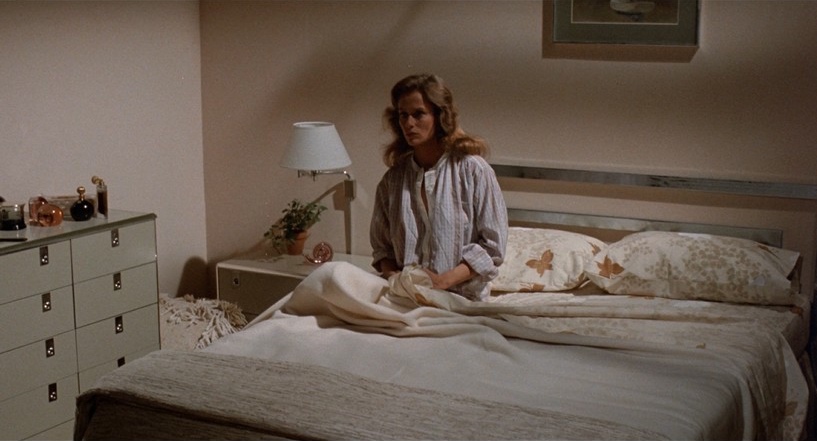
Someone’s Watching Me is an early John Carpenter film (he wrote and directed it). It’s a made-for-TV movie and it’s a suspense thriller.

This is obviously Carpenter doing a riff on Hitchcock’s Rear Window. This is Carpenter’s voyeurism film.

Leigh Michaels (Lauren Hutton) has just arrived in LA to start a job as a live TV director. Using a generous bonus from her previous job she takes a luxury apartment in the swanky Arkham Towers (and yes I’m sure the Lovecraft reference is deliberate). This is an enormous high rise apartment building and it’s very high-tech. It has elaborate security.

But as Leigh finds out she is not safe there at all.

She gets creepy nuisance phone calls. Not threatening or obscene, but subtly creepy. She gets mysterious notes delivered to her. She receives expensive gifts, supposedly from a travel company. She starts to suspect that this guy knows all about her. He knows everything that she does.

The scary part is that he makes no direct threats. She has no idea what he actually wants. He might be a relatively harmless weirdo. He might be very dangerous. There’s no way of knowing.


It takes her a while but eventually she figures out that the guy is watching her from another apartment building. But it’s a high-rise building as well. This guy could be in any one of hundreds of apartments.

The police can’t help because she doesn’t know who the guy is and he has not yet broken any actual laws.

Her new boyfriend Paul (David Birney) is sympathetic but he’s a philosophy professor not an action hero.

Her best friend Sophie (Adrienne Barbeau) is very supportive but it’s difficult for any of them to do anything really useful.


Of course everybody who has ever discussed the subject of movies about voyeurism has made the very obvious point that all movies are voyeuristic - we are watching other people’s lives. And of course a film director is not just watching the lives of the characters but also manipulating them. An interesting twist that Carpenter adds here is that Leigh is a television director, so she herself is a kind of voyeur and a kind of manipulator.

Technically this movie is impressive. Carpenter does a more than competent job as director. He understands pacing and he understands the basic techniques of suspense. The suspense scenes work. The basic setup is very promising.

There are however major flaws. There is not a single interesting characters in the movie, and not one of the characters really comes to life. By the end of the movie we do not know a single thing about Leigh. She’s a complete blank. Her apartment looks like a hotel room. It does not look like someone actually lives there. There are no personal touches.


Her friend Sophie is pleasant but she really just functions as a plot device.

Leigh’s boyfriend Paul is a harmless nonentity. We learn nothing about him. There is no erotic or romantic heat between Leigh and Paul. Even after they begin an affair they behave more like casual acquaintances.

This is an extraordinarily lifeless sexless movie. Maybe Carpenter wanted to avoid making an exploitation movie but the problem is that as a result the stalker’s motivation remains inexplicable. There is not the slightest indication that he has even the mildest sexual interest in her. So what is his motivation? OK, he wants to control her, but why? His notes to her are polite but impersonal. Maybe he hates women, but we get no indications that this is so. Maybe he has a romantic obsession with her, but we also get no indications that this might be the case. Maybe he feels powerless? Maybe, but we’re offered no evidence.

The idea that the stalker wants to stalk Leigh from a safe distance and is afraid to get close to her is a good one. Unfortunately it isn’t developed.


The vagueness of his motivation somehow makes the threat less scary.

It’s difficult to judge the acting since the characters are so underwritten.

I’m a huge admirer of Carpenter’s work but I’m inclined to think that realistic thrillers about real people were definitely not his forte. It’s easy to see why he moved rapidly away from this type of movie.

Someone’s Watching Me is well-crafted and reasonably entertaining but there’s something missing. Carpenter completists will want to seek it out and it is interesting as a movie made before Carpenter really found his voice, but it is very much lesser Carpenter.

The Scream Factory Blu-Ray offers both 1.33:1 and widescreen aspect ratios. Both look terrific. 1.33:1 is how it was originally broadcast.

Monday, 12 August 2024

Perfect Blue (1997)

Perfect Blue is a 1997 Japanese anime psycho-sexual thriller directed by Satoshi Kon.

This is the story of Mima. Mina is a pop idol, a member of a J-pop girl group called CHAM. They are moderately popular but have never quite made the big time. Mima feels she’s going nowhere and decides to make a major career change, quitting CHAM to try to establish herself as a serious actress. We’re already getting a glimpse of one of the movie’s major themes, as Mima has decided to abandon one artificial role in order to take on another role that is equally artificial.

She lands a role in a TV crime drama called Double Bind. It’s an amazingly lurid series focusing on a cop and a psychiatrist investigating sex murders. We see lots of clips of Double Bind and I’m inclined to doubt whether such a sleazy series could ever in reality have been screened on television in Japan (or anywhere else) in the 90s. But that’s not a flaw in the script for Perfect Blue since this is not a movie about reality.

Mima’s acting career progresses slowly but she does start to make a bit of a name for herself. She is a minor celebrity (just as she was a minor celebrity as a singer in CHAM). She supplements her income by doing nude modelling.


Her character in Double Bind undergoes a personality crisis after being raped. Mima’s own personality seems to be unravelling at the same time. She keeps seeing herself, but is it her?

Then people associated with the Double Bind TV series start getting murdered.

Mima has already acquired an internet stalker who posts things about her on the net. His website is called Mima’s Room. She is concerned that he seems to know an awful lot about her. It crosses her mind that he may in fact be watching Mima’s real room, in her apartment.

The lines between reality and fantasy become more and more blurred, for both Mima and the viewer of Perfect Blue. There are multiple levels of reality - the real world, the artificial reality of the entertainment world, the world of the Double Bind TV series, the world of celebrity culture, the internet and the world of Mima’s fantasies or dreams or illusions. Assuming that they’re her fantasies and not somebody else’s. And Mima doesn’t seem to know if any of these worlds corresponds to objective reality. The viewer isn’t sure either.


Mima is so accustomed to playing a part (firstly as the cute squeaky-clean pop idol and later as the sexy actress with a reputation for doing sleaze) that it’s possible that she’s forgotten how to play herself. It’s even possible that she doesn’t really have a self.

But don’t jump to conclusions. Don’t assume that Mima is crazy. This movie is open to various interpretations.

To find out whether Mima finds her way back to any kind of actual reality you’ll have to watch the movie.

It’s interesting that although this movie was made in the very early pre-social media days of the internet it’s extraordinarily prescient about the effects that the internet was about to have on society.


I have seen this movie described as Hitchcockian but apart from the fact that there are hints of voyeurism I don’t see it as being the slightest bit Hitchcockian. There might perhaps be some hints of De Palma.

This is much more of a surrealist film. It’s closer in feel to Jess Franco films like Necronomicon - Geträumte Sünden (AKA Succubus, 1968) or Paroxismus (AKA Venus in Furs, 1969) than it is to Hitchcock.

Modern viewers might find the animation style old-fashioned but I think it works, emphasising the unreality and artificiality of everything we’re seeing.


This is certainly an anime for grown-ups. There’s sex and there’s nudity, including frontal nudity. There’s violence.

Perfect Blue is a twisted but somewhat cerebral psycho-sexual thriller about madness, obsession, the nature of reality and the masks people wear and the ways in which the masks can become more real than the people behind them. Highly recommended.

The Shout! Factory steelbook release offers the movie on both Blu-Ray and DVD. The extras include a reasonably interesting interview with Satoshi Kon conducted at the time of the film’s release and a much more interesting lecture delivered by him a decade later to film students. Unfortunately Satoshi Kon’s extremely promising career was cut short by his premature death in 2010.

Friday, 9 August 2024

Whirlpool (1970)

José Ramón Larraz’s Whirlpool is an erotic horror movie with an interesting history. It’s an Anglo-Danish co-production shot entirely in England by a Spanish director and post production was done in Italy. It was released in 1970 and within a couple of years vanished completely. It became one of those legendary lost movies, to the great frustration of fans of the fascinatingly odd movies of Larraz. It was however not lost after all and a few years ago it received a Blu-Ray release from Arrow.

Tulia (played by former Penthouse Pet Vivian Neves) is an aspiring fashion model. She accepts an invitation from Sarah (Pia Andersson) to spend a weekend with her in the country. Sarah is a middle-aged woman with some vague connection to the world of fashion modelling. Sarah lives in a cottage with her nephew Theo (Karl Lanchbury). Theo is a keen photographer. He’ll be able to take some photos of Tulia. Theo and Tulia will both enjoy that.

Before this happens we’ve already had a scene in which an attractive nude young woman wakes up in bed next to Sarah. Whatever happened in that bed was clearly not to the young woman’s liking. She’s heading straight back to London pronto.

At this point one has to consider Tulia’s motivations, which are a little confused. Her problem is that having established a very tentative toehold in the world of fashion modelling she thinks she’s a sophisticated woman of the world, but while she isn’t totally naïve she isn’t as sophisticated as she thinks she is. She’s also a city girl and it has never occurred to her that spending a weekend in an isolated cottage in the country with a woman she’s met once and a young man she’s never set eyes upon might involve some risks. She’s also very young.


The fact that Sarah is a lesbian doesn’t shock her. The fact that Sarah takes an obviously sexual interest in her doesn’t shock her either. It might be an adventure.

A game of strip poker ends with Tulia and Theo getting it on on the living room floor. At which point something happens that should ring major alarm bells for Tulia, but Tulia is too inexperienced to recognise its significance.

There are some three-way games of flirtation and seduction. A drive in the countryside with Theo leads to a situation that should ring even louder alarm bells, but Tulia shrugs it off.

Of course Tulia’s lack of alarm may have something to do with those special cigarettes Sarah plies her with. The idea that they might contain ingredients other than tobacco doesn’t occur to her.


Tulia does wonder what happened to Rhonda. Rhonda was a girl who also spent some time at the cottage. Tulia has seen nude photos of her shot by Theo. Apparently Rhonda just suddenly went back to London. We, the audience, know that Rhonda was not the naked girl in bed with Sarah at the beginning of the movie so we know that a number of young women have accepted invitations from Sarah.

Tulia eventually figures out that there’s more going on than just an older lesbian looking for pretty bed companions. The fact that Sarah is middle-aged is important but in more complex ways. Sarah and Theo are both wanting to drag Tulia into their sex games but there’s another occasional player as well. All the sexual motivations in this household are perverse in very complicated ways. There’s also something significant about the differing motivations of Sarah and Theo but to say more would be to risk spoilers.

Tulia is hopelessly out of her depth and would be wise to leave, if she can.


The acting, which is a little stilted on the part of all the key players, could have been a problem in a straightforward realist movie but in a movie such as this the fact that it’s a bit off just adds an extra layer of strangeness. The real problem was probably not the dialogue but the script. It’s a fine complex twisted story but the dialogue is very stilted and doesn’t ring true. This may simply be that Larraz, who wrote the screenplay, was Spanish and just hadn’t yet developed an ear for natural English speech patterns and colloquialisms. It’s a problem that isn’t so noticeable in his later films which makes sense. As he made more movies in England he would naturally have become more comfortable with the language. Whirlpool would have benefited from some dialogue polishing from a native English speaker but the budget presumably would not have stretched to that.

There’s plenty of nudity and sex which earned the film an X rating in the United States. The sex is rather graphic for 1970. There’s also some reasonably graphic violence.

This is a non-supernatural horror movie. Or at least that’s probably the case. There are sequences that can be interpreted in various ways, and which can be seen as hinting at the supernatural, or perhaps the paranormal. It’s another way of increasing our sense of unease.


There are certainly things in this story that make no sense. The first act of violence not only makes no sense in plot terms, it makes no sense in character terms. At times you wonder to what extent Larraz is being deliberately mystifying and to what extent these problems are simply a sign that this was his first feature film and he was still learning his craft.

One thing that strikes me about Larraz’s films shot in England is his relationship with the English landscape. Of course to a Spaniard the English landscape was as exotic as the Spanish landscape would be to an Englishman and I get the feeling that Larraz saw it as offering interesting cinematic possibilities. He certainly uses it here to create an atmosphere of isolation and menace.

The most interesting thing about Whirlpool is that what appears to be a linear plot is in fact cyclical. Whirlpool is a flawed movie but an interesting one. Recommended, and if you’re a fan of Larraz’s later work you’ll certainly want to see this one.

The Arrow Blu-Ray offers an excellent transfer and there’s audio commentary by Tim Lucas.

I’ve also reviewed Larraz’s Vampyres (1974) and Symptoms (1974). Both are very much worth seeing.

Sunday, 7 July 2024

Curse of the Voodoo (1965)

Curse of the Voodoo is an obscure 1965 British horror film that turns out to be not at all what you might expect. There is certainly voodoo here but it’s more a psychological thriller than a horror film.

Mike Stacey (Bryant Haliday) is a big game hunter in Africa. He is employed by safari operator Major Lomas (Dennis Price). His troubles begin when he shoots a lion. In the process of doing so he gets mauled. Not severely, but it’s still upsetting. 

He shoots the lion within the territory of a tribe, the Simbazi, who regard lions as gods. They believe that anyone who kills a lion will pay a terrible price. They will make sure of that.

You might expect the tribesmen to come after Mike to kill him but what actually happens is a lot more interesting. He returns to London where he is haunted by dreams, and he sees African tribesmen stalking him. They appear to be merely visions of a mind that is becoming disturbed but there’s quite a bit of ambiguity in this movie. The lines between sanity and madness and between reality and illusion do become somewhat blurred.

There is definitely voodoo in this movie, although since we’re dealing with Africa it’s probably obeah rather than voodoo (but having voodoo in the title was obviously a much sounder commercial move).


Mike already had a few problems. Drinking too much, plus marital problems. His wife Janet has left him. He wants her back.

Mike’s wound is healing very slowly. His doctor is worried. Naturally he assumes that the signs of mental instability Mike is displaying are caused by a combination of an infected wound and too much alcohol. He’s a London doctor so he certainly doesn’t consider voodoo when making a diagnosis.

Mike’s dreams and visions (if they are just dreams and visions) become more and more vivid. He sees a face peering around his doorway and opens fire with his revolver but there was nobody there. Fortunately no-one was hurt and the police are not too worried.


Mike is quite an interesting character. He’s not an overly loveable guy but he’s not really unsympathetic. He’s a fairly decent man and he really does love his wife. He has tried to be a good husband. Maybe he’s not the husband she wanted and needed but he has done his best.

Bryant Haliday’s performance is a bit detached but that works in his favour since he is playing a man who is haunted but unwilling to reveal his emotions openly. I ended up being quite impressed by his performance.

Lisa Daniely as his wife Janet is pretty good. And Dennis Price is always watchable.

Look out for Dennis Alaba Peters who went on to play Sir Curtis Seretse in the wonderful ITC TV series Department S.


One could see this as a movie about the clash between the world of magic and the world of reason, between two radically different worldviews.

This movie is an example of the need to approach movies with an open mind. It would be a mistake to approach this film assuming it’s going to be a cheap shoddy Z-grade movie. If you do have an open mind you may find yourself being drawn into what really is a quite nicely executed slightly offbeat movie. And it does have that fascinating ambiguity that it never makes the mistake of trying to resolve too neatly.

It’s all very low-budget of course, but I don’t think that’s a problem here.

And it does have a screenplay by Brian Clemens, and quite a neatly done screenplay too.


Lindsay Shonteff directed. He was a minor director but made a few interesting movies including The Million Eyes of Sumuru (1967) and Permissive (1970), the bleakest most pessimistic most depressing sexploitation movie ever made (although it is intriguing). Having watched Curse of the Voodoo ii’m inclined to think I’ve been guilty of underestimating Shonteff. This is a movie made by a director who knows what he’s trying to achieve and knows how to achieve it. He pulls off some quite effective visual set-pieces which were clearly done with very little money. They rely purely on the skill of the director. This guy might not be a great director but he’s certainly an interesting one.

Curse of the Voodoo does not deserve to languish in obscurity. It’s a nice little movie that teases us with the possibility that it’s either supernatural horror or psychological horror. Highly recommended.

The Screenbound all-region DVD offers a perfectly adequate transfer.

Sunday, 19 May 2024

The Witch (La strega in amore, 1966)

La strega in amore is a 1966 Italian gothic horror movie in a contemporary setting, directed by Damiano Damiani. It was released in English-language markets as The Witch, The Witch in Love and Strange Obsession.

Sergio Logan (Richard Johnson) is a writer although he appears to be more interested in women than in writing. He replies to a newspaper advertisement placed by an old lady. She is looking for a live-in librarian to organise a huge manuscript collection. Sergio is intrigued because the qualifications outlined in the advertisement could only apply to one man in the whole of Italy - himself. Why is the old lady so interested in employing him?

The old lady is Consuelo Lorente (Sarah Ferrati). Sergio considers the possibility that she is merely looking for a toy boy. But the manuscript collection exists, as does the library. Then things get a little odd, and then Sergio meets Aura (Rosanna Schiaffino), the old lady’s daughter.

He had already decided to decline the job offer but now he thinks it might involve the possibility of persuading Aura into bed, and that interests him a lot more than old manuscripts. He decides to take the job.

Sergio is a somewhat amoral character. He’s a womaniser and he’ll do whatever it takes to get a woman into bed. He isn’t bothered by the idea of lying or manipulating people. When it comes to women he’s used to calling the shots and it doesn’t occur to him that someday a woman might turn the tables on him.


He encounters Fabrizio (Gian Maria Volontè), his predecessor in the librarian job, and his predecessor in others ways that Sergio doesn’t yet fully understand. Fabrizio has apparently been given his marching orders but he’s still there and seems to intend to stay. Sergio’s mistake is to make certain very obvious assumptions about the setup. He assumes that Consuelo is a middle-aged woman terrified of getting old and looking for young male bed partners. That’s not what is going on, and Sergio will come to regret making such blithe assumptions.

It’s obvious to Sergio that Fabrizio has been sharing Aura’s bed. It looks like a classic romanic triangle, with Sergio as Aura’s new lover and Fabrizio as the displaced lover. There’s plenty of tension between the two men.


The audience will immediately recognise that there’s something wrong about this strange household. Consuelo lives in what is virtually a palace, hidden away in the middle of an ordinary street in Rome. There’s an atmosphere of decay and decadence, we suspect there are some dark secrets concealed here, the stories Consuelo tells of her marriage to her late husband should ring alarm bells for Sergio but they don’t. There’s an unhealthy overheated excessively enclosed atmosphere.

Sergio of course doesn’t know that he’s a character in a horror movie so he assumes Consuelo is just a rich crazy old eccentric trying to convince herself that she’s still the sex kitten she once was. A viewer who didn’t know that this was a gothic horror movie might well make the same assumptions. Until very late in the movie there are no overt signs of anything supernatural. The movie seems to be a psychological or perhaps an erotic thriller, with a film noir tinge (enhanced by some quite noirish black-and-white cinematography). It might even be a twisted melodrama.


The viewer will however start to suspect what’s going on long before Sergio does. There are subtle clues, and things that don’t quite add up. We start to think that Sergio has involved himself in something very strange and very perverse and most viewers will doubtless figure out the secret long before the final reveal.

Richard Johnson was inspired casting. He’s so over-confident and arrogant that he misses all the red flags. At the same time Sergio is not actually evil and Johnson makes him just sufficiently sympathetic that we don’t want anything too terrible to happen to him. Rosanna Schiaffino is excellent. She makes Aura seem slightly mysterious without overdoing it. Sarah Ferrati is wonderfully disturbing as Consuelo. Gian Maria Volontè gives a strange unsettling highly strung performance as Fabrizio, who could just as easily be a villain or a victim.

When things get really weird and the gothic horror elements kick in they’re done quite subtly. The horror is all the more effective for being low-key. This is not grand guignol stuff.


If you’re expecting conventional gothic horror you might be disappointed. Until very late in the movie it has the feel and tone of a noirish psychosexual melodrama. It never does become a conventional gothic horror movie. It does however have a protagonist put into a situation which threatens psychological and emotional destruction. The threat is to the psyche, and maybe the soul, rather than the body. As to whether there’s a threat to his physical existence as well, you’ll have to watch the movie to find out.

This is a movie that includes some classic gothic tropes but it goes out of its way to avoid dealing with them in a routine horror film fashion. It’s creepy and disturbing rather than scary. If you can accept those things then it’s highly recommended.

This film is part of Arrow’s Gothic Fantastico Blu-Ray boxed set. La strega in amore gets a lovely transfer. Kat Ellinger’s audio commentary is as fascinating as the movie. I liked her unexpected comparison of this movie with both Sunset Boulevard and Double Indemnity and her placing of the movie within the context of decadent literature.

Wednesday, 15 May 2024

The Fifth Floor (1978)

The Fifth Floor is a 1978 thriller that is basically a One Flew Over the Cuckoo’s Nest rip-off.

Producer/director/co-writer Howard Avedis had made some interesting exploitation drive-in movies in the early 70s.

The Fifth Floor begins with Kelly McIntyre (Dianne Hull) working in a disco to pay her way through college. She’s just had a fight with her boyfriend Ronnie Denton (John David Carson).

Kelly has a drink to cheer herself up and ends up on the dance floor having convulsions. She is rushed to hospital. The diagnosis is strychnine poisoning. Kelly is convinced that someone has tried to kill her. The doctors are convinced she tried to commit suicide, so she’s locked up in the psycho ward on the fifth floor.

When she tries to explain that she isn’t crazy and that someone really tried to kill her. The psychiatrist Dr Coleman (Mel Ferrer) decides she must be deluded and paranoid. He’s going to keep her in the psycho ward.

The psycho ward is as nightmarish as you’d expect but the biggest problem is male psychiatric nurse Carl (Bo Hopkins). He’s obviously a sadist and a sleazeball but no-one on the staff has noticed because let’s face it, this is a psychiatric hospital and the staff (including the women) are all sleazebags and bullies.


Carl tries to rape Kelly. When Kelly complains it is seen as proof that she’s paranoid.

Kelly is starting to find out how psychiatric hospitals work. It doesn’t matter if you’re crazy or not. What matters is whether or not you have power. The staff have power. The patients have no power, and no rights. They are also not allowed any self-respect. The female patients have to shower while being watched by male nurses.

And Carl is not going to give up on Kelly.

Kelly isn’t the only patient being brutalised. They’re all being brutalised. And she isn’t the first female patient to have attracted Carl’s attention. She’s befriended a woman named Melanie (Sharon Farrell) who has had the same experience.


Melanie wasn’t crazy either, but she is now.

Kelly has no contact with the outside word. Patients are not allowed to make telephone calls.

She knows she isn’t crazy but she knows her sanity can only hold up for so long. She is determined not to break, but everybody breaks eventually. She contemplates escape. But what happens if she escapes? Nobody will believe that an escaped mental patient might be sane.

The acting is mostly what you expect in an exploitation movie, because this essentially is an exploitation movie. But that’s the kind of acting you need in a movie like this. You don’t want subtlety, you want scenery-chewing. And there are some fine scenery-chewers in this film.


Bo Hopkins as Carl is a study in sadistic malevolence. Anthony James and Robert Englund contribute delightfully excessive performances as patients. Julie Adams as the senior nurse is a nasty piece of work, a woman who never doubts that she is right and the patients are wrong. John David Carson is nicely ambiguous as Kelly’s boyfriend. Is he on her side or not?

Dianne Hull as Kelly is the exception. She does give a subtle performance and it works. She’s the sane centre around which all the craziness revolves.

There’s only a small amount of actual violence but this movies manages to be pretty harrowing. There’s not much nudity but there’s definitely a sleazy vibe to it.


The Fifth Floor
was obviously a low-budget effort and it’s rough around the edges but it’s effective and it gets its point across. It’s a reasonably good entry in the fascinating psychiatric terror sub-genre. Highly recommended.

The Code Red DVD offers an acceptable if hardly dazzling transfer with very little in the way of extras.

I’ve reviewed another of Howard Avedis’s movies, The Teacher (1974), which is flawed but interesting.

Friday, 12 April 2024

The Little Girl Who Lives Down the Lane (1976)

I’m not quite sure what I expected from The Little Girl Who Lives Down the Lane. I guess I expected an evil child horror movie, and while it is a horror movie of sorts it’s not really that sort of horror movie. It’s also a thriller of sorts, with some interesting quirky touches. It’s one of those really interesting movies Jodie Foster made early in her career.

This was a Canadian-French co-production.

Jodie Foster plays Rynn Jacobs, a thirteen-year-old girl who lives in a house in a seaside village (and Foster was thirteen when she made this film). Rynn lives there with her father. They’ve been there for a few months.

It doesn’t take us long to suspect that in fact she lives alone. Wherever her father might be he certainly doesn’t live in this house in Maine.

Rynn’s life is about to get complicated. The first complication is Frank Hallet (Martin Sheen). He’s the son of the woman from whom Rynn’s father leased the house. Frank is a nasty piece of work in a lot of ways but the big problem is that he is much too interested in Rynn. He’s the sort of guy who is much too interested in young girls in general. The police know all about him but his mother, Cora Hallet (Alexis Smith), wields a lot of power in the village so they can’t touch him. Rynn isn’t stupid. She knows the sort of man he is but dealing with him could be difficult.


Rynn’s second problem is Cora Hallet. Cora is nasty, vindictive, meddling and officious. She enjoys pushing people around. She intends to push Rynn around. Rynn intends to push right back.

Then something happens that makes Rynn’s situation really awkward. Fortunately she finds an ally. Mario Podesta (Scott Jacoby) is a young man with whom Rynn has a lot in common. They’re both eccentric, they’re both outsiders. Mario has a bad leg. He’s also a magician. Stage magic is his way of dealing with being an outsider - if people think you’re weird you might as well be really weird. But Mario is a nice guy.

We eventually find out a bit more about Rynn but it’s important for the viewer to find out about her gradually as the story unfolds so all I will say is that she has constructed a life for herself, an unconventional life that suits her, and the security of that life faces major threats.


She also has some growing up to do, and her circumstances require her to grow up fast.

There are lots of plot twists and I have no intention of offering any hints about them.

Director Nicolas Gessner did not see this as a horror film but as a love story. It is a love story, but it’s a psychological thriller with horror overtones as well.

All the performances are good. Martin Sheen is extraordinarily creepy and menacing. But the movie belongs to Jodie Foster. She got top billing, and deservedly so. While Taxi Driver might be better known it’s The Little Girl Who Lives Down the Lane that gave her her best role of the 70s, and one of the two or three best rôles of her career. Her star quality is very much in evidence. She underplays, which is exactly the right choice.


I don’t know much about Nicolas Gessner but this seems to be the standout movie of his career and it’s a movie he desperately wanted to make. Laird Koenig originally wrote the story as a stage play, then turned it into a novel and then wrote the screenplay.

Insofar as it can be considered a horror movie it’s the sort of horror I enjoy - it relies on suggestion and atmosphere rather than gore. As a psychological thriller it’s a slow-burner, which I also like. As a romance it’s powerful and effective, and touching.

There is a scene in the movie which upsets some people, given Rynn’s age, but it’s absolutely crucial and could not have been cut or toned down without making nonsense of the movie.


The Little Girl Who Lives Down the Lane
defies easy genre classification but it has an offbeat charm and considering that the director wasn’t trying to make a horror film it has some horror moments that pack quite a punch without ever resorting to gallons of fake blood. A superbly crafted movie which is now firmly established as one of my two favourite Jodie Foster movies (the other being Carny). Very highly recommended.

The Kino Lorber Blu-Ray looks great and includes a stimulating audio commentary by the director. Gessner has very strong ideas about how movies should be made. He was clearly in awe of Jodie’s Foster talent as an actress. There’s also an interview with Martin Sheen.

Wednesday, 7 February 2024

A Quiet Place To Kill (1970)

A Quiet Place To Kill was the third of the four gialli directed by Umberto Lenzi and starring Carroll Baker. It should be noted that the first of these four movies, Orgasmo, was released in the U.S. as Paranoia. Confusingly the third movie was entitled Paranoia in Italy but released internationally as A Quiet Place To Kill. To keep things as clear as possible we will refer to it here as A Quiet Place To Kill (which is in any case a much better title).

This movie is what I call a Phase 1 or early period giallo. You could also refer to this period as the pre-Argento giallo period. Argento’s 1970 The Bird with the Crystal Plumage redefined the giallo. Henceforward Phase 2 or late period gialli would mostly be serial killer movies, they would invariably feature a black-gloved killer and they would be characterised by an over-the-top baroque visual style with lots of blood.

Phase 1 or early period gialli are quite different. There’s not a great deal of blood. They are usually not serial killer movies. They don’t necessarily involve black-gloved killers. They are erotic thrillers and they are just as stylish as the later gialli but in a different, more subtle way. They also usually have an atmosphere of Swinging 60s decadence. I personally enjoy these early gialli a great deal and Umberto Lenzi did them very well indeed.

These early gialli have been overshadowed by the more flamboyant and blood-drenched later gialli but I actually have a slight preference for these earlier movies. Movies like Lucio Fulci’s One on Top of the Other (AKA Perversion Story, 1969), Romolo Guerrieri’s The Sweet Body of Deborah (1968) and Lenzi’s So Sweet, So Perverse (1969).


A Quiet Place To Kill
begins with a lady racing car driver having a near-fatal racetrack smash-up. She is Helen and she is payed by Carroll Baker. She will need to take things easy for a while. She is rather surprised to receive an invitation from Maurice (Jean Sorel) to spend some time recuperating at his villa. Maurice is her ex-husband. They did not part on friendly terms.

Helen gets another surprise when she arrives at the villa. Maurice has remarried. His new wife is Constance (Anna Proclemer). Maurice usually goes for younger more glamorous women. On the other hand Constance is rich, and Maurice definitely goes for rich women.

The atmosphere is rather tense. Constance is having dramas with her daughter. She doesn’t seem to have too much confidence in Maurice’s faithfulness. And Maurice’s desire to get Helen into bed is all too obvious. Helen has reasons to hate Maurice but she still feels a powerful sexual attraction for him. Then Constance tells Helen something rather surprising.


Initially it seems like this is going to be a conventional romantic triangle leading to the consequences that one might expect. But then the plot twists start to kick in and things get rather unpredictable.

I’m not going to say any more about the plot for fear of revealing spoilers.

Jean Sorel was definitely the ideal actor for this type of movie. Maurice is charming, amusing, handsome, sexy and (as both Helen and Constance agree) remarkably good in bed. He is also cynical and totally amoral, untrustworthy, irresponsible, decadent and quite possibly dangerous. A sensible woman would have nothing to do with him, but he’s so charming and sexy that women find it difficult to be sensible about him. Jean Sorel nails the character to perfection.


Carroll Baker was close to being the perfect giallo actress - very sexy but very likeable and possibly dangerous. And a very fine and versatile (and somewhat underrated) actress.

And The Sweet Body of Deborah in 1968 had already established that Sorel and Baker had real chemistry.

Umberto Lenzi should be more admired as a director than he is, and he made some great gialli including the wildly offbeat but brilliant Spasmo (1974). His late 60s and early 70s movies in particular are deserving of more attention. His early gialli are stylish without being showy, and he certainly could capture the atmosphere of the decadent jet set.


I don’t recall any blood at all in this movie, which will certainly puzzle giallo fans. There’s some nudity, but not much. There are no actual sex scenes.

If you go into A Quiet Place To Kill expecting a conventional giallo of the type that became ubiquitous in the 70s you may be disappointed. This represents a distinctive sub-genre of the giallo and it may be counter-productive to consider these late 60s movies as gialli at all. This is an erotic thriller and there’s nothing wrong with that. It’s an interesting genre and one of which I’m very fond. The focus here is on twisted emotional and erotic relationships and the screenplay and the acting are of sufficiently high calibre to make it an intelligent provocative look at such relationships.

A Quiet Place To Kill is a brilliant little movie and it’s very highly recommended.

The Severin Blu-Ray offers a fully restored transfer which looks luscious.

Saturday, 8 July 2023

The Teacher (1974)

The Teacher is another Crown International release included in the wonderful Mill Creek Drive-In Classics 32-movie pack. This one dates from 1974.

Diane Marshal (Angel Tompkins) is a high school teacher. She’s pushing thirty, she’s married but separated and she has normal female urges which can be a bit of a temptation when your pupils are cute horny teenage boys. Diana looks to go out in her cabin cruiser and sunbathe topless. Two of her pupils, Sean Roberts (Jay North) and his best buddy Lou Gordon (Rudy Herrera Jr) have discovered that they can get a very good view of Diane’s sunbathing routine from an old warehouse. Being teenage boys they naturally take advantage of the opportunity. It’s pretty harmless stuff.

Lou’s older brother Ralph (Anthony James) also watches Diane from the warehouse. Ralph might be a harmless crazy Vietnam vet or he might be a dangerous crazy Vietnam vet. He seems to be seriously obsessed by Diane. He’s pretty much stalking her.

These three peepers get into an argument and Lou falls to his death.

Ralph was already a bit crazy but now he’s really crazy. He blames Sean for Lou’s death. Maybe he blames Diane as well. Ralph drives a hearse and in that old warehouse he has a coffin in which he keeps his treasures - his binoculars, his gun, his scuba gear and other stuff.


Diane is intent on playing Mrs Robinson to young Sean. Sean is naïve and he’s a virgin but Diane soon takes care of his virginity. Romance as well as lust blossoms for Diane and Sean.

And now Ralph is stalking them. His intentions aren’t clear and it’s likely that he’s so crazy he doesn’t know himself what he intends to do.

Diane and Sean are too wrapped up in bedroom fun to appreciate just how dangerous Ralph has become. Even when they’re canoodling on her boat and Ralph’s face suddenly appears at the cabin window (he’s snorkelled out to the boat) they don’t realise that they may be dealing with a potential killer.


This is a move that isn’t quite sure what its focus is going to be. Is it going to be a serious coming-of-age movie or a twisted erotic/psychological thriller? It tries to be both. Surprisingly enough, it succeeds to a certain degree.

Jay North was famous as the child star of Dennis the Menace. This was his attempt to break into grown-up roles. After this movie he more or less abandoned that attempt. He’s not good here but he’s not terrible. Sean is supposed to be goofy and gormless - he’s a hormone-crazed teenage boy.

Anthony James does some serious scenery-chewing as Ralph and he manages to get across the point that Ralph’s craziness is growing steadily worse. He does overdo things a bit and Ralph does come across as a cartoonish monster at times. But he’s fun.


The movie’s biggest asset is Angel Tompkins. She gives a subtle finely judged performance. The danger was that Diane would come across as a bit of a predator but Tompkins convinces us that Diane isn’t really a manipulative schemer. She’s lonely and she genuinely likes Sean. She’s the one who does the seducing but she’s well aware that Sean wants to be seduced, and it’s not as if he’s under-age. Tompkins also convinces us that Diane is not entirely sure of her own emotions. She was intending the affair to be a lighthearted adventure for herself and for Sean but she finds herself getting seriously emotionally involved.

There’s a bit of nudity and a bit of simulated sex but it’s pretty restrained. The violence isn’t graphic either.

The climatic warehouse scenes are executed quite well (and it is a great setting).


Iraq-born writer-director Howard Avedis (credited here as Hikmet Avedis) loses control just a little. The movie is too long and has a few pacing issues. The dialogue doesn’t exactly sparkle. He does manage to give the movie some creepy moments and he redeems himself with the excellent ending.

This is a very very 70s movie. And I mean that in a good way. It has that 70s loopiness and weirdness. There are no rules, man. We’re just making a movie. Just let it happen.

The anamorphic transfer is quite acceptable.

The Teacher might not obey the rules of classical Hollywood movie-making but it has plenty of entertainment value. Highly recommended.