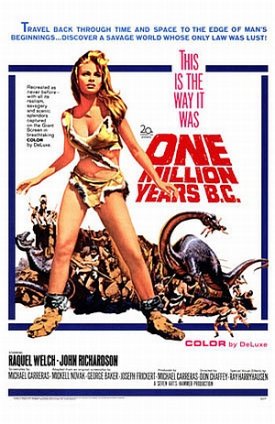
 One Million Years B.C. was one of the most expensive movies made by England’s Hammer Studios, and it was a gamble that paid off at the box office. Whether you like this movie depends very much on whether you’re a fan of the stop-motion animation techniques of the legendary Ray Harryhausen. If you are, you’ll love it – there’s lots of it in this movie, and Harryhausen did a very fine job of it (although unfortunately on a couple of occasions they resorted to using blowups of common iguanas, which looked like blowups of common iguanas). It does have other things going for it, though, and I don’t just mean Raquel Welch in a fur bikini although she does look rather fetching). There’s some rather nice location shooting, done in the Canary Islands I believe, and it’s visually surprisingly impressive, and the visuals still hold up pretty well. Some skilful use of colour as well. One of the more interesting things about the movie is the almost total lack of dialogue, apart from grunts. It was a fairly brave thing to do, but it works quite well. OK, the plot is pretty basic, but even telling such a basic story without dialogue (and without even the title cards they had in the silent days) is a challenge. The actors do a reasonable job of it, and although Ms Welch might not be held in terrifically high esteem as an actress she acquits herself quite adequately. The plot involves a romance (well, it’s about as romantic as you can really imagine a caveman and a cavewoman getting) who come from two different warring tribes, spiced up with encounters with dinosaurs. Overall it’s entertaining, it looks good, it moves along at a brisk pace and as long as you don’t let the idea of humans and dinosaurs living at the same time upset you too much there’s plenty of fun to be had.
Saturday, 1 December 2007
One Million Years B.C. (1966)
One Million Years B.C. was one of the most expensive movies made by England’s Hammer Studios, and it was a gamble that paid off at the box office. Whether you like this movie depends very much on whether you’re a fan of the stop-motion animation techniques of the legendary Ray Harryhausen. If you are, you’ll love it – there’s lots of it in this movie, and Harryhausen did a very fine job of it (although unfortunately on a couple of occasions they resorted to using blowups of common iguanas, which looked like blowups of common iguanas). It does have other things going for it, though, and I don’t just mean Raquel Welch in a fur bikini although she does look rather fetching). There’s some rather nice location shooting, done in the Canary Islands I believe, and it’s visually surprisingly impressive, and the visuals still hold up pretty well. Some skilful use of colour as well. One of the more interesting things about the movie is the almost total lack of dialogue, apart from grunts. It was a fairly brave thing to do, but it works quite well. OK, the plot is pretty basic, but even telling such a basic story without dialogue (and without even the title cards they had in the silent days) is a challenge. The actors do a reasonable job of it, and although Ms Welch might not be held in terrifically high esteem as an actress she acquits herself quite adequately. The plot involves a romance (well, it’s about as romantic as you can really imagine a caveman and a cavewoman getting) who come from two different warring tribes, spiced up with encounters with dinosaurs. Overall it’s entertaining, it looks good, it moves along at a brisk pace and as long as you don’t let the idea of humans and dinosaurs living at the same time upset you too much there’s plenty of fun to be had.


Thursday, 29 November 2007
Jess Franco’s Count Dracula (1970)
 Jess Franco’s 1970 Count Dracula (Nachts, wenn Dracula erwacht was promoted at the time as being the most faithful adaptation of Bram Stoker’s novel up to that date. In fact it’s probably still the movie adaptation that remains closest to the original book. Personally I don’t care about the faithfulness of adaptations, but this is certainly a very good version of this much-told tale. Franco was fortunate in being able to assemble a very strong cast indeed, with Christopher Lee as the Count, Klaus Kinski as Renfield, Soledad Miranda as Lucy and Herbert Lom as van Helsing. In the accompanying interview Franco claims that to the best of his recollection this film was actually Christopher Lee’s idea, and that he was very excited about the prosect of being able to play Dracula as Stoker had written the character. Lee’s enthusiasm for the project pay dividends – he gives a great performance, far better than in any of the vampire movies he did for Hammer Studios. As superb as his performance is, it’s Kinski (as so often) who steals the film. Franco recounts that while most actors will battle a director to get more lines, Kinski would do the opposite – he much preferred to have as little dialogue as possible and to show emotions rather than talking about them, and this movie shows just how well Kinski was able to do just that. Herbert Lom is wonderful as van Helsing, and Soledad Miranda is mesmerising as Lucy. Apparently Christopher Lee wasn’t too happy at first about her casting, but after the first day’s shooting he had to admit that Franco was absolutely right about her. The movie boasts higher production values than most of Franco’s films, some glorious sets and some luscious location photography. It just drips gothic atmosphere, but not the overdone rather stagey gothic atmosphere you often get in horror movies.
For those who think Jess Franco’s movies contain too much nudity and gore – this one has no nudity at all, and virtually no gore. The Region 1 DVD release contains an exceptionally interesting interview with Uncle Jess, and it looks magnificent. It’s worth buying this one just for the performances of Christopher Lee and Klaus Kinski (and I’m not even a Christopher Lee fan). For those who like their literary adaptations to be reasonably faithful to the source material this is a must-buy, and it’s really a must-buy for any self-respecting horror movie fan.
Saturday, 24 November 2007
Jungle Bride (1933)
 A ship sinks off the coast of Africa, and four mismatched survivors find themselves having to survive in the wild beat-infested jungle! This is the idea behind Jungle Bride, a 1933 offering from Monogram Pictures. The four castaways include an actor who is facing an accusation of murder if and when he reaches civilisation (he is of course innocent, this is the movies after all), his buddy, the man who is hunting him, and the woman whose brother he is alleged to have slain. The woman is (it goes without saying), beautiful, glamorous and blonde. Pretty soon they’re living a kind of Gilligan’s Island existence, but enlivened by the occasional wrestling match with man-eating lions (and it turns out that savage man-eating lions are not very good wrestlers). In between encounters with the wildlife (most of which is, surprisingly enough in a Hollywood movie of this vintage, actual African wildlife – not a tiger in sight) tensions simmer between Gordon Wayne (the accused killer) and John Franklin (the man hunting him) owing to the fact that they’re both in love with the aforementioned beautiful, glamorous and blonde Doris. Since Doris is played by Anita Page, on loan from MGM and looking stunning and very sexy, one can hardly blame them. The bonus here is that Ms Page can actually act - I use the present tense since she is apparently still very much alive and made a movie as recently as 2004. And since it’s a pre-code movie, her costumes are at times quite skimpy and on occasion she dispenses with clothing altogether. The rest of the acting is what you’d expect from a Monogram B-picture, but it doesn’t really matter. This is not exactly Hamlet, and Charles Starrett as Wayne is only required to look hunky, which is just about within his acting range. This is the sort of film that is very much for B-movie aficionados – those of us who adore cheesy social effects, rickety sets and amusingly bad acting. I you are such a person, then Jungle Bride is definitely fun.
Thursday, 22 November 2007
Scarlet Diva (2000)
 Anna Battista, the heroine of Scarlet Diva, is a rich, successful, critically acclaimed actress who is, at the ripe old age of 24, bored and disillusioned with acting and with her life of excess. She wants to be a director. She is working on a screenplay about a rich, successful, critically acclaimed actress who is bored and disillusioned with acting and with her life of excess. Anna Battista is played by Asia Argento. At the time the movie was made Asia Argento just happened to be a rich, successful, critically acclaimed 24-year-old actress directing her first feature film, called Scarlet Diva. Given all that, you’d expect this movie to be wildly self-indulgent, insanely self-reflexive and highly autobiographical, and you’d be right on the money. The most surprising thing about Scarlet Diva is that she gets away with it. The main reason she gets away with it is that it’s a wonderfully stylish and visually impressive movie. She’s not Dario Argento’s daughter for nothing. She might not have a great deal to say in this movie, other than telling us about the extraordinary capacity for self-destruction possessed by rich celebrities (something that isn’t exactly going to come as a great shock to most of us) but she tells her story economically and with flair and as director she is always in complete control. The movie’s other saving grace is an unexpected sense of humour. Argento’s acting is as excessive as everything else in the film, but it’s undeniably effective and powerful. As both star and director Argento is not afraid to go over-the-top and to take risks, and there’s a certain brutal honesty to the movie, and to her portrayal of a character clearly based to a very large extent on herself. There are more than enough pluses to balance out the self-indulgence, and the result is an impressive feature film debut.
Monday, 19 November 2007
The Devil's Nightmare (1971)
 The Devil's Nightmare is a 1971 Belgian-Italian co-production, and it’s actually a rather little gothic horror flick. A busload of travellers find themselves forced to spend the night in a gothic castle. We’ve already seen their host, in the opening scene, a flashback to World War 2 in which we see him killing his infant daughter. Now we find out the reason for his appalling action – there is a curse on the family, a curse that causes the eldest daughter in each generation to become a succubus. The baron thinks he’s managed to evade the curse, but he’s made a miscalculation. There is an unexpected guest in the castle, and she is indeed a succubus. She sets out to destroy the other seven guests, and to destroy each of them in an appropriate way – with each guest representing one of the seven deadly sins. The movie is actually considerably better than it sounds. Erika Blanc makes a wonderfully creepy and mysterious succubus, the killings are handled with a small amount of gore and a much larger amount of imagination, there’s plenty of gothic atmosphere, and there are a plethora of ingenious plot twists. The baron also dabbles in alchemy, which is always fun. The devil puts in an appearance, and a delightfully sinister devil he is, and there’s a young priest-in-training who finds himself exposed to temptations of both the flesh and the spirit. An unexpectedly proficient slice of eurohorror, and all highly entertaining.
Sunday, 18 November 2007
Female Trouble (1974)
 Female Trouble is the first of John Waters’ early pre-Hairspray films that I’ve seen. It’s every bit as gross as I expected it to be, but it is also extremely funny. Divine is Dawn Davenport, who runs away from home after her parents fail to buy her a pair of cha-cha heels for Christmas. She embarks on a career in crime, and encounters a very odd couple who own a hairdressing salon. Their fetish is crime as beauty, and photographing crime. Dawn’s criminal career really accelerates after this point, leading her to murder and to her greatest starring role. John Waters uses this story for some rather biting and surprisingly effective satire on America’s obsessions with fame and crime. Waters regular Mink Stole plays Dawn’s bizarre daughter Taffy, whose favourite pastime is recreating car accidents in the living room. The DVD includes a commentary track by Waters himself – he really does superb commentary tracks and this is no exception. Typical Waters weirdness and bad taste, and all highly entertaining.
Tuesday, 13 November 2007
Billion Dollar Brain (1967)
 I’m not sure if this is really a cult movie, but it is an under-appreciated movie, and it isBillion Dollar Brain, released in 1967, was the third of the Harry Palmer spy movies of the 1960s. Some people don't regard it as a true Ken Russell movie but I don’t agree. I think it has his visual signature all over it. And it has the characteristic Russell excess. It has almost nothing in common with the earlier Harry Palmer films. There's no pretence here of a realistic spy thriller. Billion Dollar Brain has more in common with Dr Strangelove, or even Apocalypse Now. This is the strange, deluded, paranoid world of the right-wing zealot. It's a surreal world of plots, both imaginary and real, a glimpse inside the mind of a madman. It's the mental landscape of the obsessed. If you’ve always wondered what a Ken Russell spy movie would be like, this is it. If you were going to compare it to another Ken Russell film it would have to be The Devils, with General Midwinter's rabidly anti-communist conservative fanatics in place of the religious fanatics of the later movie. The plot concerns an attempt by a crazed Texan oil billionaire to overthrow Soviet communism. In many of the British spy movies of the 60s there is no moral difference between the Cold War antagonists. That's not the case here – in this movie the Russians are unequivocally the good guys.
Harry Palmer provided Michael Caine with one of his best roles and he turns in a fine performance. Karl Malden is superb as corrupt CIA agent Leo Newbigen. It’s a role that allows him to be more flamboyant and more morally ambiguous than usual and he’s clearly enjoying himself. Ed Begley is terrifying as General Midwinter, while Oscar Homolka is delightful as the cynical but extremely likeable KGB chief Colonel Stok. Billion Dollar Brain looks superb, with some fascinatingly odd and interesting sets and enormous visual flair. It also benefits from a great score by Richard Rodney Bennett. This isn't just a real Ken Russell movie, it's a great Ken Russell movie. It's a fantastic movie. I can't recommend this movie too highly.
Subscribe to:
Posts (Atom)