Sunday, 29 November 2009

Killer Nun (1978)

Killer Nun (Suor Omicidi) is a 1978 release that was included on the British Director of Public Prosecutions’ list of banned video nasties in the 80s. It’s now been released uncut, and watching it demonstrates the utter insanity of British censorship practices. It barely even qualifies as a horror movie, much less a video nasty.

One can only assume that the very thought of evil nuns was enough to threaten the entire fabric of British civilisation.

This is actually a very unusual nunsploitation movie. Most nunsploitation flicks have an historical setting and they generally take pace within the confines of a nunnery. This one has a contemporary setting, in a hospital. It’s a psychiatric hospital, and Sister Gertrude (Anita Ekberg) is the head nurse. She had an operation a shirt time previously to remove a brain tumour. The tumour was benign, and she has made a full recovery. But she doesn’t believe it. She is obsessed by the idea that she is dying. She has also developed a rather nasty morphine habit, and this combined with her health obsessions has made her somewhat unstable.

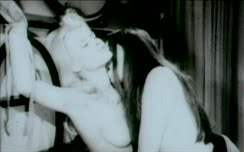
She has also been troubled by sexual thoughts. The fact that she shares a room with Sister Mathieu, who is obviously in lust with her and has a disconcerting habit of wandering about naked, doesn’t help. But Sister Gertrude is not interested in Sister Mathieu. She wants a man. Desperately. And when you add these sexual cravings to her other problems it’s not entirely unexpected when she begins to crack up. She steals a ring from a dead patient, and buys herself lots of drugs and a slinky dress, and indulges in some steamy anonymous sex with a guy she picks up in a bar.

This is bad enough, but patients have started to die rather mysteriously. By falling out of windows, or with their heads smashed in. The hospital administrators and the Mother Superior are determined to avert a scandal. They’re not going to allow a few dead patients to damage the shining reputation of the hospital or of the nursing order. The patients on the other hand are starting to show signs of rebellion, and when more deaths occur it becomes more and more difficult to prevent the police from being involved. And given Sister Gertrude’s increasingly erratic behaviour a police investigation could be very inconvenient. Sister Mathieu is doing her best to protect Sister Gertrude, while also doing her best to find a way of getting into Sister Gertrude’s bed.

This is more a psychological horror/murder mystery than a classic nunsploitation film, even though it does contain many of the essential features of the nunsploitation genre (lesbian nuns and a fairly modest amount of nudity). There is some gore, but hardly enough to explain how it could ever have been considered as a video nasty.

Hardcore gorehounds will be disappointed by this one, and those hoping for a nunsploitation sleaze-fest will be equally disappointed. That’s not to say it’s a bad movie. You just have to accept it on its own terms. If you accept it as a psychological thriller with some giallo influence then it’s reasonably effective.

The casting is eccentric but surprisingly successful. Anita Ekberg is rather good, resisting the temptation to indulge in full-on scenery chewing. Joe Dallesandro as the head doctor gives one of his better performances.

Director Giulio Berruti doesn’t seem to have had much of a career but he does a competent job. The movie would probably have enjoyed greater success had the exploitation elements been more strongly emphasised but it stands as an interesting oddity, and it’s worth a look if you enjoy off-beat 1970s Italian cinema.

The Shameless DVD presentation claims to be complete and includes previously cut scenes. Bizarrely enough the cut scenes (which are the only ones in Italian with English sub-titles while the rest of the movie is dubbed in English) are totally innocuous! The picture quality is acceptable, but the sound quality leaves something to be desired. It’s just a little muddy at times.

Saturday, 28 November 2009

Satanik (1968)

Both the title and the poster art would lead you to believe that this 1968 Spanish-Italian co-production is going to be somewhat in the style of Mario Bava’s Danger: Diabolik! but in fact Satanik has nothing in common with Bava’s classic. Although it’s also based on a European comic strip there are no masked criminals or masked crime-fighters in sight.

In fact it’s a horror movie that owes rather a lot to Dr Jekyll and Mr Hyde. A scientist is developing a potion that can not only reverse the ageing process but also cure all kinds of skin blemishes. As it happen the scientist’s female assistant Dr. Marnie Bannister suffers from horrible facial disfigurements, so she’s understandably anxious to try out the formula on herself. The professor is concerned because although the formula works on animals it does seem to have the side-effect of turning them savage. Dr Bannister is prepared to take the risk though, and when the professor tries to stop her she kill him.

The potion transforms her into a beautiful glamorous blonde. She soon finds herself a rich playboy boyfriend, but the effects of the drug are only temporary. She must keep getting another fix. Meanwhile the police are on her trail, but they don’t realise she’s now young and gorgeous. The plot becomes increasingly obscure from this point on, but her new boyfriend is some kind of criminal, jewel theft is involved, and there are further murders.

This is is a movie that no online reviewer seems to have a good word to say for. I can’t help feeling they’re missing the point. It's not a Bergman film. It’s a silly fun B-movie. It’s supposed to be silly. And no eurotrash film worth its salt has a comprehensible plot! If you compare it to one of the better giallos, or one of the classics of gothic eurohorror, or to a masterpiece like Danger: Diabolik! then yes, you’re going to be disappointed. If you’re prepared to accept it as lightweight low-budget fun then it’s reasonably entertaining.

There’s a very modest amount of nudity, and hardly any gore. There’s not a huge amount of actual horror either, but I don’t really think it’s a movie that is trying particularly hard to scare us. It’s an odd mix of genres and it might have worked better had they decided to make it an all-out horror film

Magda Konopka is slinky and seductive as Dr Bannister. There’s some wonderful 60s lounge music for those who like that sort of thing. And it has the obligatory 1960s European movie sexy night-club dancing scene. If you enjoy off-beat 60s European cinema it’s worth a look. At worst it’s a harmless time-killer.

This one probably isn’t going to be all that easy to track down. It’s not a movie I’d recommend anybody to pay a fortune for, but if you can pick up an inexpensive copy it’s amusing enough, and it does have a certain camp appeal.

Friday, 27 November 2009

The Lickerish Quartet (1970)

Nobody ever combined art and erotica more seductively or more intelligently (or more stylishly) than Radley Metzger. His 1970 movie The Lickerish Quartet may well be his masterpiece.

Questions of whether art can be porn or whether porn can be art are irrelevant when considering Metzger’s films. They so clearly and so effortlessly succeed in being both, and the two elements are combined seamlessly. Although Metzger is an American he made movies in both Europe and the US and all his movies have a flavour that is both European and American. The Lickerish Quartet is his most ambitious foray into the world of avant-garde cinema. It might be soft-core porn but it has more in common with the productions of European art film directors like Alain Robbe-Grillet, Fellini, Godard, etc, than with your average skin flick. It’s also worth pointing out that the sex is very very tame by later standards, in fact much tamer than in most modern mainstream Hollywood movies. And it’s done with a lot more style.

The narrative is fragmented, non-linear, multi-layered and extraordinarily complex. It starts with a middle-aged couple (no names are ever mentioned in this movie) watching a scratchy black-and-white stag film with their son. He’s actually the wife’s son by a previous relationship. The family lives in an enormous gothic castle, a castle so big that they themselves are in constant danger of becoming lost. The castle is the perfect setting for this movie, since it’s structured in much the same way, with lots of blind alleys, hidden rooms, staircases that seem to lead you back to where you started from. You can easily lose your bearings. The son, who appears to be about 20, finds the porno movie disgusting which simply makes it even more amusing for the parents. They are rich, bored and decadent and are perpetually searching for anything to stimulate their jaded palates.

Afterwards they visit a travelling carnival, the main attraction of which is a glamorous young woman who rides her motorcycle on the Wall of Death. When she takes her helmet off they are shocked and delighted to find that she’s the lead actress from the porn movie. This is an exciting discovery, and they simply must persuade her to come to the castle with them. They will provide her with an evening’s entertainment, watching herself in the movie. She readily agrees, but before they watch the movie the son insists on demonstrating his magic tricks. He has a considerable talent for magic, but as he explains, magic is easy, it’s reality that is difficult. He also tells the assembled company about the vision he had several years earlier, of the sufferings and martyrdom of Saint Margaret.

The entertainment doesn’t turn out quite as expected. When they run the movie they notice that it doesn’t seem quite the same as it did before, and when the beautiful blonde actress turns to face the camera, it’s not the same woman who was in the film when they watched it the previous evening!

There isn’t just one movie either. There’s another scratchy old black-and-white movie that we keep seeing, in which an American GI in World War 2 visits an Italian prostitute. And it’s the same woman again. At least it is at first. The man is one we haven’t seen before, but later this film changes as well and it’s the husband from the castle.

We also hear the story of the first meeting between the husband and the wife, but the stories each of them tell are quite radically different, as if they were from different movies. They met in the aftermath of the war, and in his version she was a prostitute, just like the woman in the second movie.

The motorcycle-riding girl from the carnival is also rather vague about her life story. The husband, the wife and the son are all fascinated by her. The wife claims her husband is impotent, but an encounter with the carnival girl in the library suggests otherwise. This is a classic Radley Metzger sex scene - visually inventive and witty as the two roll about on the floor of the library decorated with gigantic dictionary definitions of sexual activities. The carnival girl also has trysts with the son and with the wife, and they’re filmed with just a much style and wit.

As the movie progresses it starts to appear that the movies-within-a-movie are more just as real, or possibly more real, than what originally appeared to be reality. Which is the movie, and which is the audience? Who are the actors, and who is making the movie? Who is watching whom? Are the all watching each other watch each other? Has reality become illusion, or has illusion become reality? As the carnival girl says, the things that happen to people in movies aren’t real. But what is real? This might all sound terribly pretentious but Metzger has such a light touch that he gets away with it.

The Lickerish Quartet is as thought-provoking and intelligent as it is sexy and entertaining, and you can’t ask much more of a movie than that.
The good news is that most of Metzger’s movies are now available on DVD; the bad news is that most of the DVD releases have been a little disappointing in terms of picture quality. Umbrella Entertainment’s Region 4 DVD is no exception, but it’s at least acceptable and it’s a truly great movie.

Thursday, 26 November 2009

Golden Swallow (1968)

Golden Swallow (Jin yan zi) is a kind of sequel to Come Drink With Me, the ground-breaking 1966 Hong Kong martial arts classic.

What made Come Drink With Me so interesting was not just the female protagonist but the emphasis on relationships and emotions as well as on action. Although it has a different director Golden Swallow follows a similar pattern. This is not just an excuse for lots of spectacular fight scenes and general mayhem. It does have plenty of excitement and lots of sword fighting scenes and even a surprising amount of gore for 1968, but it’s really a story about love and about friendship and rivalry, the rivalry being both romantic and professional.

Pei-pei Cheng again plays the great swordswoman Golden Swallow. She finds herself hunted by a large and varied assortment of bad guys all of whom blame her for killing large numbers of their relatives, friends and hangers-on. Since Golden Swallow has been living quietly in her cabin in the mountains with her boyfriend Han Tao she’s rather puzzled by this. She hasn’t actually been killing anybody at all. She’s been blamed because her signature swallow darts have been found at the scenes of the various massacres. When she starts hearing stories of the local adventures of a particularly ruthless swordsman named Silver Roc she starts to wonder if this is really her long-lost friend Little Roc. She and Little Roc had been involved romantically, but he had disappeared after taking a bloody revenge on bandits who had killed his family.

In fact it is the same man, and he’s perpetrating these spectacular acts of violence as a way of forcing Golden Swallow to seek him out. He loves her, and alway has loved her, but he can’t just tell her that. His pride can’t stand the idea that she may have forgotten him.

Golden Swallow and Han Tao both set off in search of the mysterious Silver Roc, whose only home is a series of brothels. Inevitably Han Tao and Silver Roc will fight a duel over Golden Swallow, but the really interesting conflict is that which is occurring within Silver Roc himself. His violent acts are his way of dealing with a world that has left him emotionally crippled. He craves recognition as the greatest of all swordsmen, and as a just man (he kills many people but justifies this on the grounds that they are all evil people). And he desperately craves Golden Swallow’s love, although he already has a woman who loves him, the prostitute Meh Niang. Meh Niang is in fact the woman who could make him happy, if only he could realise that fact.

The duel between the two rivals in love is interrupted by what is almost a full-scale war between the three main characters on one side and the numerous and powerful Golden Dragon gang on the other. The bad guys follow the usual pattern of these movies, with the chief of the Golden Dragon sending hundreds of underlings to be mercilessly slaughtered by the three heroes before we finally get to a showdown between the main good guys and the main bad guy.

The action sequences might not compare to those in later Hong Kong movies but they’re still quite impressive. Director Cheh Chang does a stylish job. Like most Shaw Brothers movie it’s colourful and visually lush. The three leads (Pei-pei Cheng as Golden Swallow, Lieh Lo as Han Tao and Yu Wang as Silver Roc) are all very competent. This is a classy production, and highly entertaining as well. It offers an effective combination of action, human drama and romance.

Tuesday, 24 November 2009

A Candle for the Devil (1973)

A Candle for the Devil (Una vela para el diablo, also released in the US under the deplorable title It Happened at Nightmare Inn) is one of those horror movies that turns out to be not quite what one expected. In this case that’s rather a good thing.

Spanish writer-director Eugenio Martín had made the excellent Horror Express the year before, in 1972. He really is an underrated horror movie-maker. A Candle for the Devil is about two middle-aged women, Veronica and Marta, who run a hotel in a quiet Spanish village. They’re being driven slowly mad by sexual frustration and by their own religious bigotry. Veronica has found an outlet for her sexual cravings, taking a man 20 years her junior to her bed. But she doesn’t like getting completely undressed, because as she tells him, even married people don’t do that. Marta has no such outlet. In one memorable scene she watches the young men from the village bathing naked in the river and then runs through a field of thorn bushes, becoming more and more excited as the thorns lacerate her flesh. It’s a wonderfully effective scene.

What really upsets the two sisters is the behaviour of the young female tourists from abroad who stay at their hotel. They’re shameless hussies, parading about in their mini-skirts and hot-pants (it was 1973). They even catch one sunbathing topless on the roof of the hotel. As Marta tells her sister, only a whore would do such a thing. Marta confronts and then pursues the young Englishwoman who slips and falls through a glass window. She is dead. To Marta this is clearly a sign. The Lord is telling her to rid the world of these whores.

A difficulty arises when the dead girl’s sister Laura (played by Judy Geeson) arrives. She had arranged to meet her sister there. While the sister’s suspicions are slowly being aroused Marta and Veronica have killed again. There is one tourist they’re quite fond of though, a young woman with a baby, although they’re puzzled as to why she would be traveling alone without her husband. Then the woman makes a chance remark in a local shop, a remark that is passed on to the two sisters. It seems she doesn’t have a husband after all. Marta and Veronica are very upset, and they’re even more distressed by the idea that the child is going to be raised by a woman who is really no better than a common harlot. They really should do something to save that child.

The idea of religious intolerance and sexual repression leading to murder is hardly new, but good horror isn’t about the newness of the ideas, it’s about the execution of the ideas. In that area A Candle for the Devil rates very highly. The atmosphere of overheated frustrated sexuality is built up very economically. Eugenio Martín resists the temptation to overdo things, and Aurora Bautista as Marta and Esperanza Roy as Veronica show a similar restraint. The two sisters aren’t portrayed as monsters, and we feel a considerable amount of compassion for them. They’re not female versions of Norman Bates, and that makes them more terrifying.

Judy Geeson gives a solid performance as usual, but although she receives top billing the focus is very much on Marta and Veronica, and it’s Bautista and Roy who must carry this film. And they are equal to the task.

This is subtle psychological horror, and superbly done. There’s nothing flashy here, very little gore and only very moderate amounts of sex and nudity. The movie was given an 18 rating by the British censors, which is incomprehensible unless the DVD I saw had been savagely cut, or the British censors were being even sillier than usual when they rated this movie. Or possibly, like a lot of Spanish horror movies of that era, it was made in both a clothed and an unclothed version?

The Odeon DVD is pretty awful, with no language option other than an English dub and fairly poor picture quality. Which is a shame, since it’s an exceptionally good little horror movie that deserves better treatment.

Monday, 23 November 2009

Dead Eyes of London (1961)

Dead Eyes of London (Die Toten Augen von London) is one of the early Rialto Edgar Wallace krimis, with the classic Rialto acting line-up - Joachim Fuchsberger as the Scotland Yard inspector, Karin Baal as the ambiguous heroine, Klaus Kinski as a bad guy and Eddi Arendt as comic relief. And it’s tremendous fun.

Wealthy men are being murdered in London, and they’re all men without immediate families and mostly men from overseas. And they’re all insured with the Greenwich Life assurance company. Odd messages written in braille are found on the bodies. Inspector Larry Holt is assigned a special assistant on this case, a woman who can translate braille for him. This brings him into contact with a home for the blind, run by a blind priest. There appears to be a connection here with the muders, and there also appears to be a connection with the life insurance company, but at this stage the inspector is baffled as to how to connect the dots.

One of the murdered men had changed his will just before he was killed, leaving his entire (rather considerable) fortune to his long-lost illegitimate daughter. The inspector would dearly like to speak to this mysterious daughter. There’s also the enigmatic man in dark glasses who seems to be on the same trail as the inspector. There are more murders, and the plot becomes more complicated, building to an extremely effective climax that includes a laundry of death.

The acting is good, with Kinski being subtly creepy and Fuchsberger making a fine hero. The very words “comic relief” are enough to bring a shudder to many fans of older horror movies but if you must have comic relief then Eddi Arendt isn’t too bad. He’s mildly amusing and at least he isn’t actively annoying. Karin Baal is always reliable, and the minor players are all quite competent. Anneli Sauli is terific in a supporting role as the glamorous Fanny Weldon.

Afred Vohrer directed some of the best of the krimis and he’s in good form here. His direction is crisp and efficient without being ostentatious. The black-and-white cinematography is top-notch. There’s lots of fog, which helps to hide the fact that all of the location shooting that is supposed to be in London was done in Germany, but it adds the requisite atmosphere as well.

This particular Edgar Wallace story had been filmed in 1940 with Bel Lugosi. The Lugosi version is fun, but I think that this 1961 German remake is better.

As with most of the Wallace krimis there are definite elements of horror, and the character of Blind Jack is just about enough on its own to qualify it as a horror flick. And any movie that has an ending involving blow torches and laundry equipment used as a murder weapon has to be regarded as being at least marginally horror!

It’s released on DVD by Retromedia, paired with The Ghost (an excellent Ricardo Freda horror film starring the great Babara Steele). The print is in pretty good shape. It’s a pity it’s only available in an English dubbed version, but I suppose we should be grateful that so many of these krimis are now available to us even in less-than-perfect presentations. And part from the dubbing there’s not too much to complain of here. The picture is slightly widescreen, probably not quite the correct aspect ratio but it’s crisp and clear and the film seems to be uncut judging by the running time.

If you’ve never sampled the delights of the German Edgar Wallace krimis then you should do so at once. They’re a great mix of horror and murder mystery with a dash of humour and a serving of romance on the side, and they’re stylish and entertaining. These are B-movies, but superior B-movies. And this is an ideal example to start with. Highly recommended.

Sunday, 22 November 2009

Attack of the Robots (1966)

Another early Jess Franco eurospy flick, Attack of the Robots (Cartes sur table) dates from 1966 but has a very different feel to the following years’ Lucky the Inscrutable. It has less of a comic-book feel, but in its own way it’s just as much fun.

Eddie Constantine is a former Interpol agent Al Peterson, brought out of retirement to track down a group of mysterious assassins. These killers are in fact humans turned into automatons, almost unstoppable and without human emotions such as fear or remorse. They have been involved in the slayings of a number of important public figures, but who is behind this dastardly plot? Peterson didn’t want to come out of retirement, preferring to spend his time these days on glamorous blondes and good whisky, but he is not only tricked into it, he is also unwittingly being set up as bait.

He flies to Spain, and it doesn’t take long before he finds not only the criminal gang behind the plot but also two beautiful women. He’s really more interested in the women than the conspiracy, but things become complicated for him when he is kidnapped by Red Chinese spies. They also want to use him as bait, to discover the scientific principles behind the process of turning people into killer robots. There are plenty of plot twists, an lots of double-crossing, as Al becomes the victim of the machinations of both the beautiful blonde Lady Cecilia Addington Courtney and the equally beautiful brunette Cynthia Lewis.

Craggy-faced Eddie Constantine was born in the US but achieved fame in Europe in the 1950s as the star of the French-made series of Lemmy Caution crime/spy thrillers. As far as I know he was only capable of giving one performance, but it didn’t matter because it was a terrific one. And he’s ideal for the kind of spy spoofs that Jess Franco liked to make because that one performance of his was given with tongue planted firmly in cheek. He’s the perfect movie secret agent - brave, resourceful, scrupulously honest but more devoted to womanising and boozing than to the job. He’s immensely likeable and always slyly amusing.

Françoise Brion as Lady Cecilia and Sophie Hardy as Cynthia are equally perfect in their roles.

There’s a nice mix of humour, glamour, action, romance, sexiness and silliness. Franco solves the problems of low-budget film-making with his usual style - Al is provided with the kinds of gadgets that every self-respecting secret agent has to have, but conveniently none of them involve expensive special effects. The diabolical criminal mastermind’s secret laboratory has enough gadgetry to be convincing but it’s clearly done on a shoestring. The lack of elaborate sets and fancy effects makes no difference to the movie since it’s driven mostly by Eddie Constantine’s acting style and Franco’s flair as a director.

There are some good running gags, such as Al’s Mexican friend who is determined that next time he’s going to get the first punch in, but he never does. Being a Franco movie there are of course night-club scenes with sexy dancers and with jazz musicians (including Franco himself). Despite Al’s womanising the movie is considerably less sexist than the James Bond movies (movies that this one was obviously cashing in on). There’s no nudity, and no graphic violence. It’s a Jess Franco movie that could almost qualify for a G rating!

It’s fast-paced and consistently good-humoured, very stylish and always highly entertaining. An absolute must for eurospy fans, for Jess Franco fan, or for anyone who loves tongue-in-cheek 60s spy movies.