Thursday, 2 December 2010

Moonraker (1979)

Moonraker seems to have a fairly mixed (although mostly negative) reputation even among aficionados of the Roger Moore James Bond films. That seemed reason enough to see it.

The movie opens with the hijacking of an American space shuttle on loan to the British government. Her Majesty’s government is understandably embarrassed, so Agent 007 is assigned to find out what happened.

His first port of call is the gigantic industrial complex where Drax Industries manufactures the Moonraker space shuttles. Almost immediately attempts are made on his life. Bond starts to wonder if perhaps the fabulously wealthy Hugo Drax isn’t all that keen on having this particular mystery solved.

Bond quickly makes contact, contact of a rather physical nature, with two glamorous women who work for Drax. One is a helicopter pilot, played by Corinne Clery (a French actress probably best known for the arty S&M epic The Story of O. The second is a NASA astronaut/scientist, Dr Holly Goodhead. This time Agent 007 gets to bed both of them. It soon becomes obvious that Drax’s business empire is not quite what it appears to be. He has an enormous number of employees who seem to be just a bit too physically perfect, and who don’t seem to have any particular duties. Bond also encounters his old enemy Jaws, and survives various additional assassination attempts.

It all leads up to a climactic space battle which could be seen as the Bond franchise’s attempt to jump on the Star Wars bandwagon.

There are some very silly gadgets. The hovercraft gondola that Bond employs in Venice may be the silliest Bond gadget of all time, but the Bond movies are all about silly gadgetry and camp fun. The space shuttles themselves suffer from the same problem that NASA’s real-life space shuttles suffer from - as spacecraft go they’re petty boring.

Despite these reservations Moonraker has most of the elements you want to see in a Bond movie - spectacular stunts, explosions, outlandish gadgets, more explosions, and glamorous women. There are exotic locations, some fairly impressive sets (although perhaps not quite as impressive as in some of the other Bond movies). The action sequences are done with the panache you expect in a Bond film. As always the violence and the sex are toned way down to ensure a PG rating, which in box-office terms was probably essential.

If it’s a little sillier than the average Bond film then that probably just reflects the difficulty the producers saddled themselves with in having to come up with more and more unlikely gadgetry.

Roger Moore is in good form and Lois Chiles makes a pretty reasonable Bond girl who turns out to be a bit of a kickass action heroine in her own right. Michael Lonsdale as Hugo Drax is a good creepy villain. Richard Kiel makes yet another appearance as Jaws, and this time he finds love!

I really didn’t have any major problems with this movie. The Bond franchise was based on campy fun and it delivers both.

Sunday, 28 November 2010

Two on a Guillotine (1965)

Even in 1965 Two on a Guillotine must have looked very old-fashioned, but it’s not entirely without its charms.

It’s a combination of an Old Dark House horror mystery (a sub-genre that had already become hackneyed by the early 30s) and a romantic comedy. It does however involve stage magic, and I tend to be pretty tolerant of movies dealing with the world of illusionists.

'Duke' Duquesne is a celebrated stage magician. He is assisted in his act by his beautiful young wife, Melinda (Connie Stevens). They have an infant daughter, and his career is going well. They are working on a new trick, a rather macabre one involving a guillotine. And then Melinda disappears without explanation, and Duquesne retires from the stage and lives as a recluse for the remainder of his life. His daughter is sent to live with her aunt.

Twenty years later the daughter, Cassie (also played by Connie Stevens), receives word of her father’s death. She has had no contact with him since her mother vanished. Duquesne’s funeral is a little on the bizarre side - according to his last wishes his coffin is chained and padlocked to make escape as difficult as possible. Duquesne has vowed to return from the dead if he can, and he wants it to be a challenge! His will is odd as well - his daughter gets everything so long as she lives in his house for a week, in case he really does return from the grave.

She won’t be alone in the house though - a newspaper reporter (Dean Jones) has managed to convince her that he’s not really a newspaper reporter, he’s really a nice regular guy, and he’s talked his way into staying so that she ill have someone to protect her.

These are the usual Old Dark House spooky clichés, there’s a blossoming romance, and finally after an inordinately long wait the actual plot kicks in. We find out what really happened to persuade the great magician to retire, and what really happened to his wife.

It’s not a bad little horror tale, but it could have been told very effectively in just over an hour. In fact the movie runs for 107 minutes. And that’s the problem. Dean Jones is harmless, Connie Stevens is cute and amusing, Cesar Romero does some scenery-chewing. There are a couple of quite well done horror moments. There’s some gentle humour and some romance, and they’re handled competently enough. And there’s go-go dancing, always a major plus in my book.

All in all it’s innocuous and moderately entertaining if you’re in a tolerant mood.

I caught it on TCM at Halloween. I have no idea if it’s available on DVD. It’s definitely one to rent or watch on cable, rather than one to buy.

Thursday, 25 November 2010

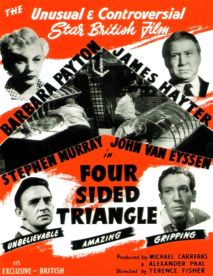
Four Sided Triangle (1953)

For many people the story of Hammer Films begins with The Curse of Frankenstein in 1957 and The Horror of Dracula in 1958. This is an entirely incorrect view. Hammer made their first horror movie in 1935 (Phantom Ship, also known as The Mystery of the Marie Celeste). It’s not even true that The Curse of Frankenstein marks a major departure for the studio. They’d already been making some very dark film noirs, quite a bit of science fiction and several movies with definite tinges of gothic horror (such as Terence Fisher’s 1952 film noir Stolen Face). And in 1953 they’d made what can be considered a dry run for their Frankenstein films, with Four Sided Triangle.

In Four Sided Triangle most of the elements of the classic Hammer Frankenstein film were already in place.

In a quiet English village three youngsters grow up under the watchful eye of the jovial local general practitioner, Doc Harvey. The two boys Robin and Bill, and the girl, Lena, are inseparable. But already a romantic triangle is forming. Even in play the two boys compete for Lena’s favour. So far the triangle has only three sides.

The boys turn out to be scientifically gifted. Bill in particular blooms under the tutelage of Dr Harvey. They go off to Cambridge, then return to continue their experiments. Lena has gone to America, but she returns as well, and is soon installed as a kind of live-in housekeeper/assistant to the two budding young scientific geniuses. But there’s still the problem of two young men, and only one young woman. That triangle has re-emerged.

Robin and Bill have made the greatest scientific breakthrough of the age. They have devised a means of duplicating any object. Any non-living object. Bill however believes that living creatures can be duplicated as well. Meanwhile Robin and Lena have announced their impending marriage, Bill, who is of course hopelessly in love with Lena, is devastated. But perhaps there is a solution. What if there were two Lenas? One for Robin, and one for Bill?

This is a Hammer film directed by Terence Fisher, so you know that Bill’s idea is going to go horribly wrong.

Terence Fisher can’t really be regarded as a horror auteur but he was an extraordinarily skilled craftsman. His camera set-ups are rarely fancy, but somehow they’re always just right. If you ask yourself if a particular scene could possibly have been filmed more effectively in some other way, the answer is almost invariably no. Fisher has come up with the simplest and best way to film the shot. With Fisher the visuals always serve the plot, and if you don’t notice the hand of the director then he’s done his job properly.

Fisher is not often thought of as an actor’s director, but he was one in the sense that his unobtrusive competence always allowed room for the actors. Again, his considerable visual skills were there to enhance the performances, not to swamp them. And he did get very fine performances from people as disparate as Lizabeth Scott and Peter Cushing. In Four Sided Triangle Stephen Murray plays Hammer’s first full-on mad scientist, and as was so often the case in the later Frankenstein movies he’s not really a bad person at all. He’s merely been tempted, and has succumbed to the temptation.

Barbara Payton is effective in her dual role as Lena and as Lena’s artificial twin. She’s not a femme fatale, she just can’t help the fact that no matter how many times she might be duplicated she’s still going to love Robin rather than Bill.

James Hayter was Dr Harvey was often annoying in roles such as this but the movie cleverly implicates him in Bill’s mad schemes, so he can’t be the moralising outsider passing judgment on others. It’s an example of just how sophisticated this early Hammer movie is.

This is also the earliest glimpse of a Hammer mad scientist’s laboratory, and it’s a pretty good early effort.

Hammer never really changed their basic approach. They always believed that the recipe for success was to make B-movies, but to make good well-crafted B-movies that managed to look more expensive than they were. This 1953 production is a fine example, and it’s highly entertaining as well. Recommended.

Sunday, 21 November 2010

The Day the Earth Caught Fire (1961)

The Day the Earth Caught Fire is, as its name suggests, an end-of-the-world movie. This time the threat isn’t aliens or meteors, it’s the atomic bomb.

Both the Americans and the Russians have carried out their largest ever H-bomb tests, and this simultaneous detonation seem to have had some rather disturbing effects. There are floods in New Zealand, cyclones in London and Greece, airports closed down by fogs unprecedented in history. Perhaps most disconcerting of all, there’s an unscheduled solar eclipse. The government assures the populace that there’s nothing to worry about.

Th story is told through the eyes of three people. Two are reporters on a London newspaper, the third works for the government’s Meteorological Office. Peter Stenning (Edward Judd) was once a promising journalist. A bitter divorce has caused him to crawl inside a whiskey bottle. He keeps his job on the paper because his friend Bill Maguire (Leo McKern) covers for him. Bill is your basic hardbitten middle-aged journalist with a heart of gold.

Stenning encounters Jeannie Craig (Janet Munro) when he tries to talk his way into an interview with Britain’s top meteorologist, Sir John Kelly. He’s not looking to get involved with another woman but he and Jeannie hit it off pretty well, and there’s a definite attraction. Jeannie leaks important information to Stenning, information that suggests that the government’s assurances that everything is under control may be a long way from the truth.

Bit by bit the truth emerges. The earth has been knocked off its axis, causing cataclysmic global climate changes. That’s the good news. The bad news is that the planet’s orbit has also been altered, and we are now heading closer and closer to the sun.

The three main characters are essentially just observers. They don’t make the important decisions. They’re not in a position to try to save the world. Their efforts to uncover the truth don’t change anything. They might know a little more about what’s going on than the average person but it doesn’t do them any good. The governments of the world have adopted a bold plan devised by the scientists, a plan that might just possibly avert disaster. Like everyone else our three protagonists can only wait and hope.

This is a fairly effective technique. When combined with stark black-and-white cinematography and a semi-documentary feel it adds to the feeling of a world at the mercy of forces beyond the control of ordinary people.

The three central characters could easily have been mere stereotypes but Edward Judd and Leo McKern in particular are able to bring their characters to life, to add some light and shade, and to make us care about them. Janet Munro is good as well although her character isn’t developed to quite the same extent.

There’s one rather surreal moment, when a bunch of beatniks run riot through the streets of London, causing mayhem. But it’s pretty mild mayhem. Their idea of rioting is dancing in the streets and throwing buckets of water (water is now strictly rationed by the government) over bystanders, accompanied by the sounds of crazy beatnik music.

Writer-director Val Guest is one of the unsung heroes of the British film industry. From the 40s to the beginning of the 80s he made countless movies in a variety of genres, and his filmography includes some extremely good movies (including quite a few for Hammer). He was always very good at building a sense of tension and impending disaster and even his lesser movies were rarely less than entertaining. He does a very skillful job with The Day the Earth Caught Fire.

One thing I especially liked was the use of tinting at the beginning and the end, a common practice in the days of silent cinema but rarely used in talking pictures. It works well in this production.

Network DVD have done a fine job with the transfer. The total absence of extras may disappoint some purchasers. A well-crafted and gripping movie.

Wednesday, 17 November 2010

The Land That Time Forgot (1975)

Hammer Studios had enjoyed some success with their mid-60s series of exotic adventure films, so it was not altogether surprising that their chief rivals, Amicus, should also try to get in on the act. The only surprising thing is that they waited until 1975. With an adaptation of Edgar Rice Burroughs’ The Land That Time Forgot they must have thought they were on a sure thing. And they were right, although the success of these movies couldn’t save the studio.

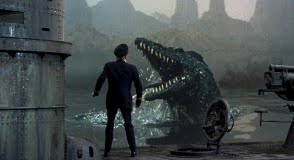
In 1916 a steamship is torpedoed by a German U-boat. The handful of survivors are drifting helplessly in a lifeboat when they spot a vessel. In fact it’s the very U-boat that sank their ship. As it happens one of the survivors, a nan named Tyler (Doug McClure) is an American expert on submarines, and using his specialised knowledge the survivors are able to capture the U-boat. Their attempts to take the captured submarine to a neutral American port are thwarted however by the efforts of the U-boat’s captain and they fimd themselves a long way out of the main shipping lanes.

They make a landfall, but this coastline is strange and unfamiliar. The U-boat commander, Captain Von Schoenvorts, is an amateur scientist and a bit of an intellectual and he has a theory that this is the lost continent discovered by a forgotten European explorer back in 1720. Finding a place to land proves difficult until Tyler manages to navigate the U-boat through an underground river into the interior of the continent. The exterior coastline is shrouded in ice but the interior of the continent is tropical. But there are bigger surprises than that in store.

The continent is inhabited by dinosaurs. And they’re none too friendly. That strange enough but our motley band of explorers will find that life woks very differently indeed in this bizarre lost world.

The dinosaurs aren’t the most convincing movie dinosaurs you’ll ever see but there’s plenty of action and plenty of fun. And lots of explosions. The model work was done by Derek Meddings, who had worked on Gerry Anderson’s classic 1960s puppet adventure series such as Thunderbirds and Captain Scarlet. As you’d expect, the model scenes work extremely well, especially the passage of the U-boat through the underground river.

Doug McClure is, as always, a fine square-jawed hero. Susan Penhaligon as a glamorous lady biologist is the token female member of the cast. She’s good but she doesn’t get much to do. John McEnery steals the picture as the U-boat commander. He’s the most complex character in the movie, capable of cunning subterfuges but with a definite sense of honour, and with genuine human warmth and even a touch of humour.

This is a very silly movie but that’s part of its charm. It’s a ripping adventure yarn that revels in its own absurdity and if you’re prepared to just sit back and enjoy the ride you’ll find it a thoroughly entertaining hour-and-a-half of B-movie hokum.

MGM have released this one, in a very handsome transfer, as a double-feature along with the sequel, The People That Time Forgot. Seriously, how can you go wrong with submarines and dinosaurs in the same movie?

Monday, 15 November 2010

Paul Naschy blogathon

The Vicar of VHS informs me that at Mad Mad Mad Mad Movies they're having a Paul Naschy blogathon from November 29 to December 3. Sounds like fun.

I shall be participating, assuming the Naschy movie I've ordered actually arrives at this far-flung outpost of the Empire in time.


Saturday, 13 November 2010

Bolero (1984)

One could easily feel slightly embarrassed for even reviewing a film like Bolero, but fortunately your humble scribe feels no shame at all even in the ace of the trashiest of movies, so here goes.

Bolero was conceived by writr-director John Derek as a starring vehicle for his wife Bo Derek. She had enjoyed some success in the movie 10 a few years earlier. 10 had the advantage of having a director who knew what he was doing (Blake Edwards) and two capable leads (Julie Andrews and Dudley Moore). All Bo Derek had to do was to look stunning, which was just about within her acting range. Although she attracted most of the publicity Ms Derek in fact played a minor supporting role.

John Derek however believed she could be turned into a real honest-to-goodness movie star. Unfortunately without a director who knew what he was doing, and without two experienced leads to carry most of the acting burden, Ms Derek was out into the position of having to carry the film herself. In retrospect that was never ever going to work.

Now there are some people who think that making bad movies is easy. That might be true of regular bad movies, but to make something spectacularly awful, something in the Mrs Doubtfire class, requires a concerted effort. John Derek was certainly equal to the challenge. His first masterstroke as to cast his wife, who was nearly 30, as a teenage virgin. His second masterstroke as to set the movies in the 1920s. The only reason to do this would have been to take advantage of the clothes and hairstyles of the 20s, but Bo Derek simply doesn’t have the right look for 1920s fashions, and her early 80s California blonde beach babe hairstyle looks absurdly out of place.

All that is bad enough, but Bolero has major weaknesses in the plot department as well. The plot involves young Bo’s attempts to lose her virginity, and that’s about it.

Perhaps the worst thing about it is that there is a germ of a good idea here. The movie opens with scenes of silent movie heart-throb Rudolph Valentino. And Bo’s two lovers are a shiekh (just like the one played by Valentino in the movie of the same name) and a matador (just like the one played by Valentino in Blood and Sand). There was some potential here to exploit the idea that our heroine was seeking to relive the romantic fantasies of the countless young women who idolised Valentino, or even to bring in an element of the fantastic as Woody Allen was to do so successfully in The Purple Rose of Cairo. But in Bolero the idea goes nowhere, and Derek’s approach is much too literal.

There’s also the problem of exactly what kind of movie this is supposed to be. Is it intended to be funny, or whimsical? There are occasional hints that this may have been intended. Is it intended to be a romance? Or a steamy sex film? This seems plausible since the movie’s main selling point was that Bo Derek gets naked, but there really isn’t enough skin to make it a decent skinflick.

The only real hope for this was that it might triumph as an exercise in camp. It does have its moments when this ambition look like having a chance of being realised, but again it just doesn’t push things far enough.

On the other hand it does have a certain wtf factor going for it, and there is a kind of morbid fascination to it. Connoisseurs of cinematic train wrecks will find themselves forced to keep watching. If you lay in a sufficient supply of strong alcoholic drinks (the stronger the better) and plenty of junk food you may find some perverse enjoyment in this effort. And Bo Derek does get naked.