Thursday, 19 May 2011

Spaceways (1953)

Spaceways has one main claim to fame. It was one of the first forays into science fiction for both Hammer Films and for director Terence Fisher.

Fisher made a series of excellent film noir-influenced crime thrillers for Hammer in the early 50s and Spaceways is in fact a murder mystery presented against a science fiction backdrop, with some elements of espionage thrown in as well.

The British government has a top-secret research facility working on plans to put the first spaceship into orbit and ultimately to build the first space stations. The scientists involved, and their families, are housed in a kind of concentration camp totally cut off from the world. This neatly provides one of the prime requirements for a classical murder mystery - all the suspects are confined together in one place without being able to escape and we know that one of them must be the killer.

The key figure in the project is an American scientist, Dr Stephen Mitchell (Howard Duff). He’s very unhappily married. His wife Vanessa despises him for not getting a high-paid job in private industry and she’s carrying on an affair with the team’s chief biologist Dr Philip Crenshaw. Mitchell meanwhile is falling for Dr Lisa Frank (Eva Bartok). She’s the daughter of the head of the rocket project. When both Crenshaw and Mitchell’s wife disappear it is assumed they have been murdered since they could not have left the base. And Stephen Mitchell is the prime suspect.

An outside investigator from one of the Intelligence services is called in to solve the mystery. He comes up with a ingenious theory - that Mitchell murdered Crenshaw and Vanessa and stuffed their bodies into the AS1 rocket’s fuel tanks just before its first test flight.

The rocket is not yet ready for a manned flight but Dr Mitchell decides he can only prove his innocence by undertaking the first manned spaceflight in the second rocket, the AS2. He will rendezvous with the AS1 in orbit and prove that there are no bodies in the fuel tanks. Lisa is horrified - she can’t let the man she loves undertake such a mission alone but she knows that no-one will allow her to accompany him.

The mixture of science fiction and murder mystery elements is a little uneasy but despite the film’s generally poor reputation I think it works quite well. Like the other sci-fi movie Fisher directed for Hammer in the same year, Four Sided Triangle, it avoids the more obvious science fiction clichés of its era.

The budget was too limited to allow any extended spaceflight sequences but making the core of the story the murder mystery means that’s not a major problem. The special effects are ultra-cheap but the spaceship interior looks rather nifty with its classy walnut control panel.

Fisher was never less than very competent and he had a real flair for crime thrillers so he was a sound choice to direct.

Howard Duff is adequate if unexciting. Eva Bartok is by far the most impressive member of the cast.

The Image Entertainment DVD looks reasonably good. There are no extras apart from a trailer.

Not as good as the Quatermass films that brought Hammer its first big successes in the mid-50s but still worth a look if you’re a fan of 1950s sci-fi movies. Certainly nowhere near as bad as its reputation suggests.

Sunday, 15 May 2011

The Coming of Sin (1978)

Spanish director José Larraz cemented his place in the pantheon of eurohorror/eurosleaze greats with his 1974 British film Vampyres. Which is a great movie, but the word most frequently used to describe Larraz’s career is erratic. His 1978 Spanish production The Coming of Sin (also released as Violation of the Bitch) encapsulates his strengths and weaknesses pretty well.

He sold the idea to a producer as a kind of Spanish Emmanuelle with gypsies and horses but in fact the resemblances to Emmanuelle are almost non-existent. The Coming of Sin is an erotic fever dream psychological thriller.

Lorna, a wealthy female Spanish painter, is asked by a friend to look after her gypsy servant girl for a while while she’s travelling abroad. The girl, Triana, has been troubled by nightmares. Lorna doesn’t worry too much about this until the next morning when she finds Triana taking a pot shot at an intruder with a shotgun. The intruder is a naked young man on a horse who is trampling Lorna’s flower beds. Triana informs Lorna that this is the young man from her dreams.

Lorna sees the man as well, raising the question as to whether he’s really a figure from a nightmare, or whether Lorna and Triana are sharing a dream. They’re definitely sharing a bed. Triana regards the young man (whose name is Chico) with a mixture of fear and desire - she is convinced that if they become lovers someone will die. Lorna regards him with pure desire. She likes the idea of a nice little ménage à trois. She paints her two objects of desire, enjoying the sexual frisson of seeing Triana and Chico naked together. Triana however is still certain that disaster is approaching.

Made on a budget of virtually nothing it has some interesting dream sequences (including the notorious girl-in-a-horse scene) and a fairly effective atmosphere of dangerous sexual passions. There’s enough sexual symbolism to keep a Freudian happy for a very long time. The symbolism is obvious and heavy-handed but then sexual symbolism in dreams is rarely subtle and Larraz has enough style to just about get away with it.

The big problem is the acting. Even by European exploitation movie standards it’s truly terrible, and this is compounded by the atrocious and bizarre English dubbing. And Unfortunately, being a psycho-thriller, this is a rare example of an exploitation movie that actually requires some real acting.

The ending is not exactly going to come as much of a shock.

Not a great movie by any standards but still a reasonable example of that characteristic 70s mix of art and eroticism.

The image quality on Pagan’s Region 2 DVD release is dismal which I suspect is a problem with the source materials rather than anything else. It’s very soft and very grainy and very washed-out. The extended interview with the director almost makes up for this though - Larraz is amusing, playful and revealing.

Worth a look if you enjoy this sort of thing and if you can find a copy.

Thursday, 12 May 2011

Justine’s Hot Nights (1976)

Justine’s Hot Nights (Les nuits chaudes de Justine) is a 1976 sex comedy written and directed by Jean-Claude Roy. The sex comedy as a genre can be dire. It really needs a considerable lightness of touch to make it work, and Justine’s Hot Nights has that touch.

Mik Farez is a fikm-maker with serious ambitions whose career is going nowhere. he just can’t come up with any ideas at all any more. In desperation he decides to do an adult film. But he can’t come up with any ideas for this project either. Luckily his wife Nina has a bit more imagination. She offers to help him out.

Most of their fantasies centre on Justine, an imaginary character they conjure up after seeing a rather striking actress on TV.

That’s it for the plot. The whole film consists of fantasy sequences of ideas they’re tossing about in their heads. This has one major advantage - it means that having a very very limited budget is no problem. Fantasies don’t require elaborate sets. When you fantasise about desert island, all you need is a painted backdrop and a hammock. Want to recreate the famous sex-on-a-plane scene from Emmanuelle? Just place your actors in front of a photograph of an aircraft interior. If you tried to do that and make it realistic you’d end up with something that looked cheap and tacky. So make sure it doesn’t look realistic at all - make the background photo black-and-white. The result is a witty riposte to Emmanuelle.

If you’re going to do this sort of thing as comedy you need to be actually funny, and this film is consistently and good-naturedly amusing. Of course these were the days when people appearing in softcore sex movies could in fact act, and the actors in this one are more than adequate. Philippe Gasté as Mik, Michèle Barton as his wife Nina and Nadia Kapler as Justine all handle the comic elements with assurance.

The film’s biggest weakness is its attempt to inject a little social commentary into the proceedings, which turns out to be as clumsy as such attempts invariably are. Fortunately they quickly get back to a more light-hearted mood.

There are a couple of very brief hardcore inserts (only a few seconds of screen time really) which were added later. The film as made was strictly softcore (although with abundant nudity) and manages to combine eroticism and humour quite deftly.

This is one of a series of interesting and odd 70s and 80s erotic films recently released on DVD by Nucleus Films on their Naughty DVD label. This is the third that I’ve seen, the others being Dressage and Scandalous Photos. The transfers aren’t exactly pristine but that’s no reflection on Nucleus Films - these sorts of movies only survive by accident and in most cases the prints that have survived are in poor condition. Image quality is still quite acceptable and all three movies I’ve seen have been pleasant surprises.

An entertaining piece of lightweight eurosleaze.

Monday, 9 May 2011

The Devil's Hand (1962)

I’m a sucker for movies involving voodoo dolls so I’m probably a bit biased but for my money The Devil's Hand is good cheesy fun.

Rick (Robert Alda) is being troubled by strange dreams about a glamorous blonde. When he and his girlfriend Donna wander into a doll shop and find not only a doll that bears an uncanny resemblance to Donna but also a doll that is the spitting image of the blonde from his dream he starts to get worried. And curious. Donna on the other hand just thinks he’s been playing around with this blonde on the side.

The blonde turns out to be real, and she has mind control powers. She forces Rick to come to her apartment and basically tells him he belongs to her now. I have to say that Rick doesn’t put up much resistance. Poor Donna is soon forgotten.

The blonde’s name is Bianca and she works in the doll shop, which is in fact a front for a cult of voodoo devil-worshippers. The cult leader is the man who runs the doll shop, Francis Lamont. The cult promises its followers wealth and power. For those who might feel tempted to betray the cult there are loyalty tests. The cult member is placed on an altar and a wheel with knives attached is lowered onto them. If the devil god Gamba knows they are loyal the knives turn out to be rubber, but if they are traitors the knives are real and death awaits them.

Rick is a loyal cult member but he also still cherishes a soft spot for Donna who has been afflicted with serious heart disease by means of a needle plunged into the doll that represents her. Can Rick balance his devotion to Gamba and to his new blonde girlfriend with his desire to prevent Donna from being harmed?

This is 1962 so there’s no gore and to be honest there’s not much in the way of genuine scares. On the other hand there’s plenty of camp fun and entertaining cheesiness. There are voodoo ceremonies complete with bongo drums and black dancers (to add some exoticism). The knife-armed wheel of death is embarrassingly low-budget but this makes it more fun.

Robert Alda makes a slightly creepy hero. Linda Christian is a splendid beautiful but evil blonde. Neil Hamilton (best known as Commissioner Gordon in the 1960s Batman TV series) is a fun villain.

It’s good-natured enjoyable silliness.

This is part of the Mill Creek 32-movie Drive-In Cult Classics boxed set. It seems to be uncut and the transfer is watchable if not brilliant.

Saturday, 7 May 2011

Dance Hall Racket (1953)

I adore the classical era of American exploitation movies, from the 1930s to the 50s. None of the these movies could possibly be considered a good movie by any conventional standard of film criticism, but it’s their very flaws that make them fun.

The stilted dialogue, the wooden acting, the contrived (and very thin) plots and the crude sets - all combined with sex, sin and sleaze (or at least the promise of sex, sin and sleaze). It’s a recipe for campy movie fun.

Dance Hall Racket was made in 1953 but has the feel of exploitation movies of the 40s. It’s greatest claim to fame is probably that the screenplay was written by Lenny Bruce, stand-up comedy legend, counter-culture hero and all-round loser. And he not only wrote the film, he plays one of the leading roles. His stripper wife Honey and his mother also appear in this film.

Like most exploitation movies it has a little plot that even with a running time of less than an hour it still feels padded out. Umberto Scalli (Timothy Farrell), a character who appeared in several earlier exploitation films, runs a dance hall. It’s one of those dance halls where the customers buy a ticket that entitles them to dance with one of the hostesses. It’s not quite a clip joint but it’s close. It also serves as a front for Scalli’s smuggling operations and assorted criminal activities.

The authorities are aware of Scalli’s activities and they’ve got an undercover agent planted in the club. Scalli’s chief henchman is the sociopathic Vinnie (Lenny Bruce). Vinnie is a little heavy-handed and when ordered to rough someone up he more often than not kills them. There’s a kind of romantic triangle involving Scalli, Vinnie and one of Scalli’s dance hall girls.

I don’t want to give the impression there’s a coherent plot happening here. There isn’t. Even by exploitation movie standards the acting is jaw-droppingly awful. And if you were wondering why Lenny Bruce didn’t go on to have a glittering career as a screenwriter you need only watch this movie. Phil Tucker’s direction is basic at best.

The sleaze is mostly implied although there is some blink-and-you’ll-miss-it nudity and there are countless scenes of the dance hall girls getting dressed and undressed. Again it’s pretty standard for exploitation movies of this era.

In fact it’s a staggeringly bad movie.

Its one big asset is Timothy Farrell. He’s one of the legends of exploitation film-making and can always be relied upon to deliver an outrageously entertaining performance. Acting was a sideline for Farrell who worked for the LA Sheriff’s Department, eventually becoming County Marshall before being fired in 1975.

Dance Hall Racket is included as an extra on the Alpha Video DVD release of Sin You Sinners (a reasonably entertaining early sexploitation feature). It’s a fairly atrocious print but it’s hardly likely this movie is ever going to be released as part of the Criterion Collection so this is probably the best version we’re ever likely to see. And it’s good value double-movie set.

Despite its faults, or more probably because of them, Dance Hall Racket is great fun. If you’re a fan of exploitation movies you’ll certainly want to see this one.

Thursday, 5 May 2011

How to Stuff a Wild Bikini (1965)

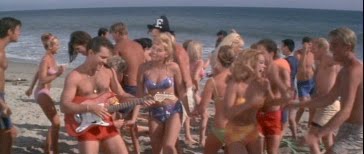
How to Stuff a Wild Bikini was the last of the Annette Funicello-Frankie Avalon beach party movies of the 60s. This represents my first exposure to these movies and it was probably not the best place to start.

It’s actually a bit of a stretch to describe it as an Annette Funicello-Frankie Avalon picture. Avalon gets very little screen time. And Funicello was pregnant at the time and was unwilling to be seen in a bikini, which is kind of a problem if you’re making a beach party movie. They’re really only in the cast all because people expected a beach party movie to star Frankie Avalon and Annette Funicello.

This all tends to cramp the movie’s style a bit, but to compensate for this it boasts a delightfully silly plot. Even after watching the movie I’m not entirely sure what was happening but the crux of the plot is that Frankie, doing his military service on a remote Pacific Island, wants to make sure his girlfriend Dee Dee back home (Funicello) isn’t tempted to fool around with any other guys. So he does what any normal guy would do, He consults the local witch doctor.

The witch doctor, rather improbably named Bwana and even more improbably played by Buster Keaton, is happy to help. So he sends a magic pelican to keep an eye on Dee Dee, and to make doubly sure (because evidently magic peliocans aren’t a hundred percent reliable) he also sends a magic leopard-print bikini. And a girl to fill it. A girl so sexy that all the boys will be crazy for her and won’t have time to pursue Dee Dee. Unfortunately Bwana’s spell doesn’t turn out perfectly so the girl, Cassandra, although beautiful is also incredibly clumsy. Dangerously clumsy. This has no bearing on the plot but it does allow for lots of visual gags as Cassandra spreads mayhem all around her.

But the silliness isn’t yet complete. Advertising executive J. Peachmont “Peachie” Keane (played by Mickey Rooney) decides Cassandra is the ideal girl for a new campaign. There’s also a sub-plot involving a motorcycle gang, with the gang leader Eric von Zipper and Ricky (Dwayne Hickman) competing in a motorcycle race that provides more opportunities for visual gags and mayhem with both sides coming up with inventive ways to cheat. And who is Ricky? He’s Dee Dee’s new boyfriend, which just shows how unwise it is to rely on pelicans as chaperones. But of course Dee Dee hasn’t actually been unfaithful despite Rick’s eager wooing.

As far as the acting is concerned the biggest weakness is Annette Funicello who doesn’t really seem interested. It’s the kind of performance that suggests she probably didn’t really want to do the film at all. The other actors are generally pretty good. Brian Donlevy is fun as advertising tycoon B. D. (Big Deal) MacPherson. Rooney is much less annoying than usual. Buster Keaton effortlessly steals the picture and seems to be having more fun than anyone else. Watch out for an amusing cameo by Elizabeth Montgomery.

The musical numbers are instantly forgettable, or at least you’ll want to try to forget them as quickly as possible.

It’s not exactly a classic of cinema, and I suspect it’s not even a classic of beach party cinema, but it’s hard to actively dislike this movie. It’s cheerfully daffy and reasonably amusing. And any movie that features both a magic pelican and a magic bikini can’t be all bad.

Sunday, 1 May 2011

The Sentinel (1977)

The Sentinel was Michael Winner’s attempt to jump on the Catholicsploitation/satansploitation bandwagon of the 70s, and it’s a glorious mess of a film.

Fashion model Alison (Cristina Raines) movies into a New York brownstone to have some time to herself sway from her lawyer boyfriend Michael (Chris Sarandon). Michael is pushing her to marry him, but although she loves him she’s still a little uneasy about the mysterious death of his first wife. The apartment seems like just what she was looking for until she meets her new neighbours. Charles Chazen (Burgess Meredith) is friendly, perhaps a little too friendly. He’s always accompanied by a small yellow parrot named Mortimer and a black-and-white cat named Jezebel. The other neighbours are much more disturbing.

When she complains to her landlady she is told that in fact there are no other neighbours, about from the reclusive blind priest on the top floor. Alison is somewhat prone to anxiety at the best of times, since the time when she walked in on her father having an orgy with two prostitutes. An orgy involving cake. Lots of cake.

Michael has his own problems. He has a grizzled old New York detective snooping around after him. The detective who didn’t like him in the first place and still has his doubts about the death of Michael’s wife. Things get really complicated for Michael when Alison is found in the street outside the apartment house covered in blood saying she has just killed her father. Her father actually died some days earlier but a corpse shows up that matches the blood type found on Alison, a circumstance that encourages the detective to take an even closer interest in Michael and Alison.

The climax is perhaps not too difficult to predict but I don’t consider that to be a major flaw in a horror movie.

This film is packed with good or at least interesting ideas, all mixed together in a rather ramshackle plot that leaves loose ends trailing all over the place. The looseness of the plot adds to the fun, giving it in some ways an almost eurohorror feel.

Michael Winner’s direction might not be especially inspired but the movie manages to combine some genuinely creepy atmospheric moments with some over-the-top gore and grand guignol excess. Personally I think he overdoes it a little towards the end but I suspect most viewers will enjoy the outrageousness of the ending.

If you get bored you can always play Spot the Star. And there are more stars here than I’ve ever seen before in one movie - Ava Gardner, Martin Balsam, Arthur Kennedy, Jose Ferrer, Jeff Goldblum, Christopher Walken, Eli Wallach, Sylvia Miles, Burgess Meredith, Jerry Orbach, Tom Berenger and John Carradine all pop up somewhere.

Chris Sarandon makes a rather low-key but fairly effective lead. Cristina Raines is less effective. Of the mammoth support cast the standouts are Ava Gardner (a delightfully tongue-in-cheek performance), Burgess Meredith and Eli Wallach.

It’s not a good movie in any conventional sense of the term. It’s one of those movies that succeeds by virtue of its own faults. It’s a highly entertaining shambles. Plus it has blind priests, lesbians, nuns, freaks, murderers and a cake orgy. And a cat in a party hat (because it’s her birthday). If that’s not enough to keep you entertained then there’s just no pleasing some people! This is what cult movies are all about.

Universal’s DVD is sadly bereft of extras but it’s a nice widescreen transfer.