Monday, 19 December 2011

This Island Earth (1955)

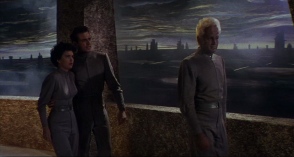
Universal’s This Island Earth was one of the more ambitious science fiction movies of the 50s. It’s been overshadowed by films such as Invasion of the Body Snatchers, The Day the Earth Stood Still and Forbidden Planet but in its own way it’s just as interesting.

It’s also typical of American science fiction movies of that era in its ambiguous treatment of the theme of alien invasion. It’s one of several such movies that suggested that taken invaders might not necessarily be completely hostile, or at the very least that they might have some justification for their actions.

The first half of the movie is especially clever. An electronics engineer, Dr Cal Meacham, at a major laboratory orders a part. The part that arrives is far more advanced than anything he’s ever seen, and the company from which he ordered it denies any knowledge of it. He orders more parts and receives a catalogue ad instructions for constructing an apparatus. He has no idea what this apparatus will do but being an inquisitive kind of chappie he builds it anyway.

It turns out to be a communications device (which he is told is called an interociter) and a guy with a curiously pronounced forehead contacts him and tells him to be at a remote airstrip at a particular time where a plane will take him somewhere where he’ll discover all sorts of interesting things. Now the average person would be pretty suspicious of all this but like he said he’s an inquisitive fellow and so he goes. He’s taken to a laboratory where a group of mysterious people have assembled a team of top-flight atomic scientists.

One of the scientists is, naturally, a beautiful woman. Dr Ruth Adams (Faith Domergue) in fact is an old fame of Cal Meacham’s but strangely she claims never to have set eyes on him before. These scientists do seem to be behaving a bit oddly and several of them have started to suspect that something very strange is behind all this. And they’re right about that. The guys with the big foreheads are of course aliens, from the planet Metaluna.

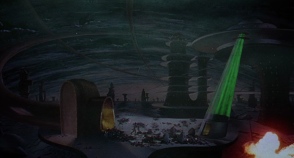
At the halfway point the movie not only switches settings but also switches tone as the aliens are recalled to their own planet. Cal and Ruth are trying to make their escape in a light plane but it’s snared by a tractor beam from the aliens’ flying saucer and they find themselves on the way to Metaluna. And they discover that the aliens aren’t evil, they’re merely desperate. They are engaged in a war with the planet Zagon and they’re losing. The laboratory on earth was part of a last-ditch attempt to find a way to save their civilisation.

This Island Earth was filmed in Technicolor and Universal did their best to give it an epic feel. Mostly they succeeded although the special effects occasionally let them down. The alien planet is rendered mostly with matte paintings and although they look obviously artificial the imaginative nature of the paintings does give an eerie other-worldly feel. Personally I like the use of matte paintings even when they’re obvious. And there are some pretty impressive sets.

There are also some very cool concepts, such as the use of comets and meteors as weapon of mass destruction. That’s the great strength of this movie - the aliens use technologies that seem genuinely alien, rather than death rays and similar gadgets.

The acting is quite passable with most of the players appearing to do their best to take proceedings as seriously as possible.

With an intelligent thoughtful script and plenty of visual imagination this movie represents 1950s Hollywood sci-fi at its best.

Universal’s UK DVD release is coded for Regions 2, 4 and 5 and although there’s a lack of extras it’s a very impressive widescreen transfer and I recommend it unhesitatingly.

Saturday, 17 December 2011

The Earth Dies Screaming (1964)

Terence Fisher will always be best remembered for his Hammer horror films but he made quite a few science fiction movies, including this 1964 effort, The Earth Dies Screaming.

It’s an end of the world movie, an incredibly popular genre at the time. A mysterious gas attack has wiped out most of Earth’s population, but as in any good post-apocalyptic movie there’s a motley handful of survivors. The gas attack has been followed up by an invasion of robot men. We assume they’re from outer space although we never get to see any spaceships.

In fact what the audience sees is exactly what the survivors see. The movie doesn’t tell us or show us anything that is outside of their immediate experience.

The survivors aren’t entirely the sorts of people you’d pick to save civilisation. Jeff Nolan (Willard Parker) is a no-nonsense engineer type and he’s the only one who really has any clue about what to do. Edgar (Thorley Walters) is a nice guy but a total mess, Quinn Taggart (Dennis Price) is completely untrustworthy, there’s a nice young couple who are OK as long as someone tells them what to do but on the whole one feels that these people have the odds stacked against them.

But they’re British and if Hitler couldn’t beat them they’re certainly not going to let a bunch of robots do it.

This movie is in some ways a precursor of the wave of zombie movies that would infest cinema screens in the 70s and 80s. It’s almost a dry run for Night of the Living Dead. The people killed by the robots come back to life as zombies.

This is a very low-budget movie but it’s not unduly hampered by this. The robots look reasonably good, the zombies are distinguished only by their eyes, and Terence Fisher manages to make both seem convincingly menacing.

The acting is adequate enough with Dennis Price being highly entertaining as always.
zombies.

An entertaining enough blend of science and horror.

The Region 2 DVD from Final Cut is a perfectly acceptable widescreen transfer.

Monday, 12 December 2011

The Fly (1958)

The Fly (I’m speaking of course of the original 1958 version) is a rather odd Vincent Price science fiction/horror movie. Price plays a minor supporting role and is neither the villain nor the doomed hero.

The actual hero is Andre Delambre (played by David Hedison although at that time he was calling himself Al Hedison). Andre is a scientist. Not a mad scientist, but a scientist who is dabbling in Things that Science Should Not Dabble In. His current project is teleportation. He has succeeded in teleporting objects over short distances, but with mixed results. Sometimes the objects are reversed during the process. When he tries to teleport his pet cat the results are entirely unsuccessful.

You’d think this would have acted as a warning that maybe this process is rather dangerous but despite this Andre decides to use himself as an experimental test subject. The first attempt is successful, but when he tries to repeat the experiment he unfortunately fails to notice that a fly is in the chamber with him. This is a very unlucky oversight since now his atoms and the fly’s atoms are mixed up. He is part man and part fly, and so is the fly.

Everything would be OK if he could find the fly. He could simply repeat the process and hopefully everything would then come unscrambled. But you’d be amazed just how difficult it can be to find one particular fly again.

The story is told in flashback, with the movie starting with what is actually the horrifying (and very gruesome) end of Andre’s story.

The story is really too ambitious for the special effects that were available at the time, but the story is strong enough to largely overcome that problem.

In most of these scientific hubris movies the scientist is clearly working in areas that raise moral questions about the limits of science, but this one is interesting because Andre is not really doing that. He’s not playing around with the building blocks of life or trying to play God by conquering death or creating artificial life. He’s not doing anything that anyone could raise any valid moral objections to it. So his downfall is brought about purely by bad luck. The most you could say is that he is perhaps being too ambitious.

The story raises potentially interesting questions about what makes us human but it largely ignores such issues. That’s one of the things that that makes David Cronenberg’s 1986 remake a more interesting film.

David Hedison makes a reasonably effective scientist doomed hero. Vincent Price is good as always but the movie doesn’t really give him much opportunity for demonstrating his acting skills. Patricia Owens as Andre’s wife has the most interesting role, a woman facing a murder charge who has to try to convince the sympathetic detective (played by Herbert Marshall) that her strange tale is true and that therefore it wasn’t really murder.

The most emotionally charged scene, the one with the spider’s web, remains affecting despite the rather crude special effects.

While the science is very silly that’s not really the main point of the movie which is more concerned with the tragic fate of Andre and the appalling dilemma faced by his wife, and it’s that aspect that distinguishes it from most other science fiction movies of its era and makes it worth seeing.

Fox’s DVD release is barebones but it’s a decent enough print and preserves the film’s correct Cinemascope aspect ratio.

Friday, 9 December 2011

Shout at the Devil (1976)

Shout at the Devil is an old-fashioned action adventure movie. Even by the standards of 1976 it’s an old-fashioned representative of its genre. And that’s why it’s so wonderfully entertaining.

This is not a movie that wants to deconstruct the action movie. There is absolutely no irony to this film. It’s completely unashamed to be exactly what it is, a rollicking tale of adventure.

Flynn O’Flynn (Lee Marvin) is an American big game hunter in East Africa in 1913. He lives in Portuguese East Africa but he regularly crosses the border into German East Africa in search of ivory. He’s not exactly scrupulous about minor details like laws and borders, and his activities are often quite close to outright thieving. He’s also drunk most of the time, but he’s a happy drunk. He’s your typical loveable rogue, the kind of person the modern world has less and less time for, but in 1913 the world was a different place and such a man as Flynn O’Flynn could thrive in that world.

His latest venture is even less legal than usual and to carry it off he needs to ship his ill-gotten ivory downriver and to do this he needs an Englishman so he can maintain the fiction that his vessel is operating under the British flag. That’s where Sebastian Oldsmith (Roger Moore) comes in. Oldsmith is conned into participating but in fact he’s a bit of a rogue himself. Before falling in with O’Flynn he was on his way to Australia, his family having raised the passage money. They wanted him as far away as possible. Oldsmith and O’Flynn make perfect partners.

For Oldsmith there’s another attraction, O’Flynn’s beautiful daughter Rosa. He and Rosa are soon married and Sebastian is happily settling into a life of big game hunting and assorted illegal ventures. But O’Flynn and Oldsmith have a nemesis - Commandant Fleischer, the German military governor in the neighbouring portion of German East Africa. O’Flynn and Fleischer have clashed many times in the past and they hate each other with a venom that increases day by day.

On one of their jaunts into German territory O’Flynn and Oldsmith have their first encounter with the German battlecruiser Blücher when it rams and sinks their dhow.

The declaration of war in 1914 gives Fleischer the excuse he has always wanted to cross the frontier and settle accounts with the troublesome O’Flynn. The tragic results of this expedition will seal Fleischer’s fate as O’Flynn and Oldsmith vow to hunt him down and kill him. As it happens their quest for revenge dovetails quite nicely with the Royal Navy’s plans. They believe the Blücher is taking refuge in an East African river and they want it sunk but they have no warships in the vicinity powerful enough to take on a battlecruiser, so O’Flynn and Oldsmith are recruited to do the job by sabotage, a task they can combine with revenge since Fleischer is believed to be on board.

The first two-thirds of this movie is pure silly fun with a nice mix of action and humour. It then takes a rather darker turn as it moves towards its apocalyptic climax but the excitement doesn’t let up.

The miniatures work is very impressive, as you’d expect when the man responsible for it is Derek Meddings, who started out on Gerry Anderson’s 1960s puppet adventure series and moved on from there to the Roger Moore James Bond movies.

Lee Marvin and Roger Moore make a great team. They might be rogues but they’re still the good guys and we want them to win. Rene Kolldehoff is delightfully over-the-top as Fleischer. Fleischer is not exactly a subtle villain, but this is not a movie that is overly worried about subtlety.

This is one of the most politically incorrect movies you’re ever going to see, a movie that could not possibly get made today. So that’s another point in its favour.

Umbrella Entertainment’s Region 4 DVD release is an uncut widescreen release and while the picture quality isn’t sensational it’s quite reasonable. It appears that some of the other DVD releases of this movie have been savagely cut and are very poor quality so the Umbrella disc is probably the one to go for. I suspect that online reviewers who complain about this movie’s supposed incoherence have only seen the cut version because the full version certainly cannot be accused of such a fault. It might be far-fetched but it all makes perfect sense.

This is a movie to enjoy for what it is. On its own terms it succeeds admirably and it’s thoroughly enjoyable.

Tuesday, 6 December 2011

S.O.B. (1981)

Blake Edwards made some amazingly popular and well-loved movies but personally I don’t find those movies all that interesting. You couldn’t pay me to sit through one of the Pink Panther movies again. For me his most interesting works were those that were most reviled by the critics, notably Darling Lili. And of course S.O.B.

S.O.B., Edwards’ hate letter to Hollywood, was undoubtedly partly inspired by his unhappy experiences with Darling Lili. Of all the many “I hate Hollywood” movies that have been made over the years by Hollywood film-makers S.O.B. may well be the most bitter of the lot.

Given the fact that one of the stars of S.O.B. is William Holden, also the star of BiIly Wilder’s Sunset Boulevard, this is clearly a movie drawing on a tradition of anti-Hollywood movies.

Felix Farmer is a very successful Hollywood producer. Very successful until the release of his most expensive and most ambitious film, Night Wind. This movie’s opening is the most disastrous in the history of Tinsel Town.

The response of the studio execs is to panic, try to shift the blame elsewhere, call in lawyers and hope that something might be salvaged by recutting the film. It’s all Standard Operational Bullshit, hence the movie’s title. Felix Farmer’s response is to go mad and try to kill himself.

The response of his wife, much-loved incredibly wholesome G-rated movie star Sally Miles (Julie Andrews), is to file for divorce. Until she realises that might do her career even more harm.

Felix finally snaps out of his suicidal depression when he has a revelation. He now knows how to save his movie. The problem with Night Wind was that it was wholesome and sweet and G-rated. If Felix can turn it into a soft-porn movie it will be a huge success. And he has an even more brilliant idea. Imagine if he could persuade his dear wife Sally Miles to do a nude scene. That would have to be worth a couple of hundred million at the box office.

Of course Sally Miles has exactly the sort of screen image that Julie Andrews had in real life so she’s absolutely horrified by the idea. On the other hand she’s even more horrified by the prospect of losing a great deal of her own money if Night Wind cannot be turned into a hit. So she agrees.

S.O.B.’s humour is dark, vicious, bitter and vindictive, but it is undeniably funny. Blake Edwards, who wrote the screenplay as well as directing, was never particularly subtle when it came to comedy and this time around he adopts a sledge-hammer approach to satire. But given that his target is Hollywood perhaps nothing short of a sledge hammer would do the trick.

There’s a galaxy of stars in the supporting cast. Overloading a movie with stars can be a recipe for disaster but mostly they do a fine job. The standout performer is Robert Preston as dissolute Hollywood doctor Dr Irving Finegarten. Robert Vaughn as the sleazy studio chief and Loretta Swit as the toxic gossip columnist are both amusing. Shelley Winters and Larry Hagman add to the fun. William Holden makes a splendid cynical drunk.

Richard Mulligan is convincingly unhinged as Felix while Julie Andrews has fun trashing her own image.

While it’s mostly notorious as being the movie in which we get to see Mary Poppins bare-breasted this is a thoroughly enjoyable if somewhat out-of-control ride and I recommend it.

The Region 1 DVD is bereft of extras and is somewhat difficult to find. There’s a European DVD release floating around as well but it appears to be a heavily cut version so the Region 1 disc is the one to go for.

Saturday, 3 December 2011

Magic (1978)

Magic is an evil-ventriloquists’-dummy movie. The problem with evil-ventriloquists’-dummy movies is that they’re fairly predictable, and Magic is more predictable than most.

The only real question with such movies is whether the dummy represents some supernatural force or whether it represents a part of the ventriloquist’s own personality. Whichever option the film-maker chooses the plot will hold few surprises.

In this case we have Corky Withers (Anthony Hopkins) who has spent years being a magician’s assistant before finally summoning up the courage to try to make it on on his own. His first attempt is a disaster and he not only bombs he also loses his cool and insults the audience. This is our first clue that Corky may be a little unstable and it comes much too early.

Within a year Corky has become a modest success, a success that is entirely due to his new partner Fats. Fats is a ventriloquist’s dummy, but his foul-mouthed hyper-confident persona provides the perfect foil to Corky’s insecure, painfully shy and socially inept persona.

Corky’s success has gained him an agent, Ben Greene (Burgess Meredith). Greene is confident he can take Corky from his present level of success to the next level - success in the world of network television. The prospect of success terrifies Corky and he flees back to his home town. When he gets there he encounters his high school sweetheart Peg (Ann-Margret). He’s never forgotten he and she’s never forgotten him.

Corky and Peg rekindle their high school romance but unfortunately Peg now has a husband. It’s not just an awkward romantic triangle, it’s a romantic quadrangle, since Fats is every bit as jealous as Peg’s husband. Ben Greene manages to track Corky down in his rural hideaway and is horrified to discover that Corky is totally out of control. He wants Corky to seek psychiatric help and in one of the movie’s more memorable scenes he challenges Corky to keep Fats quiet for five minutes. Corky is of course unable to do so.

The Corky/Fats relationship spirals further and further out of control while the return of Peg’s husband puts even more pressure on Corky.

Not unexpectedly all this eventually leads to violence, murder and madness.

The first choice for the role of Corky was Jack Nicholson, but Anthony Hopkins shows he can overact every bit as outrageously as Nicholson. It’s a bravura performance but the weak point to it is that Corky is really not a very sympathetic character. Luckily Ann-Margret is on hand to lend the movie some much-needed balance. She provides the emotional core of the movie because she’s the only character who is even halfway to being a decent human being. She’s an underrated actress and she gives a splendid performance.

Burgess Meredith is never less than entertaining and he has a lot of fun as the brash agent with a love for enormous cigars. The relationship between Corky and Greene is one of the more successful elements in this movie.

As for Fats, the idea of having a foul-mouthed ventriloquist’s dummy must have seemed terribly clever back in the 70s but it’s an an idea that gets old very quickly.

Richard Attenborough is one of Britain’s greatest actors but as a director he’s less than inspired although certainly competent.

Magic fails to produce the necessary cinematic magic to make its story truly compelling and the horror is all too predictable. As an exercise in psychological horror it lacks impact since Corky is clearly not playing with a full deck even before the arrival of Fats.

Umbrella Entertainment’s Region 4 DVD is full frame and generally unimpressive and cannot be recommended under any circumstances.

Thursday, 1 December 2011

Mr Sardonicus (1961)

William Castle may have been the master of the gimmick and may well have been greater as a showman than as a director but his 1961 offering Mr Sardonicus demonstrates that he could produce the goods when needed.

He’s helped considerably by the writing. Ray Russell wrote the screenplay based on his own novella and it manages to avoid the worst clichés of the gothic horror genre while at the same time being a very effective gothic chiller.

It is 1880 and Sir Robert Cargrave (Ronald Lewis) is a celebrated London physician who has achieved outstanding success with cases of paralysis. He receives a letter from the woman with whom he had been in love. She is now married and living in central Europe. Her husband is Baron Sardonicus and he owns a castle but apparently all is not well. The message leads Cargrave to believe that the Baroness may be in real danger.

His arrival in central Europe leads us to expect a typical gothic horror plot. The villagers warn him to keep well away from the castle; they are clearly terrified of the Baron. He is met at the railway station by one of the Baron’s retainers, a man who fulfills all our expectations of gothic horror servants. Krull (Oskar Homolka) is a shambling one-eyed rather sinister character who speaks of his master in suitably awed and mysterious tones.

When he gets to the castle itself he is in for several shocks. Firstly there is a servant woman covered in leeches, the victim of what appears to be some ghastly medical experiment. Sir Robert is a modern doctor who does not approve of the use of such antiquated methods. The Baron himself provides another shock, with his face covered by a mask. When the mask is removed it reveals a face permanently frozen into a hideous grimace, a grimace so severe that he can take only liquid nourishment.

The explanation for this disfigurement reveals a shameful secret involving grave robbing.

It is clear that Baron Sardonicus and his wife are not having normal marital relations and that the Baron is indulging his passions with unfortunate peasant girls.

Sardonicus himself was responsible for luring Sir Robert to his castle - he hopes the eminent physician can cure him. It is not merely his body that requires curing - his disfigurement has made him violent, cruel and unpredictable. The cure proves to be more difficult than expected and Cargrave is blackmailed into using dangerous and untried methods.

It’s not a William Castle movie without a gimmick. This time it’s the Punishment Poll. Just before the end of the movie Castle himself interrupts proceedings to conduct a vote by the audience. Those attending the movie had been issued with a card with which they could vote on whether Sardonicus had been sufficiently punished for his misdeeds or whether further punishment was required. In fact only one ending was shot - Castle assumed that no horror movie audience would vote for mercy for the villain!

Where the movie departs from gothic horror cliché is in the role of the scientist/doctor. We expect either a mad scientist or at the very least a dangerously deluded and misguided scientist whose work leads to evil. In fact in this story the scientist is unequivocally the hero. It’s difficult to think of another gothic horror flick in which science is presented in such a positive light.

The movie is also somewhat unusual in that it not only avoids supernatural explanation, it also avoids fanciful science fictional explanations. The entire case is shown to be a perfectly realistic example of extreme psychological states, of pathological guilt in fact. There are no real monsters, only a man made monstrous by a combination of misfortune and of his own actions.

Ronald Lewis is a likeable hero, Guy Rolfe is suitably creepy as Sardonicus and Oskar Homolka steals every scene he’s in.

Castle was not an inspired director but he was thoroughly competent and he knew what audiences wanted. Mr Sardonicus is not a great movie but it’s very entertaining indeed.

Columbia have done William Castle proud with their boxed set of his movies. The transfer is superb.