Thursday, 26 February 2015

The Italian Job (1969)

My review of the deliriously entertaining and offbeat British crime thriller/heist movie The Italian Job (1969) starring Michael Caine, Noël Coward and Benny Hill can be found at my other movie blog, Classic Movie Ramblings.

This movie is sheer fun from start to finish and of course it features one of the all-time great car chases.

Monday, 23 February 2015

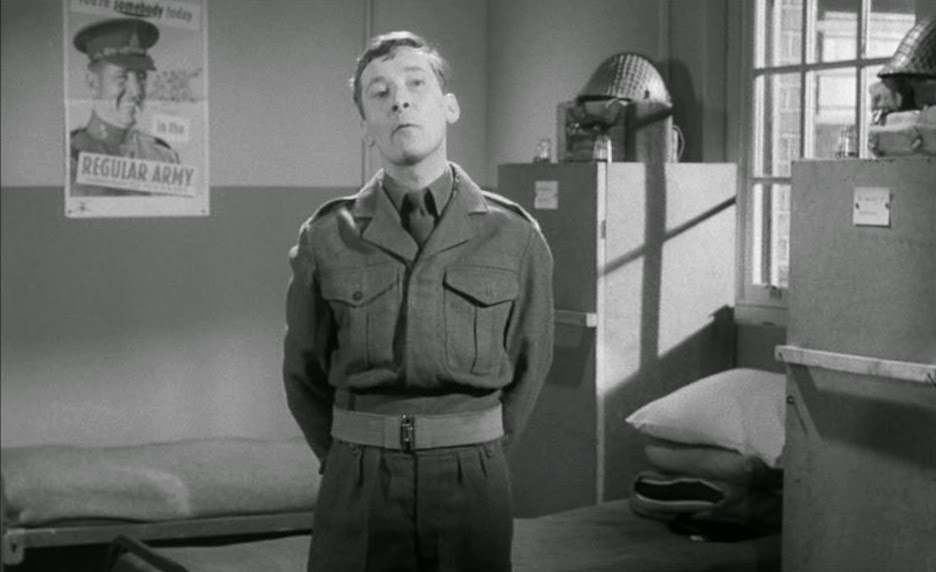
Carry On Sergeant (1958)

Carry On Sergeant was the movie that started the Carry On series. As is often the case with the first movie in a long-running series this one differs a little from the later Carry On movies.

For one thing it’s rather more plot-driven and the two major plot strands are taken fairly seriously rather than being just an excuse for a series of gags.

The first thing viewers will notice is that while quite a few of the Carry On regulars are here they’re mostly in secondary roles. Only Kenneth Connor has a really major role. Charles Hawtrey, Kenneth Williams and Hattie Jacques are all consigned to relatively minor roles among the supporting cast.

Sergeant Grimshawe (William Hartnell) is about to retire from the army after many years training National Servicemen. In all those years not one platoon he has trained has won the coveted Champion Platoon trophy. He is determined that his final platoon will win that honour. It’s not just the glory - he also has fifty quid riding on the outcome and fifty quid in 1958 was a lot of money.

Unfortunately the new recruits in Able Platoon are a particularly sorry lot. Private Golightly (Charles Hawtrey) is chronically unable to keep his mind focused on any soldierly duties. Private Charlie Sage (Bob Monkhouse) is too busy thinking of his beautiful new wife Mary (Shirley Eaton) to give much attention to the military virtues. Private Horace Strong (Kenneth Connor) is a hypochondriac who spends most of his time in the office of the camp doctor, Captain Clark (Hattie Jacques). Private James Bailey (Kenneth Williams) is an effete snobbish university graduate who makes no attempt to disguise his contempt for the Army. The other misfits in Able Platoon include a guitar-playing beatnik. And then there’s Private Herbert Brown (Norman Rossington) who has failed the army’s basic training course on no less than three occasions and has the reputation of being the worst soldier anyone has ever encountered.


Only Private Heywood (Terence Longdon) seems to have potential but he lacks any real interest.

The other major sub-plot concerns Private Sage’s attempts to find a way to spend his wedding night with his new bride. He had received his call-up papers on his wedding day. It’s the sort of sub-plot that would have given rise to a great deal of risqué humour in the later Carry On movies but it’s handled surprisingly delicately here. But then this was 1958 and there was only so much one could get past the censor.


Service comedies were very popular in the 1950s and this movie adheres fairly closely to the established formula with the long-suffering sergeant having to deal with totally inept recruits. Carry On Sergeant does vary the formula just a little though. You expect the sergeant to be a martinet who tries to make the lives of the recruits as miserable as they’re making his life but that doesn’t happen here. Sergeant Grimshawe might be a martinet by inclination but in his desperation to win that fifty quid he’s decided to try a completely different approach. He’s going to treat these recruits with gentleness, sensitivity and understanding. He’s going to be a kindly father figure instead of a stern authority figure. He doesn’t really think it will work but fifty quid is fifty quid and it’s worth a shot.

You might think this would diminish the comic possibilities but it doesn’t. If anything it enhances them since Grimshawe’s exasperation with their bumbling incompetence is even more amusing when he’s trying so hard to be Mr Nice Guy.


William Hartnell had appeared in ITV’s hugely successful service comedy sitcom The Army Game, which had inspired a spin-off movie made by Hammer Films, I Only Arsked. Hartnell was not in the Hammer movie but its cast did include a couple of Carry On regulars, Bernard Bresslaw and Charles Hawtrey. Carry On Sergeant was clearly an attempt to jump on what seemed to be a very popular bandwagon. It proved to have been a shrewd movie. Carry On Sergeant was a major box-office hit.

Perhaps the biggest surprise in Carry On Sergeant is Kenneth Williams. The superciliousness is there, and in fact most of the elements that would make so immensely popular in the later movies of the series are there, but he had not yet learnt how to make the most of those elements. Most importantly he had not yet discovered the joys of total excessiveness. His performance is very subdued and very restrained. At times he almost seems to be trying to give a serious dramatic performance.


While the later Carry On regulars in this film are mostly in supporting roles it’s easy to see why they would soon be promoted to bigger roles in subsequent movies in the series. They’re the best things in this movie.

Despite a few mis-steps and a few slow moments this is still a very enjoyable movie and it has plenty of genuine laughs. It’s also a remarkably good-natured movie. The ending has a touch of sentimentality to it that you certainly don’t expect in the irreverent world of the Carry On movie. The series had not yet hit its stride but this was a promising start. Recommended.

Wednesday, 18 February 2015

Unearthly Stranger (1963)

Unearthly Stranger is a modestly budgeted but quietly creepy little 1963 British science fiction movie.

Project TP91 is a top-secret British research project investigating the possibility of a revolutionary method of space travel. The idea is to harness mental energies to enable a kind of high-tech astral travelling. This would allow someone to make a psychic voyage to another planet and then to physically materialise on the distant planet. It might be a nutty idea but it’s certainly intriguing and original and Rex Carlton’s screenplay develops the idea rather cleverly. The outlandishness of the idea makes the movie rather reminiscent of the classic 1960s science fiction television series The Outer Limits.

The story is told in an extended flashback. The opening sequence shows us an obviously terrified man through darkened streets, but what is he running from? The man is scientist Dr Mark Davidson and when he reaches his office he recounts his extraordinary story in the form of a tape recording.

Professor Geoffrey Munro (Warren Mitchell) had been the man in charge of Project TP91, until he met his untimely death. Officially he died of a heart attack. Major Clark (Patrick Newell) from the Security Service knows it was no heart attack. Dr Davidson takes over as head of Project TP91 and pretty soon both he and his boss Professor John Lancaster (Philip Stone), the director of the space research establishment, also know it was not a heart attack that killed Munro.

Major Clark has some other concerns about Project TP91. He is rather worried about Dr Davidson’s new young wife Julie (Gabriella Licudi). He has done a background check on her and it seems that no such person exists, or ever has existed.


Mark Davidson is also puzzled by his wife. She does appear to blink and she also does not appear to have a pulse. He met her just a few weeks earlier in Switzerland and they married after a whirlwind romance. He actually knows nothing whatever about her.

Dr Davidson believes he is close to a breakthrough on the project. In fact he is closer than he thinks to finding an answer but it’s not the answer he  expects, or wants.

Apart from the nifty central idea the movie’s biggest strength is the very fine acting from all the principals. John Neville does well as the increasingly harassed and concerned Dr Davidson. Patrick Newell is a delight as the jovial but shrewd security chief. Philip Stone is excellent as Davidson’s sympathetic but worried boss. Gabriella Licudi is suitably mysterious as Julie while Jean Marsh (a very fine actress) makes the most of a fairly minor role as Davidson’s secretary. 


Director John Krish had a lengthy if not terribly distinguished career. He does a fine job here, wisely opting for an unobtrusive approach that allows the weirdness of the material to tell its on story although he does make occasional and judicious use of techniques such as Dutch angles.

This is science fiction with a dash of horror, but horror done in a moody low-key way.

It’s also the kind of science fiction that works very well on a low budget, where the material is chosen in such a way as to allow intelligent science fictional themes to be pursued without the necessity for elaborate special effects. In fact this film employs no actual special effects at all, because they are not needed. This kind of budgetary constraint can (and in this case certainly does) work in a movie’s favour, encouraging imagination, atmosphere and intelligence rather than spectacle.


The movie was shot widescreen and in black-and-white. 

Both stylistically and thematically it’s slightly reminiscent of Wolf Rilla’s superb 1960 John Wyndham adaptation Village of the Damned. In fact the story itself has some affinities with Wyndham’s work.

Network’s Blu-Ray presentation is  pretty good although I’m not totally convinced that older black-and-white movies really need to be released on Blu-Ray - they usually look just as good on a high quality DVD release. Nonetheless Network are to be commended for making this interesting oddity available to us.

Unearthly Stranger is a quirky little gem of a movie. It’s a very weird idea that is approached with subtlety and restraint and that approach makes it all the more effectively eerie. Highly recommended.

Thursday, 12 February 2015

Countess Dracula (1971)

Countess Dracula was Peter Sasdy’s second Hammer horror film, the company having been quite pleased with his initial effort, Taste the Blood of Dracula. In fact Hammer were so pleased they allowed the Hungarian-born director to choose the next project he did for them. This was to be a movie based on the infamous real-life Hungarian Countess Erzsébet Báthory, generally believed to be the most horrific female serial killer in history. Báthory was accused of the murder of hundreds of young girls and the legend grew up that she bathed in their blood in order to keep her youthful good looks. Erzsébet Báthory is likely to have been one of the main inspirations for central European legends of the vampire.

This was obviously a perfect subject for a horror movie. Sasdy and producer Alexander Paal came up with a treatment which Hammer liked and Jeremy Paul was given the task of writing the screenplay.

Sasdy had done a lot of television work for the BBC including quite a number of successful  adaptations of literary classics. He brought with them a number of key people with whom he had worked at the BBC, including costume designer Raymond Hughes and production designer Philip Harrison. Having worked on very tight BBC budgets they knew how to make a production look lavish without spending very much money. As a result Countess Dracula looks more expensive and more sumptuous than the average Hammer production even though it was made on the usual very parsimonious Hammer budget.

Sasdy brought a rather different and fresh approach to the Hammer gothic horror film and Countess Dracula has a distinctive feel compared to the other Hammer female vampire movies of the 70s. 


The actual facts of Erzsébet Báthory’s life and crimes will never be known with certainty but this movie tries to take a fairly serious historical approach to the subject. In the movie the countess (played by Ingrid Pitt) is an ageing woman who discovers quite by accident that the blood of young girls can restore her youthful appearance. She is a woman who is unwilling to accept the idea of growing old gracefully and once she discovers this secret she is determined to remain youthful forever. Unfortunately the effects of the treatment are only temporary, which means she is going to need a constant supply of virgins (the girls must be virgins or the treatment will not work). To ensure her supply of virgins she enlists the somewhat reluctant help of her steward (and old lover) Captain Dobi (Nigel Green).

The countess is determined to stay young because she has found a new lover, a dashing young hussar officer, Lieutenant Imre Toth (Sandor Elès). This of course does not please Captain Dobi but he is so hopelessly in love with her that she has no difficulty persuading him to aid her.


A possible complication is the imminent arrival of the countess’s daughter Ilona (Lesley-Anne Down). To Erzsébet Báthory her daughter is merely a potential rival so she has to be removed from the scene. Of course it will eventually be impossible to hide the fact that so many young women have been disappearing without trace, and the tensions between the countess, Captain Dobi and Lieutenant Toth are also bound to come to a head.

Ingrid Pitt has to play the countess as both an old woman and a young woman and she does a fine job. The makeup effects work well although Pitt felt (with some justification) that the young countess should have been made to took more convincingly 17th century. Hammer however clearly wanted Pitt to look as glamorous as possible and in box-office terms they were no doubt correct.


Nigel Green was an actor whose self-destructiveness prevented him from achieving the major stardom that his talents deserved. He gives a wonderfully entertaining bravura performance but he also brings out the subtle nuances of Dobi’s emotional and sexual enslavement to the evil countess. Maurice Denham is a delight as the elderly scholar Master Fabio who knows what the countess is up to but whose own motivations are rather murky. The supporting cast is extremely strong and this adds to the feel of quality that this movie possesses.

The sets are magnificent. This is probably the best-looking Hammer movie of the 70s, and it not only looks good it also looks authentically exotic and middle European. The costumes are superb - Nigel Green really does look splendidly imposing in his Hungarian uniform.


Synapse have done a fine job with their Blu-Ray/DVD combo release of this film. The transfer is excellent, there’s a terrific audio commentary featuring director Peter Sasdy, star Ingrid Pitt and screenwriter Jeremy Paul, a documentary on Ingrid Pitt’s career and an audio interview with the iconic horror star.

In the early 70s Hammer tried to breathe new life into their gothic horror cycle with some extremely interesting movies that broke free of the rigid Hammer formula. And they did so rather successfully, in artistic terms at least. Blood from the Mummy’s Tomb, Dr Jekyll and Sister Hyde, Hands of the Ripper, The Vampire Lovers and Vampire Circus were all splendid movies and Countess Dracula is one of their most successful efforts from this period. Highly recommended.

Friday, 6 February 2015

The Naked Venus (1959)

The Naked Venus is something of an oddity. It’s a nudist camp movie but it’s also an Edgar G. Ulmer movie. It bears some similarity to the nudie-cutie genre that would explode in the wake of the release of Russ Meyer’s The Immoral Mr Teas, but it’s not a nudie-cutie. It’s a romantic melodrama with nudity. It’s really in a sub-genre of its very own.

Bob Dixon (Don Roberts) is a young American painter living and working in Paris. He’s just beginning to earn a reputation as an artist with the success of his painting The Naked Venus. He is married, apparently very happily, to Yvonne (Patricia Conelle) and they have a small daughter. Yvonne had been an artist’s model. Bob’s father has just does and he announces that his mother now needs him so they must move to California.

This is where the problems start. Bob’s domineering mother takes an immediate dislike to Yvonne. This dislike intensifies when she discovers that Yvonne had not only been an artist’s model but had posed nude. She is determined to sabotage her son’s marriage.

Eventually Bob and Yvonne become involved in a bitter divorce and custody battle. The odds seem to be stacked against Yvonne - not only was she a nude model she was (and still is) a practising nudist. These are not things likely to count in her favour in court. Even worse, after fleeing from the palatial Dixon family home she has taken refuge in a nudist camp, along with her daughter.


The plot provides ample opportunities for showing nudity and the movie takes full advantage of these opportunities. Nudist camp movies tend to be a bit dull, since not much happens in a nudist camp apart from naked volleyball and one can only take so much naked volleyball. It does help if the nudist camp happens to be full of women who are not only nude but pretty and in this case the women are most certainly pretty. And it has to be said that Patricia Conelle looks very good naked.

Courtroom scenes are generally even duller than naked volleyball but fortunately in this case they’re handled reasonably well.


This was Patricia Conelle’s only movie role and while her willingness to disrobe for the cameras was undoubtedly the major factor in her casting she’s quite adequate. Don Roberts is quite good in a very unsympathetic role while Wynn Gregory drips venom as the scheming and destructive mother-in-law from Hell. It’s Ulmer’s daughter Arianne Ulmer however who walks off with the acting honours, giving a spirited performance as Yvonne’s young but determined lawyer Lynn Wingate.

As you would expect the major theme of the movie is that nudity is not immoral and that being a nudist does not disqualify a woman from being a good mother. Luckily there are some secondary themes that are much more interesting.


There was considerable concern during the 1950s abut the decline in masculinity among American men and about what was seen as the increasing feminisation of American society. This is a theme that appears in quite a few juvenile delinquent movies but it also pops up in some major productions such as Harriet Craig, Rebel without a Cause and Cat on a Hot Tin Roof. The Naked Venus tackles this concern with intelligence and sensitivity. Bob Dixon is definitely a young man with a severe masculinity deficit. Lynn Wingate makes it clear that she despises weak men like Bob and one has to admit that she has a point. Bob has a devoted and beautiful wife but unless he can escape his mother’s dominance he will never be a man and he will never be of any use to Yvonne as a husband.

In the 1950s American exploitation film-makers operated entirely outside the Hollywood system. They were not members of the Motion Picture Association of America (MPAA), they were not bound by the Production Code and they had their own distribution systems. Edgar G. Ulmer had mostly worked for Poverty Row studios that were members of the MPAA but clearly The Naked Venus had no chance of getting a Production Code Seal of Approval and it was in fact produced and distributed as an exploitation movie. On the other hand it was certainly not made as an exploitation movie. Production values are modest but higher than you expect from as an exploitation movie and Ulmer approached the project the way he would have approached any other movie.


While it cannot really be regarded as in any way a typical sexploitation movie it needs to be said that it does contain quite a substantial amount of nudity. Of course given that this is an Edgar G. Ulmer movie the nudist camp scenes are rather professionally shot.

Something Weird Video have paired this movie with a Doris Wishman nudie-cutie (Diary of a Nudist) and it’s a pairing that makes some sense. While nobody in their wildest dreams would suggest that Doris Wishman was in the same class as Edgar G. Ulmer they were both in their very different ways highly individualistic film-makers and both were examples of the opportunities that low-budget movies of that era offered for eccentric and idiosyncratic movie-makers. The transfer of The Naked Venus is quite superb for such a cinematic obscurity.

The Naked Venus works quite well as a melodrama, it makes some pertinent observations on the state of American society (and American manhood) in its day, and it has naked people. It’s really more entertaining than it has any right to be. Recommended.

Friday, 30 January 2015

The Blob (1958)

The Blob is perhaps the most famous of all the science fiction monster movies of the 1950s. It has spawned sequels and remakes and on more than one occasion a television series was even contemplated. It’s one of those movies that crosses the line and becomes a pop culture phenomenon rather than just a mere movie. Does it live up to the hype? In my view, not entirely but it’s still a good deal of fun.

The plot is standard 50s sci-fi fare. A meteorite lands, an old man investigates the meteorite and finds some horrible sticky substance adhering to his arm. A couple of teenagers find him and take to the local doctor who is mystified and alarmed. The sticky goop keeps growing and pretty soon it’s obvious it lives by devouring living creatures and it seems to have a preference for people. It seems unstoppable and the whole town is threatened, in fact if it can’t be stopped the whole world will be menaced. One of the teenagers, Steve Andrews (Steve McQueen in his first major film role), tries to warn the townsfolk of the danger but no-one will listen to one of those crazy teenagers.

The Blob was shot at Valley Forge Studios in Pennsylvania, a small studio specialising in religious films. Director Irvin S. Yeaworth Jr was in fact an ordained Christian minister which caused some slight problems during shooting since he was naturally enough unavailable to work on Sundays due to the demands of his day job. Apart from making enormous numbers of religious films Yeaworth made a couple of other notable science fiction movies including The 4D Man.

For cult movie fans one of the interesting aspects of The Blob is that it’s possibly the first movie to make reference to the “midnight movie” phenomenon. The town’s teenagers are attending a midnight “spook show” at the local movie house. Hardcore cult movie fans will be even more delighted that the movie that’s playing is Daughter of Horror, a bona fide midnight movie classic.


This reference is interesting because The Blob itself is of course part of the same phenomenon, made outside the Hollywood studio system. Producer Jack Harris started his career distributing movies under the states rights system which was a distribution system  completely outside Hollywood and the the MPAA which was used by exploitation film-makers. Harris had tried to interest all the studios, major and minor, in The Blob but eventually decided to go it alone with financing although it was later picked up for distribution by Paramount. The late 1950s saw the majors finally starting to take a reluctance interest in the sci-fi and juvenile delinquent movies made by small studios and independent producers that were making huge amounts of money on the drive-in circuit.

Although The Blob was a very cheap movie compared to mainstream Hollywood fare it was not an ultra-low budget movie. Harris’s idea was that the movie should be made in colour and with reasonably high production values so that it would be able to compete with major studio productions. It was a good strategy and the movie is reputed to have made back its production costs a hundred times over.


One unusual feature of The Blob is that there are no scientists on hand to explain where the blob comes from or to offer suggestions for combating the menace. In fact there are no scientists at all in the movie. This was deliberate - it was felt that to maximise the terror it was desirable to have the townspeople left to deal with the threat without any outside help. This is why there are no air force jets to bomb the blob or army units to offer the usual ineffectual help.

Harris’s idea for the movie was that science fiction and juvenile delinquents were proving to be box-office winners on the drive-in circuit so the obvious thing was to combine the two genres. But with a difference. The juvenile delinquents would turn out to be basically nice kids and would in fact pitch in enthusiastically to help combat the alien menace. Since the movie was going to be aimed to a large degree at teenage audiences it seemed sensible to portray the film’s teenagers in a positive light.


At the time the movie was released Steve McQueen had just landed the lead role in the popular TV western series Wanted: Dead or Alive and his star was very much in the ascendent. This certainly did the movie no harm and helped to contribute to its growing cult status. McQueen was apparently very difficult to work with and had mixed feelings about the movie, sometimes seeming to be quite embarrassed by it although he remained on good terms with producer Harris and director Yeaworth and at times he was driven to admit that the movie had played a large part in launching his career.

The special effects suffer from the inherent goofiness of the monster although some scenes, especially of the Blob oozing through cracks and under doors, are quite effective. This is a movie monster that even at the time was probably going to provoke laughter as often as terror but that of course has been part of the movie’s appeal over the years - it has very high camp value.


The Region 4 DVD release looks terrific with the colours being incredibly bright - at times even perhaps over-bright! It includes not one but two commentary tracks, one featuring producer Jack Harris and the other featuring director Yeaworth and one of the supporting actors. Both commentaries are quite interesting.

The Blob suffers from uneven pacing and it’s really not especially scary. It is however highly entertaining and it has a more polished feel than many of the other 50s sci-fi monster movies. Recommended.

Sunday, 25 January 2015

The Cassandra Crossing (1976)

The Cassandra Crossing is a somewhat surprising movie in more ways than one. It’s not the movie that the title and the posters would lead you to suppose and then having led you to believe that it’s a certain type of movie it switches gears dramatically and becomes a whole different movie.

It’s an action adventure movie that is also a classic 1970s disaster movie, and it’s also a classic 70s paranoia movie.

It starts with a well-executed action scene but you need have no fear that director George P. Cosmatos has shot his bolt early. He has a whole bag of other action scenes up his sleeve. 

Swedish peace activists have raided the headquarters of the International Health Organisation in Geneva. Presumably they were hoping for a few headlines but they ended up getting much more than they intended. Running about a medical facility with automatic weapons is not the greatest of ideas at the best of times (and is possibly not the best way to promote world peace) but it’s a seriously bad idea when the lab areas of that facility house very very dangerous stuff. Dangerous stuff like bacteria and viruses of some particularly nasty varieties, and even worse bacteria and viruses that no-one knows how to control. That’s why they were housed in an ultra-secure facility to begin with.

One of the peace activists is now lying desperately ill in an isolation bed while the other has decamped into the night. The one in the hospital bed seems to be suffering from some form of pneumonic plague, a nasty enough proposition in any circumstances but this strain may not be the regular pneumonic plague. Some of the stuff housed in the International Health Organisation’s facility is rather problematic, to say the least. Stuff like military viruses developed by the US that they were very anxious to destroy. The only problem is, they hadn’t figured out how to destroy them. So why were they housed in Geneva? For the very simple reason that it was supposed to be the safest place where they could only be stored in safety but where scientists could figure out how to get rid of them. 

Now things have obviously gone badly wrong. The US has sent in Colonel MacKenzie (Burt Lancaster), a man whose job it is to work out how to being uncontrollable situations like this back under control. He has the reputation of being very very good at his job, although he also has the reputation of being a man who will do whatever needs to be done, with the emphasis on whatever.


The Swedish peace activist who escaped is now on board the Geneva-Stockholm train. That’s about the only thing that is certainly known, other than the fact that he is almost certainly now the world’s deadliest plague carrier. On board a train with a thousand other passengers.

Among the passengers is Dr Jonathan Chamberlain (Richard Harris), a renowned neurosurgeon on his way to Strasbourg to collect an international prize. Dr Chamberlain’s presence on the train may be the first lucky break for the authorities. Although not necessarily such a lucky break for Dr Chamberlain who is travelling by train because he’s afraid to fly.

Also on board is his ex-wife twice over, Jennifer Rispoli (Sophia Loren). They’ve been married twice and divorced twice but that flame is still burning and they may yet be headed for marriage number three. If they live long enough.


Needless to say the authorities in every single country through which the train is scheduled to pass have categorically refused to allow the train to stop. That would seem to leave Colonel MacKenzie with no options, but there is in fact an option. Poland, despite being behind the Iron Curtain, has agreed to allow the train into Polish territory where it can can be unloaded and the passengers quarantined at a very secure facility. All the train has to do is cross the bridge at a place called the Cassandra Crossing and they’ll be just about home and hosed. In theory. At this point you might be thinking that the film’s title has some significance and that there’s something unusual about that bridge. Bingo.

For the first hour that’s how the movie progresses with the tension slowly being ratcheted up as one by one the passengers start to fall ill with disturbingly pneumonic plague-like symptoms. 


It’s at this point that the movie switches gears. Forget everything I’ve told you so far. That’s not what is going on. Or rather, it’s only a very small and misleading part of what is really going on. I’d only seen one George P. Cosmatos movie prior to this, Escape to Athena, which is an outrageous and delightfully silly WW2 action adventure romp. At first The Cassandra Crossing seems to be a very different type of movie, more of a taut but realistic suspense thriller. Don’t worry, Cosmatos has saved up lots of outrageousness and delightful silliness for the second half of the movie. This train still has a long way to go before it reaches the Cassandra Crossing. There’s time for plenty of mayhem. And mayhem is what we certainly get.

OK, it has to be admitted up front that this is a remarkably silly movie. But then in general silliness is a major asset in a disaster movie. It’s almost embarrassingly easy to poke fun at the gaping plot holes. For starters, the ultra-secure facility in Geneva housing bioweapons has less security than the average neighbourhood convenience store. A team of reasonably motivated pre-schoolers could knock over this facility. And then there’s the major Plot Revelation halfway through. I can’t tell you what it is, but it involves the nature of the infection and it’s a doozy. And these people think they’re scientists?


It’s also one of the most hysterically anti-American movies I’ve ever seen, although allowance has to be made for the fact that it was the 70s and even American movies in the 70s were hysterically anti-American. But this one really goes overboard. In fact the paranoia in general is hopelessly overdone. If you keep increasing the paranoia level eventually it all just seems silly and that’s what happens here. As the paranoia level rises the movie’s credibility sinks.

The cast is what you expect in a mid-70s British-Italian-German big budget co-production. Some biggish international stars (Sophia Loren and Richard Harris), some European stars (Ingrid Thulin and Alida Valli), and (being a disaster movie) it has to have at least one superannuated Hollywood great. In this case it’s Ava Gardner, doing her best but hampered by being teamed up with Martin Sheen in cinema’s all-time unlikeliest romantic coupling. There’s also O. J. Simpson as a priest. Of course we know he’s not really a priest, but what he actually is will give viewers a few giggles. Plus Method Acting guru Lee Strasberg, demonstrating once again that Method Acting is pretty much indistinguishable from old-fashioned hamminess.


Co-producer Sir Lew Grade probably understood television better than any man who’s ever lived. Unfortunately he didn’t understand movies at all and his involvement in this project is convincing proof that he should have stuck to television. 

So all in all The Cassandra Crossing is very silly indeed. It’s also undeniably fast-moving and it has plenty of action although the one mistake you don’t want to make is to think about anything you’re seeing. Once you do this the spell is broken and it’s just completely unbelievable. It lacks the delightful insanity of Airport 1975 or the even crazier Airport '77. Either way it’s kind of fun, in that manner peculiar to spectacularly bad 70s disaster movies.