Monday, 16 March 2015

Marooned (1969)

Marooned is one of those big-budget movies that seem to have everything going for them but still manage to fail at the box office. In 1969 space exploration was generating unprecedented interest and a science fiction movie dealing directly with the US space program must have seemed like a surefire winner.

The Ironman One spacecraft is about to be launched. The three astronauts on board are to spend the next seven months living and working in the Saturn IV space station. Jim Pruett (Richard Crenna) is the mission commander, Buzz Lloyd (Gene Hackman) is the pilot and Clayton Stone (James Franciscus) is the science specialist. The launch goes off without a hitch. After five months the astronauts are showing signs of fatigue so the head of the manned space program, Charles Keith (Gregory Peck) decides to bring them down. It’s no big deal. The mission has been a success and has helped to pave the way for more ambitious future missions. Everyone is pleased and the astronauts are looking forward to seeing their families. 

And then disaster strikes. The retro rockets fail to fire. A second attempt is made on the next orbit, again unsuccessfully. On the ground technicians have been working feverishly to find some reason for the failure but they can find no explanation whatsoever.

Without the retro rockets there is no way of slowing down the spacecraft for re-entry. The three astronauts are doomed to remain in Earth orbit until the orbit finally decays (in about seven years’ time) and the spacecraft falls to Earth as a fiery meteor. The astronauts will however not have to worry about that. They will be dead long before. In fact they have enough air for only another 42 hours.

Charles Keith is shaken but he has always understood the risks of space exploration and he knows that the three men in Ironman One understood those risks just as clearly. Sometimes progress has to paid for and sometimes the price is high.


Chief Astronaut Ted Dougherty (David Janssen) does not see it that way. Those three men are still alive and they cannot be allowed to die without some effort being made to rescue them. The Russians are willing to help but unfortunately their only available spacecraft is in the wrong orbit and cannot reach the men in Ironman One. Dougherty however is not giving up.

Keith tries patiently to explain that a rescue mission would take weeks to organise. Dougherty believes it could be done in 42 hours. The Air Force agrees that it would be extremely difficult but they think it could be done. There is no spacecraft available but the Air Force has an experimental craft that could be modified to do the job. Keith is finally convinced and then throws himself wholeheartedly into the rescue effort. It’s a race against time, and also a race against the weather with a hurricane heading for the Florida coast. Can the rescue mission be launched before the hurricane hits?


The major criticisms directed at this movie are that it is too slow and too dull. This is not entirely fair and seems to be based on a misunderstanding of what director John Sturges was trying to do. Sturges was something of a specialist in thrillers but his thrillers tended to be cerebral and character-driven and ideas-driven rather than just shoot ’em ups with lots of explosions. Sturges had directed the mega-hits The Great Escape and The Magnificent Seven as well as the very underrated The Satan Bug and Ice Station Zebra and he would go on to helm one of the best action thrillers of the 70s, The Eagle Has Landed. This was a guy who knew what he was doing. He wanted to make a movie that would rely on tension rather than explosions and his movies tended to be fairly long. He liked the slow burn approach.

Marooned certainly has plenty of tension and Sturges maintains that tension very effectively. 


It has also been criticised for the one-dimensionality of the characters but again I disagree. We don’t learn very much about the lives of the characters although we know that all three astronauts are married and have children. We don’t need to know details. What Sturges is interested in is how these men handle the very stressful situation they’re in, and how each of them responds differently. There’s a nice little scene where the astronauts are discussing a psychologist who tested them during their training. One of his tests was to show each man a blank sheet of paper and ask them what they saw. Pruett saw a blank sheet of paper. He’s not an imaginative guy and he just likes to get on with doing stuff. Stone saw a blank sheet of paper as well but he explains that it wasn’t a lack of imagination - it was a commitment to truth. Stone is the kind of guy who accepts reality, whether it’s pleasant or unpleasant. Lloyd on the other hand saw a field covered in snow and he saw the growing wheat beneath the snow and he saw the snow melt. Lloyd is a man who has a great deal of imagination, which can be an advantage but it can also be a liability. He has perhaps too much imagination. The scene gives us crucial insights into what makes the three men tick and it does it economically.

Crenna, Hackman and Franciscus handle their roles well without being tempted into overacting. Gregory Peck plays a guy who has had to take responsibility for the lives of the men under his command and to do that he has to judge situations coldly and clinically. It’s not that he has no motions but making decisions based on emotions can cost people’s lives so he represses those emotions. It’s a nicely understated performance by Peck and he’s utterly believable and he isn’t concerned if the character comes across as being not overly sympathetic. David Janssen does quite well also although in a less demanding  role.


The special effects are of their time but they work pretty well. This movie was probably unlucky in coming out a year after Kubrick’s 2001: A Space Odyssey set new standards for science fiction special effects. The miniatures work in Marooned is very competent but not in the same league as the effects in 2001.

The Region 4 DVD is barebones but the anamorphic transfer is acceptable.

Marooned does what it set out to do quite effectively. It’s closer in feel to a movie like Morning Departure (the classic movie about men trapped in a doomed submarine) than it is to Star Wars. If you accept Marooned on its own terms it’s a tense and effective movie. Recommended.

Wednesday, 11 March 2015

The Strange Case of Dr. Jekyll and Mr. Hyde (1968)

Robert Louis Stevenson’s 1886 novella The Strange Case of Dr. Jekyll and Mr. Hyde is one of the classics of Victorian gothic fiction. There have been countless movie and television adaptations of the novella. This 1968 US-Canadian made-for-TV movie is one of the more disappointing adaptations although not entirely without interest.

Dr Henry Jekyll (Jack Palance) is a distinguished London physician whose latest researches have aroused the ire of the medical and scientific establishment. Dr Jekyll believes every man has within him two conflicting sides of his nature, one good and civilised and one savage and animal. 

Dr Jekyll naturally uses himself as the guinea pig in his research and his potion unleashes the dark side of his nature in the person of Mr Edward Hyde. Hyde lives purely for pleasure and instant gratification and resorts to violence at the slightest provocation. Even worse, he enjoys inflicting violence.

His friends grow increasing worried about Henry Jekyll. Dr Lanyon (Leo Genn) had misgivings about Jekyll’s experiments right from the start. Jekyll’s solicitor and friend George Devlin (Denholm Elliott) stands by him despite his concerns.

Mr Hyde acquires a mistress, Gwyn (Billie Whitelaw), a dancer and singer in a very low-class music hall. He sets her up in a flat in Greek Street. Gwyn was initially attracted by Hyde’s wildness but soon the violence becomes too much for her. Escaping from Hyde is however no easy matter. She is aware that he has already committed several murders. The police are on Hyde’s trail but he seems to have the ability to vanish without trace.


Jekyll knows that Hyde is becoming uncontrollable but his own life is increasingly difficult and he finds that he can use Hyde to solve some of these difficulties.

Of course Dr Jekyll eventually discovers that Hyde is entirely out of control and events move to their inevitable conclusion.

There have been so many screen versions of the story that even by 1968 another adaptation could scarcely be justified unless it added something significant or took a fresh new approach to the material. This TV-movie does this to a limited extent. Of course by 1968 horror movies were becoming obsessed by sex and so making the mainspring of the action Dr Jekyll’s repressed sexual longings, something that seemed fresh and exciting at that time, now seems rather hackneyed. This production takes the line that not only does Hyde represent Jekyll’s repressed sexuality, this sexual obsession also (at least partly) explains why  Hyde is eventually able to become the dominant part of his personality.


A more interesting twist is that far from being a kindly dedicated scientist led astray by scientific hubris Dr Jekyll is portrayed as being very much responsible for his own downfall. He deliberately and consciously uses Hyde to commit crimes that he wants to commit but that he lacks the courage to execute himself. He is in his own way as evil as Hyde (a point made explicit by George Devlin late in the film).

This slightly novel approach is aided by the choice of Jack Palance to play the dual roles of Jekyll and Hyde. Palance makes Dr Jekyll a somewhat sinister character. He is short-tempered, arrogant, selfish and even vindictive, qualities that he just barely manages to conceal. The downside of this is that it makes Dr Jekyll a thoroughly unsympathetic character and weakens the tragic element in the story. There is also a very real problem with Palance’s acting as he is entirely unable to convey and good qualities that Dr Jekyll might possess. As a result Dr Jekyll/Mr Hyde becomes not a character split between good and evil but a character split between a very evil side and a lesser evil side.


Even as Jekyll Palance is histrionic but once he becomes Hyde his performances crosses the line into full-blown hysteria. The idea of emphasising that the evil of Hyde is inherent in Jekyll is a good one but it needed a better more controlled actor to make it work.

The supporting case is adequate with Denholm Elliott being as reliable as ever. Billie Whitelaw gives a shrill rather one-note performance which makes it impossible to feel much sympathy for her, which means the audience is left without anyone to care about apart from the faithful Devlin.

This is very much a made-for-TV movie, visually uninteresting and rather slow. Director Charles Jarrott spent most of his career in television. He made a few features in the late 60s and early 70s only to disappear back into relative obscurity. There’s nothing in this fairly pedestrian production to suggest that he had any great ability.


The makeup effects are wisely not overdone and Hyde looks human (although his eyebrows are a bit Star Trek-ish). This is a definite point in the movie’s favour.

Rod Serling was to have been the screenwriter but departed from the production at an early stage (to be replaced by Ian McLennan Hunter), and the lack of the trademark Serling preachiness is another point in the movie’s favour. Dan Curtis was the producer and it does have a rather Dan Curtis look to it.

I personally think the 1920 silent version with John Barrymore is the best adaptation of Stevenson’s novella. I think the 1932 Fredric March version is overrated. Hammer did two versions of the story, the underrated Terence Fisher-directed The Two Faces of Dr Jekyll (1960) and the unconventional and extremely interesting 1971 Dr Jekyll and Sister Hyde. Walerian Borowczyk’s bizarre 1981 Dr Jekyll and his Women also emphasises Jekyll’s complicity in Hyde’s evil and is worth a look (and it does have Udo Kier which is always a plus).

On the whole a rather disappointing movie that might have worked with a better lead actor. Possibly worth a rental if you have a greater tolerance for Jack Palance than I have.

Friday, 6 March 2015

Tarzan’s Greatest Adventure (1959)

Tarzan’s Greatest Adventure, released in 1959, was notable as being one of the few attempts to bring Tarzan to the screen in a form that was reasonably faithful to Edgar Rice Burroughs’ conception of the character as delineated in his novels beginning with Tarzan of the Apes in 1914. Burroughs’ Tarzan was not a wild man who could barely speak intelligible English. He was literate and although his education was spotty he was certainly not an uneducated man. He was genuinely a man caught between two worlds but the key to understanding the character was that he was quite capable of existing in both worlds. His understanding of the jungle was profound but he understood the ways of civilisation perfectly well.

In some ways this makes the rôle more of a challenge to an actor since he has to make both sides of Tarzan convincing. Gordon Scott does a very creditable job of doing just that.

This movie is also noteworthy for its very strong cast overall with Anthony Quayle being being particularly good as the sinister Slade. A pre-James Bond Sean Connery is quite entertaining as the ruffian O’Bannion.

There is no Jane in this movie but Tarzan does acquire (much against his will) a sort of female side-kick in the person of the glamorous but cynical Angie (Sara Shane).


The movie starts with a robbery by a group of what appear to be natives (although we will soon discover that they are in fact white men). The robbery ends with a couple of brutal murders and this sets the tone for the film - this is to be no light-hearted jungle adventure romp.

Slade (Anthony Quayle) and his villainous cohorts carried out the robbery, their object being explosives. They will need the explosives when they reach the diamond mine which is their real objective. Kruger (Niall McGinnis) is a somewhat sleazy German who may or may not be an ex-Nazi. Slade needs him because although he doesn’t know too much about mining but he does know about diamonds and he knows how to cut the stones. Dino (Al Mulock) provided the boat, an essential requirement if they are to reach the mine. O’Bannion (Sean Connery) is there to provide muscle. The fifth member of the party is Slade’s girlfriend Toni (Scilla Gabel). 


Tarzan and Slade have encountered each other before. Tarzan’s objective is to bring the murderers to justice but he has a personal motivation as well, having experience of Slade’s treachery and viciousness. Slade is well aware that Tarzan is a very dangerous enemy. It’s four men against one but Slade realises that those odds may not be enough when dealing with Tarzan.

While Slade’s party sets off upriver to reach the mine Slade knows that they are the quarry and Tarzan is the hunter.

Tarzan acquires a companion when daredevil pilot Angie, who was amusing herself by showing off her flying skills while Tarzan paddled his canoe, gets a bit too clever for her own good and crashes her aircraft. There’s no time to take her back to civilisation so Tarzan reluctantly accepts that she will have to accompany him.


Another very unusual feature for a Tarzan film is that it was shot partly on location in Kenya. This adds verisimilitude and while the scenes on the river necessarily involved quite a few process shots they’re very well done. It might not have been a very big budget movie but it looks impressive. 

There’s no shortage of action either. British director John Guillermin had a lengthy and fairly interesting career which included one of the best air war movies ever made, the criminally underrated The Blue Max. He would also helm a much later jungle adventure movie, the enjoyably camp Sheena: Queen of the Jungle. Guillermin handles the action scenes well. Not having a huge budget made it difficult to stage spectacular action set-pieces so Guillermin instead relies largely on the tension inherent in Tarzan’s hunting of his deadly human quarry (who is also trying to hunt him).

There’s a pleasing absence of comic relief. Guillermin keeps things focused and he keeps the pacing tight.


The Warner Archive made-on-demand DVD is more than satisfactory, providing a fine anamorphic transfer. Image quality is generally reasonably crisp and the colours are pleasingly vibrant without being excessive. 

Tarzan’s Greatest Adventure offers us a much more interesting than usual Tarzan. There’s  some terrific acting from Anthony Quayle (an actor who could play heroes or villains with equal effectiveness and in this instance gives us a very nasty villain with a bit of depth). While Gordon Scott is good as Tarzan he’s overshadowed a little by Quayle, who has the advantage of being the villain (it’s always easier to play an entertaining villain than an entertaining hero) and of course Quayle was a very experienced and very distinguished actor. The supporting players are all very competent. The story is pretty basic but it’s very well executed and there’s plenty of excitement. Highly recommended.

Monday, 2 March 2015

Black Magic (1949)

The Count Alessandro di Cagliostro (1743-1795) is a fascinating historical figure. An occultist, a Freemason, an accomplished charlatan, a swindler and adventurer, he was certainly no count and was probably born Giuseppe Balsamo. His colourful life naturally attracted the attention of writers of fiction. Alexandre Dumas, père featured Cagliostro in two of his novels in the 1840s and the 1949 Italian-US movie Black Magic takes Dumas’ stories as its starting point.

Cagliostro’s involvement in the Affair of the Diamond Necklace, a scandal which did much to damage the reputation of Queen Marie Antoinette and to set the stage for the French Revolution, provides the main thrust of Charles Bennett’s screenplay. The movie plays fast and loose with history although not having read Dumas’ novel I can’t say whether the historical inaccuracies were the fault of Dumas or Bennett. 

The movie begins with the execution of two gypsies for sorcery. Their son Joseph Balsamo witnesses their executions and is flogged. He was sentenced to be blinded as well but is rescued by the gypsies. Balsamo grows up determined to exact vengeance from the Viscount de Montagne, the man who ordered his parents’ execution.

Grown to manhood, Balsamo (Orson Welles) makes his living as a carnival illusionist and purveyor of patent medicines. Balsamo’s ability to convince a woman who is in great pain that she is actually experiencing no pain at all attracts the attention of Franz Anton Mesmer, the scientist who was the first to describe the the phenomenon of hypnosis (which he called animal magnetism). Mesmer realises that Balsamo has an extraordinary natural gift that could make him a great healer. Balsamo is more interested in using his gift to turn a profit for himself.


Before long Balsamo has metamorphosed into the Count di Cagliostro and has used his abilities to gain fame and fortune. A chance encounter with a young woman named Lorenza (Nancy Guild) will have fateful consequences. Lorenza just happens to be the spitting image of the Princess Marie Antoinette and this resemblance has attracted the notice of none other than Cagliostro’s old enemy the Viscount de Montagne who is involved in an elaborate plot with King Louis XV’s official mistress Madame du Barry (Margot Grahame) to discredit Marie Antoinette. Cagliostro senses the opportunity to enrich himself and to gain his revenge on the Viscount de Montagne. What he hasn’t counted on is falling in love with Lorenza, a love which becomes an obsession and a love which the lady most emphatically does not reciprocate. 

Cagliostro’s plottings rely on his ability to bend people to his will. Mesmer’s theories of animal magnetism were rather more occult than the modern science of hypnosis and the movie credits Cagliostro with powers that are closer to outright mind control than to modern notions of hypnosis. Cagliostro can force people to do just about anything, even things they very much do not wish to do.


It’s all very melodramatic and far-fetched but then the career of the real life Cagliostro was very melodramatic and far-fetched. Producer-director Gregory Ratoff handles the material with a certain amount of panache. This is one of the many movies in which Orson Welles is not credited as director but probably did have a hand in the directing and some of the more over-the-top sequences do seem to have a certain Wellesian touch to them.

The movie’s biggest asset though is Welles as actor, delivering a typically bravura performance that is enough to compensate for the movie’s occasional false steps. Nancy Guild was a competent actress but playing dual roles in a movie like this was probably a little outside of her range. She’s actually quite good as Marie Antoinette but as Lorenza she seems rather unsure of herself. In fairness to her the part of Lorenza is badly underwritten and would have given any actress very little to work with.


Akim Tamiroff has fun as Gitano, Cagliostro’s faithful gypsy side-kick. Valentina Cortese goes nicely over-the-top as Zoraida, the gypsy woman who loves Cagliostro. 

The best scene in the movie has Cagliostro very cleverly turning the tables on a cable of doctors trying to discredit him.

There’s also a scene in which Cagliostro fires at least three shots from a single-shot pistol without reloading and then tells his adversary he still has one bullet left. Now that’s real magic. 

This was probably not a very big-budget movie but it certainly looks lavish with some magnificent sets and some stunning costumes.


The Region 1 DVD from Henstooth Video is slightly problematical. There’s quite a bit of print damage although fortunately none it very serious and some scenes do look a bit washed-out. On the whole it’s an acceptable if less than stellar transfer but perhaps a little overpriced for what is clearly an unrestored print. 

Black Magic is silly spirited fun and Orson Welles as Cagliostro is more than sufficient reason for seeing this movie. Recommended.

Thursday, 26 February 2015

The Italian Job (1969)

My review of the deliriously entertaining and offbeat British crime thriller/heist movie The Italian Job (1969) starring Michael Caine, Noël Coward and Benny Hill can be found at my other movie blog, Classic Movie Ramblings.

This movie is sheer fun from start to finish and of course it features one of the all-time great car chases.

Monday, 23 February 2015

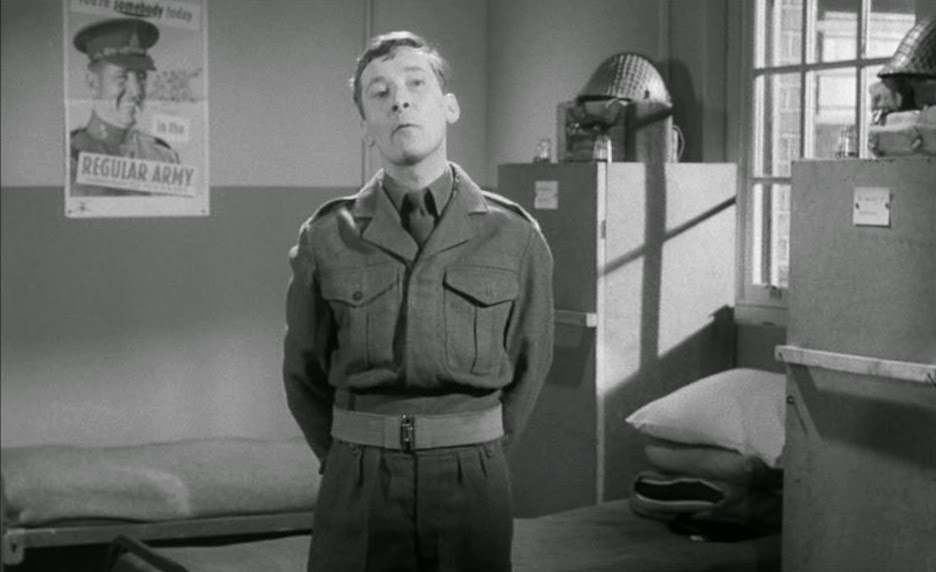
Carry On Sergeant (1958)

Carry On Sergeant was the movie that started the Carry On series. As is often the case with the first movie in a long-running series this one differs a little from the later Carry On movies.

For one thing it’s rather more plot-driven and the two major plot strands are taken fairly seriously rather than being just an excuse for a series of gags.

The first thing viewers will notice is that while quite a few of the Carry On regulars are here they’re mostly in secondary roles. Only Kenneth Connor has a really major role. Charles Hawtrey, Kenneth Williams and Hattie Jacques are all consigned to relatively minor roles among the supporting cast.

Sergeant Grimshawe (William Hartnell) is about to retire from the army after many years training National Servicemen. In all those years not one platoon he has trained has won the coveted Champion Platoon trophy. He is determined that his final platoon will win that honour. It’s not just the glory - he also has fifty quid riding on the outcome and fifty quid in 1958 was a lot of money.

Unfortunately the new recruits in Able Platoon are a particularly sorry lot. Private Golightly (Charles Hawtrey) is chronically unable to keep his mind focused on any soldierly duties. Private Charlie Sage (Bob Monkhouse) is too busy thinking of his beautiful new wife Mary (Shirley Eaton) to give much attention to the military virtues. Private Horace Strong (Kenneth Connor) is a hypochondriac who spends most of his time in the office of the camp doctor, Captain Clark (Hattie Jacques). Private James Bailey (Kenneth Williams) is an effete snobbish university graduate who makes no attempt to disguise his contempt for the Army. The other misfits in Able Platoon include a guitar-playing beatnik. And then there’s Private Herbert Brown (Norman Rossington) who has failed the army’s basic training course on no less than three occasions and has the reputation of being the worst soldier anyone has ever encountered.


Only Private Heywood (Terence Longdon) seems to have potential but he lacks any real interest.

The other major sub-plot concerns Private Sage’s attempts to find a way to spend his wedding night with his new bride. He had received his call-up papers on his wedding day. It’s the sort of sub-plot that would have given rise to a great deal of risqué humour in the later Carry On movies but it’s handled surprisingly delicately here. But then this was 1958 and there was only so much one could get past the censor.


Service comedies were very popular in the 1950s and this movie adheres fairly closely to the established formula with the long-suffering sergeant having to deal with totally inept recruits. Carry On Sergeant does vary the formula just a little though. You expect the sergeant to be a martinet who tries to make the lives of the recruits as miserable as they’re making his life but that doesn’t happen here. Sergeant Grimshawe might be a martinet by inclination but in his desperation to win that fifty quid he’s decided to try a completely different approach. He’s going to treat these recruits with gentleness, sensitivity and understanding. He’s going to be a kindly father figure instead of a stern authority figure. He doesn’t really think it will work but fifty quid is fifty quid and it’s worth a shot.

You might think this would diminish the comic possibilities but it doesn’t. If anything it enhances them since Grimshawe’s exasperation with their bumbling incompetence is even more amusing when he’s trying so hard to be Mr Nice Guy.


William Hartnell had appeared in ITV’s hugely successful service comedy sitcom The Army Game, which had inspired a spin-off movie made by Hammer Films, I Only Arsked. Hartnell was not in the Hammer movie but its cast did include a couple of Carry On regulars, Bernard Bresslaw and Charles Hawtrey. Carry On Sergeant was clearly an attempt to jump on what seemed to be a very popular bandwagon. It proved to have been a shrewd movie. Carry On Sergeant was a major box-office hit.

Perhaps the biggest surprise in Carry On Sergeant is Kenneth Williams. The superciliousness is there, and in fact most of the elements that would make so immensely popular in the later movies of the series are there, but he had not yet learnt how to make the most of those elements. Most importantly he had not yet discovered the joys of total excessiveness. His performance is very subdued and very restrained. At times he almost seems to be trying to give a serious dramatic performance.


While the later Carry On regulars in this film are mostly in supporting roles it’s easy to see why they would soon be promoted to bigger roles in subsequent movies in the series. They’re the best things in this movie.

Despite a few mis-steps and a few slow moments this is still a very enjoyable movie and it has plenty of genuine laughs. It’s also a remarkably good-natured movie. The ending has a touch of sentimentality to it that you certainly don’t expect in the irreverent world of the Carry On movie. The series had not yet hit its stride but this was a promising start. Recommended.

Wednesday, 18 February 2015

Unearthly Stranger (1963)

Unearthly Stranger is a modestly budgeted but quietly creepy little 1963 British science fiction movie.

Project TP91 is a top-secret British research project investigating the possibility of a revolutionary method of space travel. The idea is to harness mental energies to enable a kind of high-tech astral travelling. This would allow someone to make a psychic voyage to another planet and then to physically materialise on the distant planet. It might be a nutty idea but it’s certainly intriguing and original and Rex Carlton’s screenplay develops the idea rather cleverly. The outlandishness of the idea makes the movie rather reminiscent of the classic 1960s science fiction television series The Outer Limits.

The story is told in an extended flashback. The opening sequence shows us an obviously terrified man through darkened streets, but what is he running from? The man is scientist Dr Mark Davidson and when he reaches his office he recounts his extraordinary story in the form of a tape recording.

Professor Geoffrey Munro (Warren Mitchell) had been the man in charge of Project TP91, until he met his untimely death. Officially he died of a heart attack. Major Clark (Patrick Newell) from the Security Service knows it was no heart attack. Dr Davidson takes over as head of Project TP91 and pretty soon both he and his boss Professor John Lancaster (Philip Stone), the director of the space research establishment, also know it was not a heart attack that killed Munro.

Major Clark has some other concerns about Project TP91. He is rather worried about Dr Davidson’s new young wife Julie (Gabriella Licudi). He has done a background check on her and it seems that no such person exists, or ever has existed.


Mark Davidson is also puzzled by his wife. She does appear to blink and she also does not appear to have a pulse. He met her just a few weeks earlier in Switzerland and they married after a whirlwind romance. He actually knows nothing whatever about her.

Dr Davidson believes he is close to a breakthrough on the project. In fact he is closer than he thinks to finding an answer but it’s not the answer he  expects, or wants.

Apart from the nifty central idea the movie’s biggest strength is the very fine acting from all the principals. John Neville does well as the increasingly harassed and concerned Dr Davidson. Patrick Newell is a delight as the jovial but shrewd security chief. Philip Stone is excellent as Davidson’s sympathetic but worried boss. Gabriella Licudi is suitably mysterious as Julie while Jean Marsh (a very fine actress) makes the most of a fairly minor role as Davidson’s secretary. 


Director John Krish had a lengthy if not terribly distinguished career. He does a fine job here, wisely opting for an unobtrusive approach that allows the weirdness of the material to tell its on story although he does make occasional and judicious use of techniques such as Dutch angles.

This is science fiction with a dash of horror, but horror done in a moody low-key way.

It’s also the kind of science fiction that works very well on a low budget, where the material is chosen in such a way as to allow intelligent science fictional themes to be pursued without the necessity for elaborate special effects. In fact this film employs no actual special effects at all, because they are not needed. This kind of budgetary constraint can (and in this case certainly does) work in a movie’s favour, encouraging imagination, atmosphere and intelligence rather than spectacle.


The movie was shot widescreen and in black-and-white. 

Both stylistically and thematically it’s slightly reminiscent of Wolf Rilla’s superb 1960 John Wyndham adaptation Village of the Damned. In fact the story itself has some affinities with Wyndham’s work.

Network’s Blu-Ray presentation is  pretty good although I’m not totally convinced that older black-and-white movies really need to be released on Blu-Ray - they usually look just as good on a high quality DVD release. Nonetheless Network are to be commended for making this interesting oddity available to us.

Unearthly Stranger is a quirky little gem of a movie. It’s a very weird idea that is approached with subtlety and restraint and that approach makes it all the more effectively eerie. Highly recommended.