Friday, 18 September 2015

Sword of Doom (1966)

Sword of Doom (Dai-bosatsu tôge) is a frustrating but fascinating and unusual samurai movie directed by Kihachi Okamoto for Toho studio in 1966.

The movie’s story begins in 1860. Tatsuya Nakadai plays the hero (or rather anti-hero) Ryunosuke Tsukue. Ryunosuke is a rōnin (lordless samurai) and in the movie’s opening scene we see him kill an old man for no reason whatsoever. This certainly sets the nihilistic tone of the rest of the movie.

Ryunosuke is scheduled to fight a match against Bunnojo Utsuki. It is a tournament match with wooden swords but there is a lot at stake. If Bunnojo loses the match he will also lose his position as an instructor and his family will be ruined financially and disgraced. Bunnojo’s wife Ohama (Michiyo Aratama) goes to Ryunosuke to beg him to throw the match. Ryunosuke tells her that to ask a samurai to do that would be like asking a woman to give up her chastity. Would she agree to do such a thing? He answers the question for her by taking her chastity anyway. Whether he rapes her or whether she seduces him in order to induce him to throw the match is not entirely clear and the ambiguity is important since Ryunosuke obviously believes the latter was the case, and this belief makes the bitter and cynical Ryunosuke even more bitter and cynical. Of course Ryunosuke’s view of the matter may be nothing more than self-justification.

Although the match is supposed to be a bloodless tournament match it is obvious that both men will be approaching it as a genuine duel (since Bunnojo has found out about his wife and Ryunosuke). The match proves to be anything but bloodless - in fact it becomes lethal. This is followed by a memorable and superbly shot scene in which Ryunosuke is ambushed by other members of the sword-fighting school.

We then jump forward a couple of years. Ryunosuke and Ohama are now living together and they have a child. Ryunosuke ekes out a meagre living as a professional assassin. It’s clearly not exactly a blissful marriage and Ryunosuke has started to drink heavily. Meanwhile Bunnojo’s brother Hyoma Utsuki (Yûzô Kayama) is plotting revenge against Ryunosuke. 


There is another jump forward in time and Ryunosuke has joined the Shinsengumi or Shinsen Group, who practice assassination on a grand scale. 

The past keeps catching up with Ryunosuke. His story becomes intertwined not only with that of Hyoma Utsuki but also that of Omatsu (Yôko Naitô), the grand-daughter of the old man he murdered at the beginning of the film. The story is complicated by some very intricate plots and counter-plots between rival bands of rōnin and a great deal of mayhem ensues. A very great deal of mayhem. The movie builds towards what we assume is going to be a climax but it isn’t the real climax - that will come after after even more butchery and even more intricate conspiracies are unfolded.

There are two major problems that are likely to get in the way of appreciating this film. The first problem is that the story uses actual historical events as a background and viewers with little knowledge of the history of the last years of the Tokugawa Shogunate in the 1860s may find that things get a bit bewildering, since the movie assumes that the viewer will know something of that period. This was a period of political turmoil between the forces supporting the continuation of the shogunate and those seeking to re-establish the authority of the Emperor (which finally happened with the Meiji Restoration in 1868). To comprehend the film you do at least need to know that the group Ryunosuke joins was a kind of paramilitary group with some degree of official backing rather than just a group of bandits.


The second problem is that the narrative is, to say the least, somewhat incoherent. The film was based on Boddhisatva toge, a very long novel by Kaizan Nakazato. The author worked on the novel for thirty years and it got longer and longer but was never completed. The movie had been intended to be the first part of a trilogy. The remaining films of the trilogy were never made so what we have is the first third of an unfinished trilogy based on an unfinished novel. This undoubtedly accounts for most of the narrative incoherence. Characters are introduced who are obviously intended to be important but their stories are left hanging. There are sub-plots that are puzzling because they don’t seem to go anywhere. Crucial events are foreshadowed but they don’t happen. Presumably all of these narrative problems would have been resolved had the trilogy been completed.

Fortunately the narrative isn’t really the most important thing in this movie. It has other things going for it - it is a magnificent exercise in style and it’s an intriguing character study of a memorable anti-hero.


Although even as a character study there are problems. Many of Ryunosuke’s actions are explicable. Some can even be justified, to a limited extent. That first murder though - of the old man - remains a mystery. This is a major problem. Ryunosuke is set up as a cold-blooded killer, a man who will kill for no reason, but the film offers no real explanation for this. Perhaps he is a psychopath but his later behaviour tends to undercut that theory. There is a vague suggestion that he has simply been seduced by his own skill with the sword - that he has come to enjoy killing for the sake of killing. But why? Perhaps he sees himself as an instrument of fate, bringing death randomly. Perhaps he is supposed to represent the oppressive nature of the shogunate but the movie makes no attempt to explore the political situation in any depth so that their seems untenable. Perhaps he represents the inherent violence of the samurai class, but again there’s little or nothing in the actual movie to support that idea either. Perhaps he simply reflects the times he lives in - a period of social turmoil and lawlessness.

While Ryunosuke does initially appear to be a psychopathic killer he later starts to crack up, apparently as a result of guilt (an emotion that psychopaths entirely lack). He is a man who has embraced violence and he finds that it is an uncomfortable bedfellow. In some ways the mystery of Ryunosuke’s motivations does make the movie quite interesting - even a man who thinks he can kill without being troubled by his conscience may find that it isn’t so easy after all.


The theory I’m inclined to go for is that the celebrated sequence in which Ryunosuke seems to be fighting the ghosts of his victims is not a symbol of his rebelling conscience but really is a supernatural manifestation. The ghosts of your victims really can come after you. In fact there are suggestions of this earlier in the film.

Tatsuya Nakadai’s performance as Ryunosuke is strangely mesmerising and disturbing. Michiyo Aratama as Ohama is equally impressive. Look out for the great Toshirô Mifune in a small but important role.

The black-and-white cinematography is wonderfully moody and atmospheric. The fight scenes are impressively staged and become progressively more graphic. There are no geysers of blood but the reality of violent death is conveyed quite forcefully.

The Region 4 DVD offers a good transfer but the lack of extras is disappointing - this is a movie that desperately requires a commentary track.

Sword of Doom, despite its frustrations, is a fascinating and stylish movie. Recommended.

Sunday, 13 September 2015

Carry On Henry (1971)

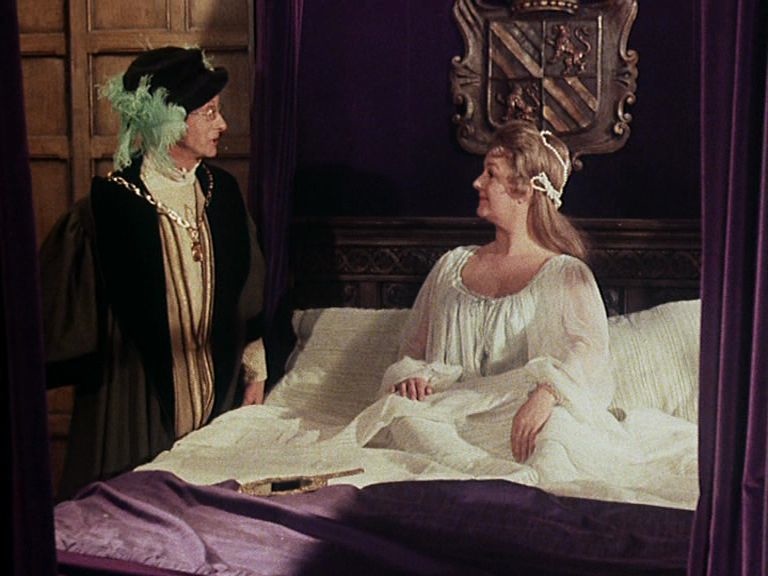
Carry On Henry was perhaps the last of the great Carry On films. The franchise declined during the 70s as changing tastes forced the films to become more overtly crude, and as the regular cast members slowly dropped by the wayside. Carry On Henry has most of the old team still in place and and still at the top of their game. It also benefits from remarkably  high production values and a genuinely clever script by Talbot Rothwell.

I’ve always been particularly fond of the historical Carry On movies - they seemed to be ideally suited to the Carry On treatment.

Henry VIII, having disposed of one unwanted wife, is looking forward to his marriage with Marie of Normandy (Joan Sims). He has been assured that she is a rare beauty and it is also a politically advantageous match, Marie being a favourite cousin of the King of France. This time he is certain he has married wisely and everything seems to be going swimmingly until the wedding night when Henry makes a horrific discovery on his wedding night - his new queen is addicted to garlic. And Henry cannot bear the thought of even being in the same room as someone who has eaten garlic, much less sharing a bed with her.

Of course the marriage must be annulled but there are difficulties. In fact Rothwell’s script throws in a whole series of hilarious difficulties as Henry constantly changes his mind. He doesn’t want his new queen but he does want the very generous present the King of France has offered him to celebrate this illustrious marriage. Further complications ensue - the queen becomes pregnant but Henry knows that whoever the father is it certainly isn’t him. Suspicion falls on Henry’s equerry, Sir Roger de Lodgerley (Charles Hawtrey). 

And Henry has his eye on a new prospective queen - the voluptuous Bettina (Barbara Windsor).


Somehow his chief advisers, his Chancellor Thomas Cromwell (Kenneth Williams) and Cardinal Wolsey (Terry Scott), have to find a way to do the impossible - to keep Henry happy, to keep the King of France happy, to keep the Vatican happy and find a way for Henry to get his hands on both the French king’s 50,000 gold pieces and the luscious Bettina. They also have to deal with a plot by the disaffected Lord Hampton of Wick (Kenneth Connor) to overthrow the king.

For a comedy film it’s quite an involved plot but it sets up a whole series of inspired farcical situations. While the screenplay is filled to overflowing with sexual innuendo it’s all good-natured harmless fun that never descends into outright crudity. There are gags in abundance and they’re very very funny.


Barbara Windsor does have a couple of brief nude scenes but surprisingly enough they actually have something to do with the plot.

This was the 21st Carry On movie and by this time the regulars knew how to get the maximum in laughs from any script and this time they are given terrific material to work with. Kenneth Williams is in scintillating form and he and Terry Scott make a superb team as the hapless constantly conspiring advisers. Sid James is perfect as the randy but perpetually frustrated Henry. Barbara Windsor is at her bubbly best. Joan Sims gets one of her best roles in the series and delivers one of the ripest French accents you’ll ever hear. Charles Hawtrey gets a bigger role than usual and takes foppishness further than anyone could possibly imagine it could be taken. Kenneth Connor has a fairly small part but makes the most of it. The supporting players get their chances as well, especially Julian Orchard’s outrageous turn as the French ambassador, the aptly named Duc de Poncenay.


Gerald Thomas directed every single Carry On movie. Apart from being very good at directing comedy he was a master of the art of bringing in a low-budget movie on schedule and on budget. 

The film was shot at Pinewood Studios and makes use of some magnificent sets (presumably built for bigger budgeted movies). The costumes are quite stunning. Cinematographer Alan Hume made sixteen Carry On movies and knew how to get good results without wasting unnecessary time. Carry On Henry was a very cheap movie but it actually looks quite lavish and rather polished. It shows what can be done on a tight budget when you have a cast of crew of seasoned professionals who get on with the job.


The ITV Studios DVD, from their Carry On: The Ultimate Collection boxed set, includes a number of extras. There’s a extremely short contemporary “making of” featurette which is worth watching for a very brief but screamingly funny interview with Kenneth Williams. There’s also an audio commentary featuring cinematographer Alan Hume who remembers the making of the movie as being non-stop fun.

Watching the movie is also non-stop fun. It’s not only the best of the later Carry Ons, it’s also one of the best of the whole series. Very highly recommended.

Tuesday, 8 September 2015

Man in the Attic (1953)

Man in the Attic was the fourth film adaptation of Marie Belloc Lowndes’ 1912 Jack the Ripper novel The Lodger. It was the first film from a company called Panoramic Productions and was distributed by 20th Century-Fox.

A rather young Jack Palance (he was 34 at the time) plays a pathologist named Slade who rents rooms in the home of William and Helen Harley (played respectively by Rhys Williams and Frances Bavier). Also living in the house is Harley’s niece Lily Bonner (Constance Smith), a rising musical comedy star.

This is London in late Victorian times and the city is in the grip of the Jack the Ripper panic. Helen Harley has her suspicions about the new lodger. He seems harmless enough but a bit withdrawn and he does seem to spend quite a bit of time wandering the streets at night, carrying a small black bag. And the Ripper has been seen carrying a similar small black bag.

Slade also seems to be less than fond of actresses. Actresses are the favourite victim of the fiendish Whitechapel murderer (in reality he killed prostitutes but the movie prefers to avoid too much sleaziness). The suspicions against him steadily grow although Lily refuses to believe them and seems rather attracted to Slade’s shyness and apparent vulnerability (he tells her he’s been forced to move constantly because he’s different and he makes people uneasy).

Although viewers are going to be inclined to share Helen Harley’s suspicions of Slade and to be a bit concerned about Lily’s wisdom in getting emotionally entangled with such an  unsettling character the evidence pointing in his direction is purely circumstantial. In fact we’re invited to share the view of both William Harley and Lily that Slade is being victimised for being socially awkward and unconventional. He might really be a harmless oddball. Meanwhile the tally of the Ripper’s victims mounts and Scotland Yard seems to be getting no closer to finding the killer.


While the movie is coy about the profession of the Ripper’s victims the sexual aspects of the crimes are made obvious enough. 

The screenplay tries to provide the necessary motivation for Slade’s antipathy towards actresses by linking it to his childhood and to his troubled relationship with his beautiful  actress mother who drove his father to self-destruction and ended her own life as a prostitute (which perhaps surprisingly is made quite explicit).

The numerous scenes of Lily performing onstage, apart from adding glamour and visual interest, do contribute to the story by helping to elucidate Slade’s ambivalent attitudes. He is attracted by the beauty and glamour but repulsed by what he believes to be the deception and corruption under the surface.


Jack Palance’s performance is the big surprise. Palance was a notorious (and often embarrassing) scenery-chewer but this is a very low-key performance. And it’s all the more effective for Palance’s willingness to go for a subtle approach.

Palance is the only big name here. The supporting cast can best be described as perfectly adequate. Constance Smith brings the necessary glamour to her role, Rhys Williams and Frances Bavier add some mild comic relief which thankfully is not overdone. Byron Palmer, who was never able to get further in Hollywood than second leads despite having leading man looks, is quite good as the determined Scotland Yard detective who falls for Lily Bonner.


The movie was shot at least partly at the old Ince studio in Culver City. It certainly has the look of a film shot shot entirely in the studio and on the backlot, which can be an advantage in this type of film since it adds to the paranoid mood. Use was made of some impressive sets originally constructed for Orson Welles’ ill-fated The Magnificent Ambersons. On the whole it’s a pretty good-looking movie. As you’d expect there’s lots of fog and lots of suitably sinister night scenes.

Argentine-born director Hugo Fregonese spent his entire career making low-budget movies in various countries. His work here is solid if not exactly inspired.

The script apparently borrowed generously from the 1944 version of The Lodger. Very generously indeed.


This movie has fallen into the public domain so some of the various DVD releases are of pretty dubious quality. Fox’s Midnite Movies release is definitely the one to go for since it pairs Man in the Attic with an excellent noirish crime thriller, A Blueprint for Murder. The transfer for Man in the Attic is very good. You might be disappointed that the only extras are a trailer and a photo gallery but it’s a bonus to get any extras at all on a Midnite Movies release. And the photo gallery is huge and includes publicity materials that do offer a few snippets of background information. Overall this Midnite Movies two-DVD pack is a very good buy indeed. 

While it might have been questionable whether a remake that borrowed so heavily from the very good 1944 version was really necessary Man in the Attic is a decent enough suspense chiller with some gothic horror atmosphere and a surprisingly good performance by Palance. It doesn’t add any significant new insights but it’s worth a look, especially given the ridiculously low price of the excellent Midnite Movies double-movie pack. 

Wednesday, 2 September 2015

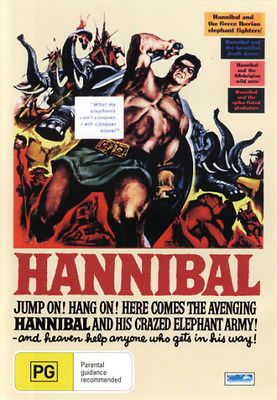
Hannibal (1959)

Hannibal was one of the last movies in the strange but fascinating career of Edgar G. Ulmer, a director who achieved very little success during his lifetime but who since his death has accumulated a considerable and very loyal cult following.

By the late 50s it seemed that Ulmer was permanently trapped in ultra-cheap B-movie territory so Hannibal comes as something of a surprise - it’s a fairly lavish costume epic with no less than 12,000 extras in the battle scenes! It’s an Italian production shot in Italy and Yugoslavia but part-financed and released by Warner Brothers. It’s by far the most large-scale movie Ulmer ever made. It must have been quite an experience for Ulmer having a budget of around $5 million to play with! That’s possibly more than all his other films put together.

The movie opens with the great Carthaginian general Hannibal’s epic crossing of the Alps in 218 BC with his army, complete with the  famous elephants. It also establishes the idea of Hannibal being a rather complex character - he doesn’t hate Rome but he is determined, in his own words, never to bend the knee to the Romans. It also establishes the idea that Hannibal’s invasion is to some extent a defensive response to Roman aggression. Hannibal is to be the hero so obviously he has to be made fairly sympathetic.


The Alps having been successfully crossed the movie then veers in two separate directions, focusing on Hannibal’s extraordinary victories over the Romans at Trebia, Lake Trasimene and Cannae but also focusing on a rather melodramatic romantic sub-plot involving Hannibal’s love for the niece of the Roman senator Fabius Maximus. This sub-plot does serve some purpose, reinforcing the notion of Hannibal as a sometimes quixotic romantic hero, although it drags a little. The crossing of the Alps is the highlight of the picture, with Ulmer managing (with a mix of location and sound stage shooting) to convey the extraordinary difficulties and dangers involved. 

The battle scenes may infuriate history buffs - the Roman and Carthaginian armies were in reality disciplined armies that fought in regular formations rather than straggling mobs of barbarians involved in a massive pub brawl. On the other hand these battle scenes do have a certain vitality and Ulmer does make an effort to show us that Cannae was a battle won by superior generalship and tactics rather than mere courage. Ulmer apparently used no less than six cameras to shot these scenes, with the Cannae sequences being shot on the Yugoslav Army’s artillery proving range.


The human elements introduced into the story are hampered by some rather poor acting from most of the supporting cast. Gabriele Ferzetti isn’t too bad as Fabius, making a real effort to portray him as a man of iron determination, cool judgment and remorseless will. Rita Gam as Hannibal’s Roman love interest Sylvia seems rather unsure of herself.

There’s no problem however with Victor Mature as Hannibal. He’s obviously having a wonderful time. He plays the part with a twinkle in his eye (I say eye rather than eyes because for most of the movie he sports a rather piratical eye-patch on one eye). Mature’s approach actually works very well, helping to humanise the character. Mature was a very underrated actor and even when overacting he is able to convey the impression that Hannibal is man of unexpected depths, capable of unpredictable moments of generosity and compassion.


In accordance with standard Italian practice the dialogue was undoubtedly dubbed in during post-production. Fortunately we get to hear Mature’s real voice, a major bonus since he delivers even potentially embarrassing lines with zest and panache.

More interesting than the film itself is one of the extras - an audio interview with Ulmer conducted by Peter Bogdanovich. Ulmer’s stories of his early career are fascinating but he also talks about making Hannibal. Ulmer wanted to make the movie a human drama rather than a mere spectacle and eventually came up with an idea of how to do this. His idea would also explain the mystery that has puzzled historians for two thousand years - when Hannibal had Rome at his mercy after the Battle of Cannae why didn’t he complete his victory by marching on the virtually undefended city and conquer it? Ulmer’s imaginative solution was to portray Hannibal as a man who knows that he represents a dying civilisation while Rome represents the future. When he finds himself in a position to destroy Rome he can’t bring himself to do it because it would mean destroying the future. Whether this idea had any basis in historical fact is more than dubious but in filmic terms it was a great idea and would have given the picture a tragic dimension as well as giving Hannibal real psychological complexity. Tragically the studio vetoed the whole idea, much to Ulmer’s disgust, and those scenes were never shot.


VIC have done a very decent job with their DVD release. The movie was shot in Cinemascope and colour and the transfer is anamorphic. The print used is in fairly good condition. It’s just a little dark in places but on the whole it’s quite vibrant and there’s no noticeable print damage.

Had Ulmer been allowed to make the picture his way Hannibal could have been one of the great epics. As it stands it’s still an interesting and slightly unusual costume film. Ulmer adds a few nice touches and Victor Mature’s performance is enough on its own to make this worth watching. Recommended. 

Friday, 28 August 2015

House of Horrors (1946)

House of Horrors was intended by Universal as a starring vehicle for Rondo Hatton, an  actor who suffered from a debilitating condition known as acromegaly. This disease, usually caused by a pituitary tumour, causes severe facial disfigurement. This tragic affliction seemed to make Hatton ideally suited for horror movie stardom but unfortunately medical complications caused his death before the release of the two movies which might have consolidated his stardom. One of these two movies was House of Horrors, released early in 1946.

The movie starts with struggling artist Marcel DeLange (Martin Kosleck) facing another week of deprivation and misery. He was just about to sell one of his statues, until art critic F. Holmes Harmon (Alan Napier) managed to persuade the prospective purchaser that DeLange’s work was utterly worthless. The sale falls through and DeLange, in despair, is about to throw himself in the river when he sees a man struggling in the water. He rescues him. The unnamed man (played by Rondo Hatton) suffers from facial deformities but DeLange doesn’t mind. In DeLange’s tortured mind this man is an outcast like himself, a victim of society’s wickedness.

The artist more or less adopts the man. He wants him to model for his next artistic masterpiece. In the course of conversation DeLange mentions that the reason they are living in abject poverty is the malice of evil art critic F. Holmes Harmon. Soon afterwards the art critic meets with a nasty, and fatal, accident. And it soon appears that such accidents are happening to anyone perceived by DeLange as an enemy.

It’s fairly obvious that DeLange knows what’s going on, but he doesn’t mind. Being an artist he sees himself as a superior being and he thinks it’s only right and proper that anyone who interferes with his glorious artistic career should end up with his spine snapped. If enough art critics are killed his genius will finally be recognised.


There is panic in the city as the spine-snapping killer dubbed The Creeper continues his murderous rampage. The police suspect Stephen Morrow (Robert Lowery), another artist with ample cause to hate F. Holmes Harmon.

Of course there has to be a young glamorous female in the cast. In this case the role is filled by yet another art critic, Joan Medford (Virginia Grey). The police are represented by the wise-cracking skirt-chasing but not very competent Lieutenant Larry Brooks (Bill Goodwin). Joan Medford has found a clue, a sketch of the Creeper, but will she live long enough to do anything with it?

While many of Universal’s 1940s horror offerings are at best marginally related to the horror genre and while this film is structurally closer to being a crime film it does have enough genuine horror elements to qualify as an actual horror movie.


As is the case with even the weakest of Universal’s horror flicks there’s plenty of atmosphere and all the visual trappings of horror that one could ask for. Jean Yarbrough was a competent B-movie director. Universal always had solid technical people working on their B-movies, in this instance the most notable being the legendary makeup artist Jack Pierce.

It’s not a bad story but the principal interest is in the characterisation. This is a movie with two monsters. The Creeper is the obvious monster. He’s almost the kind of vaguely sympathetic monster that so often appears in Universal monster movies although he’s perhaps just a bit too gleefully homicidal to be truly sympathetic. Nonetheless we can see that fate has dealt him a very bad hand and his monstrousness is at least explicable.


Marcel DeLange is more interesting. On one level he is presented as the artistic visionary suffering for his genius at the hands of an uncaring and indeed positively hostile world. On the other hand we have to admit that cynical art critic F. Holmes Harmon is quite correct in his assessment of DeLange’s talent - his only talent is for creating depraved ugliness and in spite of his surface amiability it’s clear that the ugliness of his work reflects the ugliness of his soul. He has a genuine fondness for his cat but he seems to have no real feelings for other human beings. Even his apparent compassion for the Creeper is phony - the Creeper is useful to him but that’s as far as DeLange’s feelings go.

The Creeper at least has the excuse that his behaviour is a result of his deformity and (presumably) the sufferings he has endured as a result. DeLange’s monstrousness is driven by egotism, anger, jealousy and his delusion that his hideous statues are of such towering artistic significance that a human life is of no importance by comparison.


It’s Martin Kosleck’s performance as DeLange that really stands out. It’s a surprisingly subtle performance. He makes us believe at first that DeLange is really a harmless inoffensive and rather gentle man but gradually we come to realise that he is entirely amoral and in fact in his own way more evil than the Creeper. Kosleck played many villains in his career but this remained his favourite rôle.

Robert Lowery and Virginia Grey are perfectly competent while Alan Napier is deliciously nasty as the acid-tongued art critic.

House of Horrors is one of five movies in TCM’s Universal Cult Horror DVD boxed set (the set also includes the Lionel Atwill vehicle The Mad Doctor of Market Street). The transfer is superb and there are at least some token extras.

This is one of the better 1940s Universal horror movies with some genuinely intriguing dimensions to it. Highly recommended.


Saturday, 22 August 2015

Breakheart Pass (1975)

Breakheart Pass is an interesting attempt to do something different in the western genre. It’s a murder mystery/thriller in a western setting and it works rather well. It’s also a train thriller and there’s nothing I like better than a mystery thriller set on a train. In this case it’s a very cool 19th century Wild West steam train so it’s even better.

At the time the movie was released (1975) Alistair MacLean was still the hottest thriller writer around. In this instance he wrote the screenplay himself from his own novel. Most of MacLean’s books ended up being filmed and remarkably enough almost all the film adaptations are worth seeing.

In 1975 Charles Bronson was also a very big star so this is quite a big budget movie, and the money was well spent.

The plot is the sort of thing MacLean dearly loved - take a group of people, put them in an isolated place and put a murderer amongst them. Preferably in a place with lots of snow and ice. MacLean loved these kinds of settings and he knew how to derive the full benefit from them. The protagonists are not only faced with danger from within but must also struggle to survive in a harsh and unforgiving environment where nature will kill you just as readily as the murderer will. It’s the kind of setting used to great effect in MacLean novels like Night Without End and MacLean movie adaptations like Where Eagles Dare, Bear Island and Ice Station Zebra.


Breakheart Pass really is a train adventure movie. Virtually the entire movie takes place on the train. The train is a US Army on route to remote Fort Humboldt with urgent medical supplies. The fort is being ravaged by a diphtheria epidemic. On board the train is Governor Richard Fairchild (Richard Crenna), his girlfriend Marica (Jill Ireland), Dr Molyneux (David Huddleston), a clergyman and a detachment of soldiers under Major Claremont (Ed Lauter). When the train stops at a frontier outpost to take on water it acquires two more passengers. US Marshal Pearce (Ben Johnson) has just taken escaped murderer John Deakin (Charles Bronson) into custody and intends to take him to Fort Humboldt.

It doesn’t take long before the passengers make the unpleasant discovery that there is a murderer aboard the train. You might think Deakin would be the prime suspect but in fact he’s one of the few people on the train who cannot possibly be the killer - he has an alibi for the first murder. Deakin also becomes rather important when Dr Molyneux is removed from the scene - Deakin is a doctor himself and he’s now their only doctor and thus the only hope for the beleaguered garrison of Fort Humboldt.


There will be further murders. There’s not much anybody can do about it. They can’t turn back - they’re on an emergency medical mission. They can’t make contact with the outside world since the telegraph lines are mysteriously down. There are no towns at all out here. They just have to keep going until they reach the fort. And this is an Alistair MacLean  world of snow and ice - anybody who leaves the train could not survive.

It’s a fine premise for a mystery thriller and it’s expertly executed by director Tom Gries with some excellent action set-pieces. A major bonus is Lucien Ballard’s glorious cinematography. The train itself looks wonderful and the scenery is spectacular. Nothing looks better than a Wild West steam train crossing a gorge spanned by a trestle bridge and as luck would have it there seem to be an amazing number of such gorges on the route to Fort Humboldt.


Bronson is in splendid form as the enigmatic Deakin. Bronson has the required tough guy charisma in spades and he has the subtlety to pull off this role - he never overplays but it’s always obvious that there is a lot more to this character than meets the eye. He gets solid support from the rest of the cast but this is Bronson’s film and he dominates it from start to finish.

Don’t bother looking too hard for messages or social comment or hidden meanings in this movie - Alistair MacLean’s success was based on his ability to deliver finely crafted pure entertainment and that’s what this movie provides. Just sit back and enjoy the ride.


The old MGM DVD (the one I watched) provides a pretty satisfactory anamorphic transfer. There’s now a Blu-Ray release and keen western fans (and Bronson fans) will probably want to go for that.

Breakheart Pass is a hugely enjoyable mix of action, adventure, suspense and mystery. It has Charles Bronson in fine form. It looks magnificent. What’s not to like? Highly recommended.

Thursday, 20 August 2015

reviews of relevance from my classic movie blog

Here are links to some reviews I’ve posted at my classic movies blog that might also be of interest to readers of this blog.

First up are several heist/caper movies:

The League of Gentlemen (1960), one of the very first of the modern style of cynical tongue-in-cheek heist films.

Ocean’s Eleven (1960), the first of the great American caper films (and also the ultimate Rat Pack movie).

Gambit (1966), a sparkling lighthearted but very clever heist movie with Michael Caine and Shirley MacLaine.

Also a couple of interesting spy films:

Ring of Spies (1964), a nice little low-key British movie based on a real-life spy ring.

Bulldog Drummond Comes Back (1937), one of the best (and most stylish) of the 30s Bulldog Drummond films.

And a fine old-fashioned adventure romp:

Timbuktu (1958), directed by the great Jacques Tourneur and starring Victor Mature and Yvonne de Carlo.