Thursday, 8 October 2015

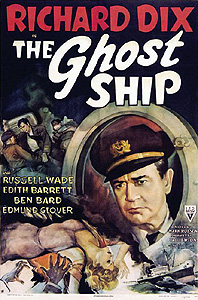
The Ghost Ship (1943)

The Ghost Ship, directed by Mark Robson in 1943, is considered to be one of the lesser pictures produced by Val Lewton at RKO in the mid-1940s. It’s certainly not in the same class as Cat People or The Seventh Victim but very few movies are. It’s still an interesting little movie.  

The story concerns a young man, Tom Merriam, on his first posting at sea as third officer of a freighter called the Altair. The captain seems to want to take Merriam under his wing, but Merriam soon notices some rather worrying things about his captain. Like the captain’s obsession with authority. He talks about it constantly. Much of what he says on the subject, and on command and responsibility, is more or less true. It’s just that he seems to take it a little too far. A captain must appear to his crew to be infallible but when he starts to believe that he really is infallible, that even an unreasonable order becomes reasonable because as captain he has the right to give such an order, the situation can become dangerous.

Things start to go wrong on this voyage right from the start. A member of the crew dies soon after the ship leaves port. There is a potentially disastrous incident involving a cargo hook, an incident that casts doubt on the captain’s judgment.

There are obvious parallels to The Caine Mutiny. Both films deal with a junior officer who begins to suspect that the captain of the ship is dangerously incompetent. In both cases the captain’s behaviour is ambiguous - there are incidents that could be interpreted as errors of judgment but could just as easily be ascribed to chance or misfortune. Once a subordinate begins to suspect a superior of incompetence there is the danger that he will misinterpret the superior’s actions.


Of course there are differences. In The Ghost Ship the captain really does turn out to be dangerous - incompetent perhaps, but mad certainly.

There are further incidents as the voyage progresses and these incidents could be ascribed not merely to incompetence but possibly even malice. 

Tom Merriam persuades himself that he must do something about the situation but his difficulty is that he has no real evidence - certainly nothing that would be likely to convince a court of enquiry. 


Richard Dix as the captain gives us a fine portrait of a lonely, insecure, fearful personality clinging to his rigid notions of authority because those notions are all he has. The major weakness of the movie is Russell Wade as Merriam – he’s too bland and too earnest.

The film’s biggest weakness is the stilted dialogue that Donald Henderson Clarke’s screenplay offers the actors, and the problem is compounded by the fact that none of the actors can be said to have the acting chops to overcome the weakness of the script. 


The story itself is a good one - it just needed someone to do a bit more work on the dialogue.

Like most of the Lewton pictures this is a psychological study rather than a monster movie – a psychological study not just of an authoritarian personality, but of the way other people allow such personalities to exercise their despotic powers. It’s a story of paranoia made more intriguing by the fact that there’s paranoia on the part of both the hero and his adversary.

The story could perhaps be interpreted as a commentary on the nature of totalitarianism - and a captain’s power over his crew is as absolute as that of a  totalitarian political leader. The theme of unwillingness to confront authority and unwillingness to defy the pressure to conform is however more of a universal theme of individualism versus the herd instinct.


The ending is just a little rushed, but the movie includes some wonderful scenes – the scene with the swinging hook, and the one with the anchor chain, are highly original, visually arresting and very scary. Since it’s done once again by Nick Musuraca (who was director of photography on several of the most notable Val Lewton pictures) it is hardly necessary to add that the cinematography is superb and that it has a definite film noir atmosphere. The feel of the movie in fact combines film noir and gothic imagery.

The Warner Home Video DVD release (which pairs The Ghost Ship with The Leopard Man on a single disc) offers a very satisfactory transfer.

This might not be in the top rank of Lewton’s RKO productions  but Lewton’s lesser films are still better than most people’s best films. The Ghost Ship is a moody low-key psychological suspense thriller with just a hint of horror. It’s an interesting enough story and the exceptionally original visual imagery are sufficient to make it as must-see. Highly recommended.

Friday, 2 October 2015

Timeslip (1955)

Timeslip (released in the US as The Atomic Man) is an obscure but very enjoyable little British science fiction B-movie rescued from oblivion and made available to us on DVD by Network in the UK.

It’s really more of a thriller with some science fictional elements thrown in but those science fictional elements are at least original and quite clever.

A man is pulled out of the river in London. He’s close to death, and in fact he does die after being taken to hospital. Just as the doctors have give up trying to resuscitate him he comes back to life. Unfortunately he seems to be suffering from amnesia and no-one knows who he is. A keen American journalist working for an English news magazine doers however recognise him - the man saved from death is none other than eminent nuclear physicist Stephen Rayner. The only problem is that when the police contact the laboratory at which Dr Rayner works they are informed that Dr Rayner is perfectly well and currently engaged on a major research project. So who on earth is the man pulled from the river?

The American journalist, Mike Delaney (Gene Nelson), is convinced the man in hospital is Stephen Rayner and that something strange is going on, something that could lead him to a very big story. With the help of his news photographer girlfriend Jill Rabowski (Faith Domergue) he starts digging into the case. There are a number of puzzling aspects to it. The photographs of the man in the hospital are all fogged. This is very odd - Jill is a very experienced photographer who doesn’t make mistakes and she can offer no explanation for this. Even more odd is that the hospital cannot take X-rays of their patient - the x-ray films come out entirely blank.


Mike figures this might have something to do with the fact that Stephen Rayner is a nuclear physicist - maybe he’s been exposed to so much radiation that he is now immune to it! Mike is on the right track but the truth turns out to be even more bizarre - this man has come unstuck in time! Because radioactivity does that sort of thing.

This is all very well, but why do there appear to be two Stephen Rayners, what is the explanation of the hat from Buenos Aires, and why is someone trying to kill Mike Delaney? And if Dr Rayner is a nuclear physicist exactly what is the research program he was working on?


The plot is a mixture of standard thriller tropes with a few genuinely original twists that are just about enough to make it a legitimate science fiction film, and they certainly make it interesting. It builds to a fairly exciting climax with a race against time to head off disaster at the nuclear research facility.

It was common practice for British B-movies of this era to feature second-rank American stars whose careers were starting to fade. They were cheap and they were grateful for the work. More surprisingly they often turned in very decent performances in these British B-pictures. In this case the two American imports, Gene Nelson and Faith Domergue, do ma very creditable job.

Gene Nelson never did become a star (although he later had a successful career as a television director). He makes a fine pushy but likeable reporter.


Faith Domergue went very close to stardom after being discovered by Howard Hughes. You won’t be surprised to learn that Hughes was interested in more than just her acting talents. After things cooled off between the starlet and the mogul her career failed to take off. She did however make a number of very notable 1950s science fiction films, most famously This Island Earth, and as a result she has quite a following among sci-fi movie fans. She’s actually very good indeed in Timeslip and she and Nelson have excellent chemistry. The relationship between Jill and Mike adds some gentle humour as well as romance but without derailing the main plot.

Peter Arne is both creepy and sympathetic as the two Stephen Rayners. Look out for Charles Hawtrey (of Carry On fame) in an amusing bit part.


This movie was made at Merton Park Studios so you know it’s going to be a very low-budget effort. Despite this it’s a well-made little movie, very competently directed by Ken Hughes and nicely paced.

The DVD is what we’ve come to expect from Network - it offers a very decent anamorphic transfer, there are virtually no extras, and it’s ridiculously cheap. 

Timeslip is a well-crafted forgotten gem of a B-movie, very much worth seeking out. Don’t expect spectacular special effects (there aren’t any), but it has suspense and a few thrills, a bit of science fiction weirdness, some creepy atmosphere, just enough humour and romance, fine acting and in general plenty of entertainment value. Highly recommended. 

Sunday, 27 September 2015

One Frightened Night (1935)

The old dark house movie is a genre that has perhaps not aged all that well. The best movies of this type can however be quite delightful and One Frightened Night is definitely one of the very best.

This 1935 release from Mascot Pictures follows the established formula rigidly but it does it very well indeed.

Needless to say we start with a Dark and Stormy Night. In a textbook example of an Old Dark House. Jasper Whyte (Charley Grapewin) is the inevitable irascible old millionaire. He has decided not to wait before dividing his fortune among his heirs - he believes that the money will bring the grasping members of his family and household nothing but trouble and he wants to be alive to watch them circling one another like sharks. He’s the sort of man who enjoys such things.

There’s a million dollars (an enormous fortune in 1935) for each of these hungry sharks - his outrageously greedy niece Laura (Hedda Hoper) and her even greedier and currently financially very embarrassed husband Arthur (Arthur Hohl), his cheerfully irresponsible playboy nephew Tom (Regis Toomey), his physician Dr Denham (Lucien Littlefield), his lawyer Felix (Clarence Wilson) and his long-suffering but scheming housekeeper Elvira (Rafaela Ottiano). Jasper would have preferred to leave his entire fortune to his grand-daughter Doris Waverly but he’d cut his daughter off without a penny when she married an actor and he’s never seen Doris and all attempts to locate her have failed.


At this point the sharks are feeling very pleased with themselves but then disaster strikes - Doris Waverly (Evalyn Knapp) turns up at the house. She will now get all of Jasper’s money and they won’t get one red cent. That’s obviously a fine setup for a typical murder mystery but there’s a twist. Shortly afterwards a second Doris Waverly (Mary Carlisle) shows up! Obviously one is an impostor, but which one?

Murder inevitably follows. And of course everyone in the house has a very strong motive for committing murder, or even multiple homicides. This includes the second Doris Waverly’s friend Joe Luvalle (Wallace Ford), a slightly shabby stage magician who goes by the name The Great Luvalle.

In a good old dark house movie you expect all the trimmings and this movie has them  - there’s poisoned coffee, a mysterious masked figure, Amazonian blow guns firing poisoned darts, a locked-room murder, secret passageways and of course the lights keep going out which offers the opportunity for lots of sinister shadows. The one thing missing is  any hint of the supernatural but this film manages very well without it.

Of course there’s plenty of comic relief but the bonus here is that the comic elements are genuinely amusing and not irritating. Wallace Ford’s bumbling magician provides much of the humour, along with the obligatory bumbling Sheriff Jenks (Fred Kelsey) and his inept deputy Abner (Adrian Morris). Whoever solves this mystery we can be pretty sure it’s not going to be these less-than-stalwart representatives of the forces of law and order.  


Director Christy Cabanne made a lot of movies, none of them particularly noteworthy, but it’s hard to fault his work here. Most importantly the pacing never slackens for an instant. Wellyn Totman's screenplay from a story by Stuart Palmer provides a decent mystery plot and plenty of deliciously vitriolic dialogue.

It’s also impossible to fault any of the performances. The players all give the impression that they’re not just going through the motions, that they’re actually enjoying themselves.


This is very much a low-budget B-movie with very few sets but the necessary atmosphere of spooky mystery is achieved very successfully.

The Alpha Video DVD is not too bad by Alpha Video standards (which admittedly isn’t saying much). The sound is a bit crackly but image quality is acceptable, and this is after all a budget-priced DVD.

One Frightened Night ticks all the right boxes for old dark house movie fans. It really is great fun. Highly recommended.

Tuesday, 22 September 2015

Telefon (1977)

Telefon, released in 1977, is a slightly unusual Cold War spy flick. A rogue agent is triggering a series of attacks against US military installations. There’s only one man who can stop this rogue agent and thus prevent World War III and that’s Major Grigori Borzov of the KGB. The odds are against him but the KGB are determined that somehow war must be avoided. That’s right, this is an American Cold War spy film in which the Soviets are the good guys. The CIA doesn’t really know what’s going on but they’re also determined to stop these attacks. They’re also the good guys. This is very much a Détente spy film, with both the KGB and the CIA working towards the same goal, although completely independently and with the CIA having no idea that the KGB is on their side.

To make this even more fun Major Borzov is played by legendary tough guy Charles Bronson.

The situation comes about because of a top-secret Soviet plan code-named Telefon dating back to the days when Cold War tensions were at their height. Fifty-two Soviet agents were sent to the US under deep cover, sleepers to be activated only in a dire emergency. These sleeper agents were subjected to drug-assisted hypnosis - they’re under such deep cover that they don’t even know they’re agents until they’re activated.

The plan has long since been forgotten, the paperwork buried away in the KBG archives. Tensions have now eased dramatically, Détente is working successfully, nuclear war now seems a remote possibility and the last thing the KGB wants is anything that might threaten the peace. There’s just one problem. One man has not forgotten that the Telefon plan exists. And he intends to put it into operation.

The man is Nicolai Dalchimsky (Donald Pleasence). He’s not only a hardline Stalinist opposed to Détente, he’s also quite quite mad. He has the list of those fifty-two sleepers with the means of activating them and he’s set off for the US to do just that, having left Moscow mere hours before the KGB could arrest him. KGB General Strelsky (Patrick Magee) assigns Major Grigori Borzov to follow Dalchimsky to the US and to liquidate him.


Borzov’s mission is of course ultra top secret since the whole idea is to liquidate Dalchimsky before the Americans figure out what’s happening - it would be very embarrassing for the Soviets to have to admit that Telefon ever existed. It would be even more embarrassing for the KGB since they never bothered to inform the current Soviet premier of its existence. They failed to inform him not because of any sinister motives but simply because they’d forgotten about the plan themselves.

Borzov will have only one person to help him in his mission, a top Soviet spy in the US code-named Barbara (played by Lee Remick). Borzov intends to tell her no more than the absolute minimum she needs to know to assist him. What he doesn’t know is that Barbara  knows things that he doesn’t know.


Bronson is in his usual fine form, tight-lipped but charismatic. It’s the sort of thing he did so well, playing an ice-cold character but with an unexpected warmth just occasionally breaking through when he flashes his characteristic smile with a twinkle in his eyes. Lee Remick’s performance is bright and breezy, almost as if she’s playing in a romantic comedy. That approach could have backfired but in fact it works, not only providing a nice contrast to Bronson but also adding an oddly chilling touch - Barbara is a happy-go-lucky soul always making lighthearted jokes but she’s also a cold-blooded killer when necessary.

Donald Pleasence plays an evil madman so it goes without saying that he does so superbly. Patrick Magee gets one of his best roles as the cheerful but ruthless KGB General Strelsky. Alan Badel plays Strelsky’s right-hand man, Colonel Malchenko, and plays him as a softly spoken good natured guy who really wishes this whole unpleasant business would go away. Tyne Daly is amusing as CIA intelligence analyst and computer whizz-kid Dorothy Putterman.


Don Siegel directed this movie and he gives us an effective mix of action scenes combined with slow-burning suspense. Action fans will be pleased by the generous ration of explosions.

This is a spy thriller that also falls into the category of 1970s paranoia movies, but it’s a paranoia movie with a difference. It’s not the US government who are the bad guys. It’s not the Soviets. It’s not evil right-wingers. The paranoia originates from the kind of bureaucratic screw-up that happens everywhere, but the general Cold War atmosphere of secrecy inflames the paranoia. It’s a nice twist that even the mania for secrecy engendered by the Cold War isn’t really sinister in this case - it’s just the common instinct of every government agency to be as secretive as they can get away with.

There’s also considerable reason for Major Borzov to be paranoid - he’s operating on a top secret mission in a foreign country and there’s nobody he can trust. He can’t even trust his colleague Barbara. He’s effectively alone.


Of course a spy movie must have double-crosses and this film has plenty of those although they don’t always play out as you might expect. The ending is a bit of a surprise but it worked for me.

Telefon was released by Warner Home Video on DVD in Region 1 paired with another Bronson flick, St Ives, on a single double-sided disc. The transfer is anamorphic but it’s somewhat disappointing - the picture is very very soft in some scenes. On the other hand it’s a ridiculously cheap DVD release and it does offer two Charles Bronson movies that are otherwise unavailable so it’s still worth buying at the price.

Telefon is unusual enough to be a must-see for spy fans and Charles Bronson fans will be equally enthused. Overall it’s a fairly stylish and rather entertaining spy thriller enlivened by some wonderful acting. It has enough going for it to be highly recommended.

Friday, 18 September 2015

Sword of Doom (1966)

Sword of Doom (Dai-bosatsu tôge) is a frustrating but fascinating and unusual samurai movie directed by Kihachi Okamoto for Toho studio in 1966.

The movie’s story begins in 1860. Tatsuya Nakadai plays the hero (or rather anti-hero) Ryunosuke Tsukue. Ryunosuke is a rōnin (lordless samurai) and in the movie’s opening scene we see him kill an old man for no reason whatsoever. This certainly sets the nihilistic tone of the rest of the movie.

Ryunosuke is scheduled to fight a match against Bunnojo Utsuki. It is a tournament match with wooden swords but there is a lot at stake. If Bunnojo loses the match he will also lose his position as an instructor and his family will be ruined financially and disgraced. Bunnojo’s wife Ohama (Michiyo Aratama) goes to Ryunosuke to beg him to throw the match. Ryunosuke tells her that to ask a samurai to do that would be like asking a woman to give up her chastity. Would she agree to do such a thing? He answers the question for her by taking her chastity anyway. Whether he rapes her or whether she seduces him in order to induce him to throw the match is not entirely clear and the ambiguity is important since Ryunosuke obviously believes the latter was the case, and this belief makes the bitter and cynical Ryunosuke even more bitter and cynical. Of course Ryunosuke’s view of the matter may be nothing more than self-justification.

Although the match is supposed to be a bloodless tournament match it is obvious that both men will be approaching it as a genuine duel (since Bunnojo has found out about his wife and Ryunosuke). The match proves to be anything but bloodless - in fact it becomes lethal. This is followed by a memorable and superbly shot scene in which Ryunosuke is ambushed by other members of the sword-fighting school.

We then jump forward a couple of years. Ryunosuke and Ohama are now living together and they have a child. Ryunosuke ekes out a meagre living as a professional assassin. It’s clearly not exactly a blissful marriage and Ryunosuke has started to drink heavily. Meanwhile Bunnojo’s brother Hyoma Utsuki (Yûzô Kayama) is plotting revenge against Ryunosuke. 


There is another jump forward in time and Ryunosuke has joined the Shinsengumi or Shinsen Group, who practice assassination on a grand scale. 

The past keeps catching up with Ryunosuke. His story becomes intertwined not only with that of Hyoma Utsuki but also that of Omatsu (Yôko Naitô), the grand-daughter of the old man he murdered at the beginning of the film. The story is complicated by some very intricate plots and counter-plots between rival bands of rōnin and a great deal of mayhem ensues. A very great deal of mayhem. The movie builds towards what we assume is going to be a climax but it isn’t the real climax - that will come after after even more butchery and even more intricate conspiracies are unfolded.

There are two major problems that are likely to get in the way of appreciating this film. The first problem is that the story uses actual historical events as a background and viewers with little knowledge of the history of the last years of the Tokugawa Shogunate in the 1860s may find that things get a bit bewildering, since the movie assumes that the viewer will know something of that period. This was a period of political turmoil between the forces supporting the continuation of the shogunate and those seeking to re-establish the authority of the Emperor (which finally happened with the Meiji Restoration in 1868). To comprehend the film you do at least need to know that the group Ryunosuke joins was a kind of paramilitary group with some degree of official backing rather than just a group of bandits.


The second problem is that the narrative is, to say the least, somewhat incoherent. The film was based on Boddhisatva toge, a very long novel by Kaizan Nakazato. The author worked on the novel for thirty years and it got longer and longer but was never completed. The movie had been intended to be the first part of a trilogy. The remaining films of the trilogy were never made so what we have is the first third of an unfinished trilogy based on an unfinished novel. This undoubtedly accounts for most of the narrative incoherence. Characters are introduced who are obviously intended to be important but their stories are left hanging. There are sub-plots that are puzzling because they don’t seem to go anywhere. Crucial events are foreshadowed but they don’t happen. Presumably all of these narrative problems would have been resolved had the trilogy been completed.

Fortunately the narrative isn’t really the most important thing in this movie. It has other things going for it - it is a magnificent exercise in style and it’s an intriguing character study of a memorable anti-hero.


Although even as a character study there are problems. Many of Ryunosuke’s actions are explicable. Some can even be justified, to a limited extent. That first murder though - of the old man - remains a mystery. This is a major problem. Ryunosuke is set up as a cold-blooded killer, a man who will kill for no reason, but the film offers no real explanation for this. Perhaps he is a psychopath but his later behaviour tends to undercut that theory. There is a vague suggestion that he has simply been seduced by his own skill with the sword - that he has come to enjoy killing for the sake of killing. But why? Perhaps he sees himself as an instrument of fate, bringing death randomly. Perhaps he is supposed to represent the oppressive nature of the shogunate but the movie makes no attempt to explore the political situation in any depth so that their seems untenable. Perhaps he represents the inherent violence of the samurai class, but again there’s little or nothing in the actual movie to support that idea either. Perhaps he simply reflects the times he lives in - a period of social turmoil and lawlessness.

While Ryunosuke does initially appear to be a psychopathic killer he later starts to crack up, apparently as a result of guilt (an emotion that psychopaths entirely lack). He is a man who has embraced violence and he finds that it is an uncomfortable bedfellow. In some ways the mystery of Ryunosuke’s motivations does make the movie quite interesting - even a man who thinks he can kill without being troubled by his conscience may find that it isn’t so easy after all.


The theory I’m inclined to go for is that the celebrated sequence in which Ryunosuke seems to be fighting the ghosts of his victims is not a symbol of his rebelling conscience but really is a supernatural manifestation. The ghosts of your victims really can come after you. In fact there are suggestions of this earlier in the film.

Tatsuya Nakadai’s performance as Ryunosuke is strangely mesmerising and disturbing. Michiyo Aratama as Ohama is equally impressive. Look out for the great Toshirô Mifune in a small but important role.

The black-and-white cinematography is wonderfully moody and atmospheric. The fight scenes are impressively staged and become progressively more graphic. There are no geysers of blood but the reality of violent death is conveyed quite forcefully.

The Region 4 DVD offers a good transfer but the lack of extras is disappointing - this is a movie that desperately requires a commentary track.

Sword of Doom, despite its frustrations, is a fascinating and stylish movie. Recommended.

Sunday, 13 September 2015

Carry On Henry (1971)

Carry On Henry was perhaps the last of the great Carry On films. The franchise declined during the 70s as changing tastes forced the films to become more overtly crude, and as the regular cast members slowly dropped by the wayside. Carry On Henry has most of the old team still in place and and still at the top of their game. It also benefits from remarkably  high production values and a genuinely clever script by Talbot Rothwell.

I’ve always been particularly fond of the historical Carry On movies - they seemed to be ideally suited to the Carry On treatment.

Henry VIII, having disposed of one unwanted wife, is looking forward to his marriage with Marie of Normandy (Joan Sims). He has been assured that she is a rare beauty and it is also a politically advantageous match, Marie being a favourite cousin of the King of France. This time he is certain he has married wisely and everything seems to be going swimmingly until the wedding night when Henry makes a horrific discovery on his wedding night - his new queen is addicted to garlic. And Henry cannot bear the thought of even being in the same room as someone who has eaten garlic, much less sharing a bed with her.

Of course the marriage must be annulled but there are difficulties. In fact Rothwell’s script throws in a whole series of hilarious difficulties as Henry constantly changes his mind. He doesn’t want his new queen but he does want the very generous present the King of France has offered him to celebrate this illustrious marriage. Further complications ensue - the queen becomes pregnant but Henry knows that whoever the father is it certainly isn’t him. Suspicion falls on Henry’s equerry, Sir Roger de Lodgerley (Charles Hawtrey). 

And Henry has his eye on a new prospective queen - the voluptuous Bettina (Barbara Windsor).


Somehow his chief advisers, his Chancellor Thomas Cromwell (Kenneth Williams) and Cardinal Wolsey (Terry Scott), have to find a way to do the impossible - to keep Henry happy, to keep the King of France happy, to keep the Vatican happy and find a way for Henry to get his hands on both the French king’s 50,000 gold pieces and the luscious Bettina. They also have to deal with a plot by the disaffected Lord Hampton of Wick (Kenneth Connor) to overthrow the king.

For a comedy film it’s quite an involved plot but it sets up a whole series of inspired farcical situations. While the screenplay is filled to overflowing with sexual innuendo it’s all good-natured harmless fun that never descends into outright crudity. There are gags in abundance and they’re very very funny.


Barbara Windsor does have a couple of brief nude scenes but surprisingly enough they actually have something to do with the plot.

This was the 21st Carry On movie and by this time the regulars knew how to get the maximum in laughs from any script and this time they are given terrific material to work with. Kenneth Williams is in scintillating form and he and Terry Scott make a superb team as the hapless constantly conspiring advisers. Sid James is perfect as the randy but perpetually frustrated Henry. Barbara Windsor is at her bubbly best. Joan Sims gets one of her best roles in the series and delivers one of the ripest French accents you’ll ever hear. Charles Hawtrey gets a bigger role than usual and takes foppishness further than anyone could possibly imagine it could be taken. Kenneth Connor has a fairly small part but makes the most of it. The supporting players get their chances as well, especially Julian Orchard’s outrageous turn as the French ambassador, the aptly named Duc de Poncenay.


Gerald Thomas directed every single Carry On movie. Apart from being very good at directing comedy he was a master of the art of bringing in a low-budget movie on schedule and on budget. 

The film was shot at Pinewood Studios and makes use of some magnificent sets (presumably built for bigger budgeted movies). The costumes are quite stunning. Cinematographer Alan Hume made sixteen Carry On movies and knew how to get good results without wasting unnecessary time. Carry On Henry was a very cheap movie but it actually looks quite lavish and rather polished. It shows what can be done on a tight budget when you have a cast of crew of seasoned professionals who get on with the job.


The ITV Studios DVD, from their Carry On: The Ultimate Collection boxed set, includes a number of extras. There’s a extremely short contemporary “making of” featurette which is worth watching for a very brief but screamingly funny interview with Kenneth Williams. There’s also an audio commentary featuring cinematographer Alan Hume who remembers the making of the movie as being non-stop fun.

Watching the movie is also non-stop fun. It’s not only the best of the later Carry Ons, it’s also one of the best of the whole series. Very highly recommended.

Tuesday, 8 September 2015

Man in the Attic (1953)

Man in the Attic was the fourth film adaptation of Marie Belloc Lowndes’ 1912 Jack the Ripper novel The Lodger. It was the first film from a company called Panoramic Productions and was distributed by 20th Century-Fox.

A rather young Jack Palance (he was 34 at the time) plays a pathologist named Slade who rents rooms in the home of William and Helen Harley (played respectively by Rhys Williams and Frances Bavier). Also living in the house is Harley’s niece Lily Bonner (Constance Smith), a rising musical comedy star.

This is London in late Victorian times and the city is in the grip of the Jack the Ripper panic. Helen Harley has her suspicions about the new lodger. He seems harmless enough but a bit withdrawn and he does seem to spend quite a bit of time wandering the streets at night, carrying a small black bag. And the Ripper has been seen carrying a similar small black bag.

Slade also seems to be less than fond of actresses. Actresses are the favourite victim of the fiendish Whitechapel murderer (in reality he killed prostitutes but the movie prefers to avoid too much sleaziness). The suspicions against him steadily grow although Lily refuses to believe them and seems rather attracted to Slade’s shyness and apparent vulnerability (he tells her he’s been forced to move constantly because he’s different and he makes people uneasy).

Although viewers are going to be inclined to share Helen Harley’s suspicions of Slade and to be a bit concerned about Lily’s wisdom in getting emotionally entangled with such an  unsettling character the evidence pointing in his direction is purely circumstantial. In fact we’re invited to share the view of both William Harley and Lily that Slade is being victimised for being socially awkward and unconventional. He might really be a harmless oddball. Meanwhile the tally of the Ripper’s victims mounts and Scotland Yard seems to be getting no closer to finding the killer.


While the movie is coy about the profession of the Ripper’s victims the sexual aspects of the crimes are made obvious enough. 

The screenplay tries to provide the necessary motivation for Slade’s antipathy towards actresses by linking it to his childhood and to his troubled relationship with his beautiful  actress mother who drove his father to self-destruction and ended her own life as a prostitute (which perhaps surprisingly is made quite explicit).

The numerous scenes of Lily performing onstage, apart from adding glamour and visual interest, do contribute to the story by helping to elucidate Slade’s ambivalent attitudes. He is attracted by the beauty and glamour but repulsed by what he believes to be the deception and corruption under the surface.


Jack Palance’s performance is the big surprise. Palance was a notorious (and often embarrassing) scenery-chewer but this is a very low-key performance. And it’s all the more effective for Palance’s willingness to go for a subtle approach.

Palance is the only big name here. The supporting cast can best be described as perfectly adequate. Constance Smith brings the necessary glamour to her role, Rhys Williams and Frances Bavier add some mild comic relief which thankfully is not overdone. Byron Palmer, who was never able to get further in Hollywood than second leads despite having leading man looks, is quite good as the determined Scotland Yard detective who falls for Lily Bonner.


The movie was shot at least partly at the old Ince studio in Culver City. It certainly has the look of a film shot shot entirely in the studio and on the backlot, which can be an advantage in this type of film since it adds to the paranoid mood. Use was made of some impressive sets originally constructed for Orson Welles’ ill-fated The Magnificent Ambersons. On the whole it’s a pretty good-looking movie. As you’d expect there’s lots of fog and lots of suitably sinister night scenes.

Argentine-born director Hugo Fregonese spent his entire career making low-budget movies in various countries. His work here is solid if not exactly inspired.

The script apparently borrowed generously from the 1944 version of The Lodger. Very generously indeed.


This movie has fallen into the public domain so some of the various DVD releases are of pretty dubious quality. Fox’s Midnite Movies release is definitely the one to go for since it pairs Man in the Attic with an excellent noirish crime thriller, A Blueprint for Murder. The transfer for Man in the Attic is very good. You might be disappointed that the only extras are a trailer and a photo gallery but it’s a bonus to get any extras at all on a Midnite Movies release. And the photo gallery is huge and includes publicity materials that do offer a few snippets of background information. Overall this Midnite Movies two-DVD pack is a very good buy indeed. 

While it might have been questionable whether a remake that borrowed so heavily from the very good 1944 version was really necessary Man in the Attic is a decent enough suspense chiller with some gothic horror atmosphere and a surprisingly good performance by Palance. It doesn’t add any significant new insights but it’s worth a look, especially given the ridiculously low price of the excellent Midnite Movies double-movie pack.