Thursday, 8 April 2010

Head (1968)

The late 60s saw Hollywood discover the counter-culture, and produced a wave of psychedelic movies as a desperate attempt to capture the youth market. These movies ranged from cringe-inducingly awful to surprisingly interesting. One of the oddest of them all was Head, starring The Monkees.

By 1968 it was all over for The Monkees. Their records were no longer selling and their TV show had been cancelled. They were never going to gain the recognition they craved, and their commercial standing was non-existent. Their fan base had collapsed. This would normally be seen as a bad thing, but by this time the band no longer cared, and just wanted it all to be over.

What this gave them was a a wonderful sense of freedom. So when Rob Rafelson and Jack Nicholson wanted to make a Monkees movie, the band were happy to let the do whatever they wanted. They no longer cared abou
t their image, and they were prepared to do anything at all.

The results were very strange indeed. Head is a bizarre mix of music video,
teen movie, drug movie, counter-culture movie, anti-war film, avant-garde surrealist art film ad the sort of general all-round weirdness you got in those days if you were rash enough to let Jack Nicholson run amok.

Of course much of it doesn’t work, but that’s part of its charm. What’s surprising though is that a good deal of it does work, in its own strange way. Sudden switches from horrific war scenes to concert footage to sequences in which the band play the role of dandruff in Victor Mature’s hair and get sucked into a gigantic vacuum cleaner, and then suddenly the boys are in a western movie until they become bored and walk straight through the scenery which turns out to
be cardboard and find themselves in the middle of a surprise birthday party for Mike Nesmith - this sort of thing has no right to work, but somehow it does.

The political elements are the least successful, as you’d expect in a late 60s movie. Fortunately they’re not overdone, and the overall tone is an odd mix of whimsy and weirdness. Despite their perennial frustration with not being taken seriously the band is happy to make fun of its own teeny-bopper image, because it simply no longer mattered.

This is a Monkees movie without any hit songs, because by this time they didn’t have any hit songs any more. But in fact the music isn’t bad at all. By this stage they were writing a lot of their own material and the film includes a couple of acid-rock songs written by Peter Tork that are actually a good deal better than much of the embarrassingly pompous drug-addled acid-rock that was being churned out at the time by bands who really were taken se
riously. As an acid-rock band The Monkees were certainly more convincing than the Rolling Stones during their psychedelic-rock phase that produced such horrors as We Love You and She’s a Rainbow.

And Mike Nesmith’s Circle Sky demonstrates that Nesmith was already a very accomplished somg-writer. The great irony of The Monkees’ career was always the fact that they were a great band if only you could get past the bubblegum-pop image.

To appreciate Head you’ll certainly need a fair degree of tolerance for off-the-wall experimental 1960s film-making and you’ll need a certain degree of fondness for the band as well. But if you can manage those two things you’ll find this to be an unexpectedly intriguing little movie.

The DVD release is a bit disappointing - it’s fullscreen and very very grainy, although given the mixture of concert and documentary footage used in addition to newly shot scenes some of the graininess may well be intentional.

Monday, 5 April 2010

The Bitch (1979)

In 1978 The Stud gave the British film industry a very big and very welcome box-office hit. It also made Joan Collins, whose career had had plenty of ups and downs over the preceding couple of decades, a very major star. The Bitch, released the following year, was an attempt to consolidate this success and in commercial terms was a definite triumph.

Personally I don’t think The Bitch quite measures up to its predecessor. The Stud set a formidably high standard in campy trashiness, a standard that possibly no sequel was going to match.

Fontaine Khaled (Joan Collins) is now divorced, not just from her husband but much more upsettingly from his vast fortune. She still has her London night-club, but it’s actually losing money. Not that Fontaine intends to let any such minor details cramp her style. She still enjoys the good things of life. Especially young and attractive men.

Returning from New York she meets an Italian charmer named Nico. She assumes he just wants to sleep with her (Fontaine naturally assumes all men want to sleep with her) but in fact he’s a jewel thief on the run from the Mob. He plants a stolen diamond in the pocket of Fontaine’s coat, intending to retrieve it after she goes through Customs. But he loses track of her in the crowd at the airport.

Eventually they meet up again. She’s not sure that she’s all that attracted to him, but she takes him to her bed anyway. After all it’s been several hours since she’s had a man, and a girl can only go so long without sex. Nico has all sorts of troubles. Apart from the difficulty of retrieving the diamond, it turns out to be a fake. He’s losing money at the gaming tables, and he has both American and English gangsters after him.

The convoluted plot also involves shady doings at the racetrack, some very shady dealings by Fontaine, and of course the obligatory swimming-pool orgy (although it’s not as good as the exceptionally memorable almost Fellini-esque swimming-pool orgy in The Stud). There’s lots of nudity, and lots of sex. Joan Collins doesn’t take her clothes off quite as often as as she did in The Stud, but she’s still fairly frequently naked.

The movie tries very hard to recapture the classic kitschy 70s decadence of the first film, but it doesn’t quite make it.

The main problem is that Joan Collins’s character has been toned down a little. She’s not quite the mega-bitch of The Stud. She’s still a very definite bitch, but it’s not quite Joan Collins in full flight. At times she even (God forbid) shows flashes of human emotions.

Ian Hendry is the pick of the supporting cast, hamming it up quite outrageously as the English gangster Thrush Feather (yes it is a silly name for a gangster).

Apart from the toning down of Fontaine, the movie just generally doesn’t have the style of the earlier film. Gerry O’Hara’s direction isn’t as good as Quentin Masters’ and the script (again based on a novel by Joan’s sister Jackie Collins) doesn’t have the same punch.

It’s still a must-see film for fans of campy trash cinema. It is after all a Joan Collins film. But not quite the sublime masterpiece of trash that The Stud was.

Saturday, 3 April 2010

The Queen of Black Magic (1979)

The Queen of Black Magic (Ratu ilmu hitam) is another slice of highly entertaining Indonesian horror weirdness from Mondo Macabro.

Murni is a young woman in love with the the handsome Kotar. He promises to marry her, but after taking her virginity he marries another woman, the daughter of the village headman. Murni is not well pleased with this. The wedding does not go off smoothly, with the bride having strange visions of skeletal husbands, and in fact the whole event becomes a shamble. It is clear to the villagers that black magic is at work here.

Kotar persuades them that Murni must be responsible. They find her, burn down her mother’s house and hurl Murni off a cliff as due punishment for her assumed witchcraft. But as luck would have it, an old man catches her and saves her. He heals her, and then rebeals his secret to her. He is a master of blsck magic, and he will teach he his secrets so that she an revenge herself on Kotar and the other villagers who tried to kill her. This seems like quite a good idea to Murni, which (considering that they did throw her off a cliff) is rather understandable.

Murni soon masters the black arts, and is now the Queen of Black Magic. She begins her campaign of revenge. A remarkably grisly campaign it is too. It looks like the whole village is doomed until a mysterious Moslem holy man arrives. A young handsome Moslem holy man. He persuades the villagers that the only way they can combat the wave of black magic is through prayer and faith. But things become a little complicated. He spots Murni bathing in a river, and not knowing that she is the notorious Queen of Black Magic he falls in love with her. Meanwhile an epic battle is being waged between Murni’s mentor in black magic and the holy man.

The plot resolution when it comes relies on unlikely coincidences and destiny and all that sort of thing, but it fits the mood of the film which at times is like a very dark fairy tale.

In common with many Indonesian horror movies it’s based (somewhat loosely perhaps) on genuine Indonesian legends and folklore. The appearance of the Moslem holy man gives the impression of being an element added by the producers to avoid trouble with the Indonesian censors. The movie is surprisingly gory and there’s a certain amount of implied nudity, pre-marital sex and general sexual misbehaviour, so it may have ben a wise move on the part of the producers, Rapi Films.

Veteran director Liliek Sudjio directs the film with a great deal of energy and verve. The pacing is quite frenetic. The special effects are cheap, but they’re executed with such flair and enthusiasm that they work surprisingly well. Even the scenes with people pulling their own heads off (yes, really). There is of course a very large element of camp to the proceedings, but combined with the rapid pacing and the general exuberance it all adds up to a very entertaining mix.

W. D. Mochtar, one of Indonesia’s most renowned actors, is delightfully obsessive and outrageously over-the-top as the black magician who rescues Murni. And for a man in his early 50s he does some pretty impressively physical acting. Celebrated Indonesian exploitation actress Suzzanna plays Murni, and it’s not difficult to understand why she enjoyed such legendary status in the world on Indonesian exploitation cinema. She’s sexy without being too obvious and she provides a nice mix of wickedness and wronged innocence.

Mondo Macabro have done a great job with the transfer on this one. It looks absolutely splendid.

It’s crazy and bizarre and completely excessive, and is probably an ideal introduction to the world of Indonesian horror.

Thursday, 1 April 2010

The Strange Vice of Mrs. Wardh (1971)

The Strange Vice of Mrs. Wardh (Lo strano vizio della Signora Wardh) is a giallo that I’ve been trying to track down for what seems like years. With the unfortunate demise of the excellent No Shame DVD label it’s been out of print, but has now been re-released by Mya DVD under the alternative title Blade of the Ripper.

This is perhaps one of those cases where excessively high expectations can lead to disappointment. It’s really just a by-the-numbers giallo, although it’s certainly made with style and flair.

Mrs Julie Wardh (Edwige Fenech) is married to a respectable financier, but she has a dark secret. She has a taste for kinky sex, a taste she used to indulge with her ex-lover Jean. Julie likes to be dominated and humiliated. Now Jean has turned up in her life gain, and she fears that her colourful sex life may become a public scandal. And Jean seems more obsessed with her than ever.

Vienna (where the film starts out) has been rocked by a series of violent sex murders. When Julie starts to receive gifts of flowers accompanied by messages including veiled threats to reveal her past sexual indiscretions she fears that Jean may have become completely unhinged, and may even be the sex murderer. To add another complication to an extraordinarily convoluted plot Julie has acquired an admirer, the cousin of her friend Carroll. This admirer, George (George Hilton), shows an astonishing degree of perseverance in trying to get into Julie’s bed.

In fact getting into Julie’s bed proves easier than expected. But now Julie has a jealous husband, a persistent new boyfriend and an obsessed and possibly deranged ex-lover, which is enough to make any woman’s life somewhat stressful. When blackmail threats follow the threatening letters she finds her life becoming more and more out of control. And after witnessing a grisly crime scene she starts to see blood everywhere. And Julie has a kinky sexual fixation with blood to begin with.

If you think the plot is already complicated, we’re only half an hour into the movie!

This film has pretty much all the standard giallo ingredients. A series of sex murders? Check. A baffled police inspector who is making no headway is solving the case? Check. A black-gloved killer? Check. A fiendishly complex storyline with countless plot twists? Check. Edwige Fenech taking her clothes off at frequent intervals? Check. Other actresses taking their clothes off at frequent intervals for no reason whatsoever? Check.

So all the ingredients are there. The main problem is those plot twists. Yes I know it’s a giallo and outrageous and unlikely plot twists tend to go with the territory, but this one doesn’t quite come together in a sufficiently convincing manner, and it requires a lengthy expositional epilogue to explain the plot.

Of course a shambolic plot doesn’t really matter in a giallo as long as the movie is executed with sufficient visual extravagance and panache. The Strange Vice of Mrs. Wardh is just about stylish enough to compensate for its weak story, although Sergio Martino’s direction lacks the spectacular set-pieces that you’d get from an Argento, or the visual subtlety that a Luigi Bazzoni might have given it.

My personal preference is for the more unconventional entries in the giallo cycle, so perhaps the reason I wasn’t overly impressed by this one is that it’s just a little too much of a basic stock-standard giallo. If you’re a fan of the giallo genre you’ll find plenty to enjoy, and it’s undeniably entertaining in a slightly silly sort of way. I’d rate it as a decent second-rank giallo.

The Mya DVD apparently uses the same transfer as the No Shame release, and although it lacks the extras that the No Shame version included in terms of image quality it’s one of Mya’s most impressive offerings so far.

Monday, 29 March 2010

Kansas City Bomber (1972)

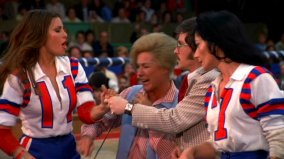
One of the oddest cultural phenomena of the 60s and 70s was the immense popularity of women’s roller derby leagues. They were a cross between pro wrestling and gladiatorial contests, but on roller skates. In the past few years they’ve made something a comeback, and have spawned a recent Hollywood movie, Whip It. But the original female mayhem on roller-skates classic was Kansas City Bomber , back in 1972.

This was the real thing. Or as close to the real thing as Hollywood ever gets. Raquel Welch is K. C. Carr, star skater of the Kansas City Ramblers and popularly known as the the Kansas City Bomber. In the rough tough world of the roller derby it’s easy to make enemies, and K. C. has made a bitter enemy of Big Bertha Bogliani. Big Bertha challenges her to a one-on-one no-holds-barred match race, and under the rules of the roller derby the loser will have to leave Kansas City forever. K.C. Loses, and finds herself traded to a team in Portland.

Unfortunately the team in Portland already has a star skater, Jackie Burdette, and Jackie is not well pleased at the arrival of a challenger for the title. They’re on the same team but they spend most of their time on the track trying to beat the daylights out of one another. K.C. has also attracted the attention of the manager of the Portland team. He’s a middle-aged businessman, a little bit sleazy, but K. C is divorced and lonely and needs some masculine company. When the news gets out that she’s the manager’s girlfriend she finds herself with a crop of new enemies.

She’s also trying to be a mother to her two children (including a daughter Rita played a very young Jodie Foster) but it’s not easy being on the road all the time, and how own mother is always giving her a hard time. Why can’t she settle down down and marry the nice local store owner who ants to marry her. The fact that K. C. might want more out of life than marrying a local shopkeeper hasn’t occurred to her mother.

K. C. soon finds that the world of the roller derby is more cynical and vicious than she had realised, especially when one of her few friends, a male skater, gets victimised by almost everybody. K.C. is a very tough cookie on the track, but she has a few weaknesses. She is loyal to people, she has some integrity, and she prefers to keep the aggression on the track. Off the track she’s just a woman looking for the same things everybody else is looking for - love, a home, friendships, a decent life for her kids. But she finds it’s just not possible to keep the increasingly bad feelings confined to the track. And and as Jackie spirals into self-destructiveness her bitterness towards K.C. grows.

Most of the performances are good, but this is Raquel Welch’s movie. Raquel Welch had the great misfortune to produce her best acting performances in movies that were either critical and commercial disasters (like Myra Breckinridge) or were the sort of movies the critics were never going to take seriously (like Kansas City Bomber ). It’s doubly unfair because one of her strengths as an actress has always been her willingness to take on the kinds of roles that are never going to get an actress an Oscar nomination.

This was her great opportunity to prove herself as a serious dramatic actress, and she gives it a pretty good shot. It’s an interesting role. K. C. is not a straightforward heroine, and she isn’t the kind of character who immediately tugs at our heart-strings. She has her faults, and she can be a cynical operator, but then her basic decency keeps getting in the way. She’s likeable, but not in an overtly emotionally manipulative way.

It was also a physically demanding role. Miss Welch did most of her own stunts, and sustained quite a few injuries during the course of filming. But it was worth it, since it’s obvious that most of the time it really is her on the track. And when she looks battered and bruised after a match, she’s convincing because she knew how it felt to be battered and bruised after filming the action scenes.

This is one of those low-key movies that I’m very fond of, not an Oscar-bait movie but a sensitive movie about real people. And in 1970s Hollywood, increasingly dominated by macho action movies and male-bonding buddy movies, this is very much a woman’s movie. It’s really a chick flick, but with a lot of extreme violence! A strange quirky movie but I liked it a lot.

Saturday, 27 March 2010

The Man Who Could Cheat Death (1959)

Terence Fisher gets plenty of respect from horror fans for his celebrated Hammer Dracula and Frankenstein movies, but I’ve always felt that he doesn’t get enough respect for the many other movies he made for Hammer. In fact most of the very large number of movies he directed for Hammer were not part of their Dracula and Frankenstein cycles. The Man Who Could Cheat Death, made in 1959, is typical of these lesser known movies.

This is both a Mad Scientist movie and a There Are Some Things With Which Science Should Not Meddle movie. Fisher wasn’t a great believer in moral ambiguity - he tended to believe that there was good and evil, and that one should know the difference. But his movie-making wasn’t as simplistic as that would imply, since he was also fascinated by characters who found themselves in a situation where they had to confront such problems, and who were not always able to find easy answers.

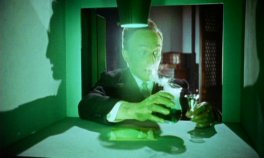
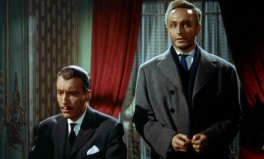
In this case we have two young and idealistic scientists who found a solution to the problem of death, a way of prolonging life indefinitely. They initially started out with the belief that this discovery would benefit humanity, but 70 years later things are are not quite so straightforward. Dr. Georges Bonnet (Anton Diffring) is 104 years old, but looks about 35. His much younger colleague Prof. Ludwig Weiss had declined to use their discovery himself, and looks every bit of his 89 years.

Dr Bonnet has found that immortality has its price. He has to relocate every ten years or so, before people start to notice that he doesn’t age. And he cannot find love, since the women he loves inevitably age while he does not. But he cannot let go of his immortality. Dr Bonnet has immortalised all the women he has loved in the form of statues, sculpture being one of his hobbies.

Things reach a crisis when his colleague Prof Weiss becomes too old and infirm to perform the operation that Bonnet requires every ten years. He has to find another surgeon. He picks on Dr Pierre Gerard (Christopher Lee), perhaps not the wisest choice since both Dr Gerard and Dr Bonnet are in love with the same woman, the beautiful Janine Dubois (Hazel Court).

Anton Diffring is both vaguely sympathetic and vaguely creepy as Dr Bonnet. He’s not quite a villain, or at least he didn’t start out to be, but somehow things are not as simple as they used to be. Immortality is not the kind of gift that is easy to give up. And moral compromises are easier the more often you make them.

Hazel Court is wonderful, as always.

Christopher Lee gets to play a hero this time, although a somewhat reluctant hero, the doctor/scientist with a conscience as opposed to the doctor/scientist who has lost his moral bearings.

With Terence Fisher Fisher directing, and with production design by Bernard Robinson, this is classic Hammer and it looks splendid.

It’s a strangely forgotten Hammer film, and an unjustly forgotten one. This is low-key horror, without any gore, but as in the best of Fisher’s films it’s more a movie about moral horror, where the horror comes from the situation the protagonists find themselves in. Like many of Fisher’s movies it was perhaps a little bit too subtle for the drive-in audience on which Hammer relied.

It’s an example of Terence Fisher’s fundamentally conservative approach to the horror genre, where those who defied the moral order and presumed to set themselves up as the equals of God inevitably paid the price for their hubris. But Fisher did this sort of thing exceptionally well.

The Legend Region 1 DVD is pretty good, although I believe Hazel Court's nude scene has been very slightly cut.

Friday, 26 March 2010

Holocaust 2000 (AKA Rain of Fire, 1977)

Alberto De Martino’s Holocaust 2000 (also released as Rain of Fire) was a 1977 British/Italian co-production designed to cash in on the success of The Omen. It’s even sillier than The Omen, and in some ways it’s even more fun.

The Antichrist is up to his old tricks again. This time it’s Kirk Douglas rather than Gregory Peck who finds himself in the midst of all the trouble. And since Kirk Douglas is a better scenery chewer than Gregory Peck, he has a definite advantage. Kirk is immensely wealthy business tycoon Robert Caine and he’s planning to build a huge new nuclear power station is an unnamed Third World country. This will be the very last word in nuclear technology. His wife is opposed to the project, but his son Angel (Simon Ward) supports his old man whole-heartedly. His wife dies in mysterious circumstances, apparently the victim of an assassination plot aimed at Caine himself. This conveniently allows Caine to go full speed ahead on the project (his wife had owned a majority of the shares in the family company).

His wife’s death also conveniently allows him to hook up with a beautiful young Italian journalist. You might think his son would be a little upset by this, but in fact he’s delighted that dear old dad has a hot new girlfriend. And he’s equally delighted by the news that he’ll soon have a little brother.

There is of course plenty of opposition to the power plant project. There are the usual environmentalist protestors, but there’s also the super-computer being used to make the project possible, which keeps printing out strange biblical warnings about ominous numerical significances. There’s also a fanatical Catholic priest who’s been just waiting for the Antichrist to make his next move. And there are some concerned dedicated scientists.

Odd accidents keep happening to those who oppose the project. The prime minister of the unnamed Third World country gets decapitated in a helicopter accident. Computers go insane and kill their controllers.

And it turns out that Angel Caine actually had a twin brother who died at birth. All this clearly points to Antichrist activity in the Caine family, but which member of the family is the actual Antichrist?

This movie is usually dismissed as a silly trashy Omen rip-off. Which I think misses the whole point. Whoever heard of an Antichrist movie that made sense or had a coherent plot? Where would be the fun in that? The things that make this such a bad movie are the very things that make it such a great movie.

Kirk Douglas overacts outrageously. Simon Ward spends most of the movie looking vaguely sinister in an innocent cute pouty kind of way. Agostina Belli just has to look sexy and worried, which she does admirably. Anthony Quayle plays the gruff but dedicated scientist who starts to suspect that there are Some Things Science Should Not Meddle With. And he plays the role in the perfectly stereotyped manner in which it should be played. Romolo Valli as the crazed fanatical priest is creepily crazed and fanatical.

The plot combines environmental paranoia, nuclear paranoia, big business paranoia and Satanic paranoia, and combines these elements in a deliriously nonsensical and fun way. There’s lots of sinister significance in numbers. Numbers that when written backwards spell demonic warnings, and other wonderfully silly warning signs of bad stuff about to happen.

It’s a low-budget movie so it doesn’t have much in the way of spectacular action set-pieces. In fact it doesn’t have any, but it makes up for it in silliness and overacting.

I honestly don’t know what more you could want in an Antichrist movie, and I thoroughly enjoyed it. You’ll need lots of popcorn.