Sunday, 24 April 2022

Werner Herzog’s Nosferatu: Phantom der Nacht (1979)

Werner Herzog’s 1979 Nosferatu: Phantom der Nacht is very much his homage to F.W. Murnau’s 1922 classic Nosferatu, eine Symphonie des Grauens. Which was of course an unauthorised adaptation of Bram Stoker’s Dracula. Herzog was however not interested in remaking Murnau’s film. It merely serves as a kind of point of departure. The tone of Herzog’s movie is very different. Much more melancholy and tragic. And Herzog departs from both Murnau’s and Stoker’s stories in major ways.

There’s presumably no need to rehash the plot of Dracula so I’ll simply mention the ways in which the movie’s plot differs from the novel. In Herzog’s movie it is Renfield (already a servant of Dracula) who sends Jonathan Harker (Bruno Ganz) to Translyvania to arrange for the lease of a house. Jonathan’s wife is Lucy (Isabelle Adjani). Joanathan falls victim to Dracula and returns home a broken man, driven only by his awareness of the danger to Lucy. By the time he reaches home his mind has gone and he no longer recognises her.

His home (which is Dracula’s destination) is in a northern European city, not London.

Dr Van Helsing is the town physician but he’s doddering and ineffectual.

Dracula’s arrival brings plague with it, with the plague clearly being engineered by Dracula (or perhaps plague simply follows vampires). It is the plague that is mostly responsible for spreading fear and despair and social collapse, not Dracula. The plague claims a lot more victims than Dracula and the townspeople are not even aware that there is a vampire in their midst.

The landscape through which Jonathan travels on his way to Dracula’s castle has very much the feel of a Caspar David Friedrich painting and Herzog’s compositions enhance that feel. Man alone in the wilderness, with nature menacing in its remorseless savage beauty.


The landscapes are romantic, in the sense of having the bleakness and cruel beauty that appealed to the Romantic Movement. Wild mountain seascapes, mist-shrouded seascapes in which the sea is more grey than blue, desolate beaches. Although it should be borne in mind that Herzog claims to have no interest in the Romantics and feels more in tune with the late Middle Ages. The landscapes in this movie are glowering and oppressive. The interiors are claustrophobic and stifling.

A major problem with gothic horror movies in the late 60s and 70s is that both actors and actresses looked like actors and actresses in period costumes. The men in particular looked wrong with their 60s/70s hair cuts. The women tended to look like models dressed for a fashion shoot. And young actors and actresses were unable to completely inhabit 19th century characters. They seemed out of period. That’s much less of a problem with this film. The cast members do behave in a convincingly 19th century manner, slightly stiff and very formal.

Isabelle Adjani looks very 19th century. Her hairstyles look like hairstyles from paintings and photographs of the period. With her pale skin, dark hair, and with her dark but subtle eye makeup, she looks at times like a 19th century goth girl. But she is very clearly a 19th century goth girl, straight out of the pages of a 19th century gothic novel.


A major challenge with a vampire movie is to persuade the viewer to identify with the vampire hunters rather than the vampire. Since Christopher Lee’s first appearance as Dracula vampires had seemed sexy and glamorous. Of course that’s partly an inherent feature of the vampire. The vampire became a popular figure in western culture at the same time as the Byronic hero. That’s no coincidence. Both were creations of the Romanic Movement. The Byronic hero was a sexual outlaw, as was the vampire (the erotic overtones were present in vampire fiction at least as early as 1797 when Coleridge wrote his poem Christabel. Vampires and Byronic heroes were outsiders, defying the rules of conventional society. Vampire hunters by contrast have always seemed to be humourless enforcers of the social rules.

Herzog avoids this problem (as Murnau had avoided it in 1922) by making his vampire truly monstrous but in an ugly repulsive way. A female viewer might have been quite willing to have Christopher Lee bite her but she was hardly likely to fantasise about being ravished by Klaus Kinski’s Dracula.

And Herzog drains all the eroticism out of the story (and there is eroticism in Stoker’s novel although it’s handled obliquely). Herzog was making a horror movie, not a supernatural love story. Except for one crucial moment, which is disturbingly erotic.
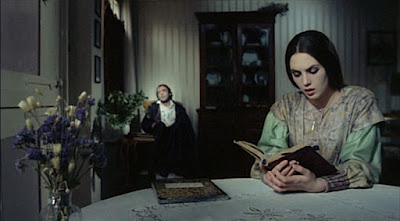

The problem of unsympathetic vampire hunters is solved by having Lucy the chief vampire hunter. But if you think that means that this is a feminist girlpower movie think again. What gives Lucy her power is her faith, her purity and her love for her husband. Lucy is a woman of the 19th century. Her ambition in life is to be a good wife. She becomes Dracula’s chief opponent because there is no-one else to do the job, and because she has studied up on vampires and she knows that a pure-hearted woman is a dangerous opponent for a vampire. The men are incapable of combating Dracula effectively not because they are weak or stupid but because they lack a woman’s simple faith.

A major theme of the novel is the clash between the decadent aristocracy (Dracula) and the rising middle class. Another major theme is the clash between science and superstition, with Stoker obviously on the side of science. Van Helsing uses religious symbols to combat Dracula but he uses science and technology as well. In Herzog’s movie science (as represented by Dr Van Helsing) is ineffectual. The only hope of defeating the vampire is Lucy’s simple faith.


Kinski’s Dracula is sympathetic in the sense of being a tragic figure. He knows he is cut off from everything that a human being takes for granted, including both death and love. He is tragic, but he is not a figure with whom an audience is going to identify. We want to see him destroyed, as much for his sake as for everyone else’s. It is one of the very rare vampire movies in which we actually buy the idea that the destruction of the vampire will be a blessing for him.

What’s immediately apparent is that his movie bears no similarity in theme, style or one to any other 1970s vampire movie. This is not the cozy central Europe of Hammer horror. There’s virtually no trace of the eroticism of 1970s vampire movies. There’s no comic relief. There’s no glamour. It’s interesting that Herzog has never seen the Bela Lugosi version of Dracula. In fact he seems to have seen very few vampire movies which is probably why his film seems so dazzlingly original.

Herzog’s movie has a strange air of unreality. The movie does not take place in our world. It takes place in a kind of dream world, or nightmare world.

The Shout! Factory Blu-Ray offers a nice transfer. There are two audio commentaries featuring Herzog, one in English and one in German with subtitles. Both are worthwhile.

Vey highly recommended.

Thursday, 21 April 2022

My Dear Killer (1972)

My Dear Killer (Mio caro assassino) is a 1972 giallo directed by Tonino Valerii. It’s his only entry in this genre and as always with movies described as giallos there’s the question as to whether it really belongs in that genre.

It certainly opens with a scene that will appeal to giallo fans who tend to like spectacular murders. In this case it’s an ingenious decapitation. The most likely suspect is soon murdered as well. This killing was made to look like a suicide but it fools Inspector Luca Peretti (George Hilton) for about thirty seconds.

The man who was decapitated was an insurance adjustor named Paradisi. A year earlier he had investigated the Moroni case, the kidnapping of a little girl which ended with two murders.

Inspector Peretti follows up some obvious leads, which involves talking to some obvious witnesses, but makes the mistake of not realising that those leads and the identities of those witnesses would be just as obvious to the killer. And this is a ruthless killer who might well decide to try to eliminate those witnesses.


The body count mounts quickly.

The Moroni kidnapping case seems to be the key. The mother of the kidnapped girl cannot offer any useful information. She has retreated into a world of madness and fantasy. The Moroni household had included not just the girl and her parents but a brother-in-law and a sister-in-law, a somewhat eccentric artist and three servants. It seems that the atmosphere in he Moroni household had been rather tense even before the kidnapping.

A child’s drawing provides a vital clue.

Inspector Peretti is under stress. His relationship with his girlfriend Dr Anna Borghese (Marilù Tolo) is rocky and he blames himself for making mistakes in the investigation.


It becomes apparent that this really is going to be a full-blown giallo. There’s a black-gloved killer, there are extravagant killings, there’s a convoluted plot, there are sexual tensions and hints of perversity. And there’s some effective suspense as the killer stalks his victims. And there are lots of good suspense sequences.

There’s a particularly chilling murder sequence shot entirely from the killer’s point of view.

The plot works quite well. I was pretty sure I knew the identity of the killer, but I was wrong.

The plot makes use of a trope that was quite popular back in the golden age of detective fiction but I won’t tell you what it is for fear of giving away a spoiler. The device is executed fairly well.


George Hilton gives a low-key performance but it’s effective. Inspector Peretti deals with stress by turning it inward on himself and Hilton conveys this successfully. The other cast members are all fine.

As a cinematic stylist Tonino Valerii is not in the Argento league but he’s more than competent and there are some quite good visual set-pieces.

Any doubts about whether this is a real giallo are soon laid to rest. It has a giallo plot and it has most of the necessary giallo ingredients. It has plenty of atmosphere. There are some sexual overtones to the plot but they’re handled subtly and we’re never sure if the killer’s motivations are sexual or not.


Amusingly the movie ends with a scene that would have warmed Hercule Poirot’s heart - Inspector Peretti gathers all the suspects in the library and then takes his own sweet time about naming the murderer.

There’s only a moderate amount of gore but there is some (there is after all a decapitation murder). There’s brief female topless nudity.

The Shameless Region 2 DVD offers the English dubbed version. The transfer is vey good.

My Dear Killer might not be in the very top rank of giallos but it’s likely to please most giallo fans. It’s rather a pity that this was Tonino Valerii’s only movie in the genre. Highly recommended.

Friday, 15 April 2022

The Inconfessable Orgies of Emmanuelle (1982)

The Inconfessable Orgies of Emmanuelle is one of the movies made by Jess Franco for Golden Films in the 80s and it’s a movie that has usually attracted sneering reviews, even from people who admire Franco’s earlier work. Like a lot of his 80s output it’s dismissed as mere softcore porn.

Which is a little unfair. The problem is that Franco in the 80s was not making the sorts of movies he’d made in the 70s. When Franco’s reputation started to revive, which happened when his movies started to become freely available on home video, that revival was based largely on the movies he made from around 1968 to the end of the 70s. Those movies became most people’s idea of what Franco’s film-making was all about. Movies like Necronomicon (Succubus), Paroxismus (Venus in Furs), Vampyros Lesbos, Female Vampire. His 1980s movies were made on even smaller budgets and the tone and the feel were slightly different. His 80s movies also tended to have even more sex. The assumption was that he’s fallen on hard times and was reduced to making ultra-cheap porno movies.

That’s not how Franco saw it. He loved making movies. For commercial reasons he found that in the 80s, if he wanted to get any money at all to make movies he had to include a lot of sex. At that time in Spain the censorship laws made it possible to make softcore erotic movies quite legally and they were very profitable. But Jess Franco, being Jess Franco, was going to throw his recurring thematic obsessions into the mix. He would make movies that seemed like straightforward softcore erotica but if you could get past all the sex and nudity you’d find him still worrying at those thematic obsessions and still finding ways to explore them.

And Franco was adaptable. He was happy to adapt his style. If he had to make a movie shot entirely in a hotel room he would do so, but he’d still make it a Jess Franco movie.

In the 80s he turned to his obsession with the Marquis de Sade again and again, in movies like The Sexual Story of O and Cries of Pleasure. He became increasingly obsessed with the alienation to which an obsession with pleasure can lead.


The Inconfessable Orgies of Emmanuelle
was of course a title the distributors liked since any movie with the name Emmanuelle in the title was saleable. The movie does take the original Emmanuelle story as a kind of very vague jumping-off point. There is a woman in the movie and she is married to a diplomat, who happens to be a scion of the nobility. But in the original script she was called Ann Marie, not Emmanuelle.

The movie is narrated by the Marquesa de Altuna (Tony to his friends), a young nobleman who strongly disapproves of the sexual licentiousness he sees around him. We get the feeling that he’s a young man who thinks Spain should return to traditional values. That doesn’t stop him from operating a very profitable strip club.

Tony tells us that Maxim (Muriel Montossé) and her husband Andreas (Antonio Mayans) live in a house not far from his own home. Maxim and Andreas are enjoying a sort of second honeymoon, Andreas having forgiven Maxim for her numerous sexual indiscretions. They are madly in love, like a couple of teenagers.


Trouble appears on the horizon when Emmanuelle and Andreas, in company with their older lesbian friend Pia (Carmen Carrión), head off to Tony’s nightclub.

A stripper named Maria (Ida Balin) is performing a very hot strip-tease routine at Tony’s nightclub. She asks if any man in the audience would like to join her onstage. Maxim, who is very drunk, encourages Andreas to do but he refuses. So Maxim goes in his place. Maxim and the stripper have a good time together having oral sex onstage. Andreas, humiliated, spits the dummy and storms out.

Maybe it wasn’t a great idea for Maxim to then go home with the lesbian Pia but she does so anyway.


The theme of the movie is sexual freedom, how much sexual freedom is worth and whether the price is worth paying. Emmanuelle likes her sexual freedom. If she wants to make love, with whomever it is that she wants to make love with at the time, then she does so. Andreas struggles with this. That’s a problem for Emmanuelle because she really does love him. She doesn’t want to hurt him. But she wants her freedom. She has to choose between being a traditional faithful wife and being free. Andreas will have to decide if he can accept the idea of allowing her to be free or not.

Tony has his struggles as well but they’re played mostly for comedy. Franco is having fun with Tony’s absurd aristocratic pretensions and his hypocritical belief in traditional values. He believes in the traditional virtues but he’s not only living with a stripper he also has sex with Emmanuelle. He needs to accept that Maria may be a stripper and she may sleep around but he’s in love with her. He cannot accept being in love with such a wanton woman. He tells us that he’s fond of her, almost as fond as he is of his dog. He’s more fond of his dog because his dog is a pedigree dog whereas Maria is just (in his mind) a slut of the streets. But Maria is his best chance of happiness.


There’s nothing terribly profound here. This is Franco in a fairly lighthearted mood. Some of the characters are absurd but they’re not evil. They’re just struggling to figure out how to live. This movie is closer in tone to a sex comedy than to Franco’s Sadeian movies. He’s being playful. Emmanuelle and Andreas have sex in a wax museum, with John Wayne in wax effigy looking on disapprovingly. Franco has once again demonstrated his uncanny ability to find bizarre but fascinating modernist locations in which to shoot. There’s an absolutely amazing crazy house.

Franco wasn’t trying to make a cinematic masterpiece here but it is a reasonably interesting look at the issue of sexual freedom, and an amusing and acerbic glimpse into the mindset of the traditional values crowd.

The DVD includes as interview with Franco who is, as always, amusing and opinionated.

The Inconfessable Orgies of Emmanuelle is a deceptively simple rather witty look at sexual mores. Recommended, but as I’ve stated in the past I think it’s better to immerse yourself in 70s Franco before tackling his 80s output which has a slightly different feel.

Saturday, 9 April 2022

King of Kong Island (1968)

What you have to accept about King of Kong Island is that there’s no king, no Kong and no island. It started life with the title Eva, la Venere selvaggia (Eva, the Wild Venus). But don’t despair - it does contain lots of fine B-movie madness.

It starts off with a mercenary named Burt who apparently doesn’t like guns (there’s a prologue which kind of explains this) and he’s in Nairobi looking up some old cronies. They’re a disreputable lot. There’s a glamorous dame named Ursula with whom Burt has a history. She seems like a very disreputable and very dangerous dame.

There’s also a younger woman, Diana. She has a brother, Robert. Robert and Diana are planning a hunting expedition. They’re after the sacred monkeys.

Unfortunately the expedition goes wrong and Diana is kidnapped by a party of gorillas.

We already know something that they don’t know, that there is a mad scientist in the bush experimenting on the gorillas. Robert does at least realise that these are no ordinary gorillas. They seem to work according to a plan.


Diana’s dad wants to organise an expedition to find his daughter and he persuades a reluctant Burt to lead it.

Burt and Robert head off to find Diana. They discover the secret of the sacred monkey. The sacred monkey is a beautiful naked jungle girl. She’s more or less the queen of the jungle. The Africans believe that all the animals obey her.

The jungle babe sneaks into their camp while Burt is sleeping, and is apparently rather impressed by his manliness.

But there’s a double-cross going on. Burt thinks he’s the hunter but actually he’s the hunted.


Burt knows there’s something sinister going on when he encounters Turk. Turk is seriously nasty and seriously crazy. What he doesn’t know is that the guy he should be worrying about is Albert Muller. Muller is a full-on mad scientist. He’s figured out how put implants into gorillas to turn them into zombie-fied slaves.

And he thinks the technology could be used on humans. Which would mean world domination!

The acting is universally terrible, but in a good way if you know what I mean. The kind of bad acting that we cult movie fans just love.


Director Roberto Mauri had an undistinguished career, making the usual variety of spaghetti westerns, peplums and related genres.

There are plenty of scenes of women being dragged off into the jungle by gorillas. There’s not much doubt this is an exploitation movie.

Muller has his mad scientist laboratory hidden in the jungle. It’s a cheap set but quite effective. The screenplay was written in a way that makes complicated special effects unnecessary.

And there are lots of guys in gorilla suits!


Retromedia have released this movie on a double-header DVD, paired with the totally insane Italian sci-fi epic Star Pilot (AKA 2+5: Missione Hydra).

King of Kong Island gets an OK 16:9 enhanced transfer, dubbed in English. What matters is this is apparently a more or less uncut print. The nude scenes involving the jungle babe were censored in some versions.

King of Kong Island is totally nuts. Don’t try to make too much sense of the plot, just go with the craziness. This is classic popcorn movie stuff. Highly recommended.

Tuesday, 5 April 2022

2+5: Missione Hydra (Star Pilot, 1966)

Directed by Pietro Francisci 2+5: Missione Hydra is a crazy 1966 Italian science fiction movie, retitled (and re-edited) in English as Star Pilot.

A scientist in Sardinia has discovered something odd. It’s a large patch of ground which appears to be covering a hollow in the Earth, but it’s a hollow that definitely wasn’t there before. What the viewer knows but Professor Solmi doesn’t know is that an alien spacecraft crash-landed at this spot.

Professor Solmi and his team start to excavate and they come across the entrance to the spacecraft. At first they don’t believe it’s a spacecraft, they think it must be an old bomb shelter or something similar. Professor Solmi’s sexy high-spirited daughter Luisa (Leontine Snell) is amused by this. To her it’s perfectly obvious it’s a spaceship and she’s right.

The crew members of the spacecraft are very much alive. They have some high-tech gizmo that allows them to speak human languages. Their intentions towards the Earth are not at all clear.

Then the North Koreans show up. I think they’re North Koreans. They’re adamant that they’re not Chinese but they’re East Asians and they despise the decadent capitalist West so the logical assumption is that they’re North Koreans. They think Professor Solmi has invented a super-weapon and they’re not happy about it.


Both Professor Solmi’s team and the North Koreans end up being prisoners of the aliens.

The aliens want help to repair their spaceship. And they’re not going to take no for an answer. The humans are going to replace the alien crew members who were lost, and the alien robots that got destroyed in the crash landing. But what fate awaits these reluctant human crew members?

There’s a beautiful alien space babe, Kaena (Leonora Ruffo). Is she an evil alien space babe? We will have to wait to find out. There’s a beautiful human babe as well, Professor Solmi’s daughter Luisa, who flirts outrageously with the good-looking male alien. Actually Luisa flirts with anything in trousers. There’s a mismatched bunch of humans who don’t trust each other but maybe they’re going to have to learn to put aside their political differences and work together.


There are cheap special effects but this is an Italian movie so the cheap special effects look cheap but they’re fun. The sets and costumes are also cheap and they’re also fun. And the costumes are quite sexy. The Italians in the 1960s were the masters when it came to making cool looking science fiction movies on budgets of almost nothing.

They even find a way to handle weightlessness in a reasonably convincing way while spending no money on complicated effects. If you have talent and imagination you don’t need a big budget.

There’s some action, as the humans are inclined to rebel against their new alien masters.

There’s also some ambiguity. The aliens sometimes give the impression that they have evil plans in store for the humans but at other times we get the impression that maybe they’re sincere when they say they’ll let their human captives go.


And we get some action in outer space and on an unknown planet.

There’s also romance. And did I mention the battle with the space apes?

The ending is slightly unexpected.

Retromedia released this movie in a double-header DVD along with another low-budget schlockfest, King of Kong Island. The print used for Star Pilot was the American print which was an edited version but it looks very good. It’s dubbed in English. The transfer is 16x9 enhanced and in the correct widescreen aspect ratio. This is a movie that exists in many different versions and many different cuts. It was re-released in the 70s with added footage from another movie called The Doomsday Machine. The version that Retromedia have paired with King of Kong Island is probably fairly close to the way the movie was intended to be.


Most reviews will tell you that this is a horrible movie that makes no sense. I suspect that whether the movie makes sense depends on which cut you get to see. I think it’s the totally unnecessary extra footage that was added in the 70s that has given this film its poor reputation. The Retromedia widescreen release version does make sense. In fact the plot, while hardly original, isn’t that bad.

This is not by any stretch of the imagination a good movie. It’s low-budget schlock. It’s tacky and silly and at times goofy. But it’s consistently entertaining. It’s a beer and popcorn movie. It’s a reminder of the days when you could make a science fiction movie even if you had basically no money. All you needed was enthusiasm. It’s also a reminder of the days when audiences didn’t expect science fiction movies to be made on budgets of hundreds of millions of dollars.

I have to say that I simply adore schlocky 1960s Italian science fiction. This one is not as good as The Wild, Wild Planet (1966) but it compares favourably to other Italian sci-fi movies like The War of the Planets (1966) and Cosmos: War of the Planets (1977). It’s just a lot of fun and if you approach it the right way it’s enjoyable nonsense. It really is great 60s sci-fi silliness and despite its cheapness it has style. I’m going to go against the majority opinion here. I think this movie is a total blast and I’m going to highly recommend it.

Thursday, 31 March 2022

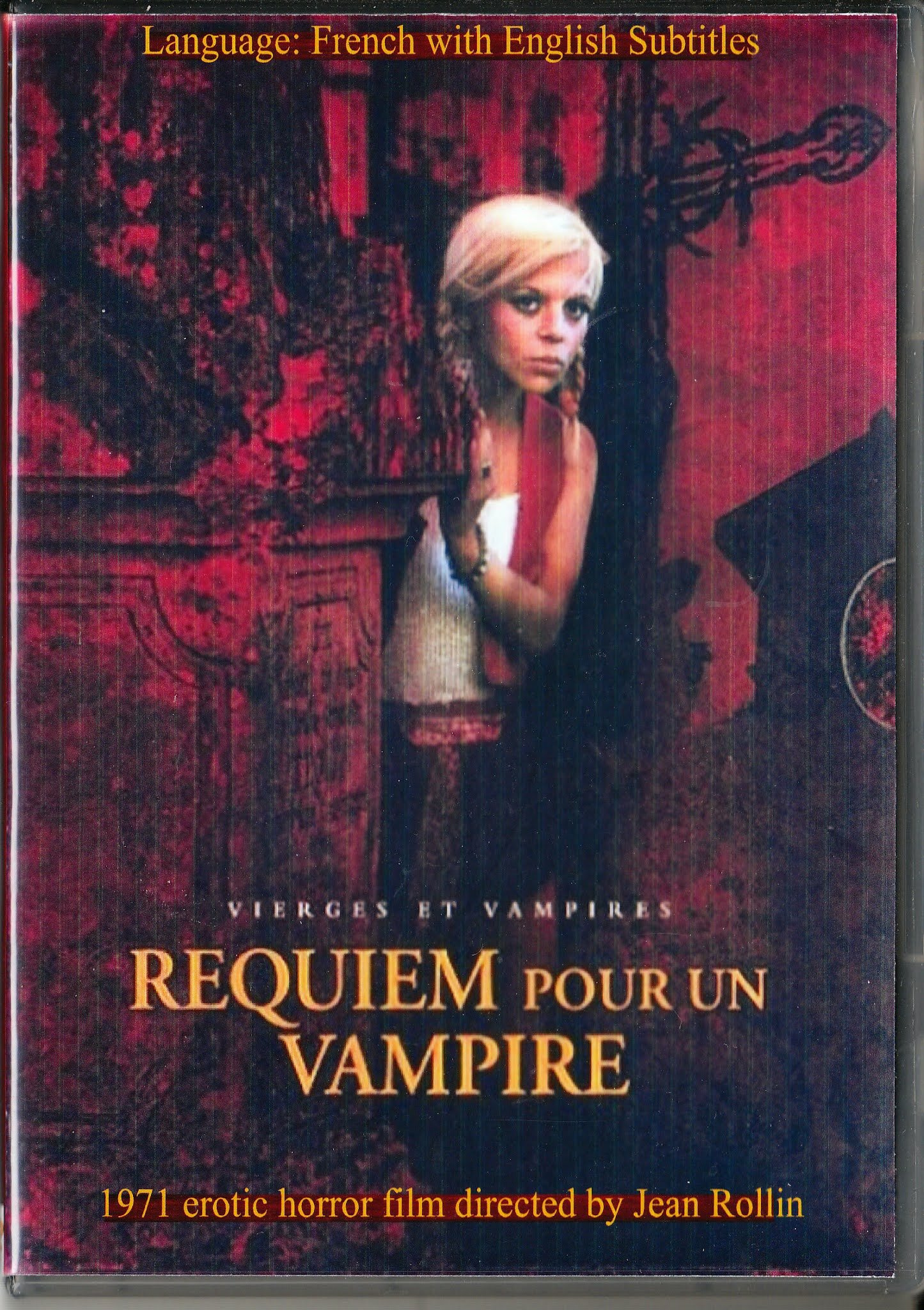
Requiem for a Vampire (1971), Blu-Ray review

Requiem for a Vampire was Jean Rollin’s fourth completed feature film and of all his films this was his personal favourite. It’s been released at various times under ten different titles, including (in the US) Caged Virgins!

This was the first Rollin movie I ever saw, many years ago, and it made me an immediate Rollin fan. I’m now the proud owner of a copy of the Redemption Blu-Ray release so it’s time to take another look at this movie.

It opens with one of the many extraordinary iconic images that Rollin offered us over the years (other that come to mind are Brigitte Lahaie with the scythe in Fascination, the vampires coming out of the clock in Shiver of the Vampires and numerous images in The Iron Rose). Two girls dressed as clowns are making their getaway in a car after an armed robbery. Their driver doesn’t make it and the girls set off on foot.

Why are the girls dressed as clowns? That’s simple. This is a Jean Rollin film and Rollin was first and foremost a surrealist. If you explain a surrealist image it loses its magic.

The girls are Marie (Marie-Pierre Castel) and Michelle (Mireille Dargent). They are lesbians. So far we have clowns, doubles and lesbians, and vampires are about to make their appearance, so you know this is definitely a Jean Rollin film.


The girls steal a motorcycle and end up at the château. The château is inhabited by vampires, or at least by one vampire and his followers. He is the last vampire, but his followers hope to become vampires. Erika (Dominique) has already grown fangs.

The girls are not held prisoner, except that they are in reality prisoners. They can leave the château but no matter which road they take it will always lead them back to the château.

The vampires have a kind of larder in the dungeon - a number of young women chained up who serve as a food supply. They also provide sexual entertainment for the vampires’s male followers. Whether these young women are innocent victims or willing participants in the perversity is left rather ambiguous.


Marie and Michelle are not to serve as vampire food. They are to be initiated which will begin their transformation into vampires. There is one slight problem, the vital question of whether or not the girls are virgins. They are in fact virgins but turning a virgin into a non-virgin is not a difficult task. In fact Marie approaches it with enthusiasm.

Michelle seems to like the idea of becoming a vampire. Marie isn’t so sure. The girls are supposed to lure victims back to the château but Marie decides that the man she’s trying to ensnare is kind of cute and rather nice. This will lead to trouble.

If I’ve given you the impression that this movie has a straightforward linear narrative then I apologise. Early Rollin vampire movies such as this one do not bother overmuch with conventional narrative. Rollin simply serves us up a succession of striking images, and the images are enough to make the film worthwhile. Louise (one of the vampire’s acolytes) playing the piano in the graveyard is one such image (and it was apparently the image that Rollin came up with first and from which he built the entire film).


One thing that is sometimes overlooked is that Rollin had a great fondness for movie serials, both the French serials of the early 20th century and even more especially for American movie serials of the 30s and 40s. These movie serials had a major influence on the way Rollin structured his narratives. Some of the outrageous elements in the plot of Requiem for a Vampire are inspired more by the delirious fun of movie serials than by artiness.

This movie is a good example of Rollin’s attempts at this stage of his career to combine the surrealist artiness which he loved with commercial exploitation elements. And there are enough exploitation elements to keep any exploitation fan happy - there’s copious female frontal nudity, bondage and plenty of sadomasochism. The scene with the presumably vampiric bat apparently feeding between a naked girl’s thighs is one of the more outré images in the film.

Which also explains why Rollin, despite the fact that he was a genuine master of surrealism, had so much trouble getting taken seriously in France.


Rollin tended to cast his actresses as much as anything for their visual suitability. That meant that they had to be pretty but with the kind of prettiness that would fit the visual tone of a particular movie. They needed to be competent but not necessarily especially accomplished actresses. Marie-Pierre Castel and Mireille Dargent are perfect for his purposes, as is Dominique as the sexy but predatory Erika - she really looks like a glamorous lady vampire, seductive and beautiful but in a weird otherworldly way.

Redemption’s Blu-Ray release looks very impressive and includes plenty of extras.

Requiem for a Vampire is certainly a vampire movie and it contains plenty of the elements you’d expect to find in a gothic horror movie, but it’s not really a horror movie. It’s a poetic melancholy movie about love, sex and death, and dreams that pass away, and about loss. It’s a world away from conventional vampire movies, and it has little in common with the lesbian vampire movies of that era such as Hammer’s The Vampire Lovers or Jose Larraz’s Vampyres. It doesn’t even have much in common with Jess Franco’s lesbian vampire movies like Vampyros Lesbos and Female Vampire. Rollin’s vampire movies formed their own unique genre.

Requiem for a Vampire is a strange surreal and entrancing mood piece. Very highly recommended.

Sunday, 27 March 2022

The Playbirds (1978)

Mary Millington was a minor pop culture phenomenon of the 1970s (and in Britain perhaps not so minor). She made a series of incredibly successful softcore sex films and became one of Britain’s best-known nude models. She committed suicide in 1979, hounded to death by police harassment.

The Playbirds (1978) was one of her major hits. I had expected this movie to be a sex comedy but while there are some comic moments it’s essentially a crime thriller. With some nudity. OK, with lots and lots of nudity.

A crazed killer is strangling nude models, all of whom have posed for Playbirds magazine. That’s one link between the killings, but there’s another. The victims all seemed to have some connection with horses. Since the owner of Playbirds magazine, a man named Dougan, is a keen racing enthusiast and racehorse owner Chief Superintendent Holbourne (Glynn Edwards) devotes some attention to Dougan. Holbourne also wonders about the witchcraft angle, since the magazine recently featured a series of photoshoots involving witchcraft.

The police fear that the next victim might be Playbirds’ latest centrefold, a rather charming cute blonde named Lena. Inspector Harry Morgan (Gavin Campbell) is assigned to keep an eye on her. Since she’s a very pretty and very personable young woman it’s a rather pleasant duty.


The Assistant Police Commissioner (played by comedy legend Windsor Davies) feels that the investigation is going nowhere. The new plan is to have a policewoman go undercover as a nude model for Playbirds magazine. That assignment will go to Woman Police Constable Lucy Sheridan (Mary Millington).

The highlight of the movie is the selection process for the policewoman who is going to go undercover. Chief Superintendent Holbourne and Inspector Morgan sit at a desk in an office while various policewomen troop in and take all their clothes off. Sometimes being a cop ain’t so bad. The great thing about this scene is that we see luscious naked women (these are the prettiest policewomen you have ever seen) but it’s not gratuitous nudity. It’s integral to the plot!


The story is mostly played fairly straight. While stylistically it bears no resemblance to the Italian giallo genre the content does appear to indicate a major giallo influence. A series of sex murders, a black-gloved killer, an atmosphere of sleazy glamour, some decadence.

Setting a sex movie in the world of girlie magazines had been a favoured technique in 1960s American sexploitation movies. It always offers an excuse for lots of nudity and doesn’t require expensive sets, and it provides a suitable atmosphere.

The movie is certainly not lacking in nude women. We get our first glimpse of female frontal nudity about fifteen seconds into the movie. There’s lots more to follow. Oddly enough while Mary Millington is in the movie right from the start we have to wait a very long time for her to take her clothes off. This means that she has to do some actual acting. As an actress she’s perfectly competent. Most of the cast are quite OK, they’re obviously just coasting and waiting to pick up their pay cheques but they’re competent actors.


There is a bit of social comment in this film. It’s certainly not directly political but the movie does take a few swipes at the self-appointed moral watchdogs of society and the police are not exactly portrayed as either competent or particularly pleasant.

This was the 70s so the movie comes down very much on the side of sexual freedom, which in today’s climate is quite refreshing. The nude models are really nice girls. There’s nothing negative about the way they’re portrayed. WPC Lucy Sheridan has no qualms at all about having lots of sexual encounters in the line of duty. She’s portrayed as one of the more competent among the cops. If the job requires her to drop her panties and jump into bed with someone she’s OK with that. Hey, it’s more fun than typing arrest reports. But she still comes across as a dedicated cop. She just happens to see it as quite natural for a woman to want to have sex. The movie doesn’t suggest that this makes her a bad person, nor does it suggest that shedding their clothes for a magazine makes the nude models bad people.

This movie could be compared to Play Motel, an erotic giallo made at about the same time. Taking the basic giallo or erotic thriller formula and adding lots of extra nudity was an obvious enough idea.


The Playbirds
doesn’t look dirt cheap and it’s technically well made. There are even a few reasonably effective visual suspense moments.

The ending is quite unexpected.

Screenbound’s DVD offers a good uncut transfer. The extras include Mary Millington’s World Striptease Extravaganza which doesn’t actually feature Miss Millington (it was shot in 1981). If you can put up with the awful comic acting as the host then it provides a fascinating glimpse of the art of striptease in 1981. It’s quite lengthy and it features an astonishing array of very naked young women. There’s also one of the shorts that Mary Millington did earlier in her career and I have to say that considering it was shot on 8mm it looks remarkably good. If you enjoy lesbian sex scenes you’ll like it. There’s a stills gallery which includes some of Millington’s photoshoots for 70s girly magazines, plus there are trailers. Overall a pretty impressive DVD presentation. The Playbirds is also included in the recent Mary Millington Blu-Ray boxed set.

The Playbirds works OK as an erotic crime thriller with a fairly serviceable plot (I guessed the killer’s identity but I turned out to be wrong) but of course the point of the movie was to display enormous amounts of bare female flesh. As a softcore erotic movie it’s pretty good. Overall The Playbirds is kinda fun. I’m recommending this one.