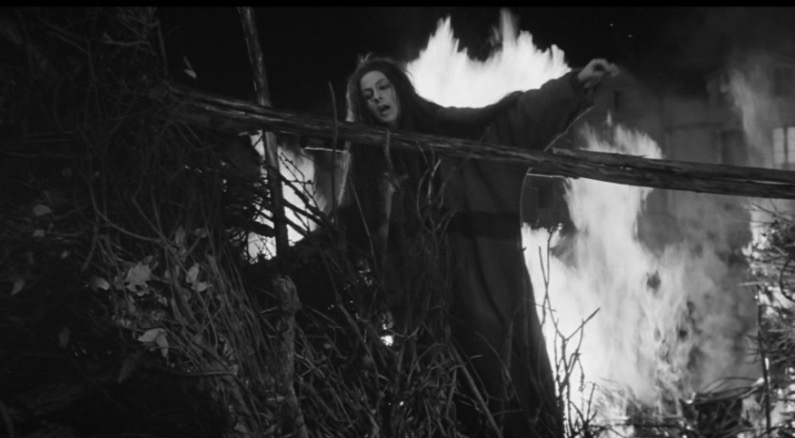
I’m not quite sure what I expected from The Little Girl Who Lives Down the Lane. I guess I expected an evil child horror movie, and while it is a horror movie of sorts it’s not really that sort of horror movie. It’s also a thriller of sorts, with some interesting quirky touches. It’s one of those really interesting movies Jodie Foster made early in her career.
This was a Canadian-French co-production.
Jodie Foster plays Rynn Jacobs, a thirteen-year-old girl who lives in a house in a seaside village (and Foster was thirteen when she made this film). Rynn lives there with her father. They’ve been there for a few months.
It doesn’t take us long to suspect that in fact she lives alone. Wherever her father might be he certainly doesn’t live in this house in Maine.
Rynn’s life is about to get complicated. The first complication is Frank Hallet (Martin Sheen). He’s the son of the woman from whom Rynn’s father leased the house. Frank is a nasty piece of work in a lot of ways but the big problem is that he is much too interested in Rynn. He’s the sort of guy who is much too interested in young girls in general. The police know all about him but his mother, Cora Hallet (Alexis Smith), wields a lot of power in the village so they can’t touch him. Rynn isn’t stupid. She knows the sort of man he is but dealing with him could be difficult.
Rynn’s second problem is Cora Hallet. Cora is nasty, vindictive, meddling and officious. She enjoys pushing people around. She intends to push Rynn around. Rynn intends to push right back.
Then something happens that makes Rynn’s situation really awkward. Fortunately she finds an ally. Mario Podesta (Scott Jacoby) is a young man with whom Rynn has a lot in common. They’re both eccentric, they’re both outsiders. Mario has a bad leg. He’s also a magician. Stage magic is his way of dealing with being an outsider - if people think you’re weird you might as well be really weird. But Mario is a nice guy.
We eventually find out a bit more about Rynn but it’s important for the viewer to find out about her gradually as the story unfolds so all I will say is that she has constructed a life for herself, an unconventional life that suits her, and the security of that life faces major threats.
She also has some growing up to do, and her circumstances require her to grow up fast.
There are lots of plot twists and I have no intention of offering any hints about them.
Director Nicolas Gessner did not see this as a horror film but as a love story. It is a love story, but it’s a psychological thriller with horror overtones as well.
All the performances are good. Martin Sheen is extraordinarily creepy and menacing. But the movie belongs to Jodie Foster. She got top billing, and deservedly so. While Taxi Driver might be better known it’s The Little Girl Who Lives Down the Lane that gave her her best role of the 70s, and one of the two or three best rĂ´les of her career. Her star quality is very much in evidence. She underplays, which is exactly the right choice.
I don’t know much about Nicolas Gessner but this seems to be the standout movie of his career and it’s a movie he desperately wanted to make. Laird Koenig originally wrote the story as a stage play, then turned it into a novel and then wrote the screenplay.
Insofar as it can be considered a horror movie it’s the sort of horror I enjoy - it relies on suggestion and atmosphere rather than gore. As a psychological thriller it’s a slow-burner, which I also like. As a romance it’s powerful and effective, and touching.
There is a scene in the movie which upsets some people, given Rynn’s age, but it’s absolutely crucial and could not have been cut or toned down without making nonsense of the movie.
The Little Girl Who Lives Down the Lane defies easy genre classification but it has an offbeat charm and considering that the director wasn’t trying to make a horror film it has some horror moments that pack quite a punch without ever resorting to gallons of fake blood. A superbly crafted movie which is now firmly established as one of my two favourite Jodie Foster movies (the other being Carny). Very highly recommended.
The Kino Lorber Blu-Ray looks great and includes a stimulating audio commentary by the director. Gessner has very strong ideas about how movies should be made. He was clearly in awe of Jodie’s Foster talent as an actress. There’s also an interview with Martin Sheen.
Horror, sci-fi, exploitation, erotica, B-movies, art-house films. Vampires, sex, monsters, all the fun stuff.
Friday, 12 April 2024
Tuesday, 9 April 2024
Death Laid an Egg (1968)
Giulio Questi’s Death Laid an Egg (AKA Plucked AKA A Curious Way to Love, original Italian title La morte ha fatto l’uovo) is an attempt to combine the giallo and the art film. It’s an attempt that mostly fails but the movie is not a total loss.
We start with a strange scene of the murder of a woman. It’s strange because it reveals the identity of the psycho killer right from the start.
The killer is Marco (Jean-Louis Trintignant) and he runs a high-tech poultry farm with his wife Anna (Gina Lollobrigida). Very high-tech. It’s completely automated. The farm requires no other human workers whatsoever.
Living with Marco and Anna is Anna’s poor relation cousin Gabrielle (Ewa Aulin). Given that Anna is in her early 40s and Gabrielle is an amazingly cute blonde 18-year-old you can see that there’s plenty of potential for trouble there. And sure enough Marco is taking a very keen interest in Gabrielle.
While this is happening there’s lots of stuff about the poultry farm and about the scientific experiments being conducted there, aimed at breeding mutant chickens that will maximise profits. I think it’s safe to say that the chicken farm is being used as an amazingly heavy-handed metaphor for capitalism. There’s a sinister poultry industry association and they’ve hired whizz-kid publicist Mondaini (Jean Sobieski) to persuade Italians not just to eat more chicken but to make poultry the centre of their lives.
Given that the publicist is a good-looking young guy who spends a lot of time at the poultry farm there’s more potential for trouble there, and sure enough there’s something going on between Mondaini and Gabrielle.
This all sounds like a lot of fun, but it isn’t. Questi just doesn’t have the necessary lightness of touch. And he’s obsessed with the chicken stuff.
There’s a giallo plot buried in here somewhere, with a couple of very nice twists, but it takes forever to develop. Questi is too busy showing us endless scenes involving chickens and bludgeoning us with crude political metaphors.
It’s difficult to judge the acting. Jean-Louis Trintignant seems to be in a daze, as if he has no idea what the movie is about. One can’t blame him. Gina Lollobrigida does her best. Ewa Aulin comes off best since her character has traces of actual personality.
There’s some game-playing going on between the four main characters, which needed to be developed a bit more. And there’s lots and lots of stuff about the fiendish plots of evil businessmen exploiting both the workers and the chickens.
The Nucleus Films Blu-Ray includes two cuts of the movie, the shortened “giallo” cut which runs 91 minutes and a much longer “director’s cut” running 104 minutes. If you watch that cut in the English-language version it’s easy to spot the scenes that were deleted for the giallo cut and subsequently restored because they’re Italian rather than English. It’s also easy to see why those scenes were cut out. They were cut out because they’re boring pretentious self-indulgent nonsense.
If you decide to see this movie then you should definitely watch the shorter giallo cut. You won’t miss out on anything of value but you will be spared a lot of tedium.
What you have here are two movies running in tandem. One is the sort of tedious, clumsy, obvious political film that you’d expect from a first-year film student. That movie is, like all political movies, a very bad movie. The second movie is a surprisingly extremely good and interesting giallo. The “director’s cut” was a very bad idea because it puts so much focus on the bad movie half.
Questi made very few feature films and it’s easy to see why. He’s self-indulgent and undisciplined.
I also think it’s safe to say that Bruno Maderna’s score is the worst score in the history of motion pictures.
I should point out at this point that although I dislike political films I have no problems at all with arty films or with weird crazy films or with incoherent plots.
The frustrating thing is that the giallo plot is very cool indeed and it builds to a very satisfying climax. So despite its egregious flaws this movie is worth watching.
Nucleus Films have done a great job with the Blu-Ray. There are lots of extras including a fair and even-handed audio commentary by Stephen Jones and Kim Newman.
Saturday, 6 April 2024
The Long Hair of Death (1964)
The Long Hair of Death is a 1964 Italian gothic horror film directed by Antonio Margheriti and starring Barbara Steele.
The main story takes place in the year 1499 but there is a prologue dealing with important events a few years earlier. Count Franz had been murdered. The murderer had diverted suspicion on to an innocent woman, Adele Karnstein. Adele was accused of being a witch and burnt. Another young woman had in her possession important evidence. This young woman also came to an untimely end. Both Count Franz’s brother Humboldt and Humboldt’s son Kurt (George Ardisson) were involved in these nefarious plots. Adele vows that retribution will seek out Humboldt and Kurt, in the last year of the century.
We then jump forward to 1499. The region is being devastated by plague, which may or may not be the result of Adele’s dying curse.
Kurt is obsessed by Lisabeth Karnstein (Halina Zalewska), the daughter of Adele. He is determined to marry her. She finds him repulsive. He marries her and he is able to possess her body but she vows he will never have her heart.
Then a mysterious young woman (played by Barbara Steele) appears at the castle. Her name is Mary. Kurt takes a more than passing interest in her. She seems to reciprocate his love, or at least his lust.
Lisabeth’s feelings towards Kurt seem conflicted. On their wedding night she was horrified by the thought of being touched by him. Despite this she is certainly not going to let any other woman have him.
A romantic triangle develops but we know from the start that it’s not a straightforward romantic triangle. Those events in the past are casting their shadow on the present. We also suspect that something supernatural is going on. This is one of those gothic horror movies that keeps us guessing until the end about whether this is really a supernatural horror story. If supernatural elements really are involved we may have our suspicions about how those elements will play out, but we can’t be quite sure.
There is also the possibility of madness playing a part as key characters start to unravel.
Romantic triangles do tend to get messy and can lead one or more participants to consider the possibilities of murder. More than one participant in this particular triangle might have reason to contemplate such a step. In fact all three might have such motives.
There’s plenty of sexual tension as Kurt’s obsession with Mary grows.
This is a fine part for Barbara Steele. She looks perfect in Renaissance-period gowns and she exudes dangerous eroticism and mystery.
George Ardisson as Kurt has a demanding role. Kurt is tortured by love, lust, guilt and fear and he slowly begins to fall apart. Ardisson doesn’t seem to have had a very distinguished career but he’s effective here.
Halina Zalewska is fine as Lisabeth but she is inevitably overshadowed by Barbara Steele’s stellar performance.
The original story was by Ernesto Gastaldi, one of the great Italian screenwriters of this era (and a highly acclaimed novelist as well). Tonino Valerii and Antonio Margheriti were responsible for the screenplay. It’s a good story with some reasonably nasty and effective twists.
I’m quite an Antonio Margheriti fan. Yes, some of his movies are schlocky and trashy but they’re never less than entertaining and he did make some wonderful movies in a variety of genres, including one of my all-time favourite science fiction movies, The Wild, Wild Planet (1966). He also made a pretty decent early giallo, Naked You Die (1968). Margheriti was very competent and had the ability to get good results on low budgets. The Long Hair of Death is one of his best efforts as a director. Margheriti deserves more attention as an important figure in European cult cinema.
The film was shot in black-and-white and Riccardo Pallottini’s cinematography drips with gothic atmosphere.
This movie ticks all the right gothic horror boxes and it’s creepy and moody and suitable doom-laden. The pay-off at the end is perfect. Add the excellent performance by Barbara Steele and you have here a very very fine gothic horror movie that deserves a lot more love. Very highly recommended.
The Long Hair of Death was available for years in very poor quality DVD transfers. Raro Video have released in on both DVD and Blu-Ray and their release looks terrific.
Wednesday, 3 April 2024
That Kind of Girl (1963)
That Kind of Girl forms part of an interesting 1960s British film sub-genre, the serious-minded didactic sex melodrama. These movies were sexploitation movies. The sexual subject matter was certainly the selling point and that’s definitely the case with this movie with its “ripped from the headlines” sensationalistic posters and promotional material.
But given the draconian British censorship of the 60s these movies are ludicrously tame.
It was quite common for sexploitation movies to try to head off censorship problems by posing as important social documents warning society of the dangers of immorality. This is something you see in 1950s juvenile delinquent movies as well. In US sexploitation movies it’s always obvious that the dire warnings are totally insincere. In some of these British movies on the other hand you really do get the feeling that the disapproval of sex is absolutely real, that sex really is seen as dirty and wrong and that while the film-makers aren’t going to be able to persuade young people not to have sex they can at least ensure that they’ll be too riddled with guilt and anxiety to enjoy it.
That Kind of Girl very much adopts the tone of a public information film. It’s difficult to judge director Gerry O’Hara’s intentions since he was allowed no real input at all. He was merely hired to direct the script as written and had no involvement in the editing. Had he wanted to soften the judgmental tone of the script he was offered very little opportunity to do so, other than perhaps to influence the performances. When you consider his inexperience (this was his first feature) it’s probably unfair to blame him for the way the film turned out. It was never in any sense his film.
Some of these British sex melodramas from the early to mid-60s also have a lot in common with the British New Wave and the kitchen sink realism style, those dreadfully earnest movies that delighted in wallowing in despair.
That Kind of Girl is the story of Eva (Margaret Rose Keil), a stunningly beautiful eighteen-year-old Austrian au pair in London. She helps a married couple, the Millars, care for their three-year-old son Nicholas. Eva likes kids and she likes the little boy.
Not surprisingly Eva attracts a lot of masculine attention. Max (Frank Jarvis), a rather earnest student, has fallen for her in a big way.
Max has a formidable rival in the person of Elliot Collier (Peter Burton). Elliott is middle-aged but he’s a smooth talker and he projects an air of sophistication which is quite sufficient to impress an eighteen-year-old girl.
Max desperately wants to sleep with Eva but he has no idea how one goes about persuading a girl into bed. He seems to think that the best way is to be as whiny as possible. Elliott wants to sleep with her as well and he knows all the tricks of seduction. Elliott is very much the Villain, taking advantage of Eva’s innocence.
Then a third man enters the picture. Max has persuaded Eva to participate in a Ban the Bomb march but it’s not her scene at all. She heads back to London. Keith (David Weston) offers her a lift in his sports car.
Keith has his own problems. He is desperate to get his girlfriend Janet (Linda Marlowe) into bed but she insists that they must wait until they are married. It will only be a few years. Surely Keith won’t mind waiting? Keith does mind, and he finds that Eva is much more willing.
Then disaster strikes. Eva discovers that as a result of her outrageously promiscuous lifestyle (she has had sex not once but twice) she has contracted syphilis. This means that all of her many sexual partners (both of them) will have to be contacted. And the Millars will have to be told. The doctors tell Eva that you don’t just catch syphilis by having sex - you can catch it by kissing or by any contact at all. The Millars’ little boy might be infected.
Things become very fraught for everyone concerned. Especially for Keith, who has finally managed to get Janet into bed. And he’s managed to get her pregnant.
An interesting aspect of this movie is the timing. It was made in 1963. This was not yet Swinging London although that phenomenon was just around the corner. This is before the arrival of the mini-skirt. It’s also just before the discotheque era. This is still the period of smoky jazz clubs.
Max’s friends of his own age have more in common with the beatniks than with the new youth subcultures of the 60s. They’re very involved in worthy political causes (such as Ban the Bomb marches), they pontificate about philosophy and they take life very very seriously.
There are some interesting class aspects to the movie. Max is working class with middle-class aspirations. Janet and the Millars are thoroughly suburban and middle-class and achingly respectable. Elliott and Keith are prosperous middle-class tending to upper middle class. Eva, being a foreigner, is considered to be classless and therefore a dangerous threat. And, being a foreigner, she is of course totally immoral.
There’s an amusing tone of hysteria. If only young people would listen to the voice of authority none of this would happen. The doctor at the STD clinic tries to warn the young that if they have sex (or even kiss) outside of marriage then they risk ruining their lives and becoming a menace to public health and safety.
The police are portrayed in grovellingly favourable terms. You can always trust authority figures (parents, doctors, the police) and you should do whatever they tell you to do. They know best.
The movie doesn’t necessarily suggest that anyone who has sex outside of marriage is totally evil, but if you do succumb to temptation you can rest assured that nothing but misery and degradation awaits you. This is full-on kitchen sink realism misery. Really the best thing to do is just to throw yourself under a bus and get it over with since any attempt to find joy or pleasure in life is doomed anyway. Life is not about joy. It’s about duty, and learning to endure misery.
This is a truly terrible movie with a clumsy script and cringe-inducingly earnest performances. But it is an interesting time capsule offering a fascinating look at England in the period just before the Swinging London period, and before the Sexual Revolution. So it’s maybe worth a look for that reason.
Gerry O’Hara went on to make other depressing sex melodramas such as All the Right Noises (1970).
What’s fascinating is that right up to the beginning of the 70s British sex melodramas continued to preach doom and gloom, with movies like Her Private Hell (1968) and Permissive (1970). The latter may be the most pessimistic despairing movie ever made.
Monday, 1 April 2024
The Adventures of Barry McKenzie (1972), Blu-Ray review
The Adventures of Barry McKenzie was released in 1972. It was torn to shreds by Australian film critics (who wanted worthy earnest Australian films) and proceeded to make a fortune at the box office. It was the newly revived Australian film industry’s first smash hit.
The Adventures of Barry McKenzie was shot partly in Australia and partly in London.
Barry McKenzie (Barry Crocker) is a young Australian who has just inherited some money, but the condition is that he has to use it to travel to Britain. His aunt Mrs Edna Everage (Barry Humphries) decides to accompany him.
Bazza’s problems (he is known to his friends as Bazza) start at Heathrow. He gets ripped off by the customs inspector but worst of all his supply of Fosters Lager is confiscated. Bazza is worried he won’t be able to buy Fosters in London.
Bazza has a series of outrageous adventures. He is recruited as an advertising model. He falls in with crooked hippies who plan to launch him as an Aussie folk-singing sensation. He encounters a middle-aged Englishman (played by the great Dennis Price) who wants Bazza to cane him. He falls into the hands of a crazy psychiatrist. He looks up a childhood friend, Gaylene (Mary Anne Severne), unaware that she is now a lesbian. Gaylene’s ex-husband Dominic (Peter Bentley), a TV producer, persuades Bazza to be interviewed on television.
All these adventures seem to end with wild fist-fights, chaos and in one memorable scene with Bazza throwing up over the psychiatrist’s head. Thousands of gallons of Fosters Lager are consumed. Bazza makes desperate attempts to persuade a variety of young females to go to bed with him, with a striking lack of success.
Bazza could easily have come across as obnoxious but Barry Crocker, giving a terrific performance, avoids that pitfall. He manages to persuade us that underneath the crude exterior Bazza is really quite vulnerable. Bazza just doesn’t understand anything that is happening to him. He’s a virgin and he’s terrified of women. His uncouthness is a defence. He’s really rather scared. If the audience hated Bazza the film would not have worked at all but Crocker is able to get us on Bazza’s side.
Barry Humphries had the Edna Everage schtick ticking along nicely by this time. He plays two other roles as well, including the hapless psychiatrist.
There are some notable British comedy figures in the guest cast, including Peter Cook and Spike Milligan.
To appreciate this movie fully you have to have some historical background. The 1950s had been the era of Cultural Cringe in Australia, a period in which Australians took it for granted that everything about Australian culture was inferior to British culture. By the late 60s a reaction was happening with the rise of the “new nationalism” which aimed to establish a distinctive cultural identity in both high culture and pop culture. The resuscitation of the long-dead Australian film industry was a part of this. And The Adventures of Barry McKenzie was the movie that proved that Australian movies could be commercially viable.
It’s also necessary to place Barry Humphries in the context of what was happening in British comedy in the 60s. This was the golden age of satire and at the forefront was Peter Cook. Barry Humphries was very part of this scene. He and Peter Cook were good friends and in 1964 Cook asked Humphries to write a comic strip (which became The Wonderful World of Barry McKenzie) for his satirical magazine, the legendary Private Eye. Both Peter Cook and Barry Humphries favoured a deliberately provocative style of comedy. They wanted to provoke howls of outrage, and they did.
And no-one could provoke howls of outrage more effectively than Barry Humphries. When the Barry McKenzie comic strip was published in book form it was promptly banned by the Australian Government. This of course was exactly the kind of reaction Humphries wanted.
The Adventures of Barry McKenzie is very much a movie that seeks to provoke and outrage. When Australian critics savaged the movie Humphries was delighted - if so many people whom he despised hated it he figured he was on the right track.
This movie is of course dated, offensive and problematic, but only in parts. I’d estimate that only 112 of its 114 minutes are dated, offensive and problematic. Of course it was intended at the time to be offensive. Nobody used the term problematic at the time but if the term had been used then Humphries would certainly have aimed to be as problematic as possible. It should be pointed out that the movie sets out to mock and offend absolutely everybody. It’s actually very offensive in a non-offensive way. You’re not supposed to take it even a tiny bit seriously.
It’s also crude and vulgar, and deliberately so. Again Humphries is gleefully setting out to provoke and outrage.
The Adventures of Barry McKenzie has a couple of flaws that are almost certainly a reflection of inexperience. Bruce Beresford had never made a feature film. Neither Beresford nor Barry Humphries (who co-wrote the script between them) had ever written a feature film. The movie is a bit too long. It’s also very episodic. On the other hand this is an adaptation of a comic strip, not a novel. Its episodic quality can be seen as both a flaw and a virtue.
The Adventures of Barry McKenzie is a unique cinematic experience. I enjoyed ever moment of it. Highly recommended.
Saturday, 30 March 2024
Orgasmo (AKA Paranoia, 1969)
OK, first things first. In 1969 Umberto Lenzi made a movie called Paranoia. The Italian distributors changed the title to Orgasmo, a less appropriate but at the time more commercial title. In 1970 Lenzi made another movie called Paranoia, a movie that is also known as A Quiet Place To Kill. In order to minimise confusion I think it’s advisable to call his 1969 movie Orgasmo and his 1970 movie A Quiet Place To Kill. That way we know which movies we’re talking about. So I will refer to the movie that is the subject of this review as Orgasmo.
There’s another matter that needs to be cleared up. Severin’s Blu-Ray release includes two different cuts of the movie. The first is the Director’s Cut. This is in fact the original cut. This is the movie that Lenzi made. The second cut is the X-Rated U.S. cut. Don’t get excited by this - this version is in fact less raunchy than the Director’s Cut. This is a hacked-up shortened version of the film that eliminates Lenzi’s ending, which has the effect of totally ruining the movie. Don’t waste your time on this version. Watch the Director’s Cut.
Orgasmo is generally considered to be a giallo. In fact there were two distinct phases or waves of the giallo genre. The first wave lasted from around 1967 to 1970 with one or two later outliers. The second wave began with Dario Argento’s The Bird With the Crystal Plumage in 1970. These two phases are so radically different that it’s important to be clear that they are totally separate and distinctive sub-genres, with their own conventions. The second wave giallos are visually flamboyant blood-drenched thrillers usually involving lots of murders and black-gloved serial killers. The first wave are stylish erotic thrillers, with often only one or at the most two murders. The first wave giallos are characterised by an atmosphere of jet-set decadence and glamour.
Both sub-genres have much to recommend them. Most people prefer the post-Argento second wave giallos. Personally I much prefer the first wave giallos which have much more interesting plots and characters and an emphasis on eroticism that is both more subtle and more genuinely perverse than the second wave.
The first wave giallos are often dismissed by fans who are disappointed that they differ so radically from the post-Argento giallo.
Umberto Lenzi made four films starring Carroll Baker and these films are superb examples of the first wave giallo.
Orgasmo begins with a very very rich widow named Kathryn (Carroll Baker). She meets a hunky young American named Peter (Lou Castel). She allows lust to cloud her judgment and begins an affair with him although there are some red flags she should have noticed.
Kathryn is a little unstable and a little too fond of a drink.
Peter’s sister Eva (Colette Descombes) turns up. Kathryn finds it fun hanging with these two exciting sexy youngsters. They are much younger than Kathryn and this seems to be what she finds most seductive about them. She’s in her mid-30s and she’s starting to become aware that her youth has slipped away from her.
She finds it hard to keep up with them but Eva keeps feeding her pills which helps.
Kathryn thinks she understands the situation and she thinks she’s in control of it. She starts to wonder about this when she catches Peter and Eva in bed together. It’s OK, they can explain everything. Kathryn is deeply shocked.
The truth is that Kathryn is more old-fashioned than she thought she was. She enjoys playing at decadence and playing at being a bad girl but for her it’s just a game and she gets frightened when it starts to get real.
And she is now in a situation which makes her very frightened and confused. She drinks more and takes more pills. She starts to lose touch with reality just a little.
It builds to a very twisted conclusion (assuming you’re watching the Director’s Cut). It’s a great gut-punch ending.
This movie was a triumphant comeback for Carroll Baker after a nightmarish period in Hollywood. It’s a difficult demanding complex rĂ´le and she handles it with ease. A great actress at the top of her game.
There’s very little violence but what violence there is is genuinely shocking not because it’s graphic but because it’s emotionally wrenching and it makes us deeply uncomfortable. Lenzi doesn’t need to throw buckets of blood at us in order to get our attention.
There’s some nudity and very little sex but again Lenzi knows how to create an atmosphere of dangerous unhealthy eroticism, and he knows how to do it subtly. And there’s a wonderfully decadent atmosphere.
Lenzi really found himself as a director with this film. Orgasmo is very very stylish.
Whatever you think of its status as a giallo Orgasmo is a superb erotic thriller. Very highly recommended.
Severin’s Blu-Ray release offers a lovely transfer. There are two audio commentaries.
I’ve also reviewed the second of the Lenzi-Baker collaborations, the wonderful So Sweet...So Perverse (1969).
Labels:
1960s,
carroll baker,
erotic thrillers,
giallo,
umberto lenzi
Wednesday, 27 March 2024
Honey (Miele di donna, 1981)
Honey is an Italian-Spanish co-production released in 1981. Assigning it to a genre is tricky to say the least. The original title Miele di donna translates literally as A Woman's Honey. It’s a very strange movie, and a very good and very interesting one.
It begins with a woman (played by Catherine Spaak) forcing her way into the office of a book editor (played by Fernando Rey). She produces a manuscript and a gun. She insists that he read the manuscript aloud. We assume she is a writer and that she has written this manuscript.
The story in the manuscript then unfolds on screen.
A young woman named Anny (Clio Goldsmith) is in a cab looking for the Pensione Desiderio (the Desire Guest House). The cab driver has never heard of the place but surprisingly it is easy to find.
Right from the start the Pensione Desiderio has a strange mysterious atmosphere. Anny is welcomed by the landlady (Donatella Damiani), an extraordinarily voluptuous woman. The landlady is annoyed by find the maid Inés (Adriana Russo) once again spying on one of the guests. She scolds the maid and then invites Anny to join her in spying on that guest. He is an amazingly musclebound individual who apparently spends almost all his time in an odd inexplicable physical training routine.
Things are already becoming a little strange. The landlady suggests that Anny might like a bath. After her bath the naked Anny has an encounter with the landlady. It’s not exactly a sexual encounter but what it is is not at all clear.
There’s some confusion about Anny’s room. It is not yet ready for her. The geography of the Pensione Desiderio is also ambiguous. It seems much bigger than it should be and finding the kitchen or the bathroom is a challenge. It’s as if Anny has entered a maze. The Guest House of Desire is a maze, as is the movie itself.
There appear to be both men and women guests. There’s a middle-aged man who seems delighted that the Pensione has another guest. There’s also Ridolfi, who seems to be a gentleman although perhaps of the playboy type. He is a dance teacher.
Anny wanders naked into one of the rooms and has to hide under the bed when Inés and the middle-aged man walk in. Inés and the man have sex on the bed, with Anny hidden under the bed but watching them in a mirror.
There’s a lot of voyeurism in this movie but it’s all female voyeurism. It’s women who do the watching.
Then the girls arrive, for their dance lesson. Anny witnesses the dancing class, and it’s a perfectly ordinary dancing class. This is actually more disturbing, since by now we are expecting weird things to keep happening.
There’s a slight sense of temporal and geographical ambiguity. We feel that we’re not in the 80s any more but these events may have occurred a few years earlier, or many years earlier. At times the music and certain other elements add a slight Middle Eastern flavour. Are we really in western Europe? There’s a subtle sense of exoticism.
There is definitely a slight surreal vibe, and a dream-like quality to the events as they unfold. So what is going on? Is this simply a novel written by the lady writer (the one played by Catherine Spaak)? It could be that, or it could be a dream or a fantasy. We can’t even be sure that the lady writer was the actual author of the manuscript. There’s also a subtle suggestion that perhaps we’re seeing events through the eyes of someone who did not understand those events. We also get a sense that Anny, although she appears to be in her early 20s, is a bit child-like and there’s a definite sense that she does not understand her own erotic longings.
And then Anny finally reaches the room assigned to her and things get a lot more dream-like.
Clio Goldsmith gives a remarkable performance. She has the right wide-eyed innocence. She makes Anny seem a little naĂ¯ve but without pushing it too far.
This is a movie in which we could be dealing with more than one unreliable narrator - the lady writer and Anny might both fall into this category. Much depends of course on whether that manuscript is fiction or non-fiction.
Ending a movie like this is always tricky. It’s a movie that relies on being mysterious and keeping us disoriented. An ending that explains too much can destroy the sense of mystery. Whether you’re happy with the ending depends to some extent on what kind of movie you were hoping for. I was fine with the ending.
This is a movie with a strong streak of eroticism but it’s not a straightforward erotic movie. It’s definitely arty and somewhat cerebral and somewhat surreal and don’t expect a conventional linear narrative. I think all these elements work. It’s also a genuinely interesting exploration of female voyeurism. I loved this movie. Very highly recommended.
The Raro Video Blu-Ray offers an excellent transfer but there are no extras. That’s a pity. I’d like to know a bit more about the film’s director and co-writer, Gianfranco Angelucci, and about the other writers (Liliane Betti and Enrique U. Herrera). I’d definitely like to know more about Clio Goldsmith.
Subscribe to:
Posts (Atom)


.jpg)
.jpg)
.jpg)
.jpg)