Friday, 27 December 2019

A View to a Kill (1985)

A View to a Kill is the Bond movie everybody hates. There are plenty of people who will tell you it’s the worst of all the Bond films. It does have its problems but actually it’s nowhere near as bad as its reputation would suggest.

It’s true that Roger Moore was, in his own words, about 400 years too old to be playing the part once again, for the seventh and last time. But he’s still Roger Moore. He still has the charm.

The plot is a stock standard Bond plot. MI6 have discovered that there’s this super-villain planning something really big but they’re not sure exactly what it is. Bond has to find out. To do that he has to get close to the villain by insinuating himself into the villain’s inner circle. Then Bond will conduct a low-level psychological guerrilla war against the villain, getting him angry enough to make a few mistake. Then Bond destroys him and saves the world.

In this case the super villain is (as in so many Bond movies) a crazed industrialist. Max Zorin (Christopher Walken) is obsessed with horse racing, oil wells, computer chips and world domination. He’s the result of a Nazi science experiment intended to produce geniuses. He is a genius but he’s totally unhinged and psychopathic. Bond gets close to him by posing as a possible purchaser of one of Zorin’s super horses (also the result of an experiment by a crazy Nazi scientist).

On this case, unusually, Bond is given a sidekick. The fun part is that the sidekick is played by Patrick Macnee, posing as Bond’s chauffeur/valet. Macnee was even older than Moore but they make an amusing and effective team.


The biggest problem with this movie is that at 131 minutes it’s much too long. There’s nothing particularly wrong with the first half of the movie except that there’s too much of it and it’s too slow. At about the halfway point the pacing picks up dramatically, the plot starts to become more interesting and we get some pretty decent action sequences. The fire engine chase is particularly good and the action climax with the blimp is justly famous. The taxi chase early on is also terrific.

Peter Lamont was art director or production designer on most of the Bond movies from the early 70s up to the first decade of the 21st century. He could always be relied upon and does his usual fine job here. So A View to a Kill looks good.

Christopher Walken is an interesting Bond villain. He’s definitely creepy although perhaps he needed to make Zorin a bit more larger-than-life. Tanya Roberts as the Bond girl has been much criticised. I don’t know why. She’s not much of an actress but she does what she needs to do, which mainly consists of looking terrific (which she does extremely well) and getting rescued by Bond. As far as the cast is concerned the standout is Grace Jones as May Day, Zorin’s girlfriend and chief henchwoman. She looks bizarre, crazy and scary which is obviously why she was picked for the rĂ´le. She’s actually much scarier and more sinister than Zorin.


The pre-credits action scene with the infamous snowboarding to the sounds of a cover version of California Girls has been accused of excessive silliness. It is silly, but silliness and campiness were things that you just have to accept in Bond films of this era. What’s interesting (and very pleasing) is that once that sequence is out of the way the silliness and campiness disappear and the rest of the movie has a slightly serious if mildly tongue-in-cheek tone that is closer to classic Bond.

Mention should be made of Duran Duran’s pretty good title song which also hits the right tone for a proper Bond movie.


If you compare it to another much-disliked Bond movie, the lamentable Die Another Day, which I reviewed here recently then A View to a Kill doesn’t seem too bad. At least, unlike Die Another Day, it feels like a proper Bond movie.

With a bit of tightening up in the first half and with a bit more energy and enthusiasm from Moore and Walken this could have been a very good Bond movie.

Wednesday, 18 December 2019

Henry’s Night In (1969)

Henry’s Night In is a 1969 American sexploitation movie that falls into a fairly select genre - sex comedies that actually work.

Henry is an inoffensive rather nerdy sort of guy with a passion for building model ships. His marriage is not going well. His wife would prefer it if he took a bit more interest in her body and a bit less interest in his model ships. To say that she is sexually dissatisfied would be putting it mildly.

She regards Henry as a weakling. In fact she despises him. Of course this might be part of the reason for the lack of bedroom action in their marriage. Her shrewish behaviour is not exactly calculated to kindle the fires of passion in a man.

Then Henry goes to an auction and finds that he’s bought a mysterious trunk. He’s not sure exactly how he managed to buy it since he didn’t want it. The trunk contains one item, a diary. It’s the diary of an invisible man, and it contains instructions for achieving temporary invisibility. Surprisingly enough it works. All you have to do is to swallow the chemical formula and then sneeze and you become invisible. If you sneeze again you become visible again.

The erotic possibilities are obvious and they’re not lost on Henry. Maybe in ordinary life he’s no stud but that’s because he’s nervous and awkward and repressed. Possibly an invisible Henry would not have those problems. His inhibitions might disappear. And that’s exactly what happens.


Of course the first thing that occurs to Henry is that he could sneak into the house of Sandy, the attractive brunette who’s just moved into the neighbourhood. It’s just a few doors from his own house. Since his invisible the brunette has no idea there’s a man in her house and Henry gets to watch her parading about the house naked. This is something she spends a good deal of time doing. As we’ll soon find out, all the women in this neighbourhood seem to spend most of their time naked when they’re home alone. Of course an invisible man can also do more than just look. All he has to do is wait until they turn the lights out, then hop into bed with them and have sex with them. Since all the local women are having love affairs they’re not the least bit surprised by a man slipping into bed with them. They just assume it’s one of their lovers.

Pretty soon Henry has sampled the delights of most of his female neighbours.

His wife soon notices that he’s behaving strangely and disappearing at odd times. She’s determined to find out what’s going on.


There’s actually a bit more than this to the plot. There’s the question of the identity of the mysterious Jack who has been pleasuring all the women in the neighbourhood, but none of them can say what he looks like. He only makes love to them with the lights out. Is he invisible as well, or does he have some other secret?

The invisibility idea provides a neat solution for one of the problems facing sexploitation movie-makers in the mid to late 60s. Nudity was no problem, but they had to be very cautious about sex. Even mildly explicit simulated sex was a no-no. But if only the girl is visible she can be as uninhibited as she likes in simulating sex with her invisible partner and some of the girls in this movie do get very uninhibited indeed.


There’s an enormous amount of nudity, including lots of frontal female nudity (since the ladies’ sex partner is invisible there’s no need to worry about male nudity). The girls are mostly pretty attractive, and this being a 60s sexploitation movie they do look like real women rather than super-models or the products of plastic surgery.

As you may have guessed from the plot outline (invisible men ravishing unsuspecting women and the women loving every moment of it) the political incorrectness levels here are absolutely off the scale. In spite of this it’s a remarkably good-natured little flick. It should be noted that neither Henry nor Martha (his wife) has given up entirely on their marriage. Henry actually does love Martha and he would very much like to be able to satisfy her physical needs. Martha loves Henry, and if only he could perform his husbandly duties in the bedroom with a bit more energy and enthusiasm she’d be quite happy with him. She isn’t really a shrew after all, she’s just incredibly frustrated sexually and emotionally. It’s pretty upsetting for a gal if her husband doesn’t want to make love to her.


The other young ladies in the neighbourhood aren’t overly outraged about being ravished - it was all very exciting and romantic.

In tone this is really a very late nudie-cutie. It’s an excuse for copious amounts of female nudity combined with light-hearted fun. There’s zero violence, the worst thing that happens to anybody is that the girls get frightened by invisible mice. And of course they do what any woman would do in those circumstances - they immediately take all their clothes off.

Henry’s Night In was paired with The Girl from S.I.N. in a Something Weird double-header DVD. The Girl from S.I.N. is actually one of the best and most entertaining of all 60s sexploitation features and in this case the two movies make a perfect double feature, since The Girl from S.I.N. is also a fun light-hearted sex comedy dealing with invisibility. Henry’s Night In gets a pretty good transfer. The black-and-white image quality is quite acceptable. This is one of Something Weird’s best DVD releases.

Henry’s Night In is sexy and it’s amusing. It could even be described as a feelgood sexploitation movie with an offbeat love story. Highly recommended.

Tuesday, 10 December 2019

Everybody’s Girl (1950)

Everybody’s Girl is a 1950 burlesque movie, which means it’s an actual burlesque stage show that was filmed. In this instance it was a show at the Follies Theater at Third and Main in Los Angeles.

Burlesque movies were filmed stage shows, but usually without an audience. That’s understandable enough. Trying to record the sound live with the added complication of an audience would have been a technical headache best avoided on the very very limited budgets these films would have had. Of course the lack of an audience does mean you miss some of the atmosphere. It’s slightly disorienting watching the comedy routines with no audience response. Whether the strip-tease routines would have benefited from hearing an audience’s appreciative response is harder to say - without the audience I guess they do seem more tasteful (and they’re pretty tasteful anyway).

This one does have a subtly different feel to Midnight Frolics. The show seems to have a bit more glamour and style, the strippers are prettier and the strip-tease routines are just a tiny bit more daring.


Which raises an interesting point. It seems quite likely that the comic routines have been cleaned up a bit for the purposes of filming. It’s also possible that the strip-tease routines have been toned down a little. In the case of a burlesque movie like Midnight Frolics it seems pretty certain that the girls have toned down their acts. The acts in Everybody’s Girl are slightly more risque but possibly still not quite going as far as they might go in a normal show.

Of course one of the interesting features of burlesque is that the risque nature of the stripping could vary quite a bit from town to town. In some towns stripping down to bra and panties was about as as the girls would dare to go, but when they played in other cities they could get away with much more and in some places they might even be tempted to risk full nudity. The problem for anyone making a burlesque movie in 1950 was deciding just how much of a risk you were going to take.


I’m quite intrigued as to what kind of an audience these movies find today. I’m inclined to think that this sort of thing would appeal more to women than men. There are some very beautiful women, they have fabulous hairstyles and wear gorgeous costumes and they dance and they project glamour and sensuality rather than overt sexuality. And there’s no actual nudity. I know that there are quite a few women these days who are fascinated by the world of burlesque.

What is particularly striking when you watch these movies today is that it’s sexiness rather than sex that they’re selling. It’s flirting and teasing and it’s good-natured and playful, which is why I’d imagine that women would enjoy them more than men. Unless of course you’re the sort of man who finds watching women indulging in flirting and teasing and playful sexiness very appealing.


This is a movie that offers us a glimpse into an erotic world that seems like a foreign country, albeit an oddly appealing one.

If you have an enthusiasm for the lost art of the strip-tease there’s plenty here to enjoy.

Everybody’s Girl is one of the six (count 'em, six) feature-length burlesque movies in Something Weird's two-disc Strip Strip Hooray set. They have found a very good print. In fact it’s good enough to suggest they may have found the original negative. Obviously filming a stage show imposes severe limitations but Everybody’s Girl is photographed rather well, and obviously with more than one camera. Overall it looks very good. Recommended, if it’s a subject that interests you.

Monday, 2 December 2019

Appleseed (1988)

Appleseed is a 1988 anime OVA based on a manga by Masamune Shirow (who was also responsible for the original Ghost in the Shell manga).

Appleseed is set in the aftermath of the Third World War. As part of the rebuilding of society the model city of Olympus has been constructed. It’s an attempt at utopia and is strictly policed. It is inhabited partly by humans and partly by bioroids (artificial humans). The city is controlled by a central super-computer, Gaia.

All is not well in Olympus. Terrorism is a major problem. The terrorists claim to want freedom (of course being terrorists they would say that) and seem to be opposed to the bioroids.

We get straight into high-voltage action with a hostage situation that ends with several ESWAT team members dead. Deunan, a young female ESWAT cop, wants revenge and so she applies for a transfer to Special Investigations. She is tired of just responding to terrorists - she wants to track them down and destroy them. Her cyborg friend and partner Briareos will naturally go with her.

Now you have to concentrate a bit on this one because the background to the story isn’t explained in detail. The bioroids are not cyborgs. They’re not machines in any way. They seem to be artificial people, created by genetic engineering. They look completely human. There are also actual cyborgs, like Briareos.


In fact this is an anime that you’ll probably appreciate more on a second viewing. Early on there’s a woman committing suicide which serves to provide the motivation for her husband’s actions but is otherwise inexplicable. Later on it starts to appear that the suicide is quite important in its own right - it’s a symbol of what’s wrong with Olympus, of the city’s lack of humanness.

One of things that’s interesting is that despite the obvious cyberpunk influence this is not a dystopian film in a conventional sense. Olympus is not utopia, but it’s not a dystopian nightmare. Most people there are happy. Of course that might well be the point that is being made - they’re happy because they have everything anyone could want in terms of material prosperity but they don’t have freedom. It’s closer to Brave New World than to your average cyberpunk future. In Huxley’s classic novel most people are happy because they have unlimited consumer goods and they have drugs. They don’t even want freedom. And in Olympus a large proportion of the population is not even exactly human, being bioroids who are programmed to like living in Olympus. Which is presumably what the terrorists don’t like - it’s an artificial utopia in which ordinary emotions like frustration and unhappiness are entirely suppressed.


The relationship between Deunan and Briareos is ambiguous. They’re partners on the force. They’re friends. They live together. But are they lovers? We can’t be sure. Two unmarried cops sharing an apartment is presumably not wildly unusual. They’re obviously fond of one another but they don’t display the kind of affection you’d expect if they were a couple. This is another of the things that I’m not quite sure about, like whether Olympus is supposed to be a flawed utopia or a not-too-terrible dystopia - are these ambiguities deliberate or not?

The most dangerous of the terrorists is A.J. Sebastian. He really is pretty sinister and he’s a more memorable character than either Deunan or Briareos.

There’s a lot of action, some of it fairly graphic. The action sequences are generally fast-moving and pretty impressive.


The comparisons to Ghost in the Shell are obvious. The main difference is that Ghost in the Shell had a lot more money to play with and is thus obviously considerably more ambitious visually. It’s also worth pointing out that Appleseed was one of Masamune Shirow’s earlier mangas which is possibly another reason that the Ghost in the Shell movie is more complex and more ambitious. Both the manga and anime versions of Appleseed can be seen as dry runs for Ghost in the Shell.

In judging Appleseed you always have to remember this was 1988. Anime for grown-up audiences was still a very new thing. Over the next few years budgets would get bigger, techniques would improve and anime would become more thematically ambitious. Appleseed was a step, and a moderately important one, on the road to much bigger and better things for anime.


The DVD release offers a good transfer (it’s full frame which was how this movie was shot) with negligible extras. Both the English dubbed soundtrack and the Japanese version (with subtitles) are provided. I watched the subtitled Japanese version because I find that American accents in anime diminish the flavour.

A lot of people don’t like Appleseed. I think they may be missing the point. The plot and the characters’ motivations are a little confusing at times but I’m inclined to think that this is deliberate, that the intention is to avoid spelling things out for us. We have to decide for ourselves whether we approve of Olympus or not, and whether we think the terrorists are mostly wrong or whether they may have a point. Appleseed may not be a complete success and it’s certainly not in the same league as Ghost in the Shell but it’s entertaining and in its own way it’s provocative. Recommended.

Wednesday, 20 November 2019

Blue Thunder (1983)

Blue Thunder is a 1983 action techno-thriller directed by John Badham that suffered greatly from being constantly tweaked and rewritten. It’s still a lot of fun and it’s better than its rather dubious reputation would suggest.

Frank Murphy (Roy Scheider) is an LAPD helicopter pilot with a tendency to get himself into trouble. He’d been in Vietnam and he’s never been quite stable ever since. He’s not crazy, just inclined to lose his cool at times. He and his observer, Richard Lymangood (Daniel Stern), are pretty disturbed by an attempted rape case they were involved in (they were spotting from the air for the cops on the ground). What disturbed them was that it was obviously not an attempted rape at all. Something was certainly going on and a woman ended up in hospital with gunshot wounds but the official version does not tally with what they saw. And it’s been made clear to them that they should just forget about the case.

Then Frank and Lymangood get what seems to be a great opportunity. They’re selected to crew a new experimental police helicopter, known as Blue Thunder. It’s more like a military helicopter gunship than a police chopper. Frank is not entirely happy about this. Having been in Nam he’s understandably a bit sceptical about the government and the military and he has just a bit of a bad feeling about Blue Thunder.

He has even more of a bad feeling when he discovers that a certain Colonel Cochrane (Malcolm McDowell) is involved in the project. Frank served with Cochrane in Vietnam and they hate each other. Frank figures that anything that Cochrane is involved in is something to be suspicious of.

Apart from an absurd array of heavy weaponry Blue Thunder carries all sorts of surveillance equipment, giving it the kind of capability that might appeal to the Feds but is perhaps not entirely appropriate for a police force. Everything about Blue Thunder seems to be calculated to give the cops capabilities that could very easily be abused, and when you give law enforcement agencies the opportunity to abuse their powers experience suggests that those powers will in fact be abused.


Frank’s fears turn out to be well grounded but as he discovers more he realises that maybe he’s discovered too much for his own safety. And maybe too much for other people’s safety as well.

It all leads up to some spectacular action sequences and some very cool aerial combat scenes.

One of the reasons that this movie is often viewed in a negative light is that the original concept (by screenwriters Dan O’Bannon Don Jakoby) was quite different and a lot of people think that original concept had a lot more potential. There’s probably some truth to that. The political overtones could have been more fully developed. On the other hand the movie does make its main political point effectively enough, and that point is much more relevant today than it was in 1983. Today we really do have government agencies with frightening surveillance capabilities at their disposal and we have much more militarised police forces than was the case in the early 80s.

The script does show signs of having been fiddled with obsessively. Some of the dialogue is clumsy (there was a writers’ strike at the time so director Badham had to write some of the dialogue himself). The characters don’t have a lot of depth. The plot has some contrived moments. It can get rather silly and cartoonish.

In the original conception Frank Murphy was a much darker character, a genuine out-of-control crazy. Murphy’s craziness was toned way down and the Colonel Cochrane character added as the chief villain. I think this change may actually have been a positive one. Having Murphy as a hero (even a flawed hero) at least gives us someone to care about and avoids too much of an emphasis on 1970s nihilism.


Roy Scheider is OK as Murphy. He’s sympathetic but we’re never entirely sure he knows what he’s doing. Malcolm McDowell plays Cochrane as an over-the-top melodrama villain but that’s why he was cast - he was very good at that sort of thing. Warren Oates is terrific as Murphy’s long-suffering boss and Candy Clark goes close to stealing the picture as Murphy’s ditzy girlfriend.

This was 1983 so there’s no CGI. The action sequences, including most of the aerial sequences, were done for real with real helicopters. It has to be said that as a result those sequences look a hell of a lot better than they would have done had they been achieved with CGI. The stunts are spectacular and all the action stuff stands up extremely well today.

The Blu-Ray special edition offers a very good anamorphic transfer and is packed with tempting extras.

Blue Thunder was successful enough to spawn a spin-off TV series which flopped badly. It also very obviously inspired the excellent Airwolf TV series.

As a politically tinged techno-thriller Blue Thunder might not have realised its full potential but mostly it works. As an adrenaline-charged fun action movie it works superbly. Highly recommended.

Monday, 11 November 2019

The Wild, Wild Planet (1966)

The Wild, Wild Planet (originally released in Italy as I criminalia della galassia  or Criminals of the Galaxy) is a 1966 Italian science fiction movie. If you’re not familiar with 1960s Italian science fiction movies then you should take immediate steps to rectify that omission and this is a pretty good place to start.

If you are familiar with Italian cinematic science fiction then you will already have a fair idea of what to expect - this is a shiny plastic and chrome vision of the future with flying cars and a huge rotating space station (called Gamma One) and rockets shuttling back and forth between the planets. This was the 1960s, so everything in the future was going to actually work. Everything in the future was going to be very cool. The men would be handsome and, more importantly of all, the women were all going to be gorgeous.

It’s not actually explicitly stated but this is a future of very advanced biotechnology so it’s possible that the women just stay young and beautiful forever. Or maybe the producers just wanted lots of hot women in the movie.

This is not Star Trek however, where sordid details like politics and business never intrude. This is a future in which real power seems to be in the hands of giant corporations. They’re not just transnational corporations, they’re transplanetary corporation. And it seems that the big money is in post-humanism - which means there’s a huge market in replacement organs. One of these corporations, CBM, has plans to grow artificial organs.

This kind of medical technology raises obvious ethical questions but CBM doesn’t seem too worried about such things. In fact CBM isn’t the least bit concerned about ethics and as will discover their chief scientist is both evil and insane.

So in some ways this movie actually does a better job of predicting the future than most British and American TV and movie sci-fi of its era.


The future might be cool but it’s not trouble-free. People are disappearing. Lots of people. And in increasing numbers. There’s a suspicion that these disappearances might be connected with flocks of girls hanging around the city. The people who have disappeared may have been kidnapped by the girl. There’s also a weird sinister guy in sunglasses who keeps popping up and then vanishing.

There are some macabre touches. Like miniature people. And people with too many arms.

Commander Mike Halstead of Space Command thinks there’s a connection with the mysterious planet Delphus. Which is a bit of a worry since his girlfriend Lieutenant Connie Gomez (Lisa Gastoni) has accepted an invitation from Mr Nurmi to take a vacation on Delphus. Mr Nurmi works for CBM.


There are no space battles but there are spaceships and they look the way people in the 60s knew spaceships should look. This is the future that we never got and it looks much better than the future we actually did get. The evil robot girls are a nice touch. I’m not sure that they’re actually robots but they do seem to be an artificial maybe semi-organic life form which is actually more interesting. And the evil artificial guys are actually quite spooky.

There is some action, and even some definite hints of horror (the bad guys are up to some pretty nefarious tricks and the results are not pretty). Margheriti had spent the preceding couple of years making gothic horror movies so he had a sound understanding of creepiness.

The acting is adequate for the type of movie this is. In other words it’s enjoyably terrible. Look out for Franco Nero in a small rĂ´le.


I’ve never understood why producer-director Antonio Margheriti doesn’t have a bigger following among cult movie fans. OK, he was no Mario Bava and you aren’t going to get the kind of visual genius that Bava could provide. But by the standards of European low-budget/exploitation film-makers Margheriti was quite competent and he had a very clear understanding of what sells - his horror movies (like The Long Hair of Death starring Barbara Steele) have some reasonable chills and some hints of sleaze and his science fiction movies have glamour and a certain amount of enjoyably cheesy style. His movies are undemanding fun. He went on to make three more Gamma One movies.

While the very low budget is evident the special effects and miniatures work is generally at least witty and fun even when it’s ludicrously unconvincing. Antonio Margheriti had a background in those areas and obviously loved using miniatures. It might be a cheap movie but it’s colourful and filled to overflowing with 60s visual style. The production design is original and impressive.


The plot is goofy and outlandish and basically crazy but it does make a kind of sense, and this is after all a mad scientist movie so the craziness is a feature rather than a bug.

The Warner Archive release offers a very nice anamorphic transfer (the movie was shot in colour and widescreen). The colours look pretty good. There are of course no extras.

The Wild, Wild Planet is not by any objective standards a great or even a good movie but as a silly outrageous popcorn movie with a lot of 60s style it’s gloriously entertaining if you’re in the right mood. And as it happens I’m always in the right mood for this type of movie! So I’m not going to apologise for giving it a highly recommended rating.

Saturday, 2 November 2019

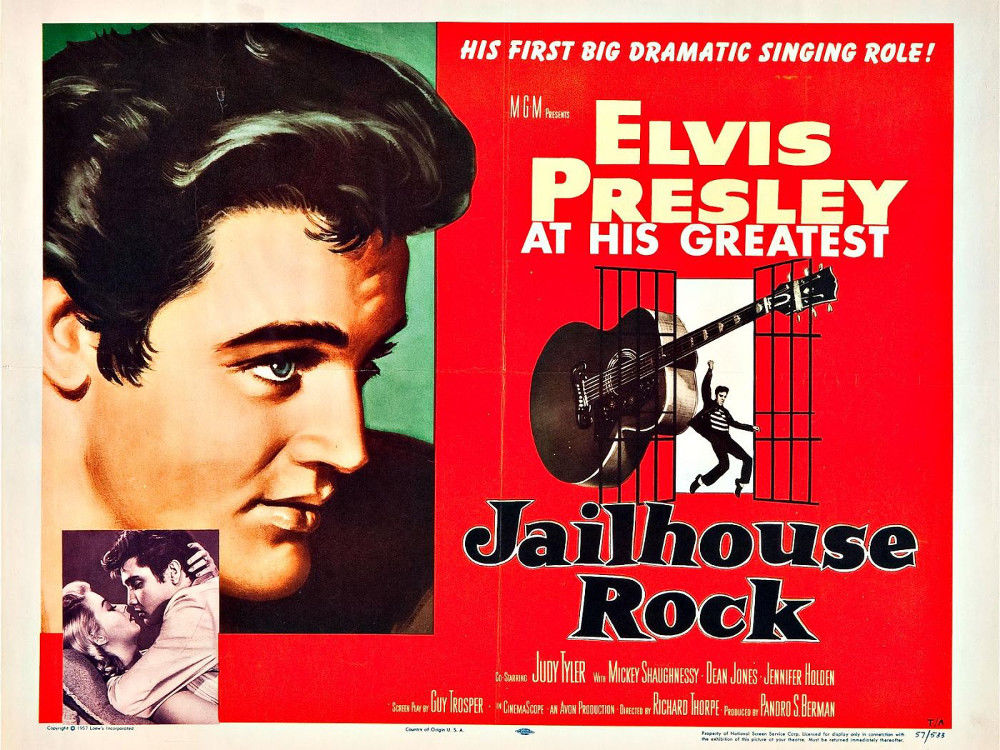
Jailhouse Rock (1957)

It’s many years since I’ve seen an Elvis Presley movie but since I like his music and since his movies certainly qualify as cult movies I thought it was about time I checked out a few of them. Jailhouse Rock, released by MGM in 1957, was his third movie. His first two movies had been hits but Jailhouse Rock is definitely a bit more ambitious. It features great songs and it makes an attempt to be at least somewhat gritty.

The character he plays, Vince Everett, is a nice guy but he’s impulsive and he has a temper. He gets into a bar fight. He’s trying to defend the honour of a lady (who probably isn’t much of a lady) but he gets carried away and the guys dies and he finds himself serving a prison sentence for manslaughter.

His cell mate is a broken-down country singer named Hunk Houghton (Mickey Shaughnessy) who is the prison entrepreneur. If there’s a way of making money in prison Hunk knows it. Hunk teaches Vince that if you don’t have money in this world you’re nothing but he also gets Vince interested in the idea that you can actually earn a living as a singer.

After being released Vince meets music industry insider Peggy Van Alden (Judy Tyler). His first attempt at stardom fails but Vince is not a guy who gives up easily. They start their own record company and pretty soon Vince is the biggest sensation in the music business. He’s on the way to fame and fortune but he’s also in danger of losing his basic decency. Too much fame and fortune too soon can be a dangerous drug. And the inevitable romance between Vince and Peggy seems destined to crash and burn.

This is of course a musical and it pretty much follows the long-established template for movie musicals. It borrows elements from the classic backstage musicals and it’s your basic rags-to-riches story wherein the star makes it to the top but then they’re going to have to learn that there’s more to life than money and fame. Musicals don’t require complicated plots and the plot in this movie is more than adequate for the purpose.


As an actor Presley is actually not that bad. In Hollywood he quickly gained a reputation for professionalism and for being, by Hollywood standards, a remarkably polite and easy-going guy. He refused to take acting lessons but he took acting quite seriously. What’s interesting is that he really is acting here, he’s not playing himself. Vince is not at all like Elvis. He’s surly and rude and bad-tempered and he tramples over other people’s feelings. It’s not that Vince is a bad guy. He would never actually cheat anybody. He won't even cheat Hunk even though Hunk tries to cheat him. There’s a lot of good in Vince. He just needs to grow up and he needs to think before he acts.

This was the era of the brooding self-pitying new style of star like Marlon Brando and James Dean who were seen by Hollywood as the key to attracting a younger audience. The performances of Brando in movies like The Wild One and Dean in Rebel Without a Cause now seem embarrassing but Presley’s performance stands up quite well. He didn’t know anything about Method Acting techniques. He just followed his instincts and as a result his performance comes across as more natural and less contrived. He wasn’t a great actor by any means but in a rĂ´le like this he’s fine.


Judy Tyler is the perfect leading lady for Elvis. As Peggy she’s strong-willed but feminine and while she’s not going to let Vince walk all over her she’s not going to give up on him either. Tragically Tyler was killed in a car accident at the age of 24 shortly after shooting of the film was completed.

It helps if a musical has good songs and that’s where Jailhouse Rock really scores.

The tricky part for Elvis was that Vince, when he’s first trying to get a break in the music industry, is really not very good so in the early songs he has to come across as a mediocre singer and it’s not easy for a great singer to sound mediocre. He does this pretty well. He manages to make those early songs sound slightly lifeless. Of course Vince soon learns what he’s doing wrong as a singer and then Elvis gets to give us some truly great local performances.


The Jailhouse Rock number was Hollywood’s first ever attempt at a rock’n’roll big production number in the classic movie musical style and it’s great. Elvis rejected the initial choreography explaining that he just couldn’t do that type of dancing so the choreographer then built the whole routine around the type of dancing that Elvis could do. The results are superb. The (You’re So Square) Baby I Don’t Care production number is in a different style but it’s just as good.

The Blu-Ray release is excellent. The black-and-white cinematography looks terrific and there are a couple of worthwhile extras including an audio commentary.

This is not a big-budget blockbuster but neither is it a low-budget affair. Production values are quite high. Having Elvis as the star in 1957 was pretty much a guarantee of box-office success (and it did extremely well) so it was obviously considered worthwhile to spend some real money on the production. It’s well made and the acting performances (Including Elvis’s) are a cut above B-movie standards.

Jailhouse Rock combines all the virtues of the traditional Hollywood musical with the energy of rock’n’roll and the charisma of Elvis. Highly recommended.