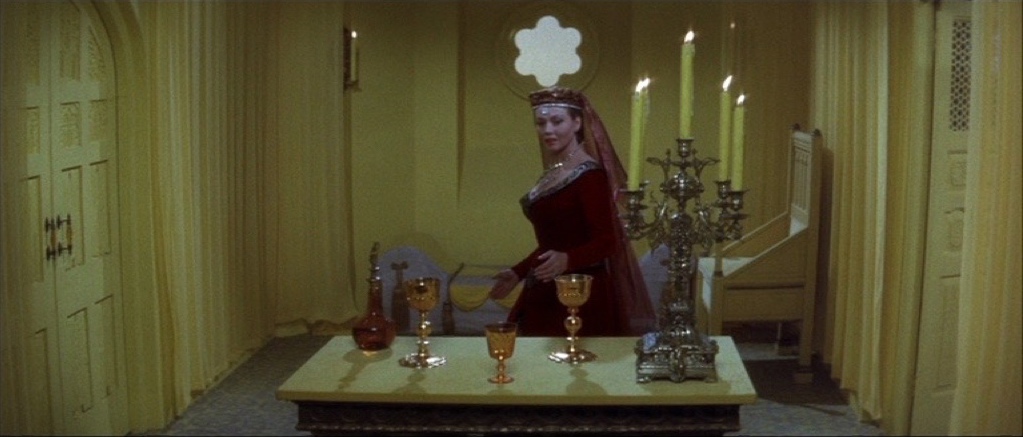
The Forger of London (Der Fälscher von London) is a 1961 German krimi (crime film) based on an Edgar Wallace story. This is one of the krimis made by Rialto Studios which were on the whole perhaps slightly superior to the ones made by rival studio CCC. This is one of several Edgar Wallace krimis made by Harald Reinl, a fairly prolific director of mostly fun potboilers (he also helmed a couple of the Dr Mabuse films.) Reinl was, sadly, eventually murdered by his third wife.
Scotland Yard is trying to break up a counterfeiting racket. They’re rather puzzled by the fact that the most recent forgeries are obviously the work of a forger well known to them but they’re nowhere near up to his usual standards. Chief Inspector Bourke (Siegfried Lowitz) is not going to be tempted to jump to any conclusions about this point.
Somehow the forgeries are going to be tied in to the story of newlyweds Peter and Jane Clifton (played respectively by Helmut Lange and Karin Dor), and to dissolute playboy Basil Hale (who had also set his sights on marrying Jane). The marriage of Peter and Jane isn’t quite a match made in heaven. It’s more a marriage that seems to be socially suitable and financial considerations may have had more to do with it than love.
Although it seems like Jane was the one who married for money she’s the one who is resentful. And she soon realises she may have got more she bargained for in Peter. He has a dark secret. Of course he’s not the only one with dark secrets, this being the world of Edgar Wallace.
It might be just as well that Jane’s uncle is a psychiatrist. Although psychiatrists might have dark secrets also.
Scotland Yard have traced Peter as the source of one of those forged bank notes but he seems very vague as to how the note came to be in his possession. Chief Inspector Bourke is definitely very interested in the goings-on at Longford Castle, where Peter and Jane are honeymooning (in separate bedrooms).
With so many secrets at stake it’s inevitable that sooner or later someone is going to get murdered. In this case it’s the traditional blunt instrument to the skull type murder.
The plot is typical Edgar Wallace krimi stuff - very complicated and you need to have your wits about you to keep track of the twists and the multiple plot strands.
The acting is competent enough. Karin Dor adds a touch of glamour, as she did in so many of these movies (and she was an OK actress). She was at the time married to Harald Reinl (although I hasten to add that she’s not the one who stabbed him to death). Naturally Eddi Arent is on hand fir comic relief purposes, which is either a good thing or a bad thing depending on your own personal tastes. He also apparently plays an additional unexpected minor rôle (although I failed to recognise him). Siegfried Lowitz is excellent as the enigmatic and surprising Chief Inspector Bourke.
Some of the exteriors were shot at Herdringen Castle in Arnsberg, Germany - a location that shows up in more than one Edgar Wallace krimi. These were the sorts of low-budget movies that kept the German film industry afloat but Rialto generally managed to make their productions look reasonably good.
Reinl does his usual competent job as director.
The Forger of London is not as extravagant visually as some krimis but it does have the plot extravagance that krimi fans know and love. And the plot, for all its convolutions, does make some sort of sense if you don’t panic and lose concentration. There’s a reasonably effective atmosphere of the sinister and the mysterious. And yes, there is at least one hidden passageway!
The Rialto and CCC krimis were invariably shot widescreen and until the end they were invariably in black-and-white.
Finding decent DVD releases of the German krimis can be a challenge. If you’re unlucky enough to live in Australia, as I do, it’s just about impossible. There are some very good German DVDs and Blu-Rays but of course they’re German-Language versions. Some have the English dubbed versions as well but most don’t, and some have English subtitles and some don’t. English dubbed DVDs are not difficult to find but the quality can be iffy (or even terrible). If you can get hold of the German releases and you check that they have subtitles then they’re the way to go - they’re usually very good.
All of these German krimis are enjoyable and while I wouldn’t put The Forger of London in the very top rank it’s a solid offering. Highly recommended.
Horror, sci-fi, exploitation, erotica, B-movies, art-house films. Vampires, sex, monsters, all the fun stuff.
Saturday, 6 February 2021
Monday, 1 February 2021
Vampyres (1974)
Vampyres (also released as Daughters of Darkness) is a 1974 British gothic horror film but it was directed by a Spaniard, José Larraz, so it’s a kind of blending of eurohorror and British gothic horror sensibilities. It has the atmosphere of a Hammer horror movie but with much more gore and a hell of a lot more sex and nudity and generally depraved eroticism.
You might as well make it clear to the audience what kind of movie it is that they’re about to see. Vampyres does this with its opening pre-credits sequences - lots of blood and mayhem plus lesbian sex. If you weren’t aware that you were watching a lesbian vampire erotic horror movie you’re certainly aware of it now. This opening scene is actually very important. It’s a clue. But to what is it a clue?
After the credits we see a young couple, John (Brian Deacon) and Harriet (Sally Faulkner), heading off on a caravanning holiday. They pass a woman by the side of the road, hitch-hiking. The odd thing is that Harriet is sure there was another woman there, hiding behind a tree.
The hitch-hiking woman (we will soon find out that her name is Fran) is picked up by businessman Ted (Murray Brown). She wants a ride to her house. And quite a house it is. It’s your typical horror movie decaying gothic pile. Fran and Ted spend an enjoyable night together although Ted has the uncanny feeling that they’re not alone. He wakes up feeling extraordinarily tired and with a deep gash in his forearm. He also wakes up quite alone.
The camping spot that John and Harriet have chosen just happens to give them a rather nice view of Fran’s house and Harriet is very interested by it. It’s supposedly empty but she sees lights in one of the windows. And then Ted turns up, in need of first aid.
You’d think Ted would be sensible enough not to go back to Fran’s house after this but he is a man and Fran is extremely hot and he can’t help himself.
You’d also think that Harriet might have enough sense not to get too curious about a house that looks exactly like a haunted house, but she can’t help herself either.
Fran turns up just after sundown, and she has two friends with her. There’s Miriam and a male friend, Rupert.
Another night of debauchery follows, with more than just straightforward debauchery. Fran and Miriam are lesbians (or in Fran’s case definitely bisexual) and vampires. Men who get invited back to their house get what they were hoping for (hot sex with gorgeous women) but they get a bit more besides that they weren’t counting on.
The problem for our two lovely lesbian vampires is that Fran is a bit obsessed with Ted. She knows she should just kill him but the sex is so good! Fran likes sex as much as she likes drinking blood. The problem for Harriet is that her curiosity is gnawing away at her.
If you’re expecting a blood-drenched finale you won’t be disappointed.
What’s fascinating about Vampyres is that it’s utterly conventional and formulaic and at the same time it’s quite unconventional and it plays around with the standard formula. You’re never quite sure how to interpret what you’re seeing. Fran and Miriam are your standard vampires. They sleep all day and only come out to play at night. All the mirrors in their house have been taped over. They mesmerise their victims and they drink blood. Miriam has a Count Dracula-style cloak. All stock-standard vampire mythology stuff. But are they actually vampires? If not, what exactly are they? And what did that opening scene actually mean?
Marianne Morris had a fairly brief film career, which is a pity. It’s even more of a pity that Anulka Dziubinska (billed here simply as Anulka) also didn’t have much of a career. I should mention that despite her name the former Playboy Playmate of the Month is in fact English. One can’t help feeling that both ladies would have had much more lucrative careers in Europe. I can certainly see Anulka in a Jean Rollin vampire movie.
The old Magna Pacific Region 4 DVD release is quite OK but there is now a Blu-Ray release and it’s a movie that probably is worth getting in Blu-Ray, if only for the sumptuous English autumn scenes.
José Larraz also directed the bizarre 1974 Spanish erotic horror movie The Coming of Sin (AKA Violation of the Bitch).
https://princeplanetmovies.blogspot.com/2011/05/coming-of-sin-1978.html
Vampyres is an erotic horror lesbian vampire movie with the eroticism, the horror and the lesbianism dialled up to the max. There’s a lot of blood and a lot of naked female flesh. Those who like lesbian vampire movies with those qualities will love it. Those who like vampire movies that attempt something different will enjoy its many subtle ambiguities. Vampyres delivers the goods. Highly recommended.
Monday, 25 January 2021
The Masque of the Red Death (1964)
The Masque of the Red Death was the second-to-last of Roger Corman’s Edgar Allan Poe movies. Vincent Price stars (he starred in all but one of these movies). It was made in Britain in 1964 with a fine mostly British cast and with Nicolas Roeg doing the cinematography. Charles Beaumont and R. Wright Campbell wrote the screenplay.
Corman was a wizard at stretching a budget and this film manages to look a lot more expensive than it was.
Prince Prospero (Vincent Price) rules a medieval Italian city state and he rules it to satisfy his taste for decadence, cruelty and cynicism. And also to serve his master, Satan. Prospero’s nihilistic view of life is about to be uncomfortably confirmed. Plague has begun to ravage the land. It is the Red Death, which produces a red rash (followed by a lingering death).
Prospero and his nobles and hangers-on are safe in the prince’s castle, or so they assume. And Prospero believes that Satan will protect him.
Prospero has taken a pretty young peasant girl, Francesca (Jane Asher), away from her family. He is sure she will amuse him. Juliana (Hazel Court) does not share Prospero’s enthusiasm for the girl. She fears losing her place in the prince’s affections. She will do anything to prevent that from happening. Absolutely anything.
This is a movie that wasn’t really embraced by audiences at that time. There’s very little plot. This is not quite a normal horror movie. It’s all about atmosphere - the atmosphere of decadence and cruelty and the atmosphere of fear. Plague is a lot more terrifying than mere monsters. Prospero’s character is established, plague ravages the countryside, Prospero and his friends party and Prospero plans a great celebration, a masque. And then we get the inevitable ending. The entire plot could have been condensed into half an hour or less. While most horror movies up until the 70s relied more on atmosphere than gore audiences still expected some kind of dramatic payoff. They expected some mayhem and they expected monsters of some sort. It’s not surprising that this movie left them mystified and dissatisfied.
It’s not that it’s a bad movie. It’s a very very good movie, in fact a great movie, but it’s not the sort of movie that the mid-60s audience for such movies would have been prepared for.
It actually has just a hint of a European feel to it. There are some very obvious nods to Bergman’s The Seventh Seal. Corman was more arty as a director than his later reputation as a shlock producer would suggest. The Masque of the Red Death is almost a European art film, but aimed at the drive-in market.
This film truly has a wonderful cast. Patrick Magee is in top form as the cynical depraved courtier Alfredo. Jane Asher captures the wide-eyed innocence of Francesca. Hazel Court, one of the great scream queens, is as reliable as ever as the jealous and vindictive Juliana. There’s my old favourite Nigel Green as well.
And of course there’s Vincent Price, giving a performance with the hamminess toned down somewhat. It’s always important to remember that Price only gave so many hammy performances because that’s what was usually demanded of him. If a director wanted something more subtle he could certainly provide it and when he was being subtle he was a lot creepier. Compared to most of the directors he worked with Corman expected a bit more from Price and Price invariably delivered.
What’s interesting about Prospero is that he seems to get more pleasure from seeing the degradation of others than from any actual personal indulgences in sensual pleasures.
The use of colour in this film is extraordinary, particularly the differently coloured rooms each of which is intended to serve a different depraved purpose. And there is very little red in the movie. Prince Prospero abhors the colour red. It reminds him uncomfortably of the Red Death. When we get an occasional slash of red it has the desired impact. With Corman’s own keen visual flair, with Nic Roeg behind the camera and with Corman’s regular production designer Daniel Haller on hand you expect a visual feast and that’s what you get.
The best of Corman’s string of Edgar Allan Poe films - this film along with The Fall of the House of Usher, The Pit and the Pendulum, The Haunted Palace, The Premature Burial and The Tomb of Ligeia - constitutes one of the most impressive cycles of gothic horror movies in cinema history. It’s certainly worthy of comparison to the Universal horrors of the 30s and to the Val Lewton RKO horror films of the 40s. Corman was quite ambitious as a director and with these movies he tried not to keep repeating himself. The Pit and the Pendulum is classic straightforward horror, The Fall of the House of Usher is a moody exercise in gothic doom and The Masque of the Red Death is full-on decadence (with perhaps an anticipation of where the 60s counter-culture was going to end up going).
The Masque of the Red Death is the most impressive of all the Corman Poe films. Very highly recommended.
Corman was a wizard at stretching a budget and this film manages to look a lot more expensive than it was.
Prince Prospero (Vincent Price) rules a medieval Italian city state and he rules it to satisfy his taste for decadence, cruelty and cynicism. And also to serve his master, Satan. Prospero’s nihilistic view of life is about to be uncomfortably confirmed. Plague has begun to ravage the land. It is the Red Death, which produces a red rash (followed by a lingering death).
Prospero and his nobles and hangers-on are safe in the prince’s castle, or so they assume. And Prospero believes that Satan will protect him.
Prospero has taken a pretty young peasant girl, Francesca (Jane Asher), away from her family. He is sure she will amuse him. Juliana (Hazel Court) does not share Prospero’s enthusiasm for the girl. She fears losing her place in the prince’s affections. She will do anything to prevent that from happening. Absolutely anything.
This is a movie that wasn’t really embraced by audiences at that time. There’s very little plot. This is not quite a normal horror movie. It’s all about atmosphere - the atmosphere of decadence and cruelty and the atmosphere of fear. Plague is a lot more terrifying than mere monsters. Prospero’s character is established, plague ravages the countryside, Prospero and his friends party and Prospero plans a great celebration, a masque. And then we get the inevitable ending. The entire plot could have been condensed into half an hour or less. While most horror movies up until the 70s relied more on atmosphere than gore audiences still expected some kind of dramatic payoff. They expected some mayhem and they expected monsters of some sort. It’s not surprising that this movie left them mystified and dissatisfied.
It’s not that it’s a bad movie. It’s a very very good movie, in fact a great movie, but it’s not the sort of movie that the mid-60s audience for such movies would have been prepared for.
It actually has just a hint of a European feel to it. There are some very obvious nods to Bergman’s The Seventh Seal. Corman was more arty as a director than his later reputation as a shlock producer would suggest. The Masque of the Red Death is almost a European art film, but aimed at the drive-in market.
This film truly has a wonderful cast. Patrick Magee is in top form as the cynical depraved courtier Alfredo. Jane Asher captures the wide-eyed innocence of Francesca. Hazel Court, one of the great scream queens, is as reliable as ever as the jealous and vindictive Juliana. There’s my old favourite Nigel Green as well.
![]() |
And of course there’s Vincent Price, giving a performance with the hamminess toned down somewhat. It’s always important to remember that Price only gave so many hammy performances because that’s what was usually demanded of him. If a director wanted something more subtle he could certainly provide it and when he was being subtle he was a lot creepier. Compared to most of the directors he worked with Corman expected a bit more from Price and Price invariably delivered.
What’s interesting about Prospero is that he seems to get more pleasure from seeing the degradation of others than from any actual personal indulgences in sensual pleasures.
The use of colour in this film is extraordinary, particularly the differently coloured rooms each of which is intended to serve a different depraved purpose. And there is very little red in the movie. Prince Prospero abhors the colour red. It reminds him uncomfortably of the Red Death. When we get an occasional slash of red it has the desired impact. With Corman’s own keen visual flair, with Nic Roeg behind the camera and with Corman’s regular production designer Daniel Haller on hand you expect a visual feast and that’s what you get.
The best of Corman’s string of Edgar Allan Poe films - this film along with The Fall of the House of Usher, The Pit and the Pendulum, The Haunted Palace, The Premature Burial and The Tomb of Ligeia - constitutes one of the most impressive cycles of gothic horror movies in cinema history. It’s certainly worthy of comparison to the Universal horrors of the 30s and to the Val Lewton RKO horror films of the 40s. Corman was quite ambitious as a director and with these movies he tried not to keep repeating himself. The Pit and the Pendulum is classic straightforward horror, The Fall of the House of Usher is a moody exercise in gothic doom and The Masque of the Red Death is full-on decadence (with perhaps an anticipation of where the 60s counter-culture was going to end up going).
The Masque of the Red Death is the most impressive of all the Corman Poe films. Very highly recommended.
Wednesday, 20 January 2021
Fairy in a Cage (1977)
Fairy in a Cage, written and directed by Kôyû Ohara, is perhaps the most notorious of the long series of roman porno movies made by Japan’s Nikkatsu Studio between 1971 and 1988. It should be explained that these movies have nothing to do with the Romans - the French term for an erotic novel is roman porno and I guess someone at Nikkatsu though it sounded classy.
In the latter stages of World War 2 the Japanese military police are cracking down on anti-war activists. Judge Murayama takes an active hand in the interrogations, especially of female suspects. He is considered to be a specialist in this area. Murayama’s idea of interrogation involves torture with definite sexual overtones.
There is however considerable doubt as to whether any of these female suspects is guilty of anything more than catching Murayama’s eye. He has now picked out his next victim, the young and very beautiful wife of a rich jeweller named Kikushima. There is not the slightest evidence against her but Murayama really wants to torture her. So evidence is manufactured implicating Mrs Kikushima and a kabuki actor named Sennosuke Inoue.
The first stage of Murayama’s interrogation technique is to tell Mrs Kikushima to take all her clothes off. At this stage she realises she’s in a for a rather unpleasant time.
Murayama works closely with the military police and in this case a new recruit, Lance-Corporal Taoka, will be taking an active part in the interrogations. Also taking an active rôle is Murayama’s young assistant and mistress Kayo. Taoka isn’t happy with the situation at first, then he starts to enjoy it and then he starts to become sexually obsessed with Mrs Kikushima. It is implied that Taoka is sexually inexperienced and may even be a virgin. He is definitely somewhat disturbed sexually. When it is suggested that he should pleasure himself with some whores he gets very uncomfortable. He is perhaps a little bit afraid of women.
Young Kayo takes charge of the torture of Inoue, the kabuki actor. Her idea of torture is to force Inoue to have sex with her and to force him to endure the horrors of fellatio. That would certainly be enough to break any man’s spirit, especially given that Kayo is young and very pretty. Yes, this is one very strange movie.
Taoka’s sexual obsession why Mrs Kikushima grows, He even contemplates rescuing her. He is however not quite a knight in shining armour. His idea is to get her out of the clutches of Murayama so that he can have for himself and rape her at his leisure. Taoka is not a healthy young man.
Murayama and the military policemen are clearly exceptionally depraved (they really really enjoying torturing attractive young women) and young Kayo is perhaps even more depraved. Her hobbies include forcing men to submit to sex, watching other women get tortured and humiliated and having Murayama tie her up (he has to make sure that the ropes really hurt her) before pleasuring her.
OK, so this sounds like a straightforward S&M software porno movie. But this was the 1970s, a time when film-makers in various countries were getting very attracted to the idea of making movies about the relationship between power and sex. More specifically playing with the idea that power leads to moral corruption which then leads to sexual depravity. Or perhaps that the sexually depraved are attracted by power, especially absolute power over others. In Italy Tinto Brass explored this idea in Salon Kitty and it was his original idea for Caligula (although Caligula as released bore little resemblance to Brass’s original conception). These ideas are perhaps vaguely plausible and they certainly had possibilities for movie-makers who could make S&M movies and then claim that they weren’t making just making porn movies - they were making movies that were serious political statements.
Fairy in a Cage is very obviously exploring these same ideas. Its main weakness is that it doesn’t offer us much insight into the psychology of the two most interesting character, Murayama and Kayo. Taoka is a bit more fully developed. It seems likely that he is only aroused by women when they’re under his power.
Minoru Ôkôchi’s performance as Murayama is extremely good and Rei Okamoto is extraordinary as Kayo. Kayo is not a girl you’d want to take home to meet Mother.
Naomi Tani has to be given credit for volunteering to undergo some pretty extreme bondage, much of which apparently was genuinely painful. She’s a gorgeous woman but to be honest she’s essentially just a prop. She’s merely an innocent victim, Naomi Tani does a good job enough job conveying her fear and her humiliation, but we know no more about her at the end than we knew at the beginning. The focus here is on the psychology of the torturers (both the male and female torturers).
Fairy in a Cage was based on a story by Oniroku Dan, a very successful writer of S&M erotica and a close friend of the film’s star Naomi Tani. She had already established herself as an actress in pink films (Japanese erotic movies) but her appearance in numerous adaptations of Dan’s stories for Nikkatsu made her a star and Japan’s queen of cinematic S&M.
Fairy in a Cage is, like all of Nikkatsu’s roman porno movies, very well-made (Nikkatsu was and is a major studio) and it looks great. It was, predictably, controversial at the time. Which is hardly surprising. It is pretty extreme. While the political subtext is definitely there this movie is really more of an exploration of the psychology and eroticism of sadomasochism. So it really is, quite unashamedly, a softcore S&M erotic movie. Which is of course exactly what Nikkatsu wanted. So whether you enjoy this movie depends entirely on your feelings about S&M erotica. If the subject matter doesn’t bother you then it has some claims to being, along with Just Jaeckin’s The Story of O and Radley Metzger’s The Image, one of the classics of the genre. And you can always pretend that you only watched it for the political subtext!
Friday, 15 January 2021
Amuck! (1972)
Amuck! (Alla ricerca del piacere) is an Italian giallo directed by Silvio Amadio, although whether it’s a true giallo can be debated.
Greta Franklin (Barbara Bouchet) is a young American who goes to Venice to work as secretary to American writer Richard Stuart (Farley Granger). What’s she’s really doing is trying to find out what happened to his previous secretary Sally (who was her best friend). Sally has disappeared but before she vanished she sent Greta a letter saying that she was caught up in a world of evil and perverse pleasures from which she could not escape. Greta figures that something bad has happened to Sally. Greta has no actual plan. She just hopes she’ll come across some clues. Commissioner Antonelli tries to tell her that what she’s doing could be very dangerous but of course she takes no notice of him.
She gets a hint of what some of those perverse pleasures might be when Stuart’s glamorous wife Eleanora (Rosalba Neri) drugs her and engages her in some lesbian bedtime romping (filmed in slow-motion!). She also discovers that Richard and his friend enjoy orgies and watching blue movies. Richard freely admits to living in a world of decadence.
Richard is dictating his latest story to her and it all sounds rather disturbingly like it’s about her and it suggests very strongly that he knows what she’s up to, and that he wants her to know that he knows what she’s up to.
Richard is definitely a bit worrying, and Eleanora is very worrying.
If I ever write a book of hints for movie heroines temped to play amateur detective my first piece of advice will be this - if you’re investigating a murder and you’re invited to join a hunting party politely decline. Plead that you have a headache.
After the hunting party Greta might have been well advised to just tell the police what she’s found out and then get as far away from Venice as possible. It’s becoming obvious that there’s a cat and mouse game being played and that she’s the mouse.
Is this movie a giallo? You have to remember that to the Italians any mystery/crime thriller novel is a giallo. In movies giallos in the ’60s and ’70s could be defined rigidly as crime thrillers featuring serial murders, black-gloved killers, psychological horror, explicit violence, lots of eroticism and lots of style but there were a lot of Italian movies that only included some of those elements that still tend to be thought of as giallos. If you define the genre broadly enough it can be any stylish Italian crime thriller (and most Italian crime thrillers of that period were stylish) that doesn’t fit into the poliziotteschi genre. You could say that poliziotteschi were crime/action movies dealing with organised crime and official corruption while giallos dealt with disorganised crime and personal corruption. Amuck! has the giallo feel without incorporating all the giallo ingredients.
Amuck! can also be considered to belong to the sub-genre of stylish 1960s/1970s thrillers (not necessarily Italian) set in Venice, along with movies like The Venetian Affair, Nicolas Roeg’s 1973 masterpiece Don’t Look Now and Who Saw Her Die?
In my review of Who Saw Her Die? I mentioned the ways in which it prefigures Don’t Look Now. There are also a couple in intriguing ways in which Amuck! also anticipates Don’t Look Now, in particular the suggestion that Eleanora can foresee the future. It’s not that Don’t Look Now is in any way a rip-off of these earlier Italian films (although it would be interesting to know if Roeg or his screenwriters had seen these Italian movies). I suspect it’s more a case of certain ideas and certain approaches being in the air in the early ‘70s. All three films to varying extents embody the zeitgeist of the early ’70s. And Don’t Look Now was based on a Daphne du Maurier story and du Maurier had had quite an influence on film-makers (Hitchcock adapted no less than three of her stories, Jamaica Inn, Rebecca and The Birds). In the case of Amuck! there are some other obvious Hitchcock influences (as there are in lots of giallos). There are some interesting similarities to Hitchcock’s Suspicion.
With both Barbara Bouchet and Rosalba Neri in the cast your first thoughts might be - will they take their clothes off? The answer is an emphatic yes.
While I’m not suggesting that there’s anything wrong with Barbara Bouchet’s performance (there isn’t) but in the acting department she is just a bit outgunned by Farley Granger and especially by Rosalba Neri. To be fair to Miss Bouchet Granger and Neri have much more interesting rôles. Granger and Neri deliver pleasingly ambiguous performances. They are both sexually depraved. Are they psychopaths? Are they mad? Are both mad, or only one of them? Does Eleanora have psychic powers? Is it possible that both are innocent of murder? That butler of theirs is a bit suspicious and there’s a huge local fisherman who seems to be in some way involved in the psychological and sex games being played out.
88 Films in the UK have release Amuck! on both DVD and Blu-Ray, with excellent transfers and quite a few worthwhile extras. There are interviews with both Rosalba Neri and Barbara Bouchet. Neri has fond and vivid memories of this movie. Bouchet talks about her career in general which is interesting - she is after all a very major cult star (which she is delighted by).
Amuck! does not have the extravagant style or the elaborate visual set-pieces to qualify as a top-tier giallo. It also features none of the gore associated with the genre, although it certainly has the necessary eroticism. While it has some scary moments they’re not quite scary enough. In other words hardcore giallo fans may be disappointed. It’s just a competently made murder mystery and as such it’s worth a look.
Monday, 11 January 2021
Night of the Eagle (1962)
Night of the Eagle is a 1962 British movie based on Fritz Leiber’s superb 1943 novel Conjure Wife.
So when he discovers that his wife Tansy is a practising witch it comes as something of a shock, to say the least. Actually, to be strictly accurate, she is more of a conjure woman since her practices have more in common with voodoo and similar religious beliefs than with more traditional notions of classic European witchcraft (although the movie does at times seem to confuse these two quite distinct practices). Norman and Tansy had lived for some time in the West Indies, which is presumably where she picked up these beliefs.
Norman hasn’t been at the university for very long, but his career has been going very well indeed and although comparatively young he is in line for a very prestigious academic appointment. Tansy tries to explain to him that his career has prospered mainly because of her conjure magic, but naturally he dismisses this opinion as childish and unworthy of the wife of such a distinguished champion of rationalism. He persuades her to destroy her magical charms and to give up her magic.
Unfortunately from this point on things start to go badly awry for Norman – in fact just about everything that could go wrong does go wrong. When Norman realises that both his life and Tansy’s are in real danger, he must re-evaluate his attitudes towards magic.
This is a movie that makes virtually no use at all of special effects, relying instead on an intelligent script, good acting, moody and atmospheric black-and-white cinematography and skilful direction. There is also no gore, but there is a great deal of suspense as Norman desperately tries to find a way to save himself and his wife.
Peter Wyngarde (looking rather odd without his trademark Jason King moustache) is absolutely perfect as Norman. The character has to be both arrogant and likeable - not an easy trick to pull off but Wyngarde does it splendidly.
Janet Blair gives a restrained an effective performance as Tansy, and there’s a fine supporting cast. Margaret Johnston is quite over-the-top but delightfully entertaining as Flora.
Optimum’s Region 2 DVD offers a very good anamorphic transfer (the movie was shot in black-and-white).
Night of the Eagle (which was retitled Burn, Witch, Burn! for its US release) is a tense and gripping and very entertaining piece of subtle atmospheric British horror movie-making which I highly recommend.
This is a fine example of understated horror, made at around the same time that Robert Wise was making The Haunting and Jack Clayton was making The Innocents – the early 60s was truly a great time for subtle cinematic horror.
Norman Taylor is a university lecturer, whose main field of academic interest is the occult – but he is most emphatically not a believer in the supernatural. In fact he has dedicated his carer to debunking the occult and ridiculing what he sees as primitive and naïve superstition.
His approach to the subject is psychological – to him belief in the supernatural is evidence of neurosis, of an ability or unwillingness to face reality. He believes in reason. He believes in reason emphatically.
So when he discovers that his wife Tansy is a practising witch it comes as something of a shock, to say the least. Actually, to be strictly accurate, she is more of a conjure woman since her practices have more in common with voodoo and similar religious beliefs than with more traditional notions of classic European witchcraft (although the movie does at times seem to confuse these two quite distinct practices). Norman and Tansy had lived for some time in the West Indies, which is presumably where she picked up these beliefs.
Norman hasn’t been at the university for very long, but his career has been going very well indeed and although comparatively young he is in line for a very prestigious academic appointment. Tansy tries to explain to him that his career has prospered mainly because of her conjure magic, but naturally he dismisses this opinion as childish and unworthy of the wife of such a distinguished champion of rationalism. He persuades her to destroy her magical charms and to give up her magic.
Unfortunately from this point on things start to go badly awry for Norman – in fact just about everything that could go wrong does go wrong. When Norman realises that both his life and Tansy’s are in real danger, he must re-evaluate his attitudes towards magic.
This is a movie that makes virtually no use at all of special effects, relying instead on an intelligent script, good acting, moody and atmospheric black-and-white cinematography and skilful direction. There is also no gore, but there is a great deal of suspense as Norman desperately tries to find a way to save himself and his wife.
Peter Wyngarde (looking rather odd without his trademark Jason King moustache) is absolutely perfect as Norman. The character has to be both arrogant and likeable - not an easy trick to pull off but Wyngarde does it splendidly.
Janet Blair gives a restrained an effective performance as Tansy, and there’s a fine supporting cast. Margaret Johnston is quite over-the-top but delightfully entertaining as Flora.
Optimum’s Region 2 DVD offers a very good anamorphic transfer (the movie was shot in black-and-white).
Night of the Eagle (which was retitled Burn, Witch, Burn! for its US release) is a tense and gripping and very entertaining piece of subtle atmospheric British horror movie-making which I highly recommend.
Friday, 8 January 2021
The Adult Version of Jekyll and Hide (1972)
There have been countless movie and television adaptations of Robert Louis Stevenson’s 1886 classic Strange Case of Dr Jekyll and Mr Hyde. Opinions vary as to which is the best. The weirdest is certainly Walerian Borowczyk’s 1981 The Strange Case of Dr. Jekyll and Miss Osbourne. The sleaziest by a very wide margin is the 1972 The Adult Version of Jekyll and Hide, one of the many strange and wondrous sexploitation films brought to the screen by the legendary David F. Friedman.
Dr Chris Leeder (Jack Buddliner) doesn’t seem to have a very busy medical practice. Most of his time is spent either with his rich fiancée Cynthia or having sex with his glamorous and very willing nurse Debbie (played by Rene Bond). On a shopping excursion with Cynthia they check out a rather dusty antique shop and they both find books they want, both of which the owner is unwilling to sell. The book Dr Leeder wants is an old journal. It is nothing less than the journal of Dr Jekyll. Dr Leeder is prepared to do anything to get the journal. Even commit murder.
Having obtained the journal he naturally wants to try out the potion that Dr Jekyll used. It has unexpected results - he turns into a glamorous woman (in which guise he is played by Jane Tsentas). At this point it becomes very obvious that this movie has ripped off the central idea of Hammer’s extremely interesting 1971 Dr Jekyll and Sister Hyde.
The movie jumps back and forth between the adventures of Dr Jekyll and Mr Hyde in Victorian London and the adventures of Dr Leeder and Miss Hyde in the present day.
Since the police are wanting to question him about the unfortunate demise of that bookstore owner Dr Leeder figures it might be a good idea to disappear for a while. And he comes up with a brilliant idea. That potion tuned him into a woman (Miss Hyde) for fourteen hours. If he drinks a whole lot more of the potion it should turn him into a woman for maybe a week or so. He’ll be able to hide in plain sight with no risk of the police finding him because they’re not looking for a glamorous blonde babe. After a week the cops may have given up. It really is a very clever plan. The only problem is that it will only work if Miss Hyde keeps a low profile but Miss Hyde represents the evil side or Dr Leeder’s personality - she’s a sex-crazed psycho killer and sex-crazed psycho killers are notoriously bad at keeping a low profile. So there are some quite cool ideas in this movie.
Miss Hyde wants to jump into bed with just about everyone she meets, including both Debbie and Cynthia. She’s a rather rough bed partner. She also tries to bed the cop who’s investigating the murder. The cop strongly suspects Dr Leeder. He can’t find him but he does find Miss Hyde.
There’s some very brutal violence - not so much graphic but incredibly brutal in concept. A red-hot poker inserted into a very delicate part of the female anatomy and the castration of a sleazy sailor are pretty gruesome concepts.
As you’d expect from an early 70s movie distributed by David F. Friedman there are lots of softcore sex scenes. There’s copious nudity including both male and female frontal nudity.
Technically this was not actually a David F. Friedman production. Lee Raymond (who had a day job as an airline pilot) and frequent Friedman collaborator Byron Mabe came up with the idea, Raymond directed and Mabe produced, and they persuaded Friedman to pick it up.
Byron Mabe directed a number of films for Friedman, including A Smell of Honey, a Swallow of Brine (one of the greatest of all sexploitation flicks) and the notorious Space Thing (which I actually enjoyed quite a bit).
A major selling point for this movie today is the presence of Rene Bond, who had quite a career in sex movies in the 70s and has a considerable cult following among sexploitation aficionados. She’s actually not too bad as an actress.
This is actually a reasonably competently made movie, for a low-budget sexploitation feature.
The Adult Version of Jekyll and Hide is kind of like a roughie (a sexploitation movie sub-genre emphasising violence that thrived briefly in the mid-60s) crossed with a gothic horror film but with the added sex and nudity that had become fairly standard by 1972.
Something Weird’s DVD release offers a transfer that is fullframe (which is in fact the correct aspect ratio) and remarkably good. There’s a bit of very minor hiss on the soundtrack at times but it really is very minor. The highlight is, as so often, the audio commentary by Friedman and Mike Vraney.
Not a classic but an interesting oddity and it would be fascinating to watch it back-to-back with Hammer’s much classier Dr Jekyll and Sister Hyde. The Adult Version of Jekyll and Hide is recommended if you like sexploitation weirdness and you can handle the sexual violence.
Labels:
1970s,
american sexploitation,
gothic horrors,
sexploitation
Subscribe to:
Posts (Atom)