If you define a cult movie as one that was commercially unsuccessful and wildly reviled at the time because it was not at all the movie audiences and critics were expecting, and as a movie that was hopelessly misunderstood but gradually gained a following who appreciated its engaging oddness, then you can’t get much more cult than Pretty Maids All in a Row. There was some excitement when the movie was announced. It was directed by Roger Vadim (just a few years after he had attracted a lot of attention with Barbarella), the script was written by Gene Roddenberry (yes, Mr Star Trek himself) and the cast was pretty promising to say the least, with Rock Hudson, Angie Dickinson and Telly Savalas headlining. The setup, a series of murders of high school girls, maybe sounded a bit exploitative but it also sounded like the basis for a stylish adult-themed crime thriller.
It was released in 1971 and the critics savaged it and the public stayed away in droves.
So what went wrong? Maybe the critics hadn’t seen Barbarella. Maybe they hadn’t actually seen any of Vadim’s movies and maybe they actually thought he was going to make a conventional sexy thriller. Which, if you were familiar with his work, should have been the last thing you’d expect from him. What Vadim actually delivered was a bizarre sex comedy, with the humour being both black and outrageously sexual. There is no point in whining because a director doesn’t make the movie you wanted him to make. Vadim made the movie he wanted to make. And, as outrageous black sex comedies go, it works in its own delirious way.
We start with a typical 17-year-old high school student named Ponce De Leon Harper (yes, really) on his way to school on his motor scooter. It’s a nightmare journey for him. Everywhere he looks there are girls. Pretty girls. With short skirts, cute bottoms and pert breasts. Ponce spends far too much time thinking about such things. In fact he spends all his time thinking about such things. Like any normal 17-year-old he is obsessed with girls. One day he hopes he’ll actually get to sleep with one.
The nightmare gets worse when he arrives at English class and meets the new substitute teacher Miss Smith (Angie Dickinson) and of course all he can think about is her delicious body. He flees to the restroom and what does he find there? He finds a girl. And she’s dead. With a note pinned to her bottom.
Of course the whole school is soon in an uproar. Principal Proffer (Roddy McDowall) is in a panic, which is normal for him. Sheriff Podalski (Keenan Wynn) blunders in and manages to contaminate just about every piece of evidence. Captain Sam Surcher (Telly Savalas) from the State Police has a challenge on his hands. The only one not worried is the school’s guidance counsellor and football coach, former football star Tiger McGrew (Rock Hudson). He’s busy giving one of the female students some hands-on guidance. It’s not until they get their clothes back on that Tiger figures out that something strange is happening at the school.
Tiger takes his job as guidance counsellor seriously. He wants these kids to develop their potential, learn to express themselves and become well-rounded confident young people. With the girls his approach is to sleep with them. What could give a girl more confidence than being bedded by an all-American hunk and living legend like Tiger McGrew? Tiger also worries about the male students. Students like Ponce.
Ponce’s problem is his lack of sexual confidence so Tiger manages to persuade Miss Smith to do something to help him. He tells her that Ponce’s problem is that he’s totally impotent (when in fact of course his problem is quite the opposite). Maybe she could invite Ponce to her apartment and find a way to cure the poor boy’s impotence? When she notices that if Ponce had ever had problems getting it up he sure isn’t having any problems now she is delighted. She is a dedicated teacher who wants to help her students. She’s really a sort of guidance counsellor herself and since she’s been without a man for quite some time after a messy breakup she finds counselling Ponce to be a most satisfying experience. This sub-plot is just one of the many reasons this movie could not possibly get made today.
The dead bodies keep accumulating. The school has been hit with so many murders that there is even talk of cancelling an important football game, but it’s decided that four murders is insufficient reason to take such a drastic step.
This movie is pretty crazy to begin with and it gets steadily more unhinged.
While contemporary critics were bewildered the cast clearly knew what was going on and they tailor their performances accordingly. They go ludicrously over-the-top. And it works. It’s one of Rock Hudson’s best performances. Angie Dickinson is superb, Telly Savalas (in a performance that is almost a dry run for Kojak) is terrific and Roddy McDowall is wonderfully demented. As for the pretty maids, they are genuinely pretty and there are lots of them and they take their clothes off a lot. The nudity is really not particularly graphic. This is titillation rather than softcore porn. It’s the ideas in the film that might shock over-sensitive modern audiences, rather than the bare flesh.
While the plot is a bit aimless the ending is rather neat as we discover the way Tiger’s counselling has made at least one of his students bloom.
Roger Vadim is a director for whom very few people these days seem to have a good word. I really have no idea why. His movies might not be conventionally good movies but they’re usually interesting.
This is truly a weird little film but it is also, in its deranged and politically incorrect way, very funny. It’s certainly not the movie MGM were hoping for but it is a treat for anyone with a taste for oddball movies. Very highly recommended.
Sadly there’s been no major restoration done but the Warner Archive release offers a reasonably good transfer.
Horror, sci-fi, exploitation, erotica, B-movies, art-house films. Vampires, sex, monsters, all the fun stuff.
Monday, 4 January 2021
Friday, 1 January 2021
best cult movies viewings of 2020
The best cult movies I watched in 2020:
Roger Corman’s deliciously decadent The Fall of the House of Usher (1960)
Alain Robbe-Grillet’s strange, moody, perplexing but fascinating L’immortelle (1963)
Don Sharp's Rasputin, the Mad Monk (1966) with an extraordinary performance by Christopher Lee
Jesús Franco's Necronomicon - Geträumte Sünden (1968), the first of Franco's hallucinogenic dreamscape masterpieces
Aldo Lado's Who Saw Her Die? (1972), a brilliant Venetian nightmare giallo.
John Hough's The Legend of Hell House (1973), a superb science fiction ghost-hunting movie.
Alain Robbe-Grillet's La Belle Captive (1983), stylish erotic horror surrealism.
My most popular posts with readers have been Joe Sarno’s Bibi (1974), softcore with emotional depth as only Sarno was capable of.
Jean Rollin’s The Nude Vampire (1970), a bizarre but intriguing mix of eroticism, surrealism and science fiction.
Five Golden Dragons (1967), Christopher Lee in a fun action romp set in Hong Kong.
Steve De Jarnatt’s Cherry 2000 (1987), an 80s sci-fi movie I’m weirdly fond of. It’s a boy meets girl robot story but done in a refreshingly non-sleazy way.
The Dungeon of Harrow (1962), an interesting bad horror movie that almost works despite itself.
Sunday, 27 December 2020
The Lonely Sex (1959)
The Lonely Sex is a low-budget (as in very low-budget indeed) gritty 1959 crime feature written and directed by Richard Hilliard. Hilliard made half a dozen films but perhaps his biggest claim to fame is that he wrote the screenplay for the deliriously entertaining The Horror of Party Beach.
The Lonely Sex is a nasty grimy little sleazefest. I should explain first up that I have no idea what most of the characters’ names are, apart from a girl named Annabelle. There’s not a lot of dialogue in this movie and Hilliard isn’t too strong on introducing his characters to us.
There’s this young guy who obviously has a huge problem with women. He tells a bored barmaid all about it. When he was a teenager he tried to join a gang but the initiation involved having sex with a hooker and he couldn’t manage to do the deed so he couldn’t joining the gang. His Dad found out about it and laughed at him.
He’s really interested in women but he has no idea how to approach them and they keep laughing at him and he just gets more obsessed.
At the beginning of the movie he sees a young couple in the woods. They’re not making out, just being romantic. This upsets our young protagonist. He goes back to his little shack and listens to a preacher on the radio but that upsets him more.
Meanwhile Annabelle has a problem. There’s this creepy middle-aged guy (we eventually find out his name is Matt) in the boarding house where she lives. He’s a friend of her father’s. We saw the guy right at the beginning of the film, spying on a girl getting undressed. This guy is obviously trying to hit on Annabelle. He tells her how much he likes seeing her in a bathing suit. And he keeps accidentally walking into her room while she’s undressing. He says he keeps forgetting which room is his even though he’s lived there for a couple of years.
Our main protagonist, the young guy with the problem, encounters a young woman in the woods. In a surprisingly effective scene (with music being used very effectively to misleads us as to his intentions) he tries to approach her but as usual he messes up and he gets really mad, with unfortunate consequences. He really needs help. Maybe everything he does is a cry for help? Or maybe he’s just a psycho?
Later he meets Annabelle in the woods. She falls over and knocks herself unconscious, he picks her up and takes her back to his shack. When he tries to talk to her we can see why he never has any success with women. He decides to keep her. He doesn’t seem to know what he wants to do with her, he just wants to keep her.
He consults a doctor, who happens to be Annabelle’s father. Annabelle’s father believes that psychos just need help and understanding. His friend Matt (the peeping tom) gets really angry with him for that. Matt believes that such people should be shot down like dogs.
It all seems likely to end very badly.
The unnamed protagonist is played by an actor named Karl Light. Nobody in this film can act but Light at least manages to appear convincingly deranged.
The movie does have a point to it. Whether you’re a psychotic weirdo or a respectable member of society depends on outward appearances. Is the protagonist a villain or a victim? Is it a crime to be creepy and inept? The points it’s trying to make may not be exactly profound but it does make them.
It’s all a bit amateurish but also at times surprisingly effective.
There’s some mild nudity (in two scenes that bookend the film and do so neatly enough). The violence levels are mild.
The print I saw wasn’t too hot but it was quite watchable. I’m told that the Vinegar Syndrome DVD release is better but I haven’t seen it.
In its own scuzzy way The Lonely Sex works. Recommended.
Friday, 25 December 2020
Tuesday, 22 December 2020
Lucio Fulci’s One on Top of the Other (Perversion Story, 1969)
Lucio Fulci’s One on Top of the Other (AKA Perversion Story) is a 1969 psycho-sexual thriller that perhaps doesn’t have enough blood and violence to qualify as a true giallo. It doesn’t have the suggestions of horror that we usually associate with that genre. It does however have some definite giallo stylistic touches.
Those who think of blood-drenched gore when they hear the name Lucio Fulci will be in for some surprises. There’s none of that here. It’s just not that type of movie.
I have never considered myself to be a Fulci fan but after this movie I may have to revise my opinions. One on Top of the Other is well-crafted and very stylish.
It’s also very decadent. The San Francisco setting is another of the surprises (it’s not just set there but filmed there). The film has (naturally) a very European feel and at first you might think that Rome would have been a more appropriate setting. As you get into it you realise that perhaps Fulci was right after all. If decadence is what you wanted then California in 1969 had plenty of it. It’s a different kind of decadence, a very non-European kind, so the movie is an odd mix of cultural influences.
Dr George Dumurrier (Jean Sorel) runs an expensive private clinic in San Francisco, a clinic that tends to eat up money very quickly. His marriage to Susan (Marisa Mell) is well and truly on the rocks. His life is made more complicated by the fact that Susan is extremely ill, she refuses to give a divorce and he’s under pressure from his mistress Jane (Elsa Martinelli).
Then Susan dies, and to his surprise he discovers that he’s the beneficiary of a huge insurance policy she had taken out, enough to solve all his problems. But given that his wife hated him why has she done this?
In a topless bar he meets a girl named Monica Weston. She’s a stripper and part-time prostitute, she’s very beautiful and she reminds him of Susan. She reminds him of Susan to an uncanny degree.
Of course he sleeps with Monica. Maybe he’s just trying to convince himself that she’s not Susan, or maybe he’s trying to convince himself that she is Susan.
There’s a very obvious Hitchcock influence here. There are some definite shades of Vertigo, reinforced by the San Francisco setting.
It has to be admitted that if you stop and think about Fulci’s script for even a second, it makes no sense at all. It’s just too ludicrously improbable and implausible. It also has to be admitted that the ending, although undeniably tense, takes too long to get where it’s going.
None of this matters for two reasons - the visuals, and Marisa Mell. Mell is best remembered for Danger: Diabolik but her rôle in One on Top of the Other is possibly the best of her career and she makes the most of it. The Austrian beauty is of course gorgeous. That goes without saying. She looks fabulous in this movie (her striptease scene is memorable to say the least) but it’s her acting that really impresses in a rather challenging rôle. If she’d made one false step the whole movie would have collapsed, but she handles things to perfection.
As for the visuals, Fulci pretty much won me over with the first sex scene in the movie. It’s very cleverly shot, very classy and very arty, almost Radley Metzger-ish although also slightly disturbing. You get the feeling that George is trapped in a web of sex. Fulci manages quite a few other fine set-pieces. The scenes in the Roaring Twenties club are terrific, with an amazing number of almost-naked young ladies and a general ambience of expensive sleaze (which suits the mood of the film).
Jean Sorel is OK as George Dumurrier. Elsa Martinelli is rather distant as Jane.
Mondo Macabro’s Blu-Ray offers both the English and Italian versions. Since Italian movie were always post-dubbed which one you choose is up to you. It should be noted that there was a different cut of this film for just about every market and trying to figure out which is the definitive or even the preferred version isn’t easy. The earlier DVD release from Severin offered the much truncated French cut. The recent Blu-Ray release from Mondo Macabro offers a much longer cut and is obviously the one to buy. Extras on the Blu-Ray include interviews with Jean Sorel, Elsa Martinelli and a very informative overview by Stephen Thrower.
The excellent visuals and Marisa Mell are more than enough reason to to watch One on Top of the Other. Highly recommended.
Wednesday, 16 December 2020
Mary, Mary, Bloody Mary (1975)
Mary, Mary, Bloody Mary follows the adventures in Mexico of an American girl named Mary Gilmore. As this 1975 film opens her van has broken down in a storm, she takes sheltered in a big abandoned house and meets Ben (David Young). We assume they’re both drifters of some kind. Then we get a flashback that tells us a bit more about Mary. She’s a successful painter. And oh yes, she’s just killed a guy and then she drank his blood.
She’s obviously a vampire. Of sorts. She doesn’t have fangs. She drugs her victim, has sex with him and then cuts his throat. So we figure she’s either a vampire or a crazy chick who thinks she’s a vampire.
So what is she going to do with Ben? Is she going to kill him and drain his blood? Fall in love with him? Keep him as her toy boy? Is she going to tell him that usually she kills her boyfriends?
Cristina Ferrare’s slightly detached performance as Mary helps here. It’s hard to get a handle on how she feels about Ben (or how she feels about being a vampire lady for that matter). She seems to like the guy, but then she seemed to like the first guy she killed. She doesn’t go into crazed psycho killer mode when she kills. She just approaches it as something that she has to do.
The movie effectively keeps us uncertain as to exactly what Mary is. She behaves like your regular vampire and she seems to be driven by blood hunger but the fact that she uses a little knife (hidden in her hair comb) might suggest that she’s not a real vampire. The uncertainty is maintained.
She certainly isn’t finished with killing. She seems to kill pretty regularly. But there’s also the person in the mask. It could be a man or a woman and the connection with the murders is unclear.
Lots of murders follow. Lieutenant Pons of the Mexican police and Inspector Cosgrove of the FBI are sure the murders were all committed by the same person. The pattern is always the same.
Or are they? The viewer is not entirely sure.
The police suspect Ben. They don’t have any evidence but he was in the right places at the right time.
Mary’s victims are usually men. But not always. Her lovers are also not always men. There’s also art dealer Greta (Helena Rojo). Mary doesn’t like killing people she knows. Nice girls don’t do that and she’s basically a nice girl, apart from the killing people and drinking their blood thing. She does have some Daddy issues. She doesn’t really remember her father although she has a picture of him that she painted. He thinks that’s what he looked like.
Mexican director Juan López Moctezuma only made a handful of movies. That handful included the wondrously bizarre Alucarda (1977) which I highly recommend.
Mary, Mary, Bloody Mary is a Mexican movie but was shot in English and obviously aimed at the American market.
I like Cristina Ferrare in this film. She plays Mary as a sweet vulnerable girl, easily frightened, craving love and who just happens to kill lots and lots of people. Somehow Ferrare makes this convincing. We like Mary. We want things to work out for her. We worry about her. We’d just like her to stop killing people. Her performance is odd but kind of chilling. Ferrare’s biggest claim to fame is having been married to John DeLorean.
John Carradine also puts in an appearance. Which is appropriate for a vampire move since he played Dracula in a couple of the 1940s Universal horror flicks. And he always adds a touch of creepiness.
The scenes in which Mary is chased through a graveyard by a figure in a Carnival mask are pretty effective. Compared to Alucarda the weirdness here is much more low-key but the weirdness is still there.
There’s some nudity and some gore but it’s all very tame by 1970s standards. It’s the movie’s subtly offbeat qualities and odd atmosphere that will draw you in.
The German Blu-Ray from CMV includes both German and English soundtracks. The transfer is anamorphic and it’s OK but there is some print damage. To be honest this transfer is only DVD quality. Sound quality is reasonable but not fantastic.
This seems like Moctezuma’s attempt to do a commercial horror film while Alucarda is much more self-consciously arty. Mary, Mary, Bloody Mary actually maintains a good balance - it’s slightly weird and arty but still entertaining in a drive-in movie sort of way. Recommended.
Labels:
1970s,
gothic horrors,
lesbian vampires,
mexican cult movies,
vampires
Saturday, 12 December 2020
Heathers (1989)
Heathers, the somewhat notorious 1989 black comedy, is a movie I’ve avoided up until now, which just shows how stupid I can be sometimes. I thought it sounded like just another mean girls movie, a genre that does not appeal to me at all. From what I’d heard of it I just didn’t think it could possibly be any good. And really it had no right to work. But it does work. It works superbly.
This is a movie set in a world that is for some people the Best Years of Their Lives but for most is an absolute nightmare world. Yes, it’s a high school movie.
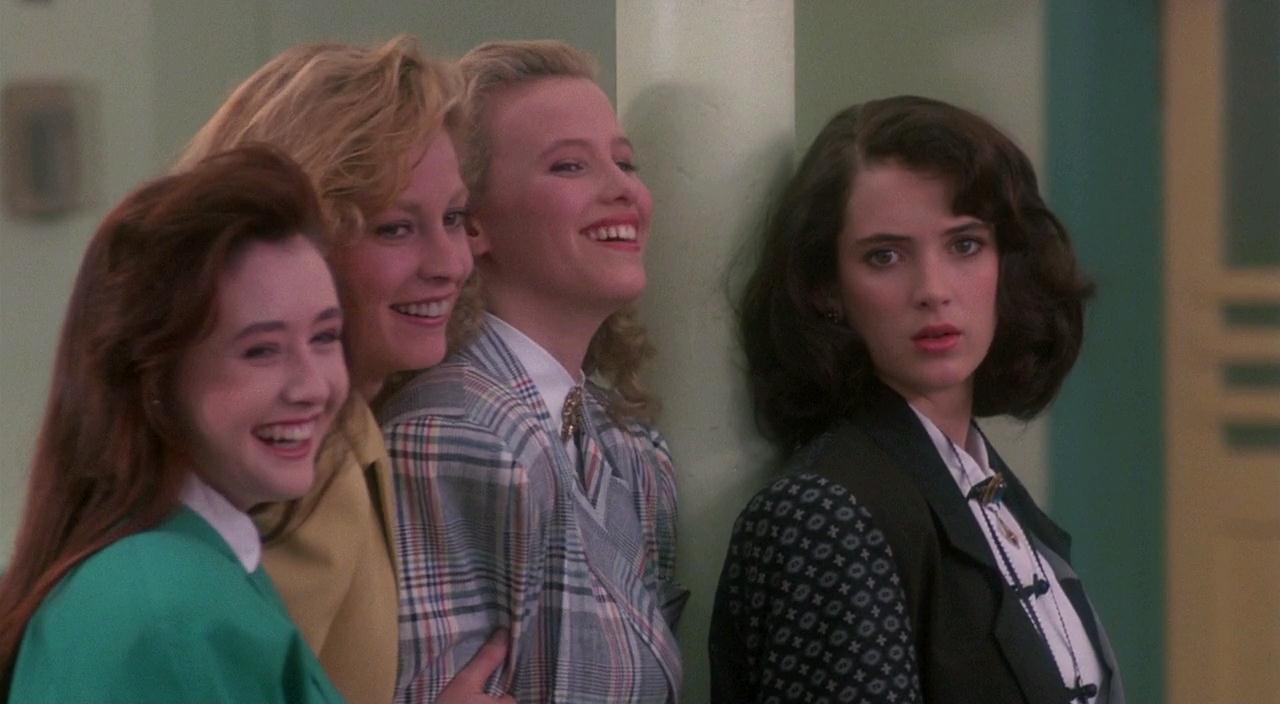
Westerburg High School is ruled by a vicious tyranny - the Heathers. Three girls who all happen to be named Heather. And there’s a fourth member of their clique, Veronica (Winona Ryder). The Heathers are the popular girls. They’re rich and they’re beautiful. They get to date the hottest guys and they get to wear expensive clothes but there’s one thing they enjoy even more than shopping - making life miserable for anyone who isn’t popular. They are total bitches.
Except for Veronica. Veronica doesn’t quite fit in. She doesn’t enjoy cruelty (which makes her an object of suspicion to the Heathers). She doesn’t really like the Heathers at all. On the other hand she’s a realist. It’s better to be part of their clique than to be outside it. It’s better to be a winner than a loser. Veronica is however not entirely happy with her situation. Sometimes she wishes Heather 1 (Heather Chandler, the leader of the clique) was dead.
Then Veronica meets J.D. (Christian Slater). He seems like just the sort of guy she’s been looking for - a good-looking sexy rebel who shares her jaundiced view of high school life. He agrees with her that it would be better for everyone if Heather Chandler died. Of course every high school student thinks this way at times about some fellow student they dislike but that doesn’t mean they would actually kill that person. But J.D. is different. He really would kill Heather Chandler. And he does. Or rather, he and Veronica kill her. Veronica thought they were just paying Heather back by playing a mean trick on her (which she thoroughly deserved) but she’s only just starting to figure out that J.D. isn’t just a rebel he’s a psycho.
Murder becomes a habit. There are other students who deserve to die, and they do. Getting away with murder is surprisingly easy. You just make it look like suicide.
This has unexpected results. Suicide becomes fashionable. Even the geeky kids have a go at it. The teen suicide craze at Westerburg High becomes a media event and an opportunity for a hippie-dippie school counsellor to indulge in emotional grandstanding. The movie is of course a satire and this is the point where the satire really hits top gear. Making a wickedly funny satire about teen suicide is a risky undertaking but Heathers carries it off effortlessly. It’s satire that is quite merciless and very very edgy but somehow it still manages to be delightfully funny. It not only hits the target, it hits the right targets. As edgy as it is it’s not exploitative. The fact that there are plenty of people prepared to exploit teen suicide and that it’s sick to do so is the whole point of the movie.
The murder spree by Veronica and J.D has other unexpected results. If you kill one Heather another one just pops up to take her place. J.D. thinks more drastic measures are required but by this time Veronica has decided that things are getting out of hand.
The fact that the movie works so well is partly due to the daring but very witty and intelligent script by Daniel Waters but the performances also have a lot to do with it. Winona Ryder is superb. She, very wisely, doesn’t overplay things. Veronica is in fact a completely normal girl. She’s smart but she’s not a misfit and she never intended to become a serial killer. It just sort of happened. But she remains essentially normal. She’s really a nice girl and very likeable.
J.D. is not normal at all but Christian Slater’s performance is also very controlled. He has to appear to be the kind of guy that a normal girl would fall for. He has to appear to be just dangerous enough to be sexy and we have to believe that even when she realises he’s crazy Veronica is still attracted to him.
Kim Walker is particularly good (and particularly funny) as the vicious Heather Chandler and Shannen Doherty is also excellent as Heather Duke, the successor to Heather Chandler’s crown as leader of the Heathers. You can understand why the three Heathers would tempt any reasonable person to murder - their bitchiness is awe-inspiring.
This was the first attempt at a feature by both writer Waters and director Michael Lehmann and they demonstrate enormous self-assurance in pulling off such a risky movie. The subject matter would render this movie quite impossible to make today. It’s also very politically incorrect.
Heathers is wickedly effective satire and delicious fun. Highly recommended.
Subscribe to:
Posts (Atom)